Futures prop firms give you access to funded accounts for trading futures contracts like the E-mini S&P 500, crude oil, and gold. You pay an evaluation fee, prove you can trade within their risk rules, and they hand you capital to trade on platforms like NinjaTrader or Tradovate.
And unlike forex prop firms, futures trading prop firms trade on regulated exchanges with real centralized order books.
No dealing desk. No spread games. What you see is what the market actually is. That changes everything.
Key Takeaways
- Futures prop firms fund traders to trade contracts on regulated exchanges like the CME, not forex pairs on decentralized markets.
- The evaluation tests discipline and risk management with strict drawdown rules, daily loss limits, and profit targets.
- Futures offer centralized execution, level 2 depth of market data, and transparent fixed commissions.
- Key platforms include NinjaTrader, Tradovate, and Rithmic, each with different strengths for different trader types.
- Account sizes range from $10,000 to $300,000, with evaluation fees starting around $50 for small accounts.
On This Page
- What Are Futures Prop Firms?
- How Futures Prop Firms Work
- Why Choose Futures Over Forex for Prop Trading
- The Rules That Make or Break Futures Prop Traders
- What Platforms Do Futures Prop Firms Use
- What Futures Markets Can You Trade
- How to Choose a Futures Prop Firm
- Common Mistakes Futures Prop Traders Make
What Are Futures Prop Firms?
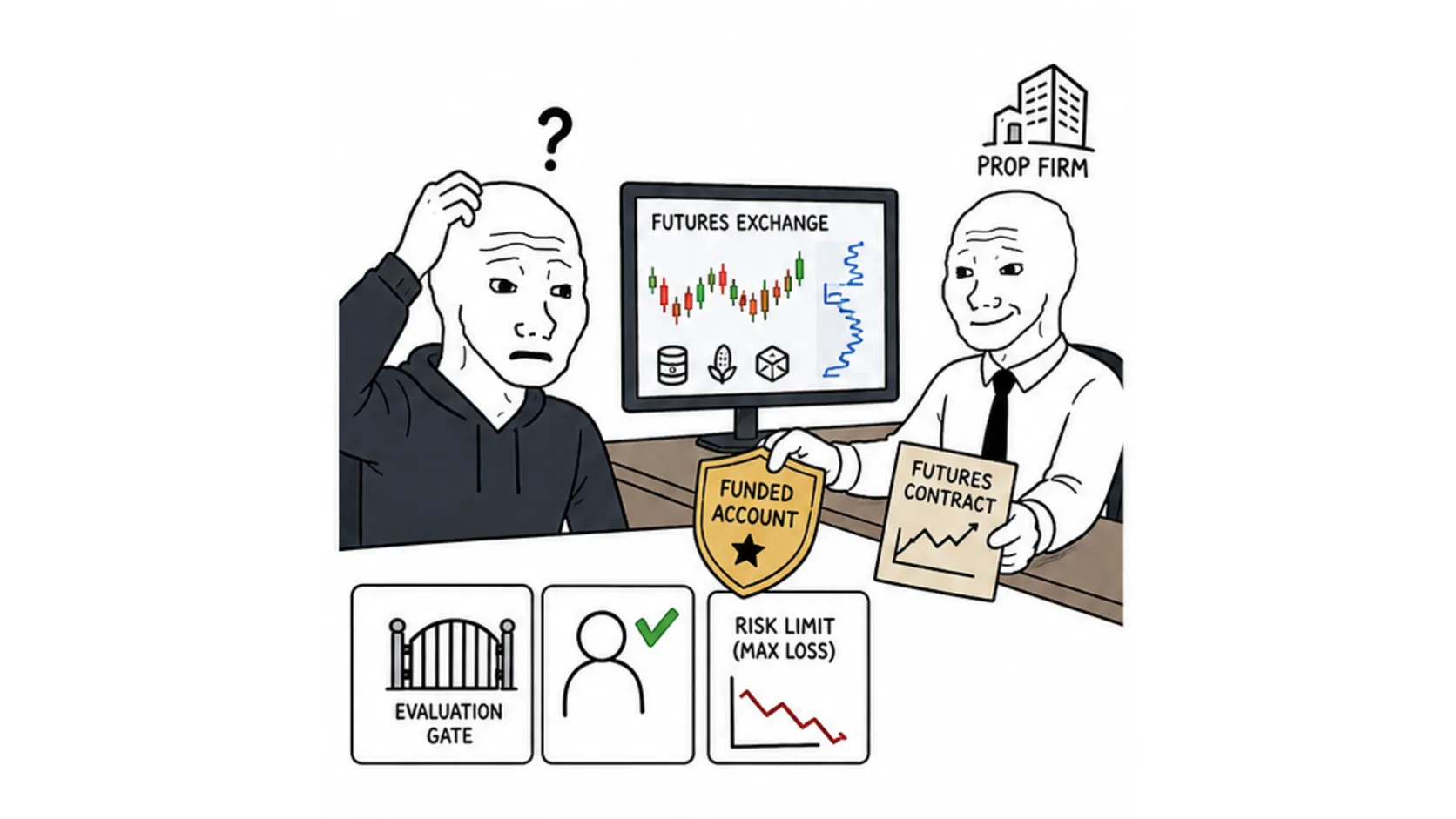
Futures prop firms are proprietary trading companies that provide capital to traders who want to trade futures contracts. You pay an evaluation fee, prove you can manage risk within their parameters, and receive a funded account if you pass.
The "futures" part is what separates these from forex prop firms. Futures are standardized contracts traded on centralized exchanges like the CME Group.
You trade contracts on indices, commodities, interest rates, and currencies, not spot forex pairs.
Think of it this way. A forex prop firm gives you an account to trade EUR/USD on MetaTrader. A futures prop firm gives you an account to trade ES, NQ, or crude oil on NinjaTrader. Different instruments, different rules, different game entirely.
The futures prop firm industry has exploded since 2022. Firms like Topstep, Apex Trader Funding, and Earn2Trade have collectively funded tens of thousands of traders.
The CME Group reported a record 29.3 billion contracts traded in 2024, and futures prop firms are riding that wave hard.
How Futures Prop Firms Work
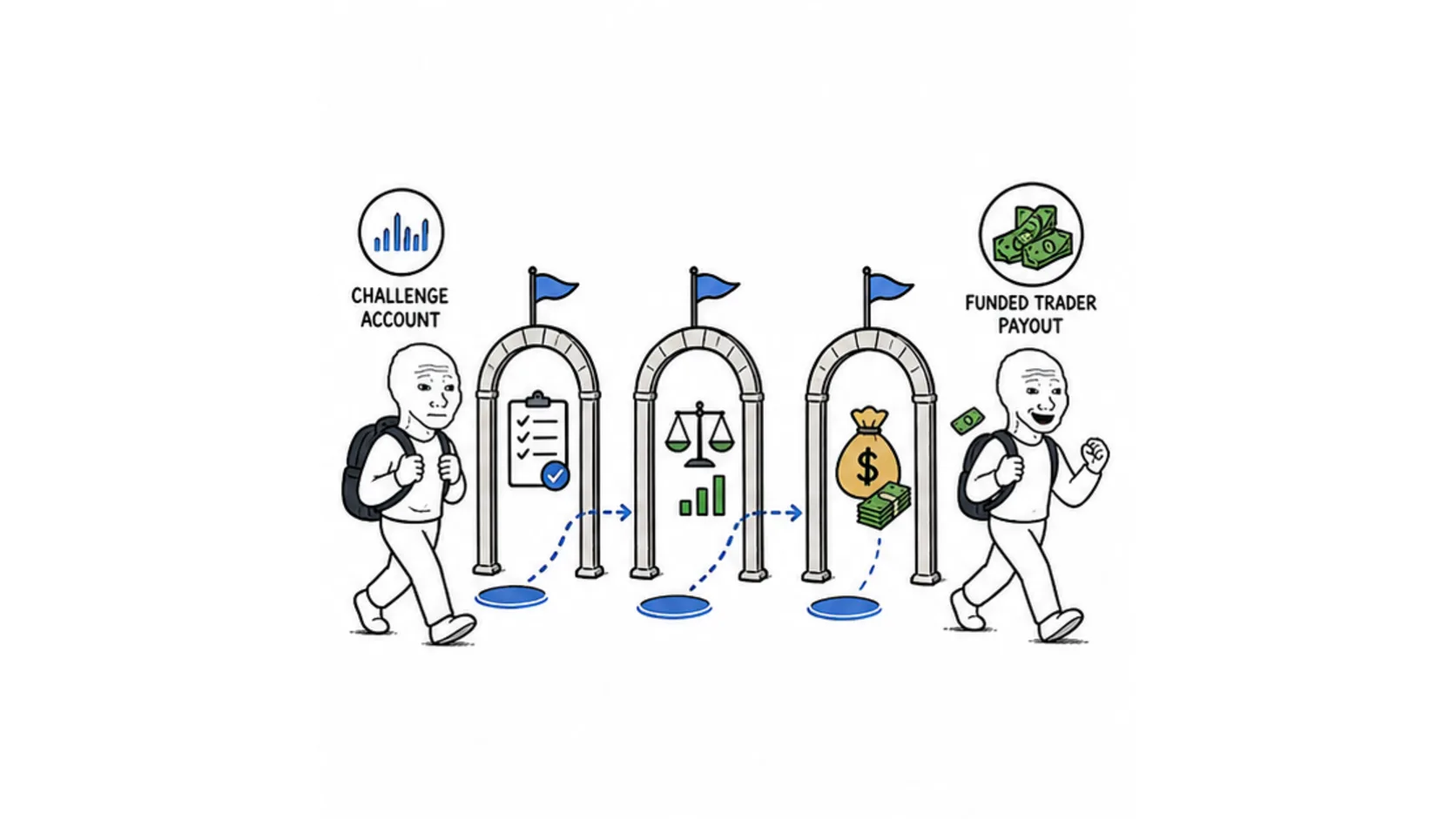
The process is straightforward. The execution is not.
You choose an account size, pay the evaluation fee, and receive platform credentials. The firm sets a profit target, usually 6 to 10 percent of the account value.
A set of risk rules applies that you must follow without exception.
The evaluation is not testing your trading strategy. It is testing whether you can follow rules under pressure.
Can you manage risk? Can you avoid blowing past your daily loss limit? Can you stay disciplined when the market moves against you?
Most futures prop firms use a one-step or two-step evaluation. One-step means you hit the profit target without breaking any rules and you are funded. Two-step means you complete an initial phase, then a verification phase with a smaller target.
Once funded, you trade and keep a percentage of the profits. The typical split is 80/20 or 90/10 in your favour. You request payouts on a regular schedule, usually every 14 to 30 days.
The model works because most traders fail the evaluation. Those evaluation fees fund the payouts for the traders who pass. The firms that survive long-term are the ones that balance this equation honestly.
Why Choose Futures Over Forex for Prop Trading
This is the question that gets people heated. Here is the actual situation.
Futures trade on centralized exchanges. Every order goes through the same order book. There is no dealing desk, no broker manipulation, and no spread widening during news events.
Forex prop firms trade on decentralized over-the-counter markets. Your broker sets the spread and can widen it whenever they want.
You are trading against your own broker's pricing, which creates a fundamental conflict of interest that never goes away.
Futures offer level 2 depth of market data. You can see every limit order sitting in the book. You can see where the institutional orders are stacked.
Forex gives you a bid-ask spread and nothing else. For traders who make decisions based on order flow, this is not a small difference.
Commissions are fixed and transparent in futures. You know exactly what each contract costs to trade. In forex, the spread is your cost, and it changes constantly based on liquidity, news, and your broker's mood.
The Commodity Futures Trading Commission and the National Futures Association regulate US futures markets. Forex is largely unregulated at the retail level, especially the prop firm version of it.
Futures are not better than forex. They are different. If you value transparency, centralized execution, and real market data, futures prop firms are where you want to be.
If you want 24-hour markets and tiny minimum position sizes, forex might suit you better. Know what you are choosing.
The Rules That Make or Break Futures Prop Traders
Here is where futures prop firms get interesting. The rules are specific, enforced by software, and absolutely unforgiving.
The daily loss limit caps your maximum loss per trading day. In futures, this is usually measured from your starting balance or from the previous day's close. Hit it and trading stops for the day. No appeals, no exceptions.
The trailing drawdown is the rule that ends most accounts. It follows your highest balance upward, meaning your safety cushion shrinks as you make money.
A $50,000 account with a $2,000 trailing drawdown means your account can never fall more than $2,000 below its highest point. That sounds manageable until you are $1,800 up and the ES drops 20 points against you.
End-of-day versus intraday drawdown is a critical distinction in futures prop firms. End-of-day drawdown is calculated at the market close.
Intraday drawdown is calculated in real time. Intraday is stricter and catches more people out because a temporary spike can breach your limit even if price recovers before the close.
Buffer rules add another layer. Some firms require you to maintain a buffer above the drawdown threshold. You cannot trade right up to the edge. You must keep a safety margin, which reduces your effective buying power.
These rules exist because futures contracts are leveraged instruments. One bad move on an ES contract can wipe out an account faster than you can click the close button.
The rules protect the firm's capital from your worst moments. Learn them before you pay a single dollar.
What Platforms Do Futures Prop Firms Use
Platform choice is not cosmetic in futures prop firms. It determines how you interact with the market, how fast you execute, and what tools you have available.
NinjaTrader is the most common platform. It offers advanced charting, DOM (depth of market) trading, and automated strategy development. Most futures traders learn on NinjaTrader at some point in their career. It is the industry workhorse.
Tradovate is the cloud-based alternative. It runs in your browser, which means no downloads and no compatibility headaches. The interface is clean and modern. Execution is fast. It has gained serious traction among futures prop firms in the last two years.
Rithmic is the professional-grade option. It is a data and execution provider rather than a full charting platform. Traders who use Rithmic typically pair it with Sierra Chart or Quantower for analysis. It is fast, reliable, and completely no-nonsense.
TradingView is the newcomer in the futures prop firm space. Some firms now offer TradingView integration, which appeals to traders who prioritize visual analysis and community-built indicators. The charting is excellent, but it is not as execution-focused as NinjaTrader or Rithmic.
The platform your firm offers matters because you will spend hours every day on it. Pick a futures prop firm that supports the platform you are comfortable with, not the other way around.
What Futures Markets Can You Trade
This depends on the firm, but the major contracts are available almost everywhere at futures prop firms.
The E-mini S&P 500 (ES) is the most popular futures contract for prop traders. It tracks the S&P 500 index, has massive liquidity, and moves in patterns that technical traders can actually read.
The CME Group reports that ES regularly trades over 1.5 million contracts per day.
The E-mini Nasdaq 100 (NQ) is the volatile cousin. Bigger moves, bigger risk, bigger reward. If ES moves 10 points, NQ moves 30. This makes it attractive for traders who want faster results and absolutely terrifying for traders who do not respect the leverage.
Crude oil (CL) is the commodity play. It moves on inventory data, OPEC decisions, and geopolitical events.
Not for the faint of heart, but profitable for traders who understand the fundamentals driving energy markets.
Gold (GC), the Russell 2000 (RTY), and the US Treasury bonds (ZN, ZB) round out the most common choices at futures prop firms. Some firms also offer micro contracts, which let you trade smaller position sizes at lower risk.
Micro ES is $5 per point versus $50 per point for the full contract. For traders starting out at future prop firms, micros are the sensible entry point.
Most firms restrict trading to these major contracts during the evaluation phase. Once funded, you typically get access to the full range of available instruments.
How to Choose a Futures Prop Firm
Not all futures prop firms are built the same. Not even close. Here is what actually matters when choosing one.
Profit target. Lower is better, obviously. Some firms require 6 percent, others want 10 percent. On a $50,000 account, that is the difference between needing $3,000 and $5,000 in profits. That difference will determine whether you pass or fail.
Drawdown type. Static drawdown gives you a fixed floor. Trailing drawdown chases you up every time you make money. Know which one you are signing up for before you pay. This single rule accounts for more blown accounts than anything else in futures prop firms.
Payout speed. Some firms pay in 14 days, others in 30. A few offer same-day payouts for the first withdrawal. Faster payouts reduce your risk exposure to the firm itself.
Evaluation cost. Prices range from $50 for small accounts to $500 or more for large ones. Cheaper is not always better, but paying $500 for an evaluation you are not ready for is a guaranteed loss. Be honest with yourself about your skill level.
Reputation and payout history. Stick with firms that have at least a year of verified payout history. New firms with unrealistic offers are the ones that disappear overnight, usually with your evaluation fee still in their pocket.
Account size options. You need a size that matches your trading style. A scalper on the ES needs a different account size than a swing trader on crude oil. Choose according to your strategy, not your ego.
Common Mistakes Futures Prop Traders Make
I have watched traders blow futures prop firm accounts in every way imaginable. Here are the ones that happen over and over again.
Overleveraging micro contracts. Just because you can trade 50 micro ES contracts does not mean you should. The leverage in futures is enormous.
One point on a micro ES is $5, but 50 of them is $250 per point. Size appropriately or do not size at all. This is not negotiable.
Ignoring the drawdown type. Trailing drawdown accounts get blown by traders who do not understand how the threshold moves. You make $2,000, the drawdown follows you up, and suddenly your margin for error has vanished. Read the rules before you start trading, not after you fail.
Revenge trading after a red day. You lose $300 on a bad trade. You are frustrated. You double your position size to "get it back."
Congratulations, you have been diagnosed with a revenge-trading mindset. The result is always the same: a bigger loss and a blown account. Go for a walk instead.
Trading during major news events. NFP, CPI, FOMC. The volatility during these events is not your friend. Some firms have explicit news trading restrictions, and violating them voids your account immediately. Even if your firm allows it, the whipsaws during news will test every weakness in your strategy.
Not practicing on the platform first. Every platform has its quirks. NinjaTrader's order entry works differently than Tradovate's. If you are learning the platform during a paid evaluation, you are burning money. Practice on a free demo first, then start the clock when you are ready.
The traders who succeed at futures trading prop firms are not the ones with the best strategies. They are the ones who respect the rules, manage their emotions, and treat the evaluation like a test of discipline rather than a race to profit.
Do that, and you will be ahead of 90 percent of the people reading this page.