A futures prop firm is a proprietary trading company that funds you to trade futures contracts on exchanges like the CME. You prove you can trade without blowing up, they give you capital, and you split the profits. That is the entire business model stripped to its bones.
Futures prop trading has exploded since 2020. The appeal is simple: real exchange-traded contracts, centralised pricing, no dealing desk manipulation, and no $25,000 Pattern Day Trader rule hanging over your head.
Key Takeaways
- A futures prop firm gives you funded capital to trade futures contracts like E-mini S&P 500, crude oil, and gold.
- You pay an evaluation fee, prove you can manage risk, then trade firm capital with a profit split typically between 80-90%.
- Futures prop firms use real exchange-traded contracts, not CFDs, and you trade on platforms like NinjaTrader, Tradovate, or Rithmic.
- The drawdown rule type (end-of-day vs intraday, static vs trailing) matters more than the profit target.
- No $25,000 minimum account balance is required because you trade the firm's capital, not your own.
On This Page
What Is a Futures Prop Firm?
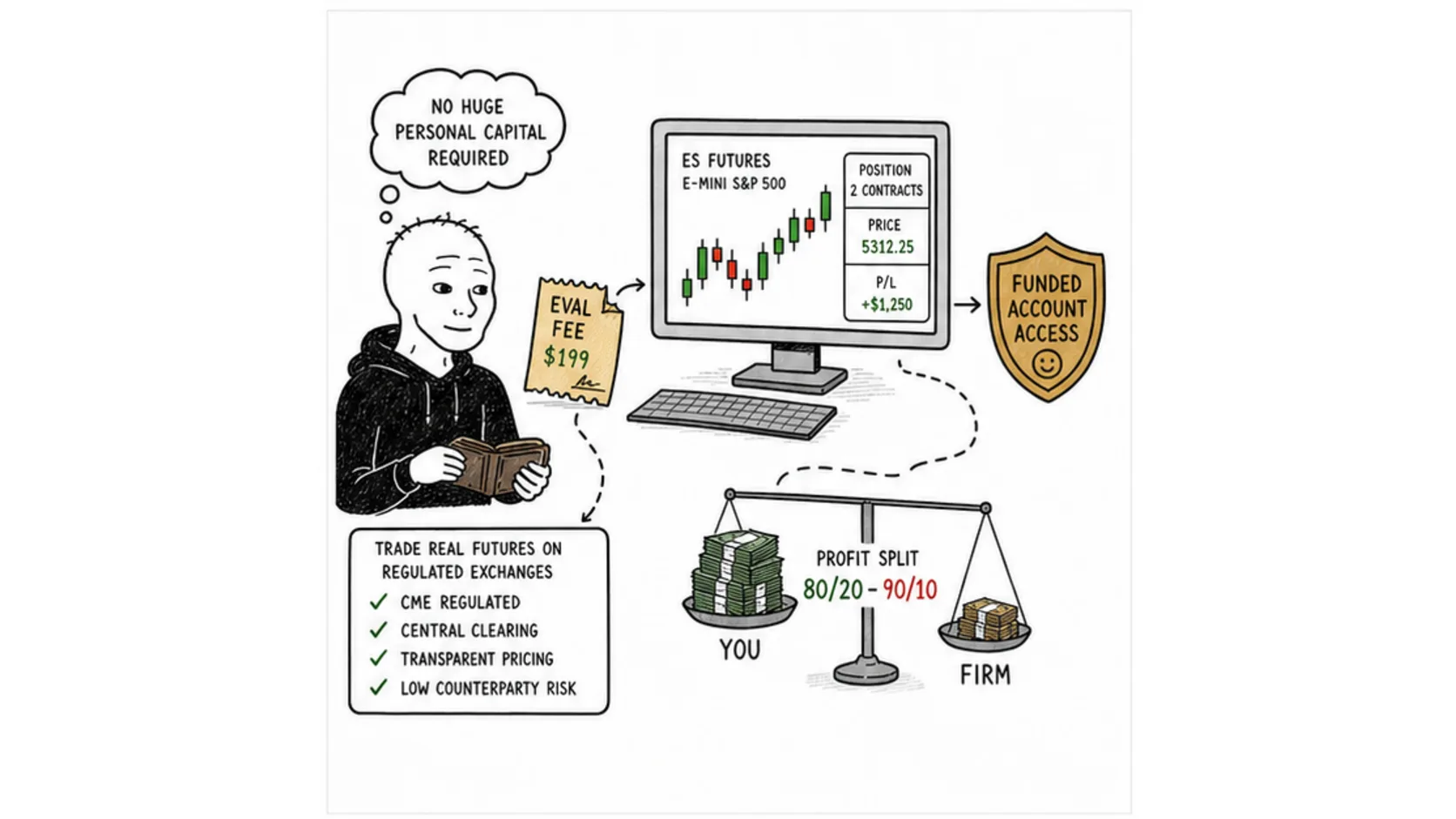
A futures prop firm provides you with capital to trade futures contracts on regulated exchanges. The Commodity Futures Trading Commission regulates the exchanges themselves, like the CME Group, where these contracts trade.
You do not deposit your own trading capital. You pay a one-time evaluation fee, typically between $50 and $500 depending on account size, prove you can hit a profit target without breaching risk rules, and then get a funded account.
The firm takes the losses. You keep a percentage of the profits, usually 80-90%. It is a straightforward value exchange. They need people who can generate returns on their capital. You need capital you do not have.
Futures contracts are standardised agreements to buy or sell an asset at a set price on a set date. The E-mini S&P 500 (ES) contract, for example, represents $50 times the S&P 500 index value. One ES contract at 5,500 index points controls $275,000 worth of notional exposure.
How Futures Prop Firms Work
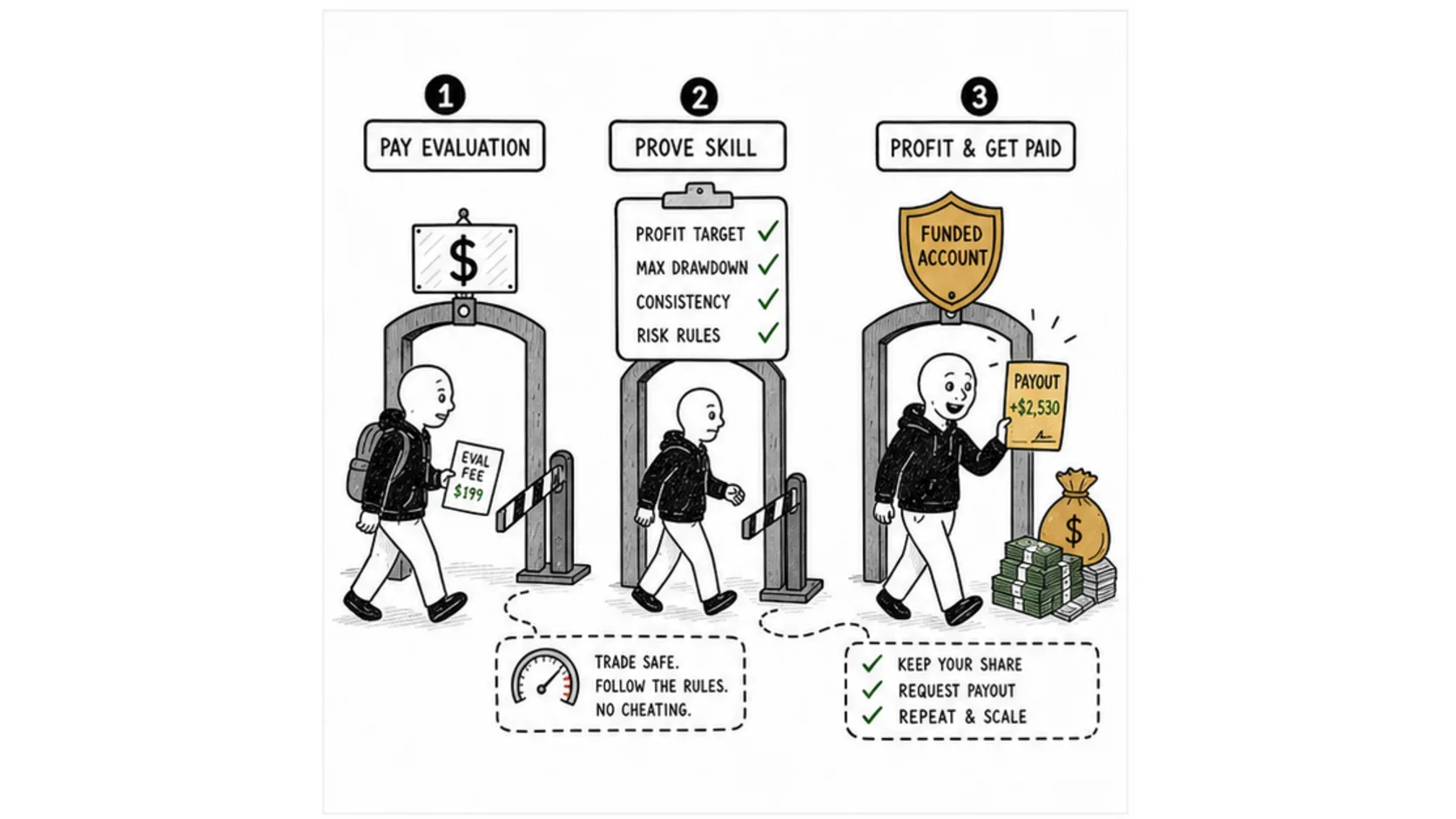
The process is the same three-step model almost every retail prop firm uses. Pay, prove, profit. The mechanics are no different from how forex prop firms operate, but the instruments and platforms change everything about how you actually trade.
Step one: the evaluation. You buy an evaluation, sometimes called a challenge or a trading combine. The firm sets a profit target, a maximum drawdown, a daily loss limit, and a time window. You trade on a simulated account that mirrors real market conditions.
Hit the target without breaking any rules, you advance. Break a rule, the evaluation ends and you lose the fee. That fee is the firm's revenue. Most traders never pass. That is the business model.
Step two: the funded account. Pass the evaluation and you get a funded account. This is where you trade real capital or a simulated account that mirrors a real one, depending on the firm. Your trades generate real payouts.
The profit split kicks in here. You keep 80-90% of what you make. The firm keeps the rest and absorbs any losses you generate.
Step three: payouts. Most firms pay out on a regular cycle, every two weeks or monthly. Some offer instant funding where you skip the evaluation entirely, but those accounts come with stricter rules and lower profit splits.
Requesting a payout is straightforward if you follow the rules. Break a rule during a payout review period and the firm will deny it. Every time.
The Futures Contracts You Actually Trade
Futures prop firms give you access to exchange-traded contracts across several asset classes. The CME Group handles roughly 85% of US futures volume, and that is where most prop firm trading happens.
Index futures. The E-mini S&P 500 (ES) is the most traded futures contract for prop traders. The E-mini Nasdaq (NQ), Dow (YM), and Russell (RTY) round out the equity index suite. These contracts have deep liquidity and tight spreads, which makes them ideal for day trading.
Commodities. Crude oil (CL), natural gas (NG), gold (GC), and silver (SI) are popular with prop traders who like macro-driven price action. Oil and gold move on economic data, geopolitical events, and dollar strength.
Interest rates. Treasury bond futures like the 10-year note (ZN) and 30-year bond (ZB) trade heavily on Fed policy expectations. These are not for beginners, but experienced traders love them for their clean technical setups.
Agriculture and others. Corn (ZC), soybeans (ZS), and wheat (ZW) are available at most firms but rarely traded by funded traders. The volume is lower, the spreads are wider, and the setups are fewer.
Most futures prop firms restrict which contracts you can trade. The common allowed list is ES, NQ, YM, RTY, CL, GC, and a handful of others. Know the firm's allowed instruments before you start, because trading a restricted contract voids your evaluation.
Futures Prop Firms vs Forex Prop Firms
Both follow the same funded account model. Both charge evaluation fees. Both have profit targets and drawdown limits. The differences are in the instruments, the pricing, and the trading experience.
| Feature | Futures Prop Firm | Forex Prop Firm |
|---|---|---|
| Instruments | Exchange-traded futures contracts | Over-the-counter currency pairs |
| Pricing | Centralised, exchange-based | Variable spreads from liquidity providers |
| Commissions | Fixed per contract (e.g. $4.24 round trip) | Built into spread, sometimes separate commission |
| Leverage | Margin-based, contract-specific | Typically 1:30 to 1:100 |
| Trading hours | Nearly 24 hours with breaks | 24 hours, 5 days a week |
| Platforms | NinjaTrader, Tradovate, Rithmic | MetaTrader 4, MetaTrader 5, cTrader |
| Regulation | Exchange-regulated (CME, NFA) | Less transparent, OTC market |
Futures contracts trade on regulated exchanges. The price you see is the price everyone sees. No dealing desk, no last-look liquidity, no spread manipulation during news events. That transparency is the single biggest reason traders switch from forex to futures prop firms.
Forex prop firms have wider account size ranges and more platform options. If you trade currency pairs specifically, a forex prop firm makes more sense. If you trade indices, commodities, or want exchange-cleared pricing, futures is the move.
Rules That Matter in Futures Prop Trading
Every prop firm has rules. Futures prop firms tend to have fewer rules than forex firms, but the ones they do have are enforced without exception. Miss a daily loss limit by one dollar and your funded account is gone.
Daily loss limit. This caps how much you can lose in a single trading day. Typical limits range from $500 to $2,000 depending on account size. Hit it and your trading day is over. Exceed it and your account is terminated.
The daily loss limit is calculated differently across firms. Some use your starting balance for the day. Others use your highest intraday balance. Understanding exactly how your firm calculates it is not optional reading. It is the difference between keeping your account and losing it.
Maximum drawdown. This is the total drawdown ceiling for the account. Two types exist: trailing and static. A trailing drawdown follows your highest balance up, so your buffer shrinks as you profit. A static drawdown stays fixed at a set level below your starting balance.
Whether the drawdown is calculated end-of-day or intraday matters enormously. End-of-day gives you breathing room during the session. Intraday means your drawdown is checked tick by tick, and a flash spike can breach you even if you close profitable by the close.
Profit target. The amount you need to make to pass the evaluation or become eligible for payout. Typical targets range from 6-10% of the account value for evaluations, and many funded accounts have no ongoing target.
Position size limits. Futures firms restrict how many contracts you can hold at once. A $50,000 account might allow a maximum of 3-5 ES contracts. Exceed this and the trade gets flagged or the account gets reviewed.
Consistency rules. Some firms require that your best trading day is not disproportionately large compared to your average. The consistency rule prevents traders from passing on one lucky trade rather than sustained skill.
Platforms Futures Prop Firms Use
Futures prop firms do not use MetaTrader. If you are coming from forex and expecting MT4 or MT5, you are in for a shift. Futures platforms are built for exchange-traded execution and the experience is fundamentally different.
NinjaTrader. The most common platform for futures prop traders. Desktop-based, chart-heavy, with a massive ecosystem of custom indicators and strategies. The learning curve is real but the tool is powerful once you know it.
Tradovate. Cloud-based, modern interface, and increasingly popular. Runs in a browser or desktop app. Good for traders who want a cleaner setup without installing heavy software.
Rithmic. A professional-grade execution platform with extremely low latency. Popular with scalpers and traders who need fast order fills. The interface looks like it was built in 2005, but the execution speed makes up for it.
TradingView. Some firms now offer TradingView integration for charting while routing orders through a connected broker. Not as common for pure execution, but growing.
Before committing to a firm, check which platforms they support. Your trading style should match your tools. Scalpers need Rithmic. Swing traders can work with NinjaTrader. If you need mobile access, Tradovate is your best bet.
Costs and Account Sizes
Futures prop firm evaluations cost between $50 and $500, depending on account size and firm reputation. The pricing is generally lower than forex prop firm evaluations for equivalent account sizes.
A $50,000 evaluation at a reputable futures prop firm costs roughly $150-$350. Compare that to forex firms charging $300-$500 for the same nominal size, and futures looks like the cheaper entry point.
Account sizes range from $25,000 to $300,000 at most firms. The sweet spot for most traders is $50,000-$100,000. Smaller accounts have tighter drawdown limits that leave almost no room for error. Larger accounts are expensive to evaluate and have proportionally larger drawdowns to manage.
Some firms charge monthly data fees for live market data on top of the evaluation fee. These range from $10-$50 per month. Always check the total cost, not just the headline evaluation price.
Who Futures Prop Firms Are Actually For
Futures prop firms are not for everyone. They are specifically for traders who understand futures contracts, margin requirements, and tick values. If you do not know what one tick of ES is worth ($12.50, by the way), you are not ready for a futures evaluation.
They are for you if: you have been trading futures on your own account, you understand contract specifications, you have a strategy that works on index futures or commodities, and you want more capital without risking your own money.
They are not for you if: you have never traded futures, you think a futures contract is the same as a CFD, you plan to learn while you evaluate, or you are coming straight from forex without understanding how futures pricing works.
The mistake most new futures prop traders make is treating it like forex with different charts. Futures have expiration dates, contract rolls, tick sizes, and margin requirements that forex does not. Understand the prop firm model first, then learn the futures specifics, then attempt an evaluation.
Start with a small evaluation. $50,000 or less. Prove you can pass it. Scale up from there. Going straight for a $150,000 account because the profit potential looks exciting is a guaranteed way to donate money to a prop firm.