The difference between end of day drawdown and intraday drawdown in futures prop trading comes down to one question: when does the firm check whether you have broken the rules? End of day only looks at your closing balance, giving you all session to recover from ugly dips. Intraday watches your equity every single second, and the moment you dip past the line, your account is gone. Choosing the wrong type for your trading style is the fastest way to donate money to a prop firm.
Key Takeaways
- End of day (EOD) drawdown only measures your account balance at market close, allowing intraday recovery from drawdowns.
- Intraday drawdown tracks your running equity in real time, meaning any dip below the threshold during the session triggers a breach.
- EOD drawdown is more forgiving and generally better for beginners and scalpers who experience wider intraday swings.
- Intraday drawdown rewards patient, low-volatility trading and punishes oversized positions.
- Always check which drawdown type a firm uses before buying a challenge, because it completely changes how you manage positions.
On This Page
- What Is End of Day Drawdown
- What Is Intraday Drawdown
- The Key Difference: When the Clock Resets
- Which Futures Prop Firms Use Which Model
- How Each Type Affects Your Trading Style
- Scalpers vs Swing Traders: Which Fits You
- Common Mistakes Traders Make With Each Type
- Red Flags: When a Drawdown Rule Is Designed to Fail You
What Is End of Day Drawdown
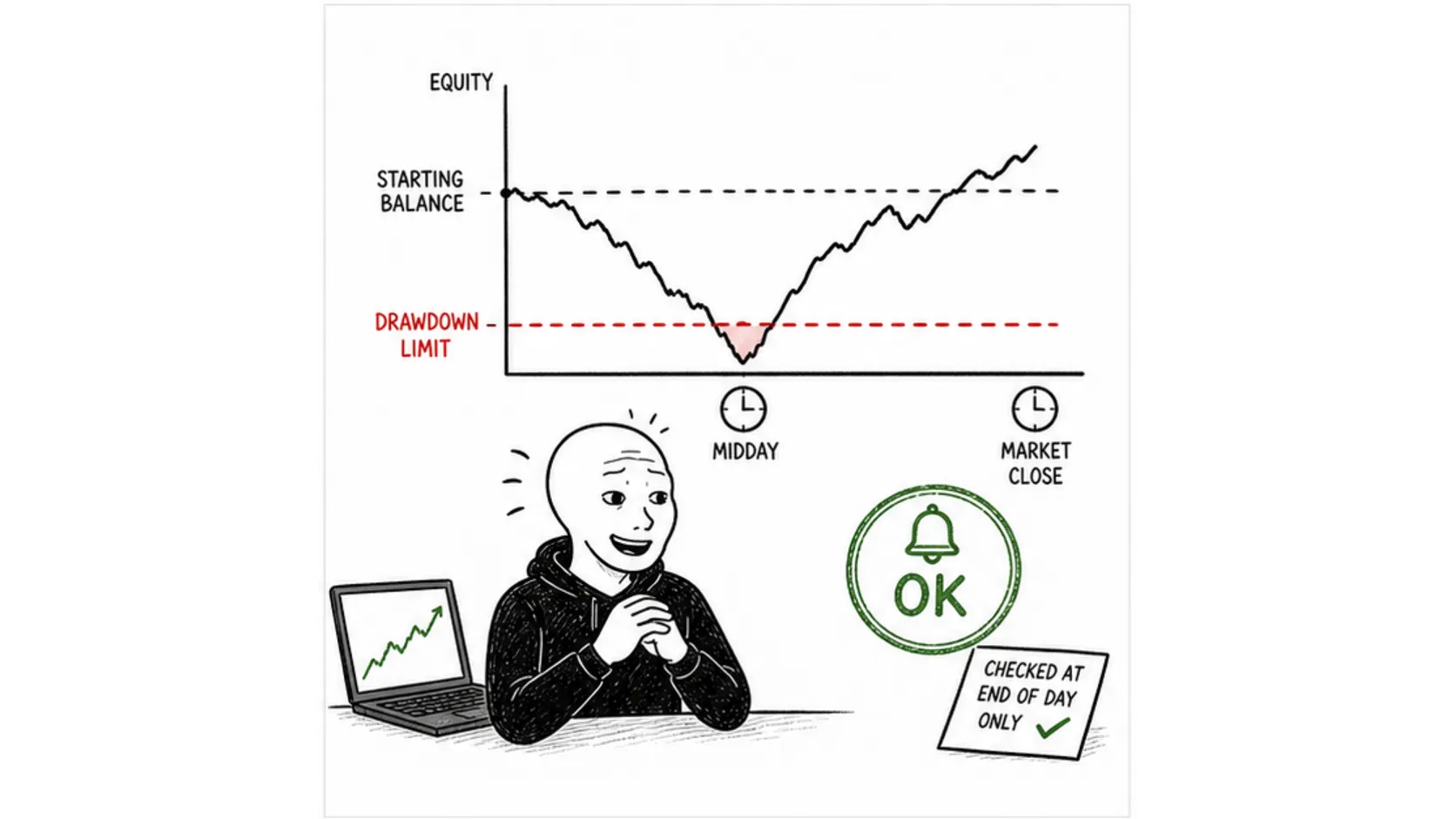
End of day drawdown, usually abbreviated as EOD drawdown, measures your account balance only when the market closes for the day. The firm does not care what happened at 10:15am or 2:30pm. They only look at where your account sits at the closing bell.
This means you can be deep in the red during the session, down thousands of dollars on paper, and as long as you recover before close, the drawdown never happened. The firm's records show you ended the day within limits.
Here is a concrete example. You have a $50,000 account with a $2,500 EOD drawdown limit. At noon, your running P&L drops to $47,000, which is a $3,000 drawdown from starting balance.
Under intraday rules, your account would already be terminated. Under EOD rules, nothing happens yet. You have until close to recover.
If you close your positions and end the day at $48,500, your EOD drawdown is $1,500. You are fine. The firm records a $1,500 drawdown for that day and moves on.
According to a Reddit survey of futures prop traders, approximately 65% of traders prefer EOD drawdown because it provides breathing room that intraday simply does not offer.
What Is Intraday Drawdown
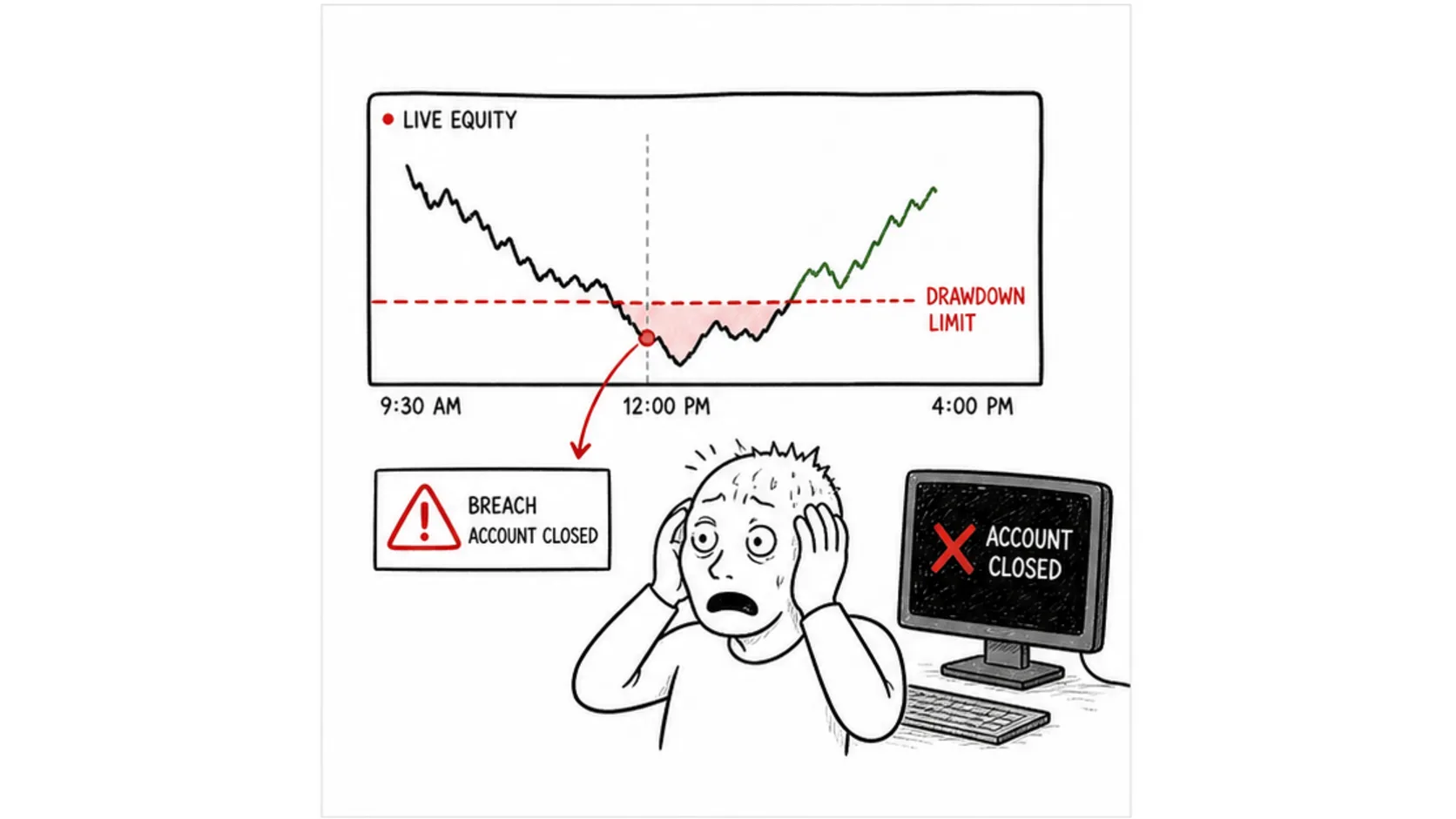
Intraday drawdown tracks your running equity in real time. The firm monitors your account value continuously throughout the trading session. The moment your equity drops below the threshold, your account is breached.
There is no recovery window. There is no second chance at close. The breach happens the instant your equity crosses the line, and your account is closed.
Using the same example. $50,000 account, $2,500 drawdown limit. At noon your equity drops to $47,000. Under intraday drawdown, your account is terminated immediately.
It does not matter that you had a stop order that would have recovered. It does not matter that the market reversed two minutes later. The equity touched $47,000, the threshold was breached, and you are done.
This is why intraday drawdown is sometimes called the "widow maker" rule in prop trading communities. It catches traders who use wide stops, trade volatile instruments, or hold positions through news events.
Trailing drawdown adds another layer on top of this. A trailing intraday drawdown means the floor moves up with every new equity high, making it even harder to stay above the line.
The Key Difference: When the Clock Resets
Everything about your trading strategy changes depending on when the drawdown clock resets. Let me make this crystal clear with a side by side comparison.
| Feature | End of Day Drawdown | Intraday Drawdown |
|---|---|---|
| When measured | At market close only | Continuously in real time |
| Intraday dips | Ignored if recovered | Triggers breach immediately |
| Recovery window | Full session available | No recovery window |
| Breath holding | Relaxed, wait for close | Constant monitoring needed |
| Best for | Scalpers, volatile strategies | Low-volatility, tight-risk traders |
| Difficulty level | Moderate | Hard to very hard |
The table tells the story. EOD drawdown gives you a safety net. Intraday drawdown does not.
This does not make intraday drawdown unfair. It makes it a different game. Traders who use tight stops, small position sizes, and low-volatility setups can thrive under intraday rules because their equity curve rarely dips deep enough to trigger a breach.
But if you are the type of trader who lets positions breathe, uses wide stops, or trades volatile instruments like NQ or ES during high-impact news, intraday drawdown will eventually catch you.
Which Futures Prop Firms Use Which Model
Drawdown types vary between firms and sometimes even between account levels at the same firm. Here is the landscape.
Firms using EOD drawdown. Topstep's standard trading combine uses EOD drawdown. Apex Trader Funding uses EOD on most of their account plans. Bulenox offers EOD on standard accounts.
These firms tend to market themselves as beginner-friendly because EOD drawdown is more forgiving.
Firms using intraday drawdown. Take Profit Trader uses intraday trailing drawdown on most plans. Earn2Trade uses intraday drawdown on their GPA program. Some Topstep express accounts also use intraday models.
Firms with intraday rules tend to have lower challenge fees and faster funding, but the tradeoff is stricter drawdown enforcement.
Firms offering both. Some firms let you choose between different account types that use different drawdown models. The EOD plans usually cost more upfront, while intraday plans are cheaper but harder to pass.
Before buying any challenge, understand the max drawdown rule and confirm which type applies to the specific account you are purchasing. The marketing page might say "generous drawdown" without mentioning it is intraday and measured in real time.
How Each Type Affects Your Trading Style
Your drawdown type should influence every aspect of how you trade, from position sizing to stop placement to time of day.
Under EOD drawdown. You can afford wider stops because intraday swings do not matter. You can hold through temporary drawdowns, knowing that only the closing balance counts.
This means you can trade larger timeframes, hold swing positions within a session, and use strategies that require patience during volatile periods.
The risk is complacency. Because intraday dips do not count, some traders get lazy about stop placement. They let positions run too far, assuming they can always recover before close. Sometimes the market does not cooperate.
Under intraday drawdown. Every tick matters. Your stop loss must be tight enough that a single losing trade never pushes your running equity past the threshold.
This means smaller position sizes, tighter stops, and a much more defensive approach to every single trade. You cannot afford to let a trade breathe. You cut early and move on.
Risk management under intraday rules is a completely different discipline. The daily loss limit becomes even more critical because hitting it under intraday rules means an instant breach, not just a bad day.
Scalpers vs Swing Traders: Which Fits You
If you are a scalper, EOD drawdown is your friend. Scalpers take many small trades with tight targets. The cumulative intraday drawdown from stopped-out trades can be significant, but individual losses are small and the strategy relies on netting out positive by close.
Under intraday drawdown, a string of five stopped-out scalps in a row can push your running equity past the threshold before you have time to recover with your winners. The math does not work in your favour.
If you are a swing trader holding positions for hours within a session, intraday drawdown can actually be more manageable. You typically have fewer trades, larger targets, and tighter risk per trade. Your equity curve is smoother, so it rarely dips deep enough to trigger the intraday alarm.
Here is the simple recommendation. If your strategy has high trade frequency or wide stop losses, go EOD. If you take fewer trades with tight risk and smooth equity curves, intraday is manageable.
If you are a beginner and not sure yet, go EOD. Always. No exceptions. Learn to pass a challenge first, then decide whether you want to upgrade to the harder drawdown model later.
Common Mistakes Traders Make With Each Type
Every drawdown type has its own trap, and traders fall into them repeatedly.
Mistake one with EOD: ignoring intraday risk entirely. Just because the firm does not count intraday dips does not mean they cannot destroy you. A position that drops $4,000 intraday on a $2,500 EOD limit is a position that requires a miracle recovery. Sometimes the miracle does not come.
Treat your intraday equity with respect even under EOD rules. Set personal intraday alarms at 70-80% of your EOD limit.
Mistake two with EOD: not closing positions before close. Some traders forget that the EOD calculation happens at a specific time. If you hold a futures position past the settlement time and it is in the red, that counts. Close or manage positions before the cutoff.
Mistake one with intraday: sizing too large. Under intraday rules, one oversized trade can end your account. A $50,000 account with a $2,500 intraday drawdown and a 5-lot NQ position that drops 10 points is a $250 loss per contract, which is $1,250 total. That is half your drawdown budget gone in one trade.
Size small. Always. Half of what you think is reasonable.
Mistake two with intraday: not monitoring running equity. Under intraday rules, you need to know where your equity stands at all times. Not roughly. Exactly. Use a secondary monitor or a mobile app to track your running P&L continuously.
The Commodity Futures Trading Commission does not regulate prop firm drawdown rules, so there is no standard. Each firm sets its own measurement method, and some are more transparent than others about how they calculate intraday equity.
Red Flags: When a Drawdown Rule Is Designed to Fail You
Most drawdown rules are fair. They exist to manage risk. But some are designed to make you fail.
Red flag one: the firm does not clearly state which drawdown type they use. If you have to dig through the FAQ or contact support to find out whether the drawdown is EOD or intraday, that is intentional. They are hiding it because intraday is harder, and they know fewer people would buy if it was clearly advertised.
Red flag two: the drawdown type changes after you pass. Some firms use EOD drawdown during the evaluation and switch to intraday trailing on the funded account. This is a bait and switch. Read the funded account rules, not just the challenge rules.
Red flag three: the drawdown is intraday AND trailing AND very tight. A $50,000 account with a $1,000 intraday trailing drawdown is nearly impossible for most traders. The combination of real-time monitoring plus a moving floor plus a tiny budget is designed to generate challenge fees, not funded traders.
Red flag four: retroactive rule changes. If a firm changes its drawdown type or calculation method after you have already started trading, that is predatory. Legitimate firms grandfather existing accounts under the rules that were in place when the account was purchased.
Check the full prop firm red flags guide before trusting any firm with your money. And always screenshot the rules page on the day you purchase. It is your insurance policy.
The drawdown type you choose to trade under will determine how you manage every single position. Pick the wrong one and your challenge is over before it starts. Pick the right one and you have a fighting chance.