Trailing drawdown is the most misunderstood rule in prop firm trading. Traders think they understand it, start their challenge, and then watch their account get terminated while they are still in profit. That is the trailing drawdown doing exactly what it was designed to do.
The trailing drawdown is literally following you around. You cannot shake it. Every profit you make, it catches up. It is a dog that bites you when you are winning.
This is the only page where you will find an interactive trailing drawdown calculator, a comparison table covering over 20 prop firms across forex and futures, the three trailing sub-types explained plainly, and the post-funded account rules nobody else explains.
Key Takeaways
- Trailing drawdown follows your highest equity point, raising the floor as you make profits. It never moves down.
- You can be in profit and still breach a trailing drawdown if your account drops below the trailing floor.
- There are three sub-types: hard trailing (real-time), balance-only trailing (end-of-day), and breakeven trailing. Each behaves differently.
- Static drawdown stays fixed at your starting balance and is more forgiving for most traders.
- Over 20 major prop firms use trailing drawdown. The specifics vary wildly between firms and between forex and futures accounts.
On This Page
- What Trailing Drawdown Actually Means (in Plain English)
- Trailing Drawdown vs Static Drawdown vs End-of-Day Drawdown
- The Three Trailing Drawdown Sub-Types (Hard, Balance-Only, Breakeven)
- Trailing Drawdown Comparison Table (20+ Firms)
- How to Calculate Your Trailing Drawdown Floor
- Why Trailing Drawdown Traps Profitable Traders (The Profit Trap)
- Trailing Drawdown in Funded Accounts (What Changes After You Pass)
- 6 Strategies to Survive Trailing Drawdown
- Trailing Drawdown Calculator: Find Your Exact Buffer
- My Trailing Drawdown Story (What I Learned the Hard Way)
What Trailing Drawdown Actually Means (in Plain English)
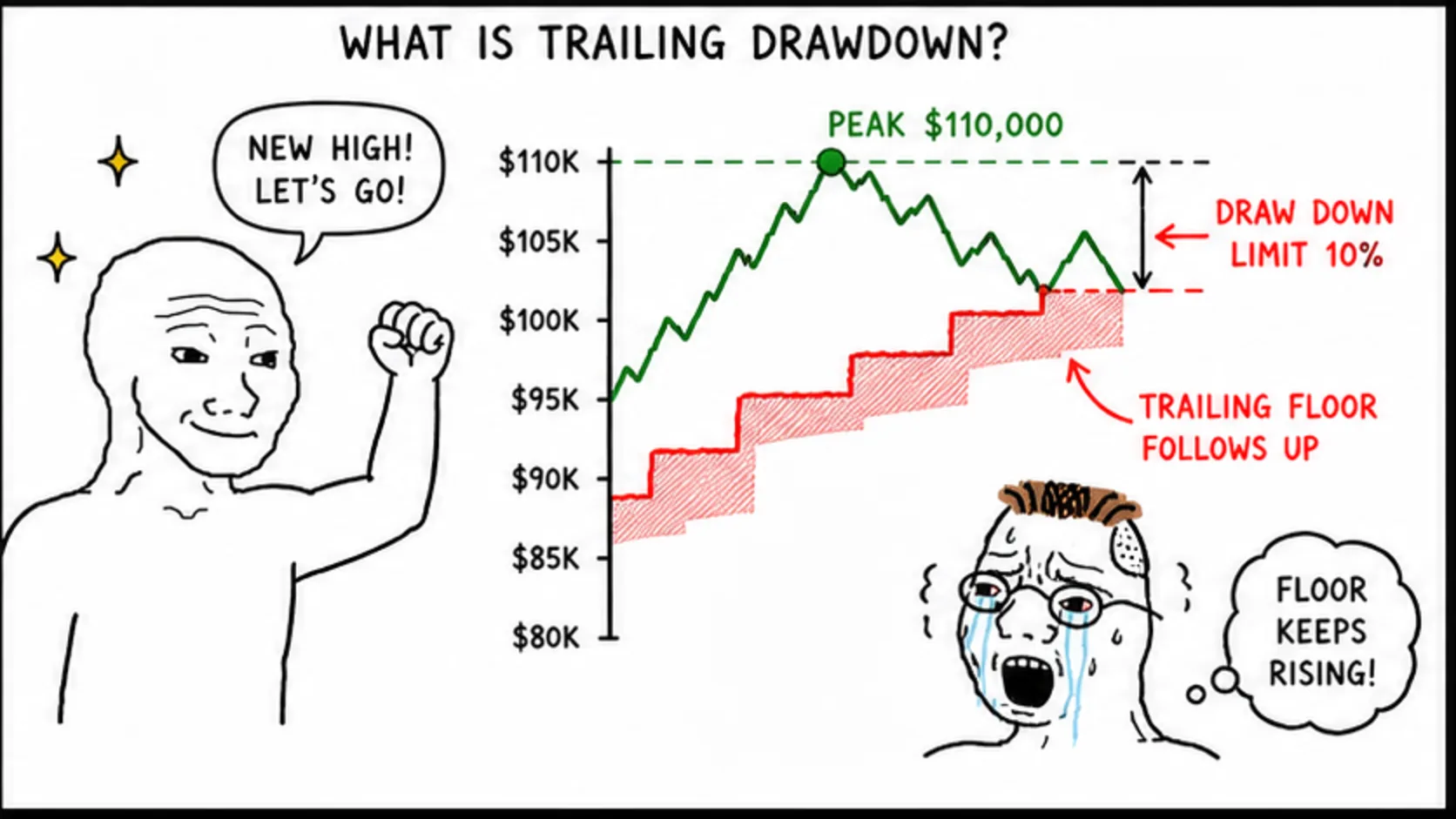
Trailing drawdown is a risk management rule that sets a floor beneath your highest account equity. The floor moves up every time your equity reaches a new high. It never moves down.
On a $50,000 account with a 10% trailing drawdown, your initial floor is $45,000. Make $5,000 and your equity is now $55,000. The floor trails up to $49,500. You are still in profit, but your safety margin has changed.
The trailing drawdown is literally following you around. You cannot shake it. Every profit you make, it catches up. It is a dog that bites you when you are winning.
This is not a regulator-mandated standard; it is a firm risk policy. The ESMA investor corner is a useful baseline for understanding why retail trading risk needs clear limits, but the specific drawdown mechanics are chosen by each individual firm.
Unlike maximum drawdown, which defines the outer boundary of your total allowed loss, trailing drawdown is dynamic. It adjusts continuously based on your performance. The better you do, the tighter the leash becomes. That sounds counterintuitive, and it is. But from the firm's perspective, it makes perfect sense.
The key word is trailing. It follows. It tracks your highest point and ensures you can never give back more than the trailing percentage from that peak. Every dollar you make, the trailing drawdown creeps up behind you.
According to FTMO's own documentation, their 1-Step challenge uses end-of-day trailing drawdown at 10% of initial capital, while the 2-Step uses static drawdown at the same percentage. The type of drawdown you face depends entirely on which challenge you purchase. That is a detail most traders miss entirely before they start.
Industry estimates consistently show that 80-95% of traders fail their first prop firm challenge, and trailing drawdown is the single mechanical rule responsible for more of those failures than any other. According to Topstep's published data, fewer than 10% of traders pass their Combine evaluation, with the majority breaching the drawdown floor rather than failing to hit the profit target. That is a remarkable statistic: most traders could actually hit the target, but they cannot survive the drawdown rules that come with it.
Trailing Drawdown vs Static Drawdown vs End-of-Day Drawdown
Which is better, static or trailing drawdown? For most traders, static is more forgiving. But the picture is more nuanced than that simple comparison suggests.
Static drawdown stays fixed at your starting balance. On a $50,000 account with 10% static drawdown, your floor is always $45,000 regardless of how much profit you make. You could grow the account to $70,000 and your floor is still $45,000.
Trailing drawdown follows your highest equity. Same $50,000 account, same 10%, but your floor moves to $63,000 when your equity hits $70,000. You can only give back $7,000 from your peak.
End-of-day trailing drawdown is a hybrid. The floor only updates at the close of the trading day based on your closing balance, not your intraday equity peaks. A brief intraday spike does not immediately raise the floor. If your equity hits $56,000 during the session but closes at $54,000, the floor trails based on $54,000, not $56,000.
Here is a direct comparison to make this clear. Start at $50,000 with 10% drawdown. All accounts grow to $60,000.
Static account: floor is still $45,000. You can lose $15,000 before breaching. Trailing account: floor is $54,000. You can only lose $6,000 before breaching. End-of-day trailing: floor depends on whether $60,000 was your closing balance. If you hit $60,000 intraday but closed at $58,000, the floor trails to $52,200, not $54,000.
Same starting balance, same percentage, same current equity. Completely different safety margins. That is the drawdown effect, and the type you are dealing with changes everything about how you should trade.
Some firms offer both options. If you have the choice and you are not a highly consistent trader, take the static option. It gives you more room to recover from losing streaks. For a deeper comparison, see our dedicated guide on static vs trailing drawdown.
Drawdown timing also matters: firms measure drawdown differently depending on whether it is end-of-day or intraday. And the relationship between leverage and drawdown also matters because higher leverage means your equity swings faster, which means the trailing floor moves faster too.
The Three Trailing Drawdown Sub-Types (Hard, Balance-Only, Breakeven)
Not all trailing drawdowns are created equal. Within the trailing category, there are three distinct sub-types, and firms use different ones. Understanding which one applies to your account is the difference between managing your risk correctly and getting blindsided.
Hard Trailing (Real-Time Intraday)
This is the strictest version. The floor updates in real time based on your highest equity point at any moment during the trading day. If your equity spikes to a new high for even one second, the floor moves up immediately and permanently.
Futures prop firms are the most common users of hard trailing drawdown. Topstep and many Apex Trader Funding accounts use this type. A brief scalp that pushes your equity $200 higher than any previous point will raise the floor. You cannot get that floor back.
Balance-Only Trailing (End-of-Day)
This version only trails based on your account balance at the close of the trading day, not your intraday equity peaks. Unrealized gains that you give back before closing the session do not affect the floor.
This is significantly more forgiving than hard trailing. FTMO's 1-Step challenge uses this approach. If you are up $5,000 during the session but close flat, the floor does not move. You had a wild ride but the trailing drawdown did not penalize you for the intraday volatility.
Breakeven Trailing
This is the most generous variant. The trailing drawdown does not activate until you have reached a certain profit level, usually the breakeven point or sometimes a specific milestone. Until you hit that threshold, the drawdown behaves like static drawdown.
Some firms offer breakeven trailing as an option on certain account types. Once your equity crosses the breakeven point, the floor begins trailing from that point forward. Before that, it stays fixed. This gives you the most room during the early stages of a challenge when you are trying to build initial momentum.
| Sub-Type | When Floor Moves | Forgiveness | Typical Users |
|---|---|---|---|
| Hard Trailing | Real-time, any intraday peak | Lowest | Futures firms (Topstep, Apex) |
| Balance-Only | End-of-day closing balance | Moderate | Forex firms (FTMO 1-Step, FundedNext) |
| Breakeven | Only after hitting profit threshold | Highest | Select firm account types |
Knowing which sub-type you are trading under is non-negotiable. If you think you have balance-only trailing but your firm uses hard trailing, you will make risk decisions based on incorrect assumptions and breach without understanding why.
Trailing Drawdown Comparison Table (20+ Firms)
I have compiled trailing drawdown details for over 20 prop firms covering both forex and futures. Rules change frequently, so always verify on the firm's website before purchasing a challenge. This table reflects information available as of June 2026.
| Firm | Asset | Drawdown Type | Sub-Type | Max DD % | Notes |
|---|---|---|---|---|---|
| FTMO (1-Step) | Forex | Trailing | Balance-Only | 10% | Trails based on highest closing balance at 00:00 CET |
| FTMO (2-Step) | Forex | Static | N/A | 10% | Fixed at starting balance minus 10% |
| FundedNext | Forex | Trailing | Balance-Only | 10-12% | Varies by account type; some static options available |
| The 5%ers | Forex | Trailing | Breakeven | 6-10% | Trails only after reaching profit milestone |
| MyFundedFX | Forex | Trailing | Balance-Only | 8-10% | Varies by challenge type |
| SurgeTrader | Forex | Static | N/A | 8% | Static drawdown, no trailing |
| E8 Funding | Forex | Trailing | Breakeven | 8% | Trails to breakeven then stops |
| The Funded Trader | Forex | Trailing | Balance-Only | 10% | Trails based on highest daily balance |
| Funding Pips | Forex | Trailing | Balance-Only | 10% | Standard EOD trailing |
| Alpha Capital Group | Forex | Trailing | Balance-Only | 10% | EOD trailing with scaling plan |
| City Traders Imperium | Forex | Trailing | Breakeven | 10% | Trails to breakeven, then static |
| BluFX | Forex | Trailing | Balance-Only | 6% | Tight 6% trailing on all accounts |
| Funded Academy | Forex | Trailing | Balance-Only | 10% | Standard EOD trailing |
| Topstep | Futures | Trailing | Hard (Intraday) | $3,000-$4,500 | Fixed dollar amount, real-time trailing |
| Apex Trader Funding | Futures | Trailing | Hard (Intraday) | $2,500-$6,500 | Varies by account size; some EOD plans |
| MyFundedFutures | Futures | Trailing | Balance-Only | $2,500-$4,000 | Trailing based on closing balance |
| Take Profit Trader | Futures | Trailing | Hard (Intraday) | $2,000-$3,500 | Real-time trailing on evaluation |
| Bulenox | Futures | Trailing | Hard (Intraday) | $1,500-$3,000 | Tight trailing on smaller accounts |
| Earn2Trade | Futures | Trailing | Hard (Intraday) | $2,250-$3,000 | Trails intraday on evaluation phase |
| Funded Trading Plus | Forex | Static | N/A | 10% | Static drawdown on standard accounts |
| Fidelcrest | Forex | Static | N/A | 10% | Static drawdown on pro accounts |
Notice the pattern: forex firms mostly use balance-only trailing or static, while futures firms lean toward hard intraday trailing. That is not a coincidence. Futures markets move fast with less room for error, so firms need tighter real-time controls. Forex has overnight gaps and wider spreads, so firms give a bit more room with end-of-day calculations.
If you trade both asset classes, you need to understand that the trailing drawdown rules are fundamentally different between them. Your muscle memory from one will get you breached in the other.
How to Calculate Your Trailing Drawdown Floor
The calculation is straightforward. The execution is where people mess it up because they forget to recalculate after every new equity high.
The formula:
Floor = Peak Equity − (Peak Equity × Trailing Drawdown %)
Let me walk through a detailed example because the details matter.
You start with $50,000 and a 10% trailing drawdown. Initial floor: $45,000.
Day one: You make $2,000. Equity: $52,000. Floor moves to $46,800.
Day two: You lose $1,000. Equity: $51,000. Floor stays at $46,800 because your equity did not reach a new high.
Day three: You make $3,000. Equity: $54,000. Floor moves to $48,600.
Day four: You lose $2,500. Equity: $51,500. Floor stays at $48,600. You are $2,900 above the floor. Safe, but closer than you think.
Day five: You make $4,000. Equity: $55,500. Floor moves to $49,950.
Day six: You lose $4,000. Equity: $51,500. Floor is $49,950. You are now only $1,550 above the floor. You are still $1,500 in profit from your starting balance, but one more losing day and you breach.
Notice what happened. You made $6,000 total but the trailing drawdown turned a $6,000 profit cushion into a $1,550 safety margin. Every time you hit a new equity high, the floor chased you up.
This is why traders on Reddit constantly ask about workarounds for trailing drawdown. There are no workarounds. The only solution is understanding the math and trading within it.
If you want to run the numbers on your specific account, use our free drawdown calculator which handles both static and trailing modes, or the drawdown recovery calculator to see how much you need to earn back after a loss. A 10% loss needs 11.1% to recover. A 50% loss needs 100%. The deeper the drawdown, the more punishing the math becomes.
Why Trailing Drawdown Traps Profitable Traders (The Profit Trap)
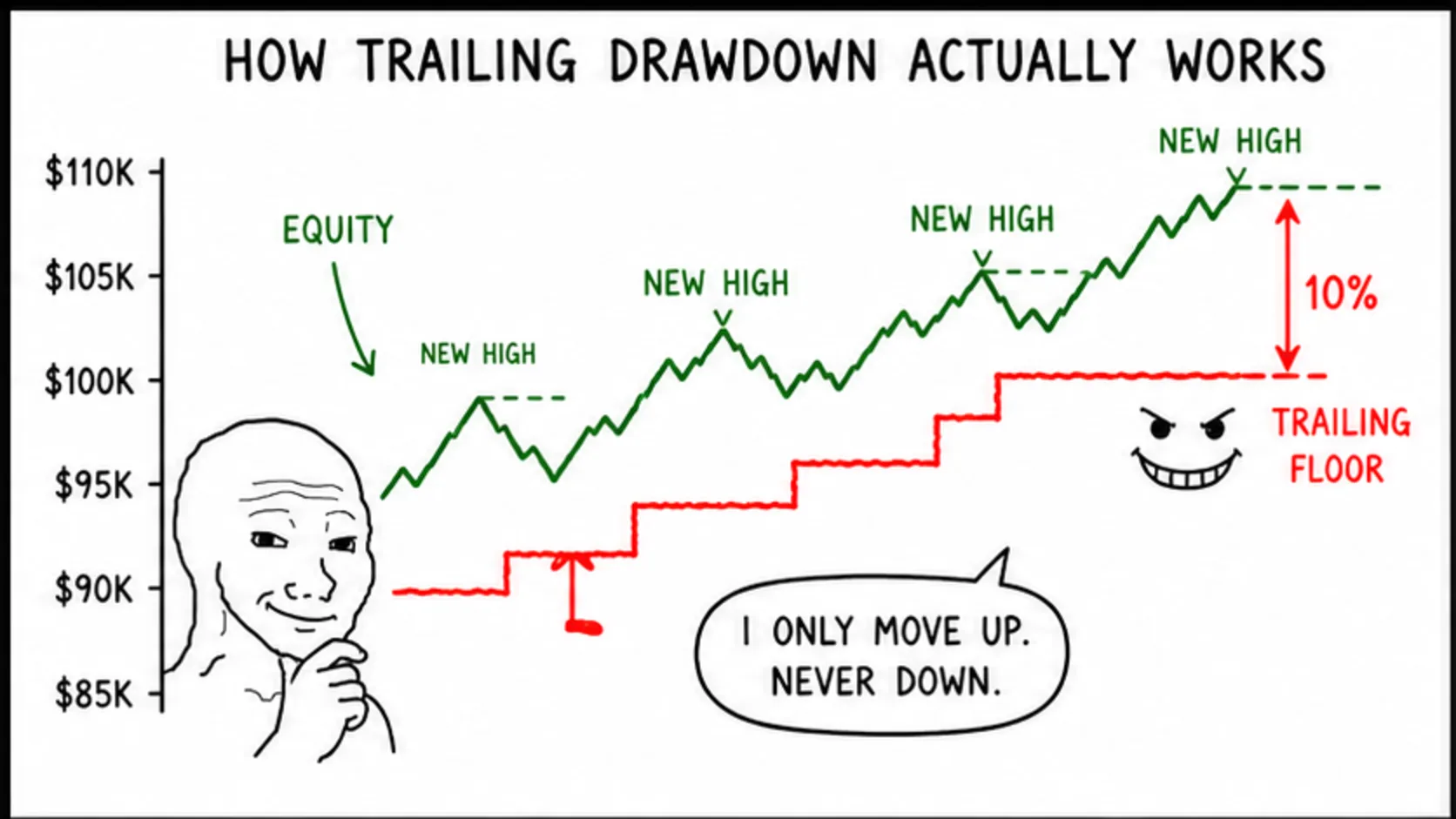
This is the section that will save you from the most common trailing drawdown breach in existence. The profit trap.
You could be $3,000 above your starting balance and still breach the trailing drawdown. How? Because the floor moved up while you were making money.
Start at $50,000. Make your way up to $58,000 through a series of winning trades. Floor is now $52,200 with a 10% trailing drawdown. Then you have a bad couple of days and drop to $52,000. You are still $2,000 in profit from where you started, but you just breached the $52,200 floor.
Anyone watching thinks your challenge is fine. You are in profit. But your account just got terminated because the trailing drawdown was chasing you the whole time.
Here is the profit trap in numbers. You start at $50,000. You trade well and reach $62,000.
Your 10% trailing floor is $55,800. You have a rough week and lose $7,000. Your equity is now $55,000.
You are still $5,000 in profit from your starting balance. But you breached the $55,800 floor by $800. Account closed.
You were up $12,000 at your peak. You gave back $7,000. You are still up $5,000 overall.
And you are out. That is the profit trap. That is the part that infuriates traders. They feel like they were punished for being profitable.
They were not. They were punished for giving back too much of their profit relative to their peak.
This is why revenge trading after a trailing drawdown breach is extremely common. You feel like the rules cheated you, so you buy another challenge and try to trade aggressively to "make it back." That is exactly the pattern that leads to a second breach. And a third.
Why funded traders fail often comes down to not understanding this dynamic. They pass the challenge with careful risk management, get funded, and then loosen up because they think they have "proven themselves." The trailing drawdown does not care about your past performance. It is a cold, mechanical rule that breaches you the moment your equity dips below the floor.
Understanding the relationship between account sizes and their associated rules matters here too. A larger account does not always mean a proportionally larger safety margin with trailing drawdown. The percentage may stay the same, but the dollar amounts and the speed at which equity swings move the floor are different.
Trailing Drawdown in Funded Accounts (What Changes After You Pass)
This is the section nobody else explains properly, and it matters more than the challenge-phase rules because this is where real money is on the line.
When you pass a prop firm challenge and receive a funded account, the trailing drawdown rules may change. Not always. Not every firm. But often enough that you need to check before you assume anything.
There are three common patterns for how trailing drawdown behaves in funded accounts:
Pattern 1: Drawdown resets to starting balance. Some firms reset the trailing drawdown floor back to the funded account's starting balance after you pass. This gives you a fresh start. Your floor is once again the initial balance minus the drawdown percentage, and it begins trailing only as you make new profit. This is the most generous approach.
Pattern 2: Drawdown continues trailing from your challenge peak. Other firms keep the floor at whatever level it reached during your challenge. If you finished the challenge at $58,000 on a $50,000 account, your funded account floor starts at $52,200, not $45,000. You carry your trailing floor with you. This is the most restrictive approach and the one that catches the most people off guard.
Pattern 3: Drawdown switches from trailing to static. A third group of firms switches from trailing drawdown during the challenge to static drawdown once you are funded. This is the best-case scenario. Your floor is fixed at the starting balance and never moves, regardless of how high your equity goes. You can let profits run without worrying about the floor chasing you.
The reason this matters is that payout pressure compounds the trailing drawdown problem in funded accounts. When you know you need to withdraw profits to justify the account, you are tempted to push harder. But pushing harder means hitting higher equity peaks, which means the floor rises further, which means your safety margin shrinks at the exact moment you need it to be largest.
Always read the funded account terms before you pass the challenge. The rules that apply during evaluation are not guaranteed to apply during funding. This is one of the most important things to understand about your account size and its associated rules.
6 Strategies to Survive Trailing Drawdown
You have six strategies for surviving trailing drawdown. Follow them or keep donating to prop firms. Your choice.
Strategy 1: Lock in profits early. When you are up significantly for the day, close your best positions. Do not let winners turn into losers. The trailing drawdown punishes giving back gains more than it punishes taking small losses. A closed profit is a profit the trailing floor cannot take from you.
Strategy 2: Reduce position sizes after big wins. If you just had a $3,000 day, do not trade the same size tomorrow. Scale back to 70% of your normal size for the next session. Your equity just peaked, which means the floor just moved.
Let the floor settle before pushing again. This is counterintuitive because your instinct after a big win is to press harder. Press less.
Strategy 3: Build a cushion before trading aggressively. If your challenge allows 30 trading days and the profit target is 10%, do not rush to hit 10% in week one. Build slowly. A $2,000 cushion means the trailing floor has room to breathe if you have a losing streak. Discipline in the early days of a challenge directly determines whether you survive the middle and end.
Strategy 4: Track your trailing floor in real time. Know your highest equity point at all times. Calculate the floor manually if your platform does not show it. This is not optional. If you do not know where the floor is, you cannot avoid it. Write it on a sticky note if you have to.
Put it on your monitor. Check it before every trade.
Strategy 5: Avoid large equity swings. Your account should climb steadily, not rocket up and crash down. A smooth equity curve is your best friend with trailing drawdown. Volatile equity curves get you killed. The peak-to-trough swings are what shrink your safety margin. Consistency beats volatility every time with this rule.
Strategy 6: Know when to stop trading for the day. This is the most underrated strategy. If you are up and the floor has just moved higher, walk away. Close the platform. The best thing you can do for your trailing drawdown is not trade when you are already at a new equity high. Let the day end, let the floor lock in, and start fresh tomorrow with a clear picture of your new safety margin.
The trailing drawdown is designed to find traders who build steadily and filter out those who swing wildly. Be the steady trader. Your funded account depends on it.
Trailing Drawdown Calculator: Find Your Exact Buffer
Use this calculator to determine your exact trailing drawdown floor and remaining buffer. Enter your account details and see the math in real time.
After you calculate your floor, check what it would take to recover if you did breach. Our drawdown recovery calculator shows the asymmetric math between losses and recovery gains.
My Trailing Drawdown Story (What I Learned the Hard Way)
I need to tell you this story because it perfectly illustrates the profit trap and because it happened to me when I had already been trading for over a decade.
It was a futures challenge with a hard trailing drawdown. $50,000 account, $2,500 trailing. I was experienced. I knew the rules. Or I thought I did.
I traded well for the first week. Built my account to $53,200. Floor was at $50,700. Everything was comfortable. I had over $2,500 of buffer and I was ahead of schedule on the profit target.
Then I took a crude oil trade during a volatile session. Standard position size, nothing reckless. But the market whipped against me faster than I could manage it. I stopped out for a $1,800 loss.
Equity dropped to $51,400. Floor was still at $50,700. I was fine. $700 of buffer.
That night I reviewed my journal and realised I had been trading too large relative to my trailing buffer. I had $700 of room. On a futures account. With crude oil. That is not a buffer. That is a rounding error.
The next morning I traded tiny. Micro lots. Built the account back to $52,500 over three days.
Then I had two consecutive losing sessions and dropped to $50,900. Floor was still $50,700. $200 of buffer. On a $50,000 account. That is 0.4%.
I stopped trading that account. Not because I breached, but because I recognised that the trailing drawdown had turned my account into a minefield. One normal losing trade would have put me through the floor. I had turned a healthy account into a barely-surviving one because I did not manage the relationship between my peak equity and my current equity carefully enough.
I passed that challenge eventually, but only because I spent the remaining days trading micro lots and building the account back slowly.
No big wins. No exciting trades. Just grinding. That is what trailing drawdown demands. Excitement kills you. Grinding keeps you alive.
The lesson I learned is that the trailing drawdown is not a number you check once at the start of the challenge. It is a number you manage every single day, every single trade, every single position. The moment you forget it is there is the moment it catches you. Trading discipline is not optional with this rule. It is the only thing that keeps you alive.
Trailing drawdown is the rule that causes the most confusion and frustration across the entire prop firm industry. It is also the rule that teaches you the most about risk management if you pay attention to what it is telling you. Respect the floor. Track the floor. Trade below the floor's expectations. And you will survive it.