For a regulator-backed starting point, use the FCA warning list before sending money to any firm that looks questionable.
Over 80 prop firms collapsed between 2023 and 2025. That number is not a typo. Traders lost millions to prop trading scams that showed every warning sign months before the plug was pulled. This page gives you the 15 red flags I use personally, plus documented scam cases, a scoring system, and a printable checklist you can run before every single purchase.
Key Takeaways
- The biggest prop firm red flags are no verifiable payout history, vague rules, aggressive affiliate marketing, and operating for less than six months.
- Legitimate firms have clear terms, consistent payout records, and independent verification from real traders on Reddit and Trustpilot.
- Retroactive rule changes and delayed payouts are warning signs that a firm may be running low on capital or preparing to collapse.
- Discount-heavy pricing and "too good to be true" terms often indicate a firm racing to collect fees before the business model fails.
- Use the Scam Score system on this page: each red flag equals 2 points, 6 or above means stop and walk away.
On This Page
- Red Flag 1: No Verifiable Payout History
- Red Flag 2: The Firm Is Less Than Six Months Old
- Red Flag 3: Vague or Buried Rules
- Red Flag 4: Rules That Change Without Warning
- Red Flag 5: Aggressive Affiliate Marketing With No Substance
- Red Flag 6: Constant Discounts and Flash Sales
- Red Flag 7: Delayed or Inconsistent Payouts
- Red Flag 8: Unrealistically Generous Terms
- Red Flag 9: No Independent Online Presence
- Red Flag 10: The Same Operators As a Collapsed Firm
- Red Flag 11: Pressure to Buy Immediately
- Red Flag 12: No Clear Company Information
- Red Flag 13: Fake or Manipulated Reviews
- Red Flag 14: The Firm Asks for Additional Payments
- Red Flag 15: Poor or Nonexistent Customer Support
- Prop Trading Scams: 5 Documented Cases
- The Scam Score: Turn Red Flags Into a Number
- The Scam Playbook: How Fake Prop Firms Unfold
- The Printable Checklist
- Frequently Asked Questions
Advertisement
11 Years of Payouts or a $10 Test
11 years of payouts. $650M+ paid since 2015, according to FTMO. 4.8/5 Trustpilot (checked 9 Oct 2026).
See FTMO account optionsInstant funded accounts from $10. 95% split. No profit target on instant accounts.
Risk: Public track record is weeks old. Treat it as a test, not a home for rent money.
See Vest instant accountsWe may earn a commission at no extra cost to you if you buy through these links. Terms and payouts are set by each firm; check them before you pay.
Red Flag 1: No Verifiable Payout History
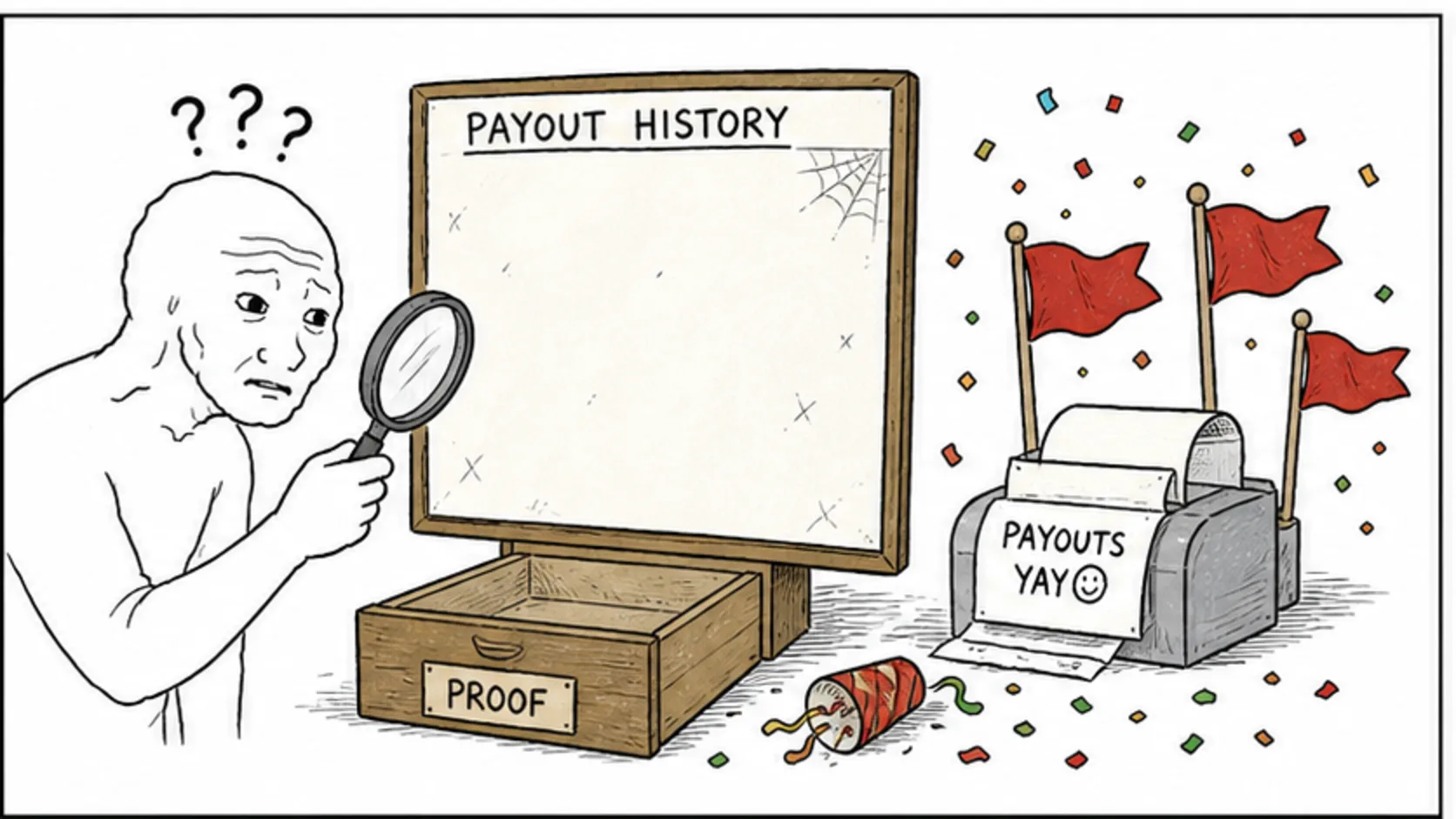
This is the single biggest warning sign. If a firm cannot show you evidence that it has paid traders, do not give it your money.
Legitimate firms publish payout certificates. They have public dashboards. You can find independent confirmation on Reddit where real traders post bank transfer receipts and crypto transaction hashes. The firms that actually pay want you to know they pay. It is their best marketing. Our FTMO payout proof guide shows what genuine payment evidence looks like from a firm with over $200 million in verified payouts.
If the only payout evidence you can find is on the firm's own website, that is not verification. That is marketing. You need third-party confirmation from people who have no financial incentive to lie to you.
Red Flag 2: The Firm Is Less Than Six Months Old
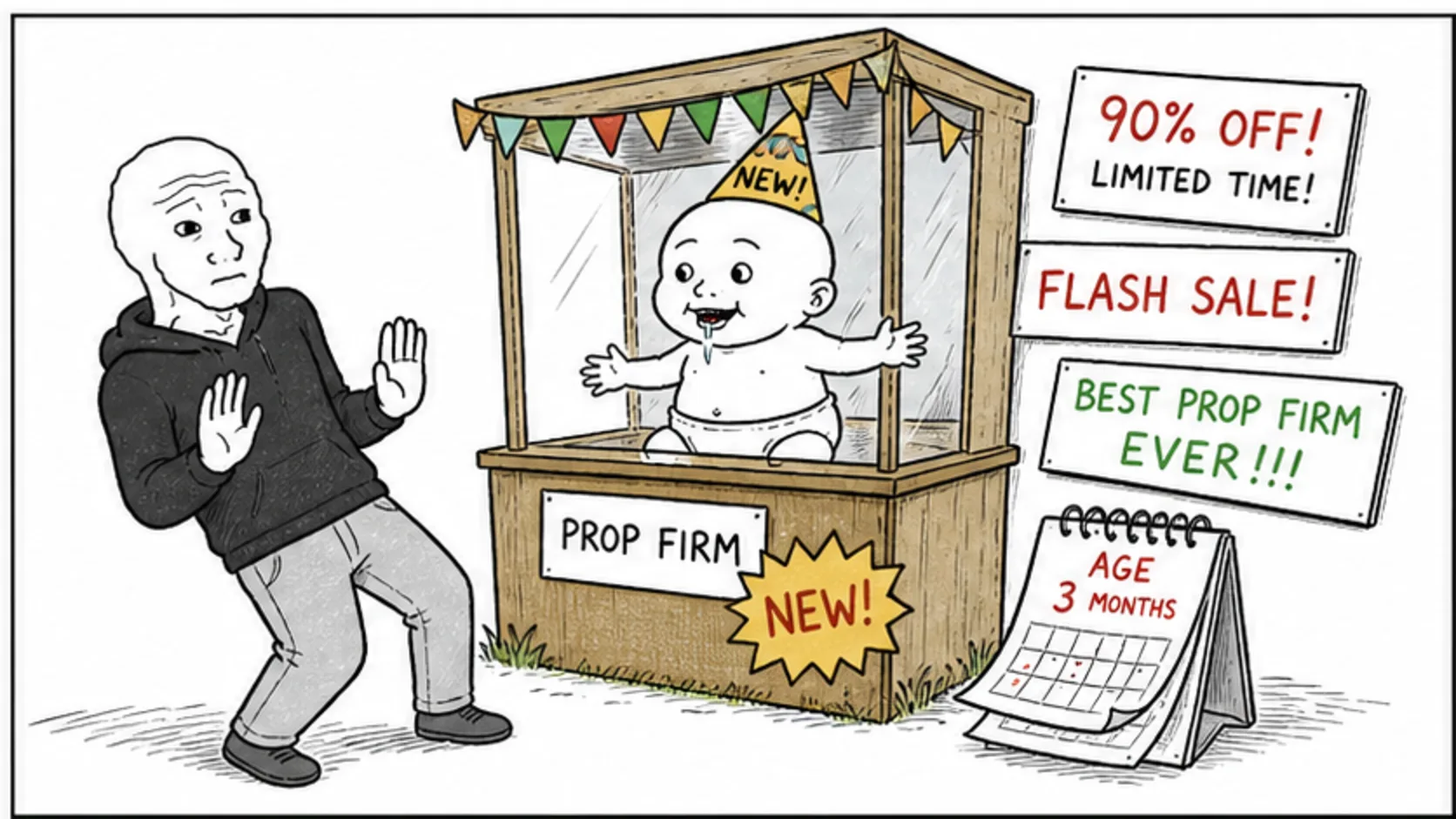
New prop firms launch every single week. Most of them will not survive their first year. Some of them are genuine startups. Some of them are restarted versions of firms that just collapsed. You cannot tell the difference from the outside.
The solution is simple. Do not be a beta tester with your own money. Established firms like FTMO (Read the PassPropTradingFirms FTMO breakdown), Topstep, and FundedNext have been operating for years. They have proven their business model works. Let someone else be the first to try the new firm with the flashy website and the too-good pricing.
If a new firm is still around and paying consistently after six months, that is when you can start considering it. Not before.
Red Flag 3: Vague or Buried Rules
A legitimate firm wants you to understand the rules. A shady firm wants the rules to be ambiguous enough that it can interpret them however it wants when payout time comes.
If the rules are buried three clicks deep in a terms and conditions page written in legalese, or if the daily loss limit calculation is described as "at the firm's discretion," walk away. Clear rule definitions protect both you and the firm. If the firm is not interested in clarity, it is because ambiguity serves them, not you. For a detailed breakdown of what to watch for in the fine print, read our guide to prop firm terms red flags.
Red Flag 4: Rules That Change Without Warning
This is the one that burns experienced traders. You bought your challenge under Rule Set A. You traded carefully under Rule Set A. You hit the profit target under Rule Set A. Then the firm changes to Rule Set B and denies your payout because your trades do not comply with the new rules.
Retroactive rule changes are a massive red flag. Firms that do this are either poorly managed or actively looking for reasons to deny payouts. Either way, you should not be doing business with them.
Most firms reserve the right to change rules in their terms and conditions. The question is whether they apply those changes going forward or retroactively. Legitimate firms apply changes prospectively. Shady firms apply them to trades you have already placed.
Red Flag 5: Aggressive Affiliate Marketing With No Substance
You have seen the YouTube videos. A trader sitting in front of a Lamborghini, telling you that [Firm X] changed their life, and by the way here is an affiliate link in the description.
Affiliate marketing itself is not a red flag. Most prop firms use affiliates. The red flag is when every single piece of content about a firm is from someone who gets paid when you sign up, and none of that content mentions the firm's rules, drawbacks, or limitations.
If you cannot find a single honest critique of a firm, that is not because the firm is perfect. It is because the people talking about it are being paid to only say positive things.
Red Flag 6: Constant Discounts and Flash Sales
If a firm is running 50% off sales every other week, ask yourself why. Established firms do not need to discount aggressively because they have a steady stream of traders willing to pay full price. Their reputation sells itself. When established firms do offer discounts, they tend to be occasional and modest, as our FTMO challenge discount page shows.
Firms that are constantly discounting are usually trying to accelerate signups. Why? Because they need the revenue now. A firm that needs to discount every week to stay afloat is a firm whose business model may not survive long enough for you to get funded and request a payout.
A one-time promotional discount is normal. A permanent "limited time" 70% off sale that has been running since the firm launched is not.
Red Flag 7: Delayed or Inconsistent Payouts
If the firm's own community is full of posts asking "where is my payout?" and the responses from support are vague, run. Do not walk. Run.
A firm that cannot pay its traders on time is either poorly managed or running out of money. Neither is good for you. Delays of a few days can happen. Payment processors have their own timelines. But when delays stretch to weeks and the firm starts citing "technical issues" or "security reviews" without giving specifics, the money is running out.
Red Flag 8: Unrealistically Generous Terms
95% profit split. No daily loss limit. Unlimited time. $100,000 challenge for $99. If the terms seem too good to be true, ask yourself how the firm stays profitable when it is giving away almost all of its revenue to traders.
The answer might be that it does not plan to. A firm offering terms that no established competitor can match is either subsidising growth with investor money and will tighten terms later, or it is collecting as many evaluation fees as possible before the math stops working. Either way, the generous terms are temporary.
Sustainable prop firm business models require a balance between what they charge and what they pay out. When that balance is wildly in the trader's favour on paper, something else is making up the difference. Usually, that something is the firm's long-term viability.
Red Flag 9: No Independent Online Presence
Google the firm's name plus "Reddit." Search Trustpilot. Check Forex Peace Army. If the only information about the firm comes from its own website and its own social media channels, you have no way to verify anything it claims.
A complete absence of independent reviews is not neutral. It is negative. It means the firm is either too new to have a track record or has been actively suppressing negative feedback. Either way, you are flying blind.
Red Flag 10: The Same Operators As a Collapsed Firm
This happens more than you would think. A prop firm collapses. Traders lose their money. A few months later, a new firm launches with a different name, different branding, and the same people behind it.
The new firm might be legitimate. The operators might have learned from their mistakes. But do you really want to be the one who tests that theory with your own money?
Research who is behind the firm. Check LinkedIn. Look for connections to previous firms that failed. If you find them, treat the new firm with extreme caution regardless of how polished the website looks.
Red Flag 11: Pressure to Buy Immediately
"Limited time offer." "Only 3 spots left." "Price goes up at midnight." These are sales tactics designed to stop you from thinking clearly. A legitimate firm's pricing does not depend on whether you click the button in the next 15 minutes.
If a firm is pressuring you to buy immediately without giving you time to research, read the terms, and compare alternatives, it does not have your best interests in mind. A firm worth your money is confident that you will come back after doing your homework.
Red Flag 12: No Clear Company Information
Where is the firm registered? Who are the directors? What is the company registration number? If you cannot find this information on the firm's website, or if it is hidden behind a "contact us" form, you are dealing with a company that does not want to be found.
Legitimate businesses publish their company information. It is not a secret. It is public record in most jurisdictions. If the firm makes it hard to find out who they are and where they are based, there is usually a reason.
Red Flag 13: Fake or Manipulated Reviews
Check the Trustpilot profile. If every review is five stars, written in similar language, posted within a short time window, or from accounts with no other reviews, you are looking at manufactured feedback.
Genuine review profiles have a mix of ratings. They have detailed complaints alongside positive experiences. The positive reviews mention specific features. The negative reviews are responded to professionally. If every review reads like it was written by the same marketing department, it probably was.
Also check if the firm has been flagged on Trustpilot for review manipulation. This is a strong signal that the public reputation does not match the private reality.
Red Flag 14: The Firm Asks for Additional Payments
You paid your evaluation fee. You passed. You got funded. Now the firm wants an "activation fee" before you can start trading your funded account. Or a "platform fee." Or a "data feed fee." Or an "account setup fee."
Some legitimate firms charge activation fees. Apex Trader Funding, for example, has a known activation fee structure. But this should be disclosed clearly before you buy the challenge, not sprung on you after you have already passed.
If a firm asks for money you were not told about upfront, that is a bait-and-switch. The terms you agreed to should list every possible fee. If they do not, the firm is adding costs on the fly.
Red Flag 15: Poor or Nonexistent Customer Support
Send the firm a question before you buy. See how long it takes to get a response. If the answer is days, or if you get a generic copy-paste reply that does not address your question, imagine what happens when you have an actual problem with a $5,000 payout request.
Customer support quality is a proxy for how much the firm values its traders. A firm that invests in responsive, knowledgeable support is a firm that wants to retain traders long term. A firm that treats support as an afterthought is focused on acquisition, not retention.
The thing about prop firm disasters is that almost all of them are preventable. The red flags were there. The warning signs were visible. The community was talking about it.
But the trader was in a hurry, or the price was good, or the marketing was convincing, and they ignored every signal. Do not be that trader. Print this checklist. Use it every time. Your due diligence checklist is the only protection you have in an industry with no regulatory safety net.
Prop Trading Scams: 5 Documented Cases That Cost Traders Thousands
Knowing the red flags in theory is one thing. Seeing them play out across five real collapses with real money lost is another. These five cases are not ancient history. They happened between mid-2024 and 2025, and every single one displayed multiple red flags from the list above before the collapse. If you had used a scoring system on these firms, you would have walked away before losing a penny.
1. FundedFirm
FundedFirm claimed over $95 million in total payouts, a figure that was fabricated. The firm copied FundedNext's website layout, terms, and even branding language. Fake funded accounts were created specifically for influencer reviews, meaning the payout screenshots circulating on YouTube were staged. The firm paid initial small withdrawals to build trust, then payout delays started by month three. By month six, operations ceased entirely.
Red flags visible before collapse: No verifiable payout history (Red Flag 1), aggressive affiliate marketing with no substance (Red Flag 5), constant discounts (Red Flag 6), fake reviews (Red Flag 13), no clear company information (Red Flag 12), pressure to buy immediately (Red Flag 11), and poor customer support (Red Flag 15).
2. The Funded Trader (TFT)
TFT was one of the industry's biggest names. It paid approximately $17 million in January and February 2024 alone. But behind the scenes, it was denying roughly $2 million in withdrawal requests. Operations were paused on March 28, 2024, and the firm never relaunched. Traders who had passed evaluations and earned funded accounts were left with nothing. TFT proves that even large, well-known firms can display warning signs if you are paying attention.
Red flags visible before collapse: Delayed payouts (Red Flag 7), poor customer support (Red Flag 15), rules that changed without warning (Red Flag 4), pressure to buy immediately through limited-time promotions (Red Flag 11), and vague or buried rules about payout terms (Red Flag 3).
3. True Forex Funds
True Forex Funds shut down on May 13, 2024, after losing its MetaQuotes (MT4/MT5) license. Approximately 300 traders were left with roughly $1.2 million in unpaid earnings. The firm had been operational for over two years, which normally signals legitimacy. But the MetaQuotes license loss exposed a dependency that should have been a red flag. When your entire operation depends on a third-party platform provider and that provider revokes your access, the business model was fragile from the start.
Red flags visible before collapse: Delayed payouts in the weeks leading to shutdown (Red Flag 7), poor customer support during the transition (Red Flag 15), and a lack of transparency about platform dependencies (Red Flag 12). The lesson here: even firms with multi-year track records can collapse suddenly when infrastructure dependencies are not disclosed.
4. Funded Engineer
Funded Engineer was a deliberate exit scam. The founders collected evaluation fees, filed for bankruptcy to shield themselves from legal action, and then disappeared. Estimated losses ranged from $1 to $2 million. The bankruptcy filing was a calculated move to prevent traders from pursuing claims. Unlike firms that collapse because their business model fails, Funded Engineer was designed from day one to extract money and vanish.
Red flags visible before collapse: No verifiable payout history (Red Flag 1), no clear company information (Red Flag 12), unrealistic terms to attract signups (Red Flag 8), aggressive affiliate marketing (Red Flag 5), and no independent online presence initially (Red Flag 9).
5. Hola Prime
Hola Prime purchased approximately 1,300 fake Trustpilot reviews to manufacture credibility. When Trustpilot removed them, investigators discovered that some reviews were dated before the firm had actually launched. This is Red Flag 13 on steroids. The fake reviews were designed to bypass the exact due diligence process that would have caught the scam. Hola Prime is a textbook case of why review scores alone cannot be trusted.
Red flags visible before collapse: Fake or manipulated reviews (Red Flag 13), no verifiable payout history (Red Flag 1), aggressive affiliate marketing (Red Flag 5), constant discounts (Red Flag 6), and pressure to buy immediately (Red Flag 11).
Every one of these firms displayed five or more red flags before the collapse. The traders who lost money either did not check or chose to ignore the warnings. For a deeper dive into how firms go from operating to gone, see our prop firm collapse warning signs guide and our reasons prop firms deny payouts breakdown.
The Scam Score: Turn Red Flags Into a Number
The problem with a list of red flags is that people read them, nod, and then forget to apply them. So here is a scoring system. Each of the 15 red flags on this page equals 2 points. If a firm displays a red flag, add 2 to its score. If it displays it prominently or deliberately, add 3. Tally the total and compare it to the scale below.
Scam Score Scale
| Score Range | Risk Level | What To Do |
|---|---|---|
| 0 to 5 | GREEN | Low risk. Proceed with standard due diligence. Verify payouts independently. |
| 6 to 10 | AMBER | Elevated risk. At least two or three red flags present. Dig deeper before purchasing. |
| 11 or above | RED | Do not buy. Five or more red flags. Walk away immediately. |
Real firms score differently depending on how you weight the flags. FTMO, for example, would score a 0 or 2 on this system because it has a verifiable payout history, clear rules, and years of operation. A brand new firm with no reviews and 70% discounts might score a 10 before you even check the terms.
The scoring system is not perfect. No scoring system is. But it forces you to quantify what you are seeing instead of relying on gut feeling. Gut feeling loses traders money. Numbers do not. For a step-by-step verification process beyond this scoring system, read our guide on how to check if a prop firm is legit.
Scoring Worksheet
Use this checklist to score any prop firm before you buy. Check each red flag that applies, add up the points, and read your score against the scale above.
Total Score: _____
GREEN (0-5): Proceed. AMBER (6-10): Dig deeper. RED (11+): Walk away.
The Scam Playbook: How Fake Prop Firms Unfold
Every scam prop firm follows roughly the same timeline. I have watched this pattern repeat dozens of times across 15 years in the industry. The names change. The playbook does not. Here is how a typical prop trading scam unfolds, month by month.
The firm launches with a polished website, aggressive pricing, and a heavy affiliate push. YouTube influencers get early access and post glowing reviews. Discount codes flood social media. The firm is designed to look established from day one. Reddit activity is seeded with fake testimonials. The goal is maximum signups in minimum time.
The firm pays out small to medium withdrawals to build trust. These payouts are real and they generate social proof.
Funded traders post screenshots. Affiliate content doubles down.
The firm is operating at a loss, but the evaluation fee revenue covers it. This is the honeymoon phase. Everything looks legitimate.
Payout requests start getting delayed. First by a few days, then by weeks. Support starts citing "security reviews" and "payment processor issues." New discount codes appear, pushing even more signups to generate fresh revenue. The firm is now using new evaluation fees to pay older withdrawal requests. This is the beginning of a run on the bank.
Payout denials spike. Traders are told they violated rules that were never clearly communicated.
Retroactive rule changes appear. Customer support goes silent or responds with copy-paste templates.
The community on Reddit starts raising alarms. Affiliates quietly remove their promotional content. The firm's Trustpilot profile shows a wave of one-star reviews.
The firm shuts down abruptly. The website goes offline. The Discord server is deleted. Traders with pending payouts receive nothing.
Within weeks or months, a new firm launches with a different name but the same operators. The cycle begins again. For a full breakdown of this pattern, see our prop firm collapse warning signs guide.
The r/ScamPropFirms subreddit on Reddit tracks these patterns in real time. It is one of the few independent resources where traders share verified information about firms that are displaying warning signs. If you are evaluating a firm, search that subreddit first. If no one has posted about it, that is not necessarily good. It might just be too new to have a track record yet.
The lesson from every scam playbook is the same: the early signs are visible months before the collapse. Delayed payouts, rule changes, and support silence are not random events. They are symptoms of a business model that is running out of runway. When you see two or three of these symptoms together, the firm is almost certainly heading toward trouble.
The Printable Checklist: 15 Red Flags to Check Before Every Purchase
This is the checklist I use myself. Print it out. Keep a copy next to your desk. Run every firm through it before you hand over money. The severity indicators tell you how serious each flag is when found in isolation.
Prop Firm Red Flags Checklist
On-screen, this checklist is hidden. But when you hit print, it appears formatted for paper with clean checkboxes and severity labels. One CRITICAL flag should make you pause. Two or more means you need a very good reason to proceed. Three or more means stop. If you want a more comprehensive due diligence process beyond red flags, our prop firm due diligence checklist covers the full evaluation framework.