A funded trading account is not the same as a protected client brokerage account. The FCA guidance on avoiding scams is useful when comparing firms and payout claims.
A funded trading account is an account loaded with a prop firm's capital that you trade after passing their evaluation. You keep a cut of the profits. The firm keeps the rest. You risk none of your own money beyond the evaluation fee. That is the short version.
The longer version involves understanding what "funded" actually means, what you give up in exchange for access to capital, and whether this setup makes sense for your specific situation. Because it is not for everyone, despite what the affiliate marketers tell you.
Key Takeaways
- A funded trading account is a prop firm's capital that you trade after proving yourself through an evaluation.
- Evaluation fees range from $50 to $600. A $100,000 account evaluation typically costs $400-$600.
- Profit splits range from 70% to 90% in your favour, paid out every 14-30 days.
- Funded accounts come with strict risk rules. Break them and you lose access immediately.
- The average funded account lasts less than 60 days. Surviving past 90 days puts you in the top 20%.
On This Page
- What Is a Funded Trading Account?
- What "Funded" Actually Means
- How You Get a Funded Account
- The Rules That Come With It
- What Funded Accounts Cost
- Is a Funded Trading Account Worth It?
- Funded Account vs Trading Your Own Money
- Funded Account vs Demo vs Personal Account
- Funded Account Types: Forex, Futures, and Stocks
- From Evaluation to Funded: The Journey Step by Step
- Funded Account Survival Data
- Choosing Your Funded Account Size
- Common Funded Account Myths Debunked
- Frequently Asked Questions
What Is a Funded Trading Account?
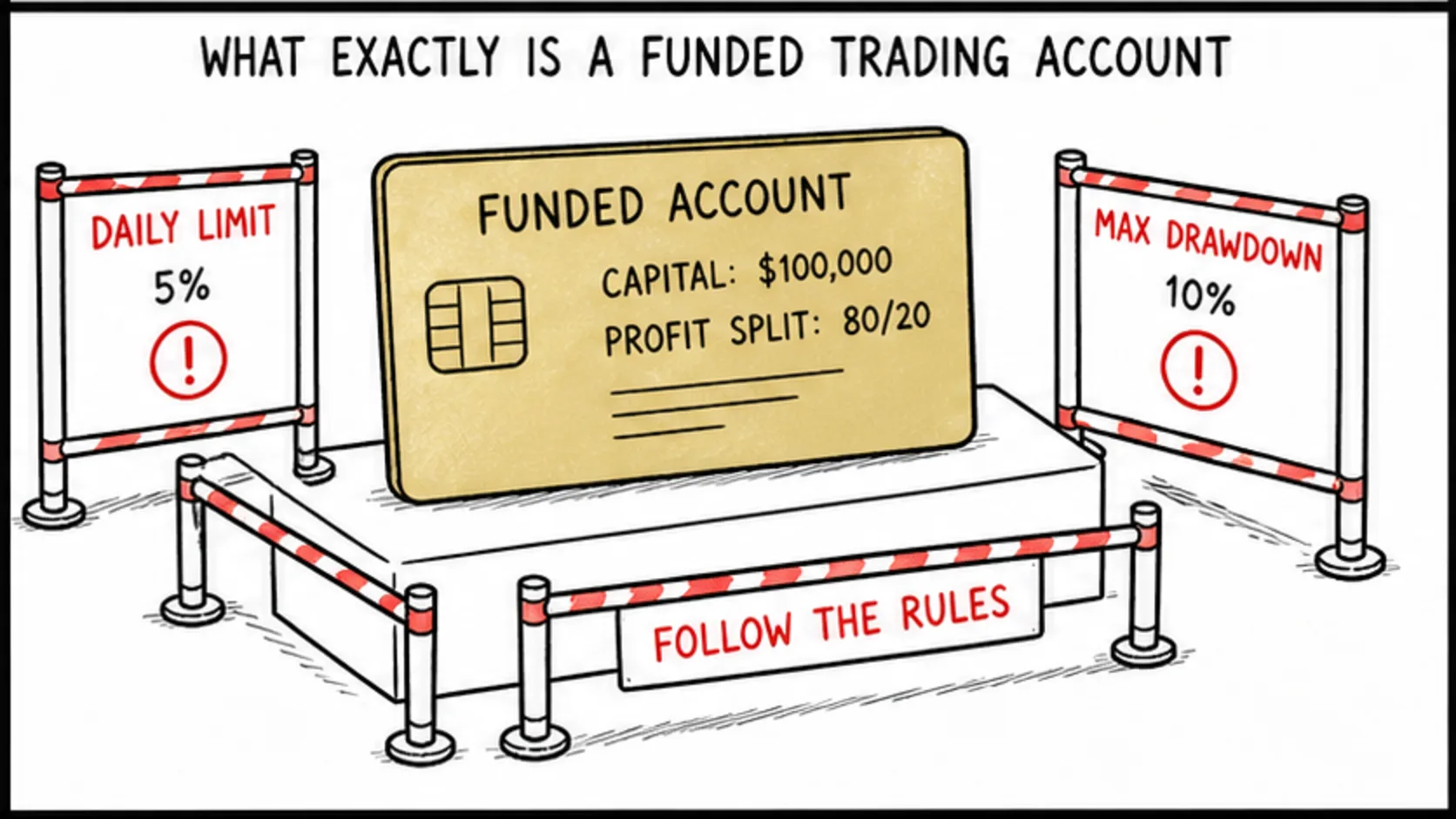
A funded trading account is capital provided by a proprietary trading firm that you, the trader, manage in exchange for a share of the profits. The firm owns the money. You direct the trades. The profits get split.
This is not a loan. You do not owe the firm anything if you lose money while following their rules. This is not a job. You are not an employee with a salary and benefits. This is an arrangement where you prove you can trade responsibly, and the firm rewards you with access to their capital.
The prop firm exists to identify traders who can generate returns without taking reckless risks. The funded account is the instrument through which those traders operate.
You get the account only after passing an evaluation. The evaluation is a filtering mechanism. It is designed to let through traders who manage risk and reject traders who do not. Simple concept, brutal execution.
What "Funded" Actually Means
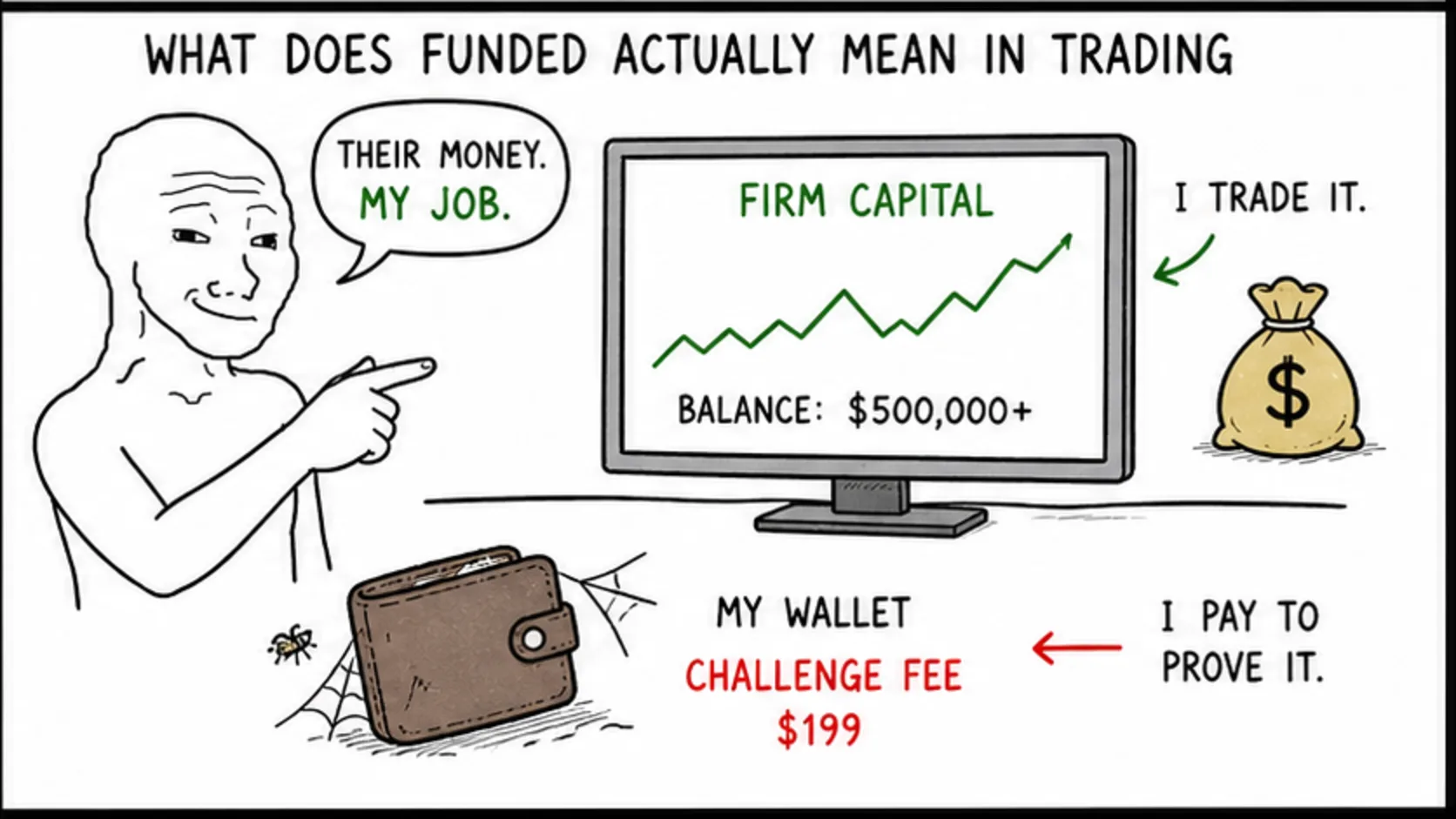
The word "funded" creates confusion because it sounds like someone handed you a bag of cash. Let me clarify what is actually happening.
When you get funded, the firm gives you access to a trading account with a specific balance. This could be $25,000, $50,000, $100,000, or more depending on what you applied for and passed.
Wondering what is a funded trader compared with the evaluation account you are trading now? That switch is smaller than most people expect. Others give you a simulated account that mirrors live market conditions but where the firm's actual capital is not directly at risk. Either way, the trading experience is identical. You place orders, they fill at market prices, and your P&L moves in real time.
The "funded" part means you are trading with the firm's backing. Your profit split is real money paid to you on a schedule. Your losses, within the rules, are absorbed by the firm. Step outside the rules, and the arrangement ends.
How You Get a Funded Account
The path to a funded account follows a clear sequence, and I cover the full step-by-step version on the approval process page. Here is the summary.
First, you choose a prop firm and buy an evaluation. The evaluation fee is your only cost. Then you trade the evaluation account, hitting a profit target while following all risk rules. Pass the evaluation, possibly complete a verification phase, and you receive your funded account.
The entire process can take anywhere from two weeks to several months depending on your trading style, the firm's rules, and how quickly you hit the target.
There are no interviews, no CV submissions, no background checks. The evaluation is the interview. Your trading results are your resume.
The Rules That Come With It
Funded accounts are not free money with no strings attached. The strings are called rules, and they exist to protect the firm's capital from traders who cannot control themselves.
Daily loss limit. The maximum you can lose in a single trading day. Usually 3-5% of the account balance. Hit this limit and your trading stops for the day automatically.
Maximum drawdown. The maximum your account can drop from its peak or starting balance. Typically 6-10%. Breach this and the account closes permanently. Our FTMO drawdown rules explained article shows exactly how these limits work in practice.
Consistency rule. Some firms require that no single trading day accounts for too large a portion of your total profits. This prevents one lucky trade from passing an otherwise inconsistent trader.
Minimum trading days. Some firms require you to trade a minimum number of days before requesting a payout. This stops traders from making one big trade and immediately withdrawing.
Understanding every rule before you start trading is not optional. The same applies to FTMO's specific challenge rules, which are among the most detailed in the industry. It is the difference between keeping your account and losing it over something you did not know about.
What Funded Accounts Cost
The cost of getting a funded account is the evaluation fee. Here is what you can expect to pay based on account size.
- $10,000 account: $50 to $100
- $25,000 account: $100 to $200
- $50,000 account: $200 to $350
- $100,000 account: $400 to $600 (see FTMO's account pricing for a specific example)
These fees are one-time payments for the evaluation. There are no monthly subscriptions or ongoing fees on most funded accounts. You pay once, pass the evaluation, and trade.
If you fail, you pay again. Some firms offer resets at a discount. Either way, the fee structure is transparent. You know exactly what you are paying before you start.
Is a Funded Trading Account Worth It?
This is the question Reddit threads are made of, and the answer depends entirely on who is asking.
If you have been trading profitably on demo for months, you understand risk management, and you have a strategy with a real edge, then yes. A funded account gives you access to capital you could never afford to deposit yourself, with limited downside risk.
If you have been trading for three weeks, watched some YouTube videos, and think you are ready because you made $200 on a demo account last Tuesday, then no. You are about to donate money to a prop firm. Wait. Learn. Prove yourself on demo first.
The funded account is a tool. Like any tool, it is only as good as the person using it. A hammer is great if you know where to swing it. It is terrible if you do not.
Funded Account vs Trading Your Own Money
The comparison is straightforward. With your own money, you have complete freedom and complete risk. With a funded account, you have strict rules and limited personal financial risk.
A trader with $5,000 making 5% a month earns $250. The same trader on a $100,000 funded account at 80% profit split earns $4,000. The skill level is identical. The access to capital makes the difference.
But your own account has no daily loss limit, no drawdown ceiling, no consistency rule, and nobody telling you to stop trading. For some people, that freedom is worth more than the extra capital.
The right choice depends on your capital, your discipline, and your goals. Neither option is inherently better. They serve different purposes for different types of traders.
A funded trading account is not a magic solution. It is leverage on your skill. If your skill is real, the leverage works in your favour. If it is not, the leverage works against you.
Funded Account vs Demo vs Personal Account: Comparison Table
The three account types look similar from a distance but function very differently once you sit down to trade. A funded account combines the capital of a professional desk with the rules of a gaming tournament. You get the upside of large capital and the downside of zero tolerance.
Here is the side-by-side breakdown that most firms will not give you because it makes the comparison look obvious.
| Feature | Funded Account | Demo Account | Personal Live Account |
|---|---|---|---|
| Capital source | Prop firm's money | Virtual (fake) money | Your own money |
| Your financial risk | Evaluation fee only ($50-$600) | Zero | Everything you deposit |
| Profit split | 70-90% to you, 10-30% to firm | No profit (it is fake money) | 100% is yours |
| Risk rules | Strict daily loss, max drawdown, consistency | None | None (but your broker may margin call you) |
| Emotional pressure | High (real money, strict rules, time pressure) | Zero (nothing at stake) | Moderate to high (your own money at risk) |
| Withdrawal access | Every 14-30 days on profit splits only | No withdrawals (not real money) | Anytime (but you lose the capital to trade with) |
| Account scaling | Yes, after consistent performance (most firms) | No | Only if you deposit more |
| Rule enforcement | Automatic. Break a rule and the account closes instantly. | No enforcement | Broker enforces margin requirements only |
If you have $5,000 to trade, you can make 5% a month and earn $250. If you pass a funded evaluation on a $100,000 account and make 5% a month at an 80/20 split, you earn $4,000. Same skill, 16x the income. That is why funded accounts exist.
But that income comes with constraints. The rules are not optional. The drawdown limit is not negotiable. The consistency requirement does not care about your feelings. If you want freedom, trade your own money. If you want capital, follow the rules.
For a deeper comparison of the funded account versus personal account decision, see our full guide on prop firm vs personal account trading. And if you are still confused about whether you are trading on a real or simulated environment, our breakdown of prop firm simulated vs live accounts clears it up.
Funded Account Types: Forex, Futures, and Stocks
Funded accounts are not one-size-fits-all. The asset class you trade determines which firms you can work with, which platforms you will use, and which regulatory frameworks apply. Most traders only know about forex funded accounts because that is where the marketing money goes. But futures and stock funded accounts are growing fast.
Forex funded accounts are the most common. You trade currency pairs and sometimes metals or indices through CFDs on MT4 or MT5. Most prop firms offer forex accounts. The evaluation typically requires hitting 8-10% profit with a 5% daily loss limit and 10% maximum drawdown. The competition is fierce, which means the best firms compete on profit splits and rule flexibility.
Futures funded accounts operate on a different model. You trade contracts like the E-mini S&P 500, NASDAQ, crude oil, or gold on platforms like NinjaTrader or Tradovate. Futures firms are regulated by the CFTC in the US, which adds a layer of legitimacy that forex firms often lack. Payout splits at futures firms can go as high as 90/10 or even 100/0 on some programs. The evaluation structure is also different. Many futures firms use a "combine" format with daily profit targets rather than a single lump-sum target.
Stock funded accounts are the newest category. Fewer firms offer them, and the rules tend to be different because equities have different risk characteristics. You can hold overnight, dividends matter, and short selling has locate requirements. If you want to trade individual stocks with a funded account, your options are narrower but growing. Some firms offer US equity allocations within a broader multi-asset account, while others focus exclusively on equities.
The key difference between these account types is not the money. It is the environment. Forex is 24/5 with high leverage. Futures trade nearly 23 hours a day with regulated exchanges. Stocks have fixed hours, earnings risk, and overnight gap exposure. Each environment demands a different skill set, and passing a forex evaluation does not automatically prepare you for futures.
For the full breakdown of each asset class, see our guides on what is a forex prop firm, what is a futures prop firm, and futures prop firms explained.
From Evaluation to Funded: The Journey Step by Step
Passing the evaluation is not the finish line. It is the starting line. What happens in the first 30 days after you get funded determines whether you are still trading in 90 days or back in the evaluation queue. I have been through this process multiple times, and the steps are more specific than most people realise.
Step 1: Account activation. After you pass, the firm sends you login credentials for your funded account. This usually takes 24-48 hours. Some firms charge an activation fee (typically $0-$100) before you can start trading. Check this before you pass so you are not surprised. I have seen traders fail to budget for a $50 activation fee and delay their start by a week while they sorted out the payment.
Step 2: Your first funded trades. Here is what changes from the evaluation. The profit target is gone. You are no longer trying to hit 10%.
You are trying to produce consistent gains over time without breaching any rules. The emotional shift is massive.
The numbers on your screen are real money now. Your brain knows it even if the trading platform looks identical.
Step 3: Building a buffer. The first two weeks after funding are the most dangerous. I aim to build a 3-4% buffer above my starting balance before I even think about my normal position sizing. This buffer is your breathing room. It means a couple of losing days do not put you near the drawdown limit. Without a buffer, you are one bad session away from the edge.
Step 4: First payout request. Most firms require a minimum number of trading days before you can request your first payout, usually 10-20 days. When you are eligible, you submit a payout request through the firm's dashboard. Some firms require KYC verification at this stage, which means uploading a government ID and proof of address. Processing takes anywhere from same-day to two weeks depending on the firm and payment method. For the full breakdown, see our first prop firm payout guide.
Step 5: Ongoing management. After your first payout, the funded account becomes routine. You trade, you get paid, you repeat.
If you are on a scaling plan, hitting consistent targets will increase your account size. If you are not, you focus on protecting what you have and growing it steadily.
The novelty wears off. The discipline must not.
Funded Account Survival Data: How Long Do They Last?
This is the section that separates marketing from reality. The prop firm industry does not publish survival statistics voluntarily because the numbers are not flattering. But based on industry analysis and trader community data, the picture is clear.
The pass rate across major prop firms sits between 10-15% for the initial evaluation. That means 85-90% of traders who buy an evaluation never make it to a funded account. For a deeper look at these numbers, see our prop firm pass rates breakdown.
Of the traders who do pass and receive a funded account, the average lifespan is less than 60 days before a rule breach closes the account. The most common causes are breaching the daily loss limit during a volatile session, hitting the maximum drawdown after a losing streak, and violating consistency rules by trying to rush toward a payout.
The survival curve is steep. After 30 days, roughly 50% of funded accounts are still active.
After 60 days, that drops to around 30%. After 90 days, only about 20% of funded traders remain.
But here is the critical insight: traders who survive past the 90-day mark have a dramatically higher chance of staying funded for a year or more. The first 90 days are the filter. If you can get through them, the odds shift in your favour.
Smaller accounts ($10,000-$25,000) tend to survive longer than larger accounts ($100,000+). The reason is simple. The psychological pressure on a $100,000 account is enormous. Every pip move feels like real money because it is. Traders on smaller accounts tend to trade more conservatively, which paradoxically produces better long-term results.
The data from Spotern's prop trading industry report and Influencer Marketing Hub's financial creator data both point to the same conclusion. The prop firm ecosystem is designed to filter out the majority of participants. Your survival depends on risk management discipline, not trading talent. For the full data breakdown, see our prop firm survival rate analysis.
Choosing Your Funded Account Size
The single most common mistake new funded traders make is starting too big. They see a $100,000 account and think that is what they need to make real money. Wrong. The account size you choose should be the smallest one you can afford to fail three times. That is the rule.
Here is the math. A $10,000 account evaluation costs roughly $50-$100. A $100,000 account evaluation costs $400-$600. If you budget $150 total for learning, you can attempt a $10,000 account three times. Or you can attempt a $100,000 account once and be done.
The smarter play is starting small. A $10,000 or $25,000 account lets you learn the evaluation process, test your strategy under real rules, and build confidence without risking hundreds of dollars. The profit potential is lower, yes. But the learning-to-cost ratio is far better. You are paying for education disguised as an evaluation.
I started with a $25,000 account. My first two attempts failed. My third passed. Total investment: approximately $300 across three evaluations. If I had started with a $100,000 account, that same learning curve would have cost me $1,200-$1,800. The $25,000 account taught me the same lessons at a fraction of the price.
Once you pass consistently on a small account, you can scale up. Most firms allow you to purchase a larger evaluation after demonstrating you can trade profitably. Some firms even offer scaling plans that increase your account size based on performance. The path up is always open. The path down, once you have blown a large account, costs real money and real time.
For the full breakdown of how different account sizes compare, see our guide on prop firm account sizes explained.
Common Funded Account Myths Debunked
There are more myths about funded accounts circulating on YouTube and Discord than there are about Bigfoot. I have heard every one of them, usually from someone who has never passed an evaluation. Here are the four that cause the most damage.
Myth 1: "Funded accounts use real money from day one." This is not accurate for the majority of funded accounts. Most firms use simulated accounts that mirror live market conditions. Your trading experience is identical either way, your profit splits are real, and your payouts are real money. The distinction matters for your understanding of the business model but not for your trading. For the full explanation, see do prop firms use demo accounts.
Myth 2: "You can withdraw whenever you want." No. You cannot. Payouts follow a schedule, typically every 14-30 days.
Some firms require a minimum number of trading days between payouts. Some have minimum withdrawal amounts.
You do not have an ATM. You have a structured payout system. Plan around it.
Myth 3: "The firm wants you to fail so they keep your fee." This is backwards. A single evaluation fee is worth $200-$600.
A profitable trader generating consistent profit splits is worth thousands per year. The firm wants you to succeed.
They just also want to filter out the traders who cannot handle risk. These are not the same thing. Read the full breakdown at do prop firms want you to fail.
Myth 4: "Bigger accounts are always better." A $200,000 account sounds impressive until you realise the drawdown is proportionally smaller relative to the psychological pressure. If you cannot trade profitably on a $25,000 account, you will not trade profitably on a $200,000 one. Scale comes after consistency, not before it. Our guide on prop firm account sizes explained covers the math behind choosing the right size.