Being a funded trader does not remove market risk. The CFTC forex advisory is a reminder that trading skill and risk controls matter more than account labels.
A funded trader is someone who trades a prop firm's capital after proving they can manage risk. That is the definition. The reality is messier, more interesting, and involves a lot more people failing than the marketing materials suggest.
Most people hear "funded trader" and picture someone at a desk in Canary Wharf with two monitors and a six-figure salary. That version exists, but it is not what this article is about. The funded trader you are looking into is a retail trader who passed an online evaluation and now trades someone else's money for a cut of the profits.
Key Takeaways
- A funded trader trades a prop firm's capital, keeps a profit split of 70-90%, and risks none of their own money beyond the evaluation fee.
- The evaluation pass rate is roughly 5-10%. Most traders fail because they break risk rules, not because they cannot read a chart.
- Funded trading is not a salary. Your income depends entirely on what you produce. Some months you make money, some months you do not.
- The evaluation fee is your only financial risk. Once funded, you trade the firm's capital, not yours.
- Only about 20% of funded traders remain funded past the first 90 days. The first three months are the real filter.
On This Page
- What Is a Funded Trader?
- How Funded Trading Works
- What Funded Traders Actually Make
- Income Reality: The Numbers Nobody Shares
- Career Paths: Different Types of Funded Traders
- Survival Statistics: How Many Funded Traders Last?
- A Day in the Life of a Funded Trader
- Is It Hard to Become a Funded Trader?
- Your Three Missions as a Funded Trader
- Funded Trader vs Regular Trader
- Is Funded Trading a Real Career?
- Funded Trader Communities and Support
- Common Myths About Funded Trading
- The First 90 Days: What Actually Kills Funded Traders
- One Funded Account or Several: How Real Funded Traders Set Up
- Frequently Asked Questions
What Is a Funded Trader?
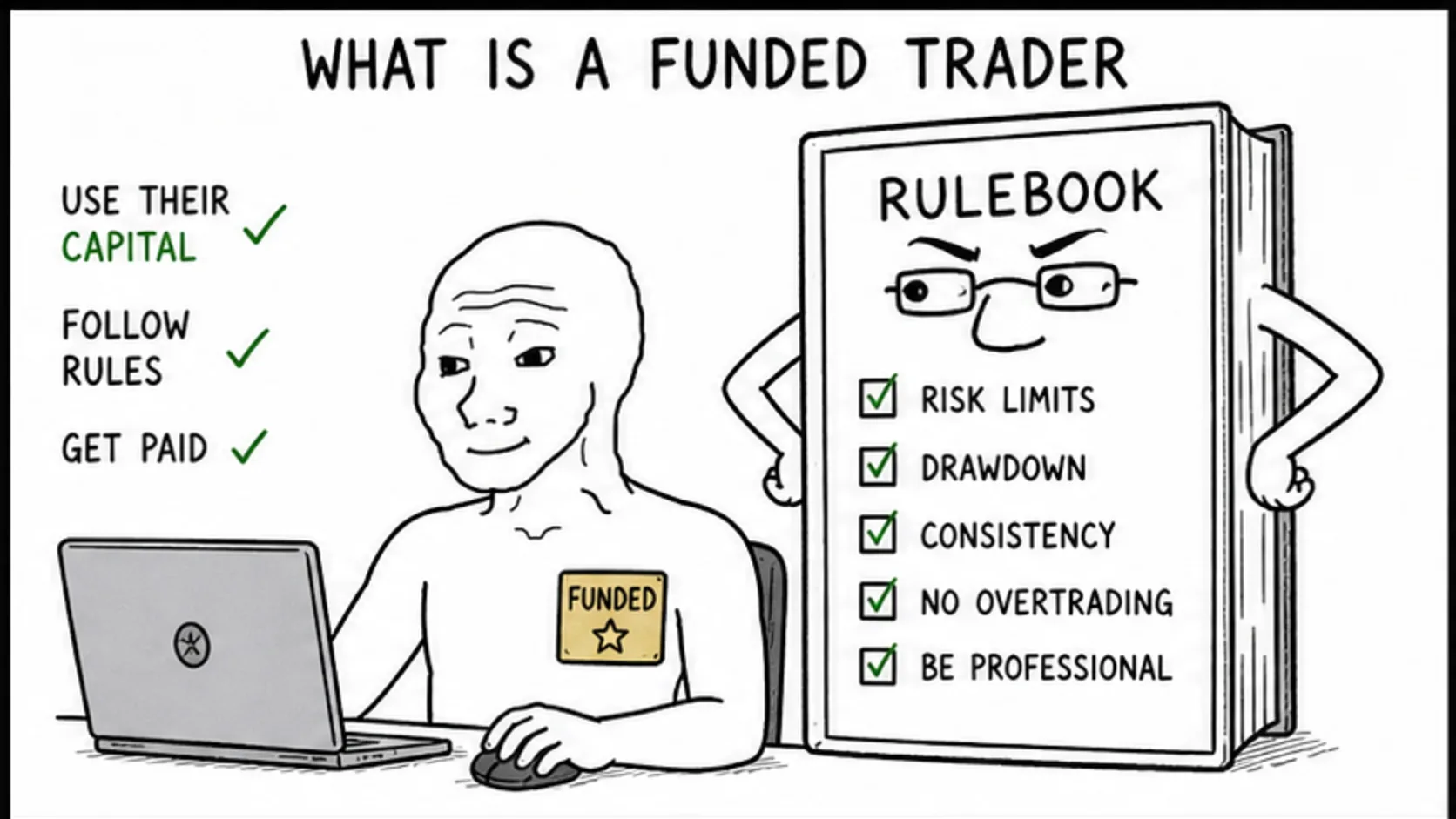
A funded trader is a person who has passed a proprietary trading firm's evaluation and now trades the firm's money on a live or simulated account. The trader keeps a percentage of the profits. The firm keeps the rest. The trader risks none of their own capital beyond the initial evaluation fee.
Think of it like this. You rent access to someone else's trading account. The rent is the evaluation fee. If the account itself is still fuzzy, this is what is a funded account in plain terms. The landlord takes a cut of whatever you earn. If you lose money, the landlord absorbs the loss as long as you followed the house rules.
Those house rules are where things get serious. Every prop firm has strict risk parameters, daily loss limits, maximum drawdown rules, and consistency requirements. Break any of them and you lose the account.
The prop firm is not a charity. Their business model works because most people fail the evaluation. The funded traders are proof the system is real. The failed evaluations are how the firm stays profitable. If you are evaluating your options, our FTMO challenge overview breaks down how one of the largest firms structures its evaluation.
How Funded Trading Works
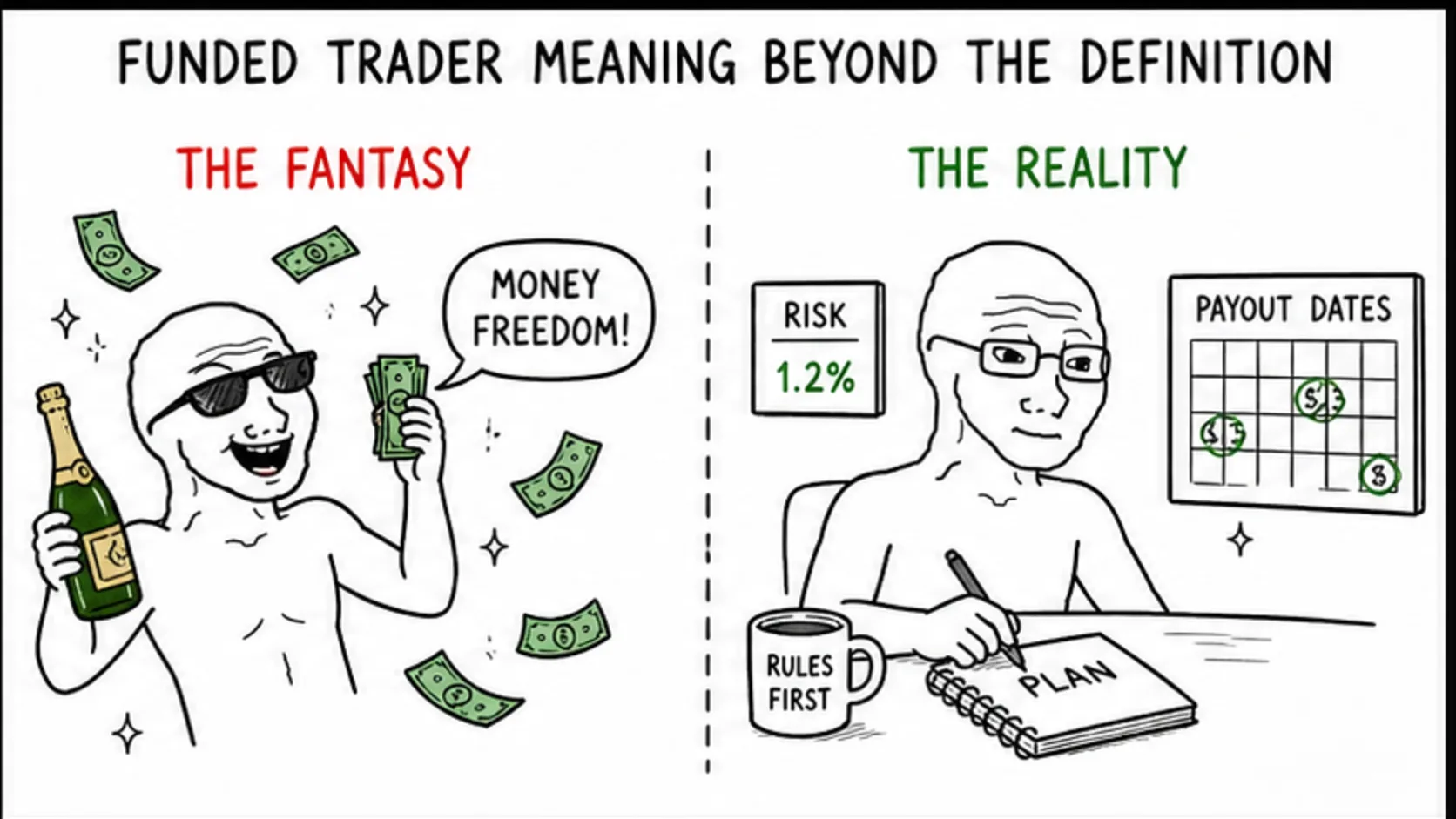
The path from random person to funded trader follows a specific process. It starts with choosing a firm and buying an evaluation. That evaluation typically costs between $50 for a small account and $500 for a larger one.
Once you pay, the firm gives you access to a trading platform with a simulated account. You have a profit target to hit, usually 8-10% of the account balance, and a set of risk rules you cannot violate.
Hit the target without breaking the rules, and you get funded. The firm gives you a live account to trade with their capital. Everything you earn above the starting balance gets split between you and the firm.
The typical profit split ranges from 70% to 90% in the trader's favour. Some firms offer 80/20 as standard. A few go up to 90/10. The firm takes their cut and pays you the rest on a regular schedule, usually every 14 to 30 days.
If you blow through the risk rules, the account gets closed. No refund on the evaluation fee. No second chances. You can buy another evaluation and try again, but that failure is permanent on your record and your wallet.
What Funded Traders Actually Make
How much do funded traders make? It depends on account size, profit split, and how consistently the trader produces returns. That is not a cop-out. It is the reality.
Let us run some real numbers. On a $100,000 funded account with an 80% profit split, a trader making 3% per month generates $3,000. That is $36,000 per year. Not bad, but not the yacht money people imagine.
A trader making 5% per month on the same account walks away with $5,000 monthly, or $60,000 annually. Consistent 5% monthly returns are extremely difficult to achieve. Anyone telling you otherwise is selling something.
Some months you will make more. Some months you will make less or nothing at all. The funded trader income is variable, unpredictable, and depends entirely on your performance. There is no base salary, no safety net, and nobody handing you a paycheck for showing up.
Most funded traders make between $500 and $3,000 per month on average. A small percentage make significantly more. A large percentage lose their funded account before their first payout.
Income Reality: The Numbers Nobody Shares
The income tables on prop firm marketing pages show best-case scenarios. Nobody advertises the actual distribution. After years of trading funded accounts and talking to hundreds of other funded traders, here is what the income curve really looks like.
About half of funded traders make between $0 and $500 per month. These are traders on small accounts ($10,000-$25,000) or traders who just got funded and have not yet built a buffer. Many of them will not make it past the first payout.
Thirty percent of funded traders earn between $500 and $2,000 per month. This is the middle ground where traders with decent discipline and medium-sized accounts land. They are not retiring on this income, but they are generating real money from a skill they built. For the full breakdown, see our how much do funded traders make analysis.
Fifteen percent earn between $2,000 and $5,000 per month. These traders usually have $100,000+ accounts, strong risk management, and at least a year of funded trading experience. They are the quiet majority of successful funded traders. No YouTube thumbnails, no flashy cars, just consistent monthly payouts.
The top 5% earn $5,000 or more per month. These are traders running multiple funded accounts, managing $500,000+ in combined capital, and producing steady returns month after month. They exist, but they are rare enough that you should not plan your life around joining them.
Several factors drag your income down before you even start. Minimum trading days mean you cannot earn and withdraw in a single week. Payout minimums can require $200-$500 before you can request a withdrawal. Consistency rules cap how much any single day can contribute to your total. These structural constraints are real income floors that most traders never factor into their projections.
Career Paths: Different Types of Funded Traders
Funded trading is not one career. It is at least four different paths, each with different time commitments, income profiles, and stress levels. I have tried two of them personally, and they felt like completely different jobs.
The full-time funded trader treats trading like a nine-to-five. They are at the charts every morning, usually trading two to four accounts simultaneously, and managing $200,000 to $1 million or more in combined capital. They produce 2-5% monthly across all accounts. Income ranges from $4,000 to $20,000 per month depending on total capital managed. This path requires 30-50 hours per week including analysis, trading, journaling, and account management. For tips on running multiple accounts, see our guide on managing multiple prop firm accounts.
The part-time funded trader has a day job and trades before or after work. They typically manage one or two accounts with $25,000 to $100,000 in total capital. They produce 1-3% monthly. Income ranges from $500 to $3,000 per month.
This is the most common path for new funded traders, and honestly, the most sustainable. The pressure is lower because you have another income source. You can afford to be patient.
The evaluation grinder continuously passes evaluations and builds a portfolio of funded accounts. They treat each evaluation as a product to be completed efficiently, using the same strategy every time. Once funded, they trade conservatively to maintain the account while moving on to the next evaluation. This path is exhausting but can produce a diversified income stream across multiple firms. The risk is spreading yourself too thin and failing to manage any single account properly.
The scaled trader has been funded long enough to reach top-tier account sizes through scaling plans. They trade $500,000 to $2 million accounts with enhanced profit splits of 90/10 or better. Income can exceed $10,000 per month. Getting here takes 1-2 years of consistent performance. Most funded traders never reach this level, but it is the genuine long-term upside of the path.
Survival Statistics: How Many Funded Traders Last?
Here is where the optimism stops and the data starts. The prop firm industry does not publish survival statistics because the numbers would scare away new customers. But based on trader community data, firm disclosures, and industry analysis, the picture is clearer than you might expect.
The evaluation pass rate across major firms sits between 5% and 15%. That means for every 100 people who buy an evaluation, only 5 to 15 receive a funded account. Our full breakdown at prop firm pass rates covers the data by firm and account size.
Of those who do get funded, roughly 30% receive their first payout. The rest breach a rule before they become eligible. The average funded account lifespan is under 60 days. The most common causes are breaching the daily loss limit, hitting the maximum drawdown, and violating consistency rules by trying to rush toward a payout.
The survival curve is brutal but informative. After 30 days, approximately 50% of funded accounts are still active. After 60 days, that drops to around 30%. After 90 days, only 20% of funded traders remain. The full survival rate analysis includes breakdowns by account size and firm type.
Here is the critical insight that changes how you should think about funded trading: traders who survive past the 90-day mark have a dramatically higher probability of staying funded for a year or more. The first 90 days are the real filter. If you can get through them with disciplined risk management, the odds shift meaningfully in your favour.
Smaller accounts tend to survive longer than larger accounts. The psychological pressure of a $100,000 account makes traders trade worse, not better. Traders on $25,000 accounts tend to be more conservative, which paradoxically produces better long-term results. For the full data, see our why funded traders fail analysis.
A Day in the Life of a Funded Trader
The Instagram version of a funded trader shows a laptop on a beach with a cocktail. The reality involves more screens, more coffee, and significantly more routine than anyone admits. Here is what a typical trading day actually looks like for me.
6:30 AM. I wake up, check my phone for any overnight news that could affect open positions, and scan the economic calendar for the day. I am looking for high-impact events: central bank decisions, NFP, CPI releases. If something major is scheduled, I adjust my plan accordingly.
7:00 AM. I sit down at my desk and review the charts. I mark key levels, identify the trend, and decide whether today is a trading day or a patience day. Not every day warrants a trade. Some of my best days as a funded trader are the days I did nothing.
8:00 AM - 12:00 PM. This is my primary trading window, usually the London or New York session overlap. I take only A+ setups. I risk 0.5% to 1% per trade depending on my buffer above the starting balance. I use a trading journal to log every entry, exit, and the reasoning behind each decision.
12:30 PM. I close my charts. I review the morning's trades, update my journal, and calculate where I stand relative to my daily loss limit and maximum drawdown. If I am up for the week, I reduce position size for the remaining sessions. If I am down, I reduce even further.
1:00 PM onward. I do not look at charts again. I exercise, run errands, spend time with family. The market will be there tomorrow. My job is to protect the account, not to micromanage every tick. This discipline is what keeps me funded.
For the broader psychology framework behind this routine, see our prop firm stress management guide.
Friday afternoon. I take every Friday afternoon off. No charts, no analysis, no trading Discord. Cortisol takes 48 hours to fully reset. If I trade on Saturday, I am still carrying Thursday's stress.
The weekend break is not optional. It is part of the system.
Is It Hard to Become a Funded Trader?
Yes. The pass rate for most evaluations sits between 5% and 10%. That means for every 100 people who buy an evaluation, between 5 and 10 actually get funded.
But here is what that statistic does not tell you. Most of those failures are not because people cannot trade. The failures happen because traders crack under the pressure of the rules.
They trade well for 18 days, then revenge trade on day 19 and blow past the daily loss limit, which are among the most common FTMO beginner mistakes. They get close to the profit target, size up to finish faster, and hit maximum drawdown. They change strategies three times in one week because the first one was not exciting enough.
The evaluation is designed to test your risk management, not your chart-reading ability. If you can keep your losses small, trade consistent position sizes, and survive long enough for your edge to play out, you can pass.
That is a big "if" and the statistics prove it. But the difficulty is behavioural, not technical. You are fighting yourself, not the market.
Your Three Missions as a Funded Trader
Once you are funded, the game changes. You are no longer trying to hit a target. You are trying to survive and produce consistently. Here are your three missions.
Mission one: protect the account. Non-negotiable. Always. Every day. No exceptions.
The funded account is your income source. Lose it and you are back to paying evaluation fees. Our what happens after you pass the FTMO challenge guide explains exactly what the funded phase looks like in practice.
Mission two: produce consistent returns. Not massive returns. Consistent returns. Making 2-3% every month for a year is infinitely more valuable than making 15% one month and losing 20% the next.
Mission three: grow your track record. The longer you stay funded and the more consistent your payouts, the more value you have. Some firms offer scaling plans that increase your account size based on performance. A proven track record is worth more than any single trade.
Funded Trader vs Regular Trader
If you are wondering why anyone would bother with prop firms instead of just trading their own money, here is the comparison that matters.
A regular trader with a $5,000 account making 5% per month earns $250. A funded trader on a $100,000 account making 5% with an 80% split earns $4,000. Same skill level, vastly different outcome.
The prop firm gives you leverage on your skill without leverage on your bank account. You access capital you could never afford to deposit yourself, and you only risk the evaluation fee.
The trade-off is the rules. Funded traders have daily loss limits, maximum drawdowns, and sometimes consistency rules that cap how much you can make in a single day relative to your total performance. The consistency rule exists to prevent traders from getting lucky on one trade and passing.
Regular traders answer to nobody. Funded traders answer to the firm's risk parameters. Which one is better depends on your capital, your skill, and your discipline.
Is Funded Trading a Real Career?
I get asked this more than any other question, usually by someone who has a stable job and is wondering whether funded trading could replace it. The answer is yes, but the conditions matter more than the headline.
The case for funded trading as a career: No boss. No commute. No office politics. You earn what you produce, and your income scales with your skill.
You can trade from anywhere with an internet connection. The startup cost is a few hundred dollars in evaluation fees, not the tens of thousands you would need to fund your own account. For traders with under $10,000 in personal capital, funded accounts are the fastest path to meaningful income from trading.
The case against: There is no guaranteed income. No health insurance. No pension. No paid holidays. The failure rate is high enough that most people who attempt this path will lose their evaluation fees and go back to their day job.
The psychological toll of trading with strict rules, tight drawdown limits, and variable income is real. It is not for everyone.
The middle ground that actually works: Treat funded trading as a career supplement, not a career replacement, for the first 1-2 years. Keep your day job. Trade one or two funded accounts on the side. Build a track record. Prove to yourself that you can produce consistent returns month after month. Only then should you consider going full-time.
I spent three years trading alongside my job before I went solo. That runway saved me from financial disaster.
To treat funded trading like a real career, you need a few things in place. A dedicated workspace free from distractions. Business records for tax purposes. An emergency fund covering 6 months of expenses. And a tax plan that accounts for your independent contractor status.
Full-time funded trading is real. But it is a business, not a hobby, and treating it like one is what separates the traders who survive from the ones who flame out.
Funded Trader Communities and Support
Trading is isolating by design. You sit alone with your charts, your decisions, and your P&L. Community does not change that fundamental reality, but it changes how you handle the psychological weight of it.
The funded traders who last the longest are almost always plugged into some form of community. Not for signals or trade calls, but for accountability and perspective. When you have had three losing days in a row, hearing from someone who went through the same thing and came out the other side is more valuable than any technical indicator.
The main places funded traders connect are Discord servers, Reddit communities like r/Forex and r/Daytrading, and trading Twitter (X). Our trading communities hub lists the communities we have vetted. For curated recommendations, see our best prop firm trading communities guide. We also review specific firm communities at prop firm Discord reviews.
Not all communities are equal. Avoid servers run by signal sellers or "prop firm coaches" who make more money from subscriptions than from trading. The best communities are the ones where people share their actual P&L, discuss their losses openly, and do not try to sell you anything. If a community costs money, make sure you are paying for access to experienced traders, not for someone else's marketing funnel.
Common Myths About Funded Trading
"Funded traders are employees." No. You are an independent contractor. There is no salary, no benefits, no pension. You earn what you produce.
"Once funded, the money is guaranteed." Absolutely not. You can lose the account at any time if you breach the rules. Many funded traders blow their first account within weeks because they start trading like the rules do not apply anymore.
"You need to be a pro to get funded." You need to be disciplined, not professional. Plenty of traders with fancy credentials fail evaluations. Plenty of self-taught traders with boring strategies pass them.
"Funded trading is a scam because most people fail." Most people fail at everything difficult. Most businesses fail. Most diets fail. Most gym memberships go unused. The failure rate does not make something a scam. The firms that have been operating for years and paying out consistently are legitimate.
"You can make $10,000 a month from day one." You cannot. The income curve for funded traders is steep. Most start at $0 (they do not pass the evaluation) or $500 (small account, first payout). Reaching five-figure monthly income requires large account sizes, consistent performance over 12+ months, and usually multiple funded accounts. Anyone promising fast results is selling a dream, not a reality.
Funded trading works. For the right person with the right approach. Whether it works for you depends on whether you are willing to do the boring, disciplined work that the 90% are not willing to do.
The First 90 Days: What Actually Kills Funded Traders
Everyone asks how to get funded. Almost nobody asks how to stay funded, which is backwards, because the first 90 days after you pass are where most funded traders die.
The survival curve is steep and unforgiving. About half of funded accounts are still active at 30 days.
By 90 days, only around one in five remains. Our prop firm survival rate analysis pulls the numbers together if you want the full dataset.
Having watched dozens of traders go through this in the communities I am part of, the killers are always the same three.
Killer one: the victory lap. The account gets approved and the trader who ground out a careful evaluation immediately sizes up threefold.
Same strategy, quadruple the risk, gone inside a fortnight. I did this exact thing after my first pass, and the account lasted 41 days.
Killer two: the invisible drawdown. Traders track their balance but not their drawdown floor.
They look at a small profit and feel safe, while the max drawdown sits a few hundred dollars below. One normal losing streak closes the account from a position that felt like winning.
The drawdown recovery calculator shows exactly how much room a losing streak really leaves you.
Killer three: payout rush. The trader gets close to the minimum payout threshold and starts forcing trades to get there faster.
Payout deadlines turn a patient trader into a gambler with a date. The account dies right before the money was due.
Here is what actually works instead, and it is boring. Treat month one as a buffer-building phase and risk a fraction of your normal size.
My personal rule is a 3-4% buffer above the starting balance before anything close to full size. Month two is where you resume normal operation.
Month three is where the habits have hardened enough that the odds finally tilt your way.
Survive the filter once and everything gets easier, because the trader who makes it past 90 days is usually the one who stopped trying to make money and started trying not to lose the account.
One Funded Account or Several: How Real Funded Traders Set Up
Once traders get a taste of funded income, the next question arrives fast. Do I scale one account or spread across several?
I have run both setups, and they are genuinely different jobs.
The single account route is the right starting point. One account, one strategy, one set of rules to respect.
Your full attention sits on protecting it, which is precisely what the first 90 days demand. The math is simple too: 3% a month on one $100,000 account at an 80% split is $2,400, which is real money for one screen's worth of focus.
The multi-account route comes later. A trader running three $100,000 accounts across two firms is managing $300,000 with the same trades placed three times.
Same edge, more splits, more admin. The catch is that every firm has different rules, and mixing a static drawdown firm with a trailing drawdown firm means running two risk models in your head at once.
There is a trap here worth naming. Diversifying across firms feels like risk reduction, but the risk was never the firm.
The risk is you on a bad day, and you are present in every account. A revenge trade mindset does not stay contained in account one.
I have watched a single bad London session take out two accounts simultaneously, same trader, same mistake, twice the damage.
My rule after learning this the hard way: never run more accounts than you can journal properly in one sitting. Two is comfortable for me.
Three is the ceiling, and only in a quiet month.
If you do go multi-account, plan the downside before the upside. The risk of ruin calculator run at your combined size will tell you whether the whole structure survives a normal losing streak, and whether one firm's payout schedule keeps your personal cash flow alive while another account recovers.