If you are wondering what percentage of traders get a payout from prop firms, the answer from a 2025 FinanceMagnates analysis of over 300,000 accounts is roughly 7%. That is not a typo. Ninety-three out of one hundred people who buy a prop firm challenge will never see a single dollar returned to them, and the prop firm statistics behind that number tell a story the marketing pages never mention.
Key Takeaways
- Only approximately 7% of all prop trading accounts achieve at least one payout, according to 2025 industry data covering 300,000 accounts.
- Challenge pass rates range from 5-15% for standard two-step evaluations, meaning 85-95% of traders fail before reaching a funded account.
- Of those who do get funded, many blow their first account within 6 weeks before earning enough to withdraw.
- The traders who get payouts share common traits: consistent sizing, strict risk management, and deep knowledge of firm-specific rules.
- Prop firms generate most of their revenue from challenge fees, not from trading losses, which explains the low total payout percentage across the industry.
On This Page
- The Real Numbers: How Many Traders Actually Get Paid
- Why the Payout Percentage Is So Low
- Pass Rates by Firm Type
- How Many Funded Traders Earn Enough to Withdraw
- What Separates Traders Who Get Paid From Those Who Do Not
- The Math Behind Prop Firm Revenue Models
- How to Put Yourself in the Payout Percentage
The Real Numbers: How Many Traders Actually Get Paid
These are the numbers prop firms do not put on their landing pages.
If you want to know what percentage of traders get a payout from prop firms, the data from 2025 is brutal but clear.
The FinanceMagnates report from 2025 analysed over 300,000 prop trading accounts across multiple firms. The finding: only about 7% of those accounts ever received a payout. That is the headline number.
But that 7% needs context. It includes every single account ever purchased. That means the person who bought a challenge at 2am on a Sunday and never logged in to the platform is counted. The person who traded for two days and gave up is counted.
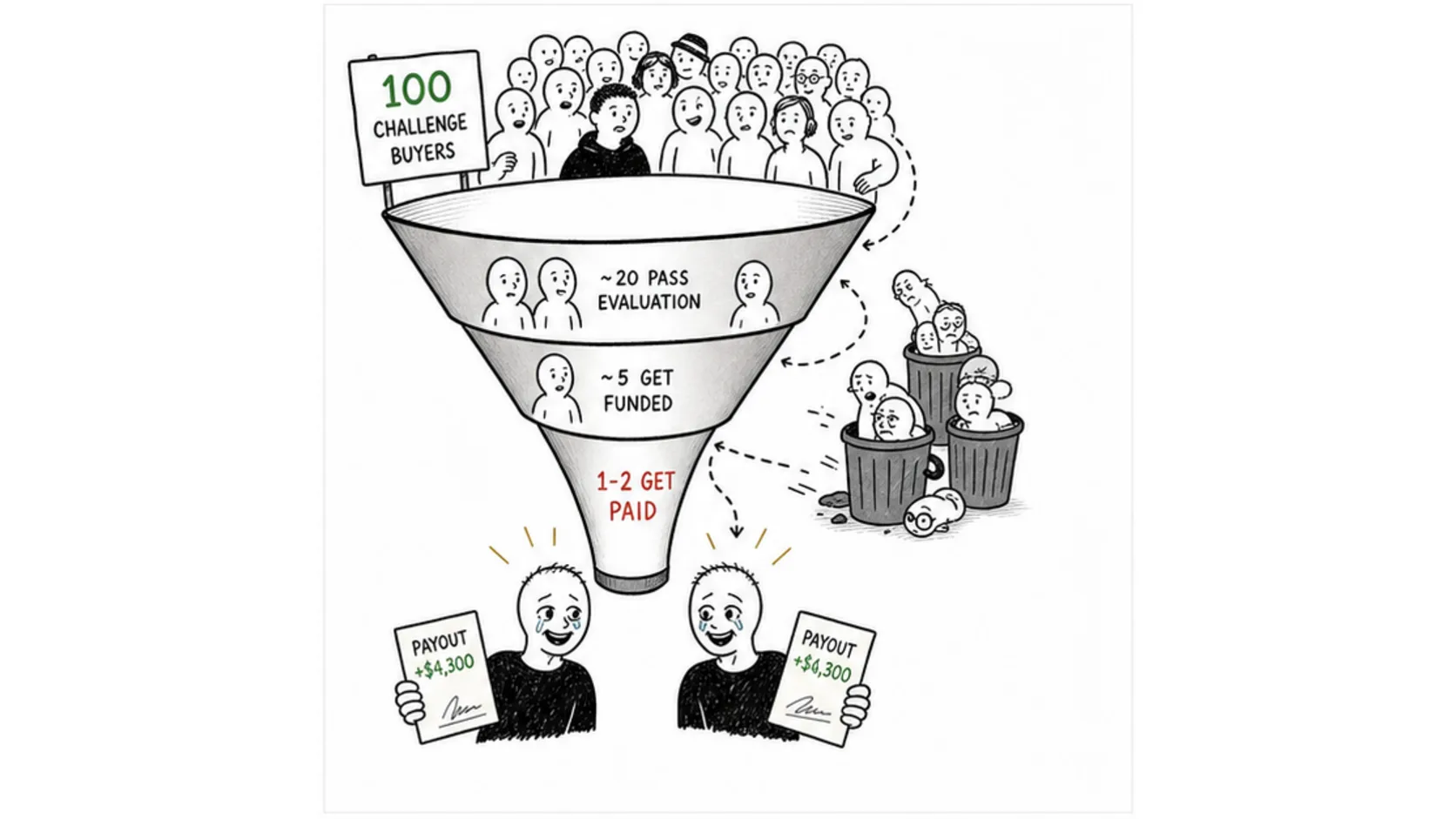
So here is the funnel broken down more honestly. Out of 100 traders who buy a challenge, roughly 5 to 10 will pass and receive a funded account. Of those 5 to 10 funded traders, maybe 2 to 4 will survive long enough to generate meaningful profit. Of those 2 to 4, maybe 1 to 2 will actually request and receive a funded trader payout.
That lines up with the 7% headline figure when you account for people who buy multiple challenges. The maths works out, and the question of what percentage of traders get a payout from prop firms has a consistent answer across data sources.
Another data point. A YouTube video titled "Why 90% of Prop Firm Traders Never See a Payout" has been circulating in trading communities. The 90% figure is broadly accurate if you look at the total population of challenge buyers, and the actual number for some firms may be even higher.
Very few traders get paid from prop firms relative to the total number who try. But the ones who do get paid share very specific habits that we will break down later in this article.
Why the Payout Percentage Is So Low
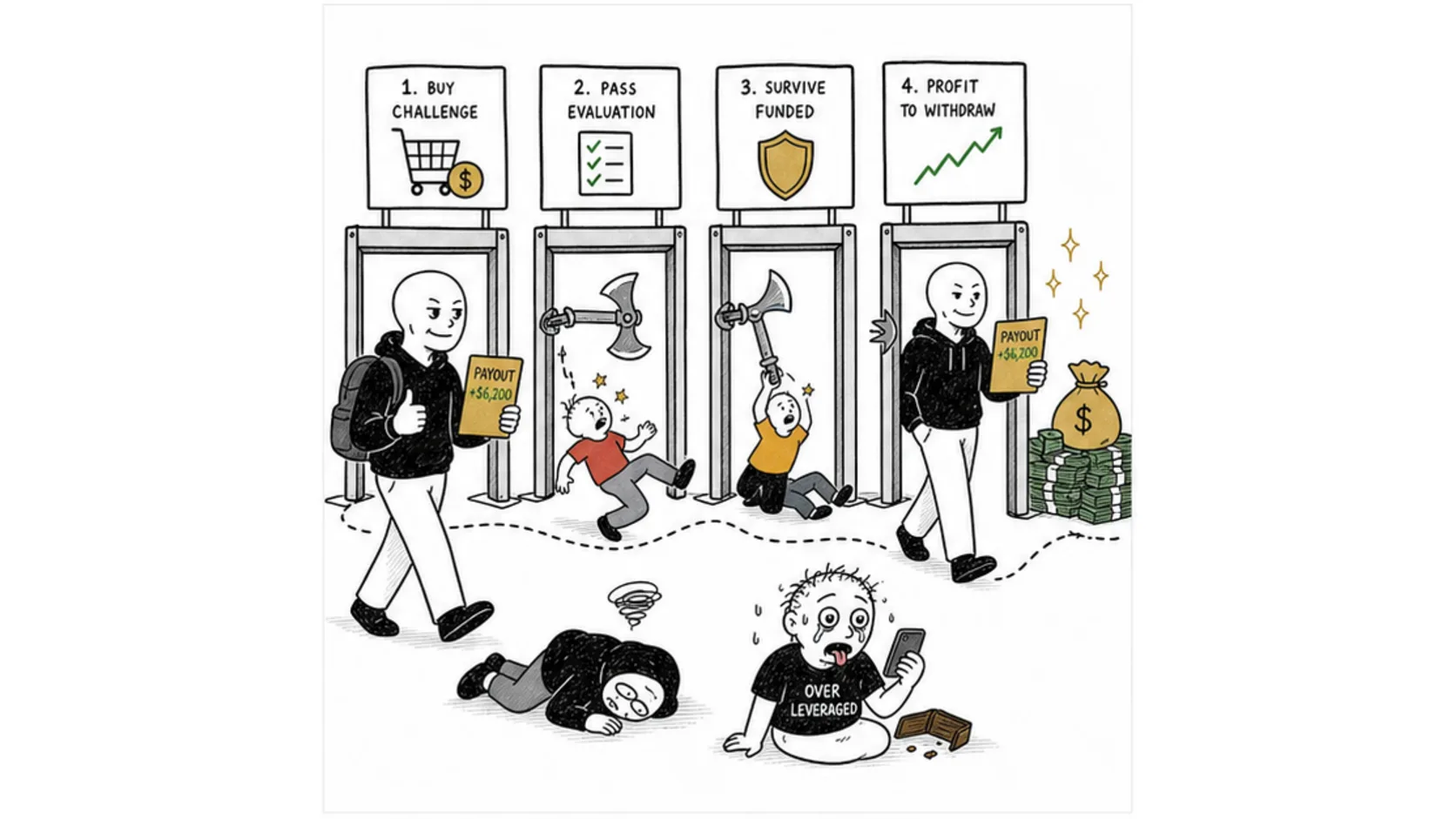
The low prop firm payout percentage is not a conspiracy. It is a funnel, and every stage of it is designed to filter people out.
Stage one: the challenge purchase. Roughly 100% of people who buy a challenge intend to pass it. Many never even start trading. Life gets in the way, fear kicks in, or they realise they are not prepared. Some estimates suggest 20-30% of purchased challenges are never completed.
Stage two: the evaluation. The challenge itself has a pass rate of roughly 5-15% depending on the firm. The prop firm pass rate is not a secret, but most traders never look it up before buying. The profit target, the drawdown limits, the time restriction, the daily loss ceiling. These are all filters.
Stage three: funded account survival. Getting funded is not the finish line. The funded account is where the real filtering happens. Traders who passed by the skin of their teeth often blow the funded account within weeks because the pressure of trading real capital is different from the evaluation.
Stage four: earning enough to withdraw. Even surviving on a funded account does not guarantee a payout. You need to generate enough profit to meet the minimum withdrawal threshold, satisfy the consistency rule, and avoid any rule violations during the payout period.
Each stage eliminates a huge chunk of traders. By the time you reach the payout request, you are in a very small minority. That is the reality.
Pass Rates by Firm Type
Not all prop firms have the same pass rate. The difficulty of the evaluation depends on the firm's rules, profit targets, and drawdown structure.
Standard two-step evaluations (Legendary difficulty). These are the FTMO-style (See if FTMO is the best prop firm for you) challenges with two phases, strict rules, and profit targets of 8-10% in phase one. Pass rates are typically 5-10%.
The first phase is where most people fail. The combination of a high profit target, tight drawdown, and time pressure is brutal.
One-step evaluations (Solid difficulty). A single phase with a slightly lower profit target, typically 8-10%. Pass rates range from 8-20% because there is only one hurdle to clear.
The catch is that the rules are often tighter. You might get a lower max drawdown or stricter consistency requirements.
Instant funding accounts (Different game entirely). There is no evaluation to pass. You pay a higher fee and get funded immediately. The pass rate is technically 100% since there is no challenge, but the survival rate on these accounts can be lower because traders skip the learning phase that evaluations force.
Understanding what it takes to pass is more important than comparing raw pass rates between firms. A firm with a 20% pass rate but easier rules might produce worse funded traders than a firm with a 5% pass rate and rigorous evaluation.
How Many Funded Traders Earn Enough to Withdraw
Getting funded is a milestone. Earning enough on a funded account to actually request a withdrawal is a different challenge entirely.
On a $100,000 funded account with a typical 80/20 profit split, you need to generate enough profit to justify a withdrawal after the firm takes their 20%. Most firms have a minimum payout threshold, often $100 to $500.
The realistic earning range for a consistently profitable funded trader is $1,000 to $5,000 per month. Some earn more, many earn nothing.
The average funded trader blows their first account within 6 weeks. Not because the market destroyed them. Because they started trading like they owned the place the second they got the green light. Oversized positions, skipped risk management, revenge trades. Funded traders fail for specific, predictable reasons. The psychology of trading a funded account is completely different from trading a demo or a challenge.
The traders who survive and earn consistently tend to do three things. They trade the same way they traded during the evaluation. They treat the funded account like it is still a challenge with strict rules. And they withdraw profits regularly instead of letting them accumulate.
According to data from funded trader communities, approximately 30-40% of funded traders generate enough profit to request at least one payout within their first three months.
What Separates Traders Who Get Paid From Those Who Do Not
After watching hundreds of traders go through this process, I can tell you the difference is not intelligence. It is not even trading skill, technically. It is discipline and rule awareness.
When you look at what percentage of traders get a payout from prop firms, the answer is largely determined by behaviour, not by strategy. Traders who get payouts do one thing that the other 93% do not. They treat the entire process like a structured system rather than a gamble.
Here is what the payout minority have in common.
- They read every rule before buying the challenge. They know the consistency rule, the drawdown calculation, the daily loss limit, the minimum trading days, and the payout schedule before they place a single trade.
- They size consistently. Same lot size or close to it, every trade. No doubling down after a loss. No hero trades with 3x normal size because the setup looks perfect.
- They use a written trading plan. Not a mental one. A written one. Entry criteria, exit criteria, risk per trade, max trades per day, everything documented.
- They track every trade. Win rate, average win, average loss, max drawdown per session. They know their numbers because they write them down.
- They do not rush. They do not try to pass the challenge in a week. They spread it out, take clean setups, and let the process work.
And here is what the 93% do instead. They buy a challenge without reading the full terms. They size up after losses because they "know the market is going to reverse." They ignore rules they think are minor until those rules block their payout. They try to speedrun the challenge and blow it on day three.
The risk management approach that gets traders funded is not exciting. It is not the sexy trading content you see on Instagram. It is boring, methodical, and it works.
The Math Behind Prop Firm Revenue Models
You need to understand why the payout percentage is so low from the firm's perspective, because it explains everything about their business model.
Most prop firms make money from challenge fees, not from funded trader losses. Here is how the maths works.
A firm sells 100,000 challenges at an average price of $300 each. That is $30 million in revenue. Out of those 100,000 challenges, maybe 7,000 traders get funded and maybe 2,000 eventually receive payouts.
If the average payout is $2,000, the firm pays out $4 million total. The firm keeps $26 million. That is a healthy business even before you account for upsells, account resets, and repeat challenge purchases.
This is why firms can afford to offer 80/20 or even 90/10 profit splits. They do not need to profit from your trading losses. They profit from the volume of challenge fees collected from traders who never make it to payout.
The European Securities and Markets Authority has flagged this model as potentially misleading for retail traders, because the marketing focuses on big payouts while the business model depends on the majority of customers never reaching that point.
This does not make prop firms a scam. It makes them a business. But you should understand the business model before you become a customer.
How to Put Yourself in the Payout Percentage
Here are your three missions. Yes, missions. Not tips. Not suggestions. Missions.
Mission one: prove you can trade before you buy a challenge. Non-negotiable. If you cannot show three months of consistent results on a demo account or a small live account, you are not ready for a prop firm challenge. You are just donating money.
Track your win rate, your average reward-to-risk ratio, and your maximum drawdown over at least 60 trading days. If those numbers are not where they need to be, keep practising.
Mission two: choose a prop firm whose rules match your trading style. The full prop firm comparison covers the rules, costs, and payout records of the top firms. If you are a scalper, do not pick a firm with a minimum trade duration. If you are a swing trader, do not pick a firm with a 5-day max hold rule. Find a legitimate firm that lets you trade the way you actually trade.
Mission three: protect the funded account like your life depends on it. Because your payout does. The funded account is where the money is, and the number one reason traders lose it is not bad analysis. It is bad behaviour after a loss.
Risk 0.5% to 1% per trade. Never more. Set your daily loss limit at half of what the firm allows, so you have a buffer. And request your payout the moment you are eligible. Do not wait for a bigger number.
Here is the emotional truth that nobody wants to hear. Most traders who never get a payout from a prop firm were never going to get one. Not because they are stupid. Because they were not prepared for the level of discipline required. The skill was within reach. The self-control was not.
The people getting funded and getting paid are not smarter than you. They are just doing this. Now you know it too.