Prop firm payout rules are the specific conditions a firm enforces before releasing your trading profits, and they are the difference between money in your bank account and an email saying your withdrawal has been denied. I have had payouts approved in 24 hours and I have had firms invent reasons to delay them for weeks, so here is every rule you need to understand before you trade a single day on a funded account.
Key Takeaways
- Prop firm payout rules cover minimum trading days, consistency requirements, drawdown limits, profit splits, and KYC verification before you can withdraw.
- Most firms require 14 to 30 active trading days before your first payout request.
- The consistency rule can void your payout if one day accounts for too much of your total profit, typically above 25-30%.
- Payout processing ranges from same-day crypto to 14 business days for bank transfers depending on the firm.
- Reading the full terms before buying a challenge is the single most important thing you can do to protect your payout.
On This Page
- The Rules That Decide Whether You Get Paid
- Minimum Trading Days and Waiting Periods
- Profit Split Structures Explained
- The Consistency Rule and How It Blocks Payouts
- Drawdown Limits That Can Cancel Your Payout
- The Payout Request Process: Step by Step
- Why Prop Firms Deny Payouts
- Payment Methods and Processing Times
- Red Flags in Payout Terms You Should Never Ignore
The Rules That Decide Whether You Actually Get Paid
You passed the challenge, you got funded, you made money, and now you think the payout is automatic. It is not.
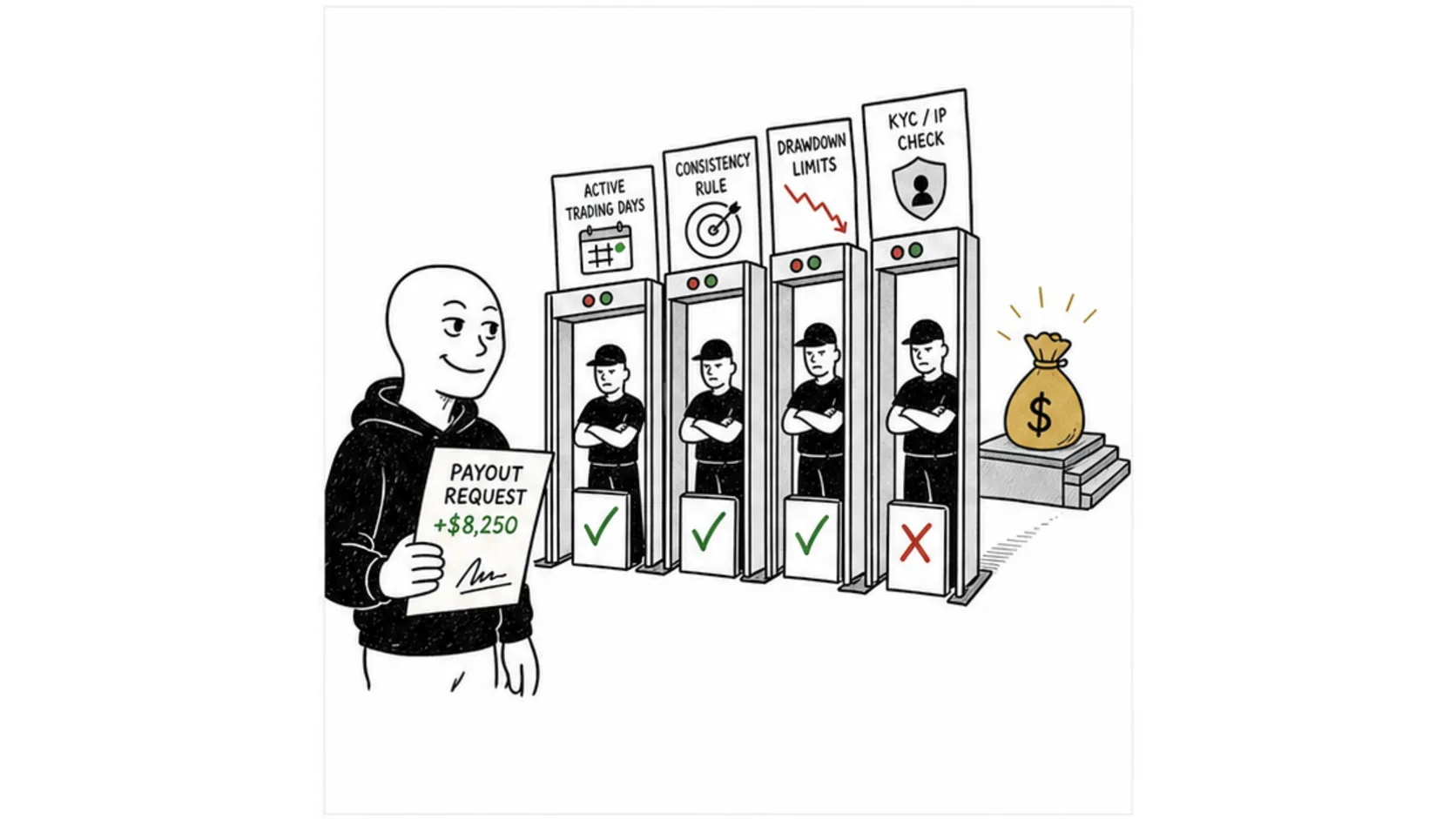
Prop firm payout rules fall into three buckets. Time-based rules like minimum trading days and waiting periods before your first withdrawal. Performance-based rules like the consistency requirement, drawdown limits, and daily loss ceilings. And administrative rules like KYC verification, IP address restrictions, and payment method requirements.
For the specific hoops you need to jump through on your very first payout, we have a dedicated guide. Here is a concrete example. You are on a $100,000 funded account with an 80/20 profit split. You make $4,000 in profit over 18 trading days.
Before that $3,200 payout hits your account, the firm checks whether you met the minimum trading day requirement, whether any single day contributed more than 30% of your total profit, whether you stayed inside all drawdown limits, and whether your KYC documents are current.
Fail any one of those checks and your payout is delayed, reduced, or denied. For FTMO-specific payout denial causes including the 1% risk rule and slippage cases, see our FTMO payout denied guide. The full payout process only works if every rule is satisfied.
According to data compiled from multiple prop firm statistics sources, roughly 70% of funded traders who earn enough to request a payout actually receive it without complications. The other 30% hit a rule they either did not know about or chose to ignore.
Minimum Trading Days and Waiting Periods
This is the most universal payout rule in the industry. Nearly every prop firm requires you to trade for a minimum number of days before you can withdraw.
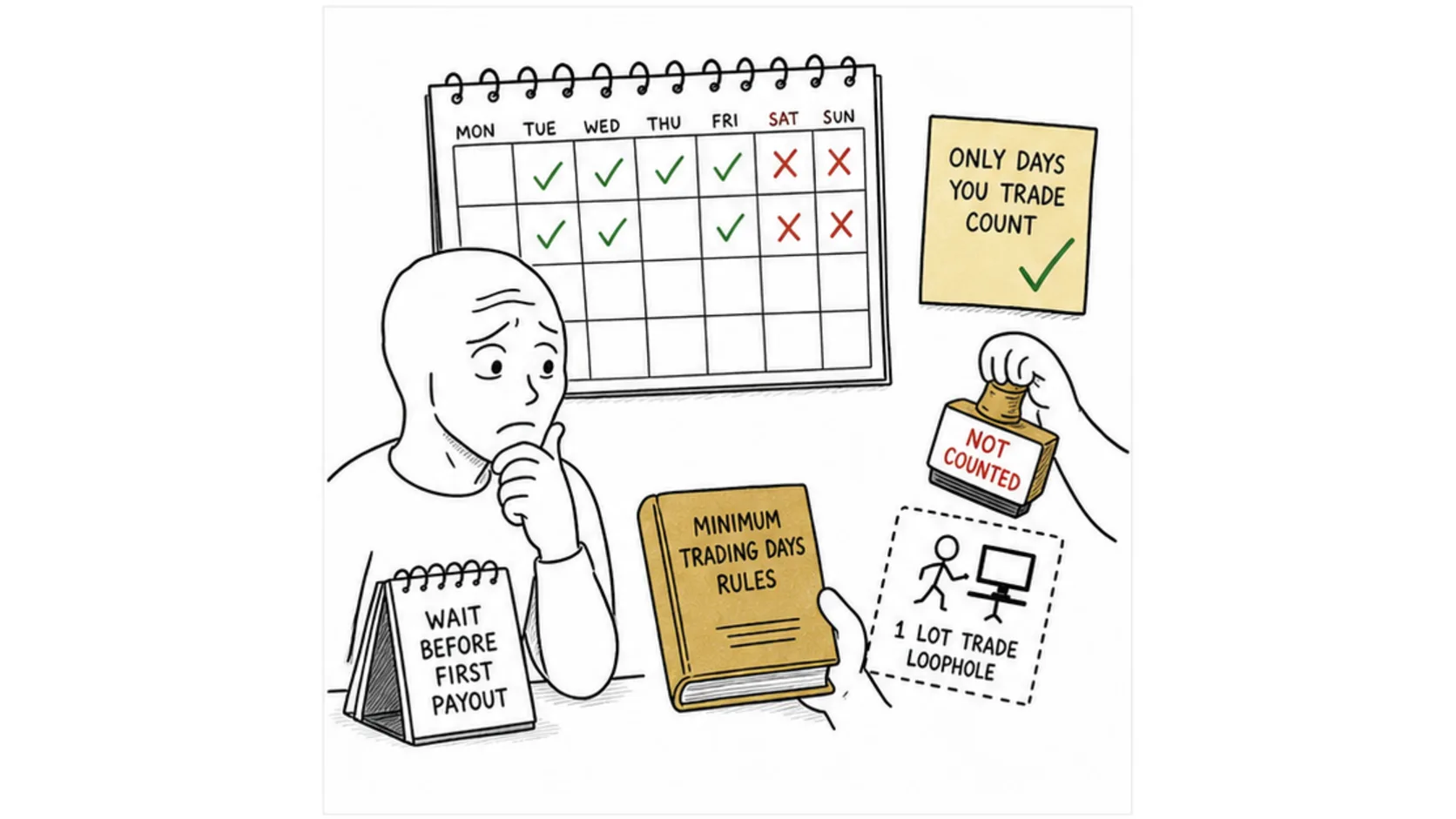
The typical range is 14 to 30 active trading days. Some firms go as low as 7 days for instant funding accounts. Others require a full 30 calendar days before your first request goes through.
Notice I said active trading days, not calendar days. If you trade on Monday and take Tuesday off, that is one active trading day. The clock does not tick on days you do not open or close a position.
This rule exists for one reason. Prop firms do not want you hitting one lucky trade and withdrawing immediately. They want evidence that you can trade consistently over a meaningful period.
You might think you can game this by placing one micro lot trade per day for two weeks. Some firms allow that. Others have a minimum trade size or minimum time-in-trade requirement buried in the terms.
The waiting period usually applies only to your first payout. After you have successfully withdrawn once, subsequent payouts often process faster with fewer restrictions.
Before you buy a challenge, find the minimum trading day rule on the firm's website. If it is not clearly published, that is already a warning sign.
Profit Split Structures Explained
The profit split is the percentage of your trading profits that you actually keep. The firm takes the rest as their revenue.
The industry standard is 80/20. You keep 80%, the firm keeps 20%. This is the baseline you should expect from any reputable firm.
Here is how different splits look on $3,000 of profit on a funded account.
- 50/50 split: you receive $1,500, firm keeps $1,500
- 70/30 split: you receive $2,100, firm keeps $900
- 80/20 split: you receive $2,400, firm keeps $600
- 90/10 split: you receive $2,700, firm keeps $300
- 95/5 split: you receive $2,850, firm keeps $150
Over a year of consistent trading, the difference between a 70/30 split and a 90/10 split is thousands of dollars out of your pocket. The split matters.
But a generous split from a firm that never pays is worth exactly zero. An 80/20 from a firm that processes reliably beats a 95/5 from a firm that finds creative ways to deny you.
Some firms offer scaling plans where your split improves over time. You might start at 80/20 on your first funded account and move to 85/15 or 90/10 after proving consistent payouts over several months.
Be wary of firms advertising 100% payouts. No firm gives you all the profit for nothing. There is always a catch: higher challenge fees, stricter drawdown rules, payout caps, or a revenue model that depends on you failing.
The Consistency Rule and How It Blocks Payouts
This is the payout rule that catches more people off guard than any other. The consistency rule says no single trading day should account for more than a set percentage of your total profit.
That percentage is typically 25% to 30%, depending on the firm. Some firms have removed the rule entirely, but most still enforce it.
Here is the scenario that gets traders denied. You grind out small profits for 18 days, making $100 here and $200 there. Total so far is $2,000. Then on day 19, you catch a massive move and make $2,500 in one session.
Your total profit is now $4,500. Your best day is $2,500. That is 55% of your total profit from a single day. The consistency rule threshold was 30%. You failed it.
What happens next depends on the firm. Some deny the payout entirely. Some reduce it. Some ask you to trade additional days to dilute that one big day back under the threshold.
Understanding the consistency rule before you start trading is not optional. It is the difference between a smooth payout and a frustrating email from compliance.
The fix is simple. Size consistently. Do not suddenly triple your lot size because you see a setup you love. If you trade 0.5 lots most days, a 1.5 lot day is going to trigger the consistency alarm.
According to community data from funded trader reports, consistency rule violations account for roughly 15-20% of all denied first payouts. That is a huge number for a rule most traders do not even know exists.
Drawdown Limits That Can Cancel Your Payout
Drawdown rules are not just about protecting your account during the challenge. They follow you into the funded phase and they can void your payout at any time. For FTMO-specific drawdown math with real dollar examples, see our FTMO drawdown rules explainer.
Hit your maximum drawdown on a funded account and your account is closed. Any pending payout is gone. Any profit you earned is gone. The max drawdown rule does not care that you were profitable for three months before the breach.
There are two types you need to understand. Trailing drawdown follows your highest point of profit and tightens as you make money. It is literally chasing you. Every dollar you earn pulls the floor up behind you.
Static drawdown is fixed from your starting balance. It does not move. It is simpler and more forgiving for traders who have big winning days followed by pullbacks.
Then there is the daily loss limit, which is the hard ceiling on how much you can lose in a single day. Breach it and your account is terminated immediately. No warning. No second chance.
Here is a scenario that happens more often than you think. A trader is $3,000 in profit, requests a payout, and then has a terrible day that pushes past the daily loss limit. The account breaches. The payout that was in process gets cancelled.
The lesson is simple. Request your payout as soon as you are eligible. Do not sit on profits waiting for a bigger number while your drawdown exposure grows.
The Payout Request Process: Step by Step
This is the actual process from clicking "request payout" to money landing in your account. It is not instant. It is not automatic. Here is what happens.
Step one: verify you are eligible. Check that you have met the minimum trading days, have no active rule violations, and your profit is above the minimum withdrawal threshold if the firm has one.
Step two: submit the request. Go to the firm's dashboard, navigate to the withdrawal section, select your payment method, and confirm the amount. Some firms require you to specify which payment processor you want.
Step three: KYC verification. If this is your first payout, the firm will verify your identity. Have your government-issued ID and proof of address ready. Make sure the name on your account matches exactly.
Step four: trading review. The firm's finance or compliance team reviews your trading history for the payout period. They check for rule violations, consistency, and that your trading activity matches their expectations.
Step five: approval and processing. Once approved, the payout is sent to your chosen method. Crypto can arrive within hours. Bank transfers take 3-7 business days. Deel usually takes 2-3 business days.
The total timeline from request to money in your account is typically 3-10 business days for your first payout and 1-5 business days for subsequent ones.
The Commodity Futures Trading Commission does not regulate prop firm payouts, which means there is no external authority enforcing fairness. You are relying entirely on the firm's own policies and integrity. Choose accordingly.
Why Prop Firms Deny Payouts
Payouts get denied. Not sometimes. Regularly. Here are the reasons, ranked from most common to most frustrating.
Consistency rule violation. Already covered. One big day that breaks the threshold. This is the number one reason for denied first payouts.
Drawdown breach. You hit the max drawdown or daily loss limit during the payout period. Account closed, payout cancelled.
Hedging violation. Some firms prohibit hedging between accounts or across challenge phases. If they detect it, your payout is gone.
Copy trading or EA detection. If the firm suspects you are copying trades from another account or using an unapproved Expert Advisor, they will deny the payout and potentially ban you.
IP address flags. Trading from multiple devices or locations can trigger security flags. The IP address rule is there to prevent account sharing, but legitimate traders get caught by it too when they trade from home and then from their office.
Hidden terms. This is the one that should make you angry. Some firms bury conditions in their terms of service that affect payouts without clearly advertising them. Things like minimum holding periods, maximum payout percentages in the first month, or retroactive rule changes.
Understanding exactly why payouts get denied gives you a checklist to follow before you request yours.
The practical defence is straightforward. Screenshot every rule when you sign up. Keep a trading journal. Use one device for trading. And read the full terms, not just the marketing page.
Payment Methods and Processing Times
The payout method you choose affects how fast you get paid and how much you actually receive after fees.
Cryptocurrency (USDT, USDC, BTC). The fastest option available at most firms. Processing typically takes 24-48 hours. USDT on TRC-20 is the most common choice because fees are low, usually under $2 per transfer.
The downside is that you need a crypto wallet and you are exposed to price volatility if the firm pays in BTC or ETH instead of a stablecoin.
Bank transfer (ACH or wire). The most reliable method for most traders. ACH is free or very cheap but takes 3-5 business days. Wire transfers cost $15-50 but arrive faster.
Some firms require bank transfers for payouts above a certain threshold.
Deel. Many firms use Deel as their payment processor. Deel supports bank transfers, crypto, PayPal, and local payment methods depending on your country.
Processing through Deel usually takes 2-3 business days. Deel also handles tax documentation in some cases, which is a small but real benefit.
Rise. Used by a growing number of firms, especially for international traders. Supports bank transfers and crypto with competitive exchange rates.
When choosing a payout method, consider three things. Speed, fees, and whether the method is available in your country. Remember that all payouts are taxable income regardless of how you receive them.
The Financial Conduct Authority in the UK has issued warnings about unregulated prop firms, and payout reliability is one of the key areas they flag. If a firm is not transparent about how and when they pay, that is your signal to look elsewhere.
Red Flags in Payout Terms You Should Never Ignore
Not all payout rules are reasonable. Some exist purely to give the firm an excuse not to pay you. Here are the red flags ranked from annoying to dealbreaker.
Tier one: annoying but survivable. Long processing times with no explanation. Minimum payout thresholds that seem unnecessarily high. Limited payout frequency, like once per month maximum.
These are frustrating but they do not necessarily mean the firm is dodgy. They might just be slow.
Tier two: proceed with caution. No public payout proof anywhere on the website or social media. Vague language in the payout terms like "subject to review" or "at management discretion." Frequent rule changes that are not clearly communicated.
Any firm that reserves the right to change payout terms retroactively is a firm you should not trust with your time.
Tier three: run. The firm has no payout page at all. Traders on Reddit and Discord consistently report delays of more than 30 days. The firm requires you to buy another challenge before processing your payout. The firm has changed its payout rules multiple times in the past year, always in the firm's favour.
These are not inconveniences. They are business models built on not paying traders.
Before trusting any firm, check how to verify real payout proof and confirm the firm is legitimate. The National Futures Association maintains a registry you can check for any firm claiming US regulatory oversight.
The single best thing you can do is read the complete terms and conditions before you buy a challenge. Not the marketing page. Not the FAQ. The actual legal document. It takes 20 minutes and it will save you from firms that make their money by not paying traders. The specific red flags buried in prop firm terms are worth knowing before you encounter them the hard way.