IP address checks are often part of fraud and account-sharing controls. For the broader compliance context, FCA financial-crime guidance explains why financial services monitor identity and access patterns.
You are trading your funded account from your laptop at home. Then you go to a coffee shop and log in from there.
Then your friend asks to see your setup and you log in from their place. Congratulations, you might have just triggered an IP flag.
The IP address rule is one of the most misunderstood prop firm rules. It is not about controlling where you trade, it is about proving you are the one actually trading your account.
Key Takeaways
- Prop firms track your IP address to verify account ownership and prevent account sharing.
- Trading from multiple locations is usually fine. Simultaneous logins from different locations is not.
- Multiple accounts trading from the same IP address will trigger a flag, even if they belong to different people.
- VPN policies vary by firm. Some allow them, some ban them entirely, and some only restrict VPNs from certain countries.
- An IP violation can result in anything from a warning to permanent account termination and payout denial.
On This Page
Why the IP Address Rule Exists
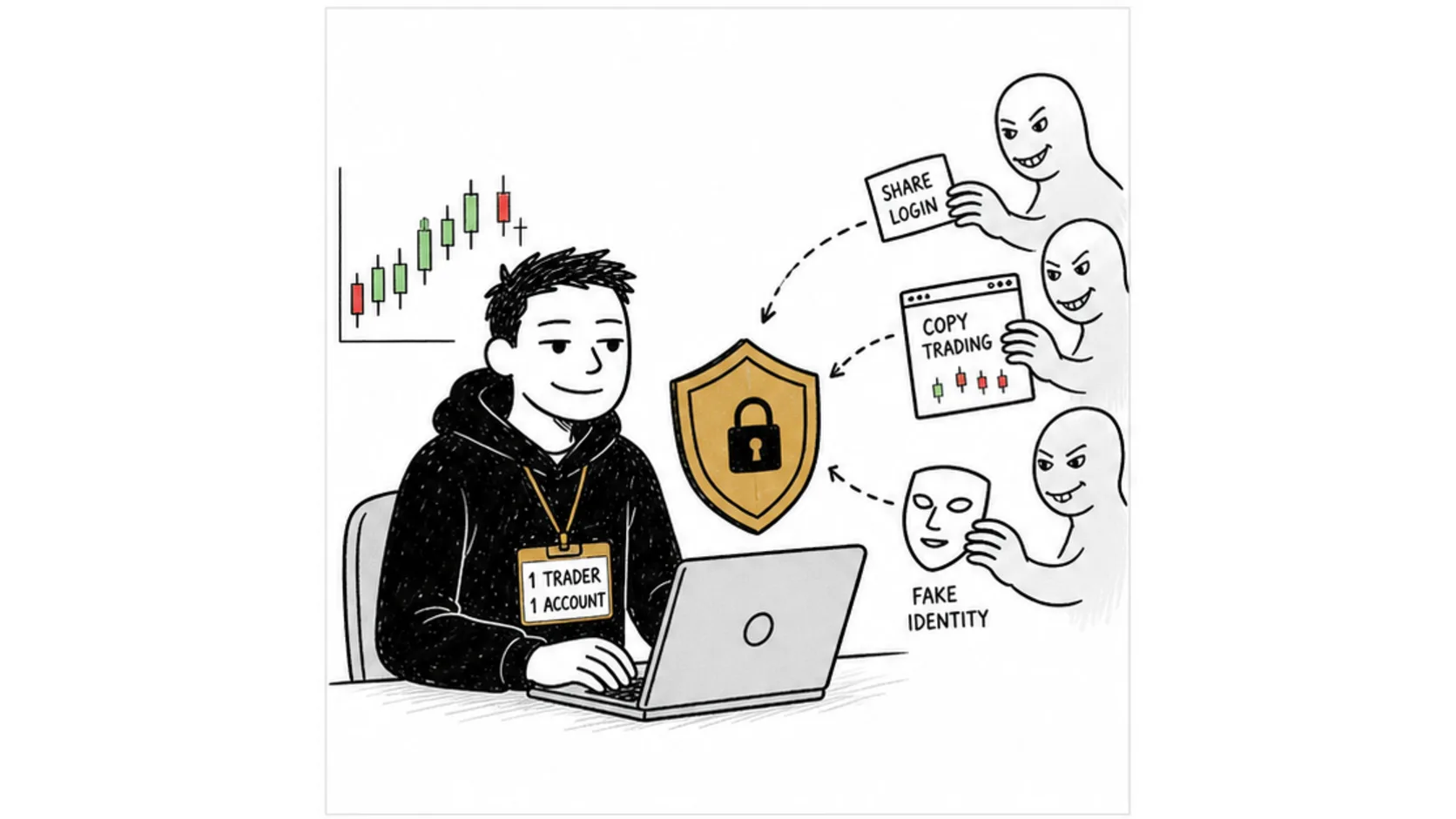
Prop firms have one core concern: making sure the person who bought the evaluation is the person trading the account. The IP address rule exists to stop three specific problems.
Account sharing. You buy an evaluation and then hand the login to someone else who trades it for you. This defeats the entire purpose of the evaluation, which is to test your skill, not your friend's.
Copy trading across multiple accounts. One trader runs multiple accounts from the same IP using automated tools. The firm detects identical trading patterns across accounts funded under different names.
Identity fraud. Someone creates multiple accounts under different identities but trades them all from the same device and connection. The IP rule catches this immediately.
The firm is not trying to track your movements or restrict your freedom. They are trying to ensure a level playing field where one person equals one account.
How Firms Track Your IP
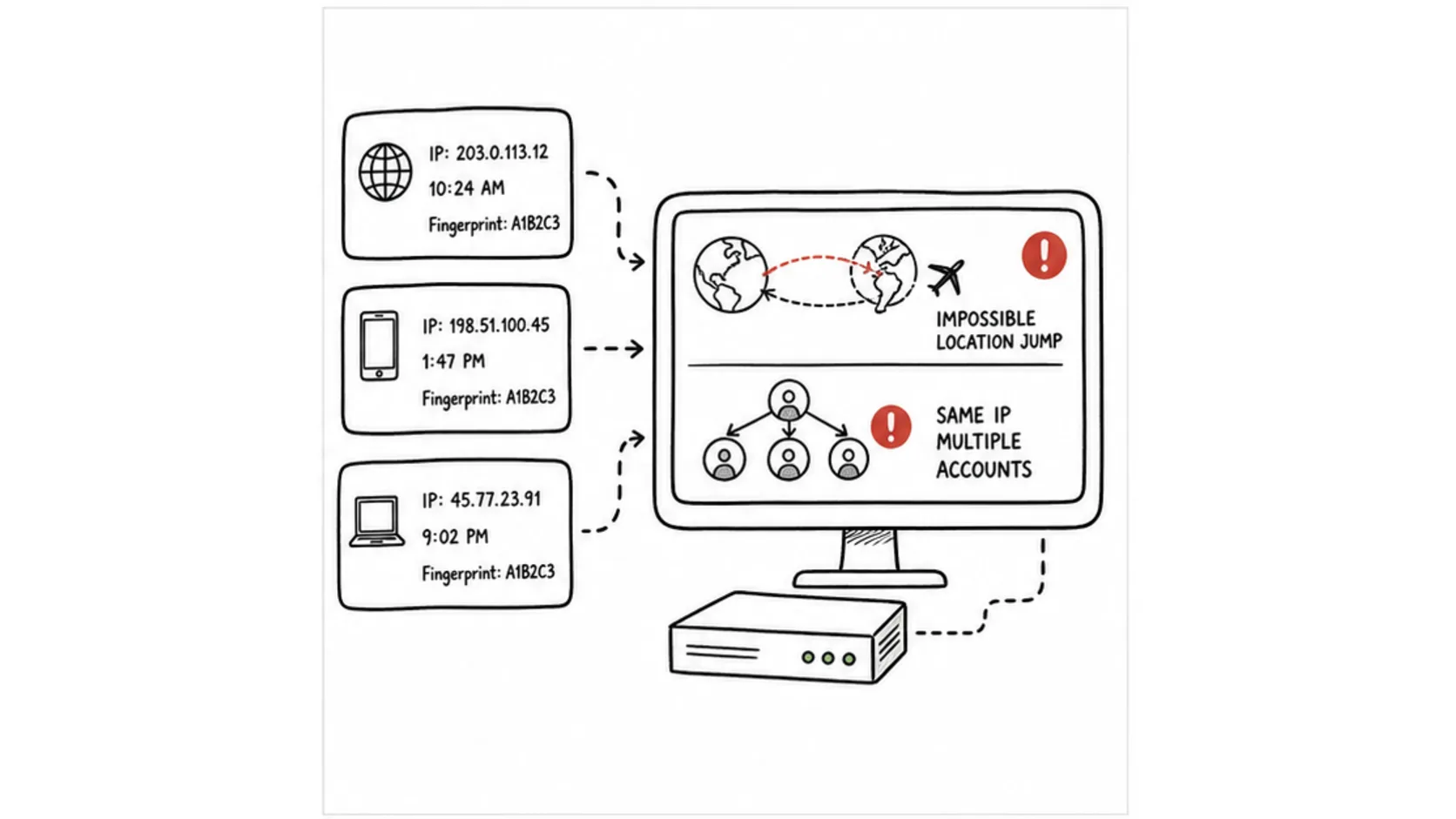
Every time you log in to your trading platform, the firm records the IP address associated with that session. They log the timestamp, the device fingerprint, and sometimes the browser or platform version you are using.
This data is checked automatically. The system looks for anomalies like simultaneous sessions from different countries, multiple accounts logging in from the same IP, or rapid location changes that are physically impossible.
Some firms also track device IDs. This means even if you switch IP addresses by changing networks, they can still tell it is you because the device identifier stays the same.
This is actually helpful for you, because it proves you are on your own equipment even if your IP changes.
Your home IP address changing occasionally because your ISP reassigned it is not a problem. Firms expect this.
What Triggers an IP Flag
Not every IP change triggers a flag. The system is looking for specific patterns that indicate something suspicious.
Simultaneous logins from different locations. Your account is active in London and Lagos at the same time. You cannot be in two places at once, so the system assumes someone else is using your account.
Multiple accounts from the same IP. Two or more accounts are trading from the same internet connection. This is the most common trigger, and it catches people who share a household with another trader.
Rapid location switching. Your account logs in from one city and then another city 500 miles away, minutes later. This suggests you are using a VPN or proxy that is jumping between servers.
Restricted country IPs. Some firms restrict traders from specific countries due to regulatory or sanctions reasons. If your IP resolves to a restricted country, even through a VPN, the account may be flagged or terminated.
Normal behaviour like trading from home, then moving to a coffee shop, then going to your office is fine. The system is designed to catch impossible or suspicious patterns, not your daily routine.
VPN Rules by Firm
VPN policies are not universal. Each firm sets its own rules, and they range from "do not care" to "instant ban."
VPNs allowed. Some firms explicitly allow VPNs and have no restrictions on them. This is common with firms that operate globally and understand traders need privacy.
VPNs allowed with conditions. The firm allows VPNs but restricts the IP from originating in certain countries. If your VPN server is in a non-restricted country, you are fine. If it routes through a restricted country, your account gets flagged.
VPNs banned entirely. Some firms prohibit all VPN usage. If they detect a VPN IP address, they may warn you or terminate the account. This policy is becoming more common in 2025-2026.
Check your firm's specific VPN policy before you connect. If they say no VPNs, do not use one.
If they allow VPNs, make sure the server location is in an approved country.
Multiple Devices and Locations
Using multiple devices is generally fine. Trading from your desktop at home, your laptop at a coffee shop, and your phone on the train will not trigger an IP flag as long as you are not logged in from all three simultaneously.
The key rule is: one active session at a time. If you are logged in on your desktop and then open the platform on your phone, some firms will flag that.
Others handle it gracefully by disconnecting the first session.
Travelling while funded is allowed by most firms. Just make sure the country is not on the firm's restricted list.
Do not let your account appear active in two countries at the same time.
If you are planning to travel while trading a funded account, check the firm's policy on international trading first. Some firms require you to notify support before changing countries.
Two Traders in the Same Household
This is where the IP rule causes real problems. You and your partner, roommate, or sibling both trade prop firm accounts, and you share the same Wi-Fi.
That means you share the same public IP address.
Most firms will flag this. Two accounts trading from the same IP looks like one person running multiple accounts under different names, even if you are genuinely two separate traders.
Some firms allow same-household trading if you notify them in advance and provide proof that you are separate individuals. Others will simply terminate both accounts without discussion.
If you are in this situation, email support before you start trading. Ask what their policy is and whether they can whitelist your household.
The ones that do not allow it are not being unreasonable. They have no way to verify that two people at the same address are actually trading independently rather than coordinating or sharing strategies.
What Happens When You Violate It
The consequences for an IP violation depend on the severity and whether it is a first offence.
Warning. For minor or first-time infractions, like a brief simultaneous login or a VPN slip-up, the firm may send a warning and ask you to explain. Cooperate fully and it usually gets resolved.
Account suspension. The firm temporarily freezes your account while they investigate. You cannot trade or request payouts during this period. Investigations can take days or weeks.
Account termination. For serious violations like account sharing, running multiple accounts, or repeated IP infractions after a warning, the firm will close your account permanently.
Payout denial. If an IP violation is discovered during a payout review, the firm can deny your withdrawal even if you have already earned the profits. This is the worst-case scenario.
If you get flagged, do not panic. Contact support immediately with an honest explanation and provide evidence.
How to Stay Safe
Staying compliant with the IP address rule is straightforward if you follow a few basic principles.
Only trade from your own devices. Do not log in from someone else's computer, even briefly.
Do not share your account credentials with anyone. Not your friend, not your trading mentor, not your "account manager." If someone else trades your account, you will get caught.
If you travel, trade from one device at a time and make sure you close your session before opening it somewhere else. Check the firm's restricted country list before you go.
If you live with another trader, contact the firm before you both start trading. Get written confirmation that same-household trading is allowed.
Do not use a VPN unless the firm explicitly allows it. If they do allow it, keep the VPN server in the same country you are actually in.
The IP address rule is not complicated and it is not designed to catch you out. It is designed to catch the people who are cheating.
If you are trading your own account, on your own devices, from reasonable locations, you have nothing to worry about.