The prop firm consistency rule is the number one complaint on Reddit. I have seen it on every trading forum, every Discord server, and every YouTube comment section. Traders hit their profit target, celebrate for about five minutes, and then find out their challenge failed because one good day did all the heavy lifting.
Most traders obsess over drawdown limits and daily loss caps. Those matter, obviously, but the consistency rule is the silent killer. It does not lose you money. It loses you the challenge after you already made the money.
I have been through this myself. Early in my prop firm journey, I blew a $100,000 evaluation because I had one monster EUR/USD day that accounted for 52% of my total profit. The firm had a 30% consistency rule. I was 22 percentage points over the limit. The irony of making $12,000 in profit and still failing the challenge was not lost on me.
Here is the complete breakdown of the consistency rule. Every threshold, every calculation, every fix. This is the only page you need.
Key Takeaways
- The consistency rule limits how much of your total profit can come from a single trading day, typically 20-35%.
- The most common thresholds are 30% and 25%, but firms range from 15% to 35%.
- Losing days do NOT dilute your best day. Only profitable days count toward the denominator.
- You can pass any consistency rule by capping daily profits, using fixed lot sizes, and trading across the minimum required days.
- The consistency rule is a standard industry filter, not a punishment. Every major firm uses some version of it.
On This Page
- What the Prop Firm Consistency Rule Actually Means
- What Is the 15% Consistency Rule?
- Why Prop Firms Enforce Consistency Rules
- Consistency Rule Thresholds Compared (20%, 25%, 30%, 35%)
- Cross-Firm Consistency Rule Comparison Table
- How to Calculate Your Consistency Limit (Worked Examples)
- The 10-Day Consistency Passing Plan
- Consistency Rule vs Other Prop Firm Rules
- What Happens If You Break the Consistency Rule
- Consistency Rule Myths Debunked
- My Consistency Strategy (What Actually Works)
What the Prop Firm Consistency Rule Actually Means
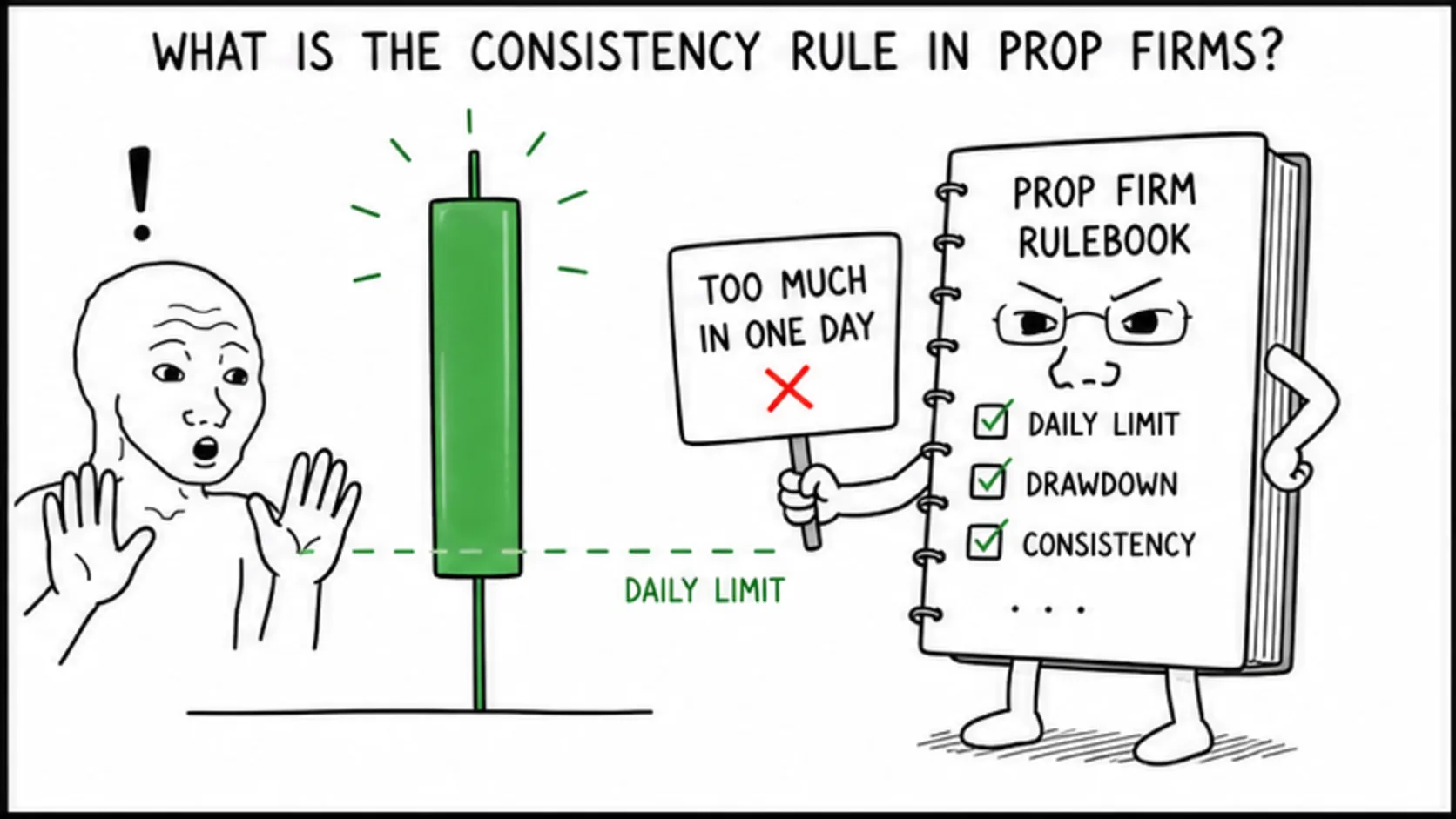
The consistency rule is a restriction that limits how much of your total profit can come from any single trading day. If your best day accounts for too much of your total gains, you fail the rule even if you hit the profit target.
Think of it like this. The firm wants to fund traders who can produce reliable daily results, not someone who got lucky on one trade and then coasted. The consistency rule is their filter.
The rule is expressed as a percentage. A consistency calculator will tell you the same thing: a 30% consistency rule means your best trading day cannot represent more than 30% of your total net profit. Go above that, and your challenge does not pass.
Here is the key detail most people miss. The rule uses your total net profit as the denominator, not your profit target. That means every dollar of profit you make above the target counts toward diluting your best day. If your target is $10,000 and you end the evaluation at $15,000, your consistency is calculated against $15,000, not $10,000. This matters because it means finishing with more profit above target actually makes passing the consistency rule easier.
Some traders think this is unfair. You made the money, why does it matter how you made it? The firm's perspective is different. They are about to hand you real capital. They want proof that your edge is repeatable, not that you caught one good move and hung on for dear life.
The consistency rule also shows up on hidden rules lists because many traders do not even know it exists until they fail. Firms bury it in their terms and conditions rather than highlighting it alongside drawdown and daily loss limits. That is a problem, but it is the reality of the industry.
What Is the 15% Consistency Rule?
The 15% consistency rule caps your best single trading day at 15% of your total profit. If you make $10,000 across a payout cycle, no single day can contribute more than $1,500. That is a tight cap, and it rewards many small profitable days over one large one. Some firms apply it during the evaluation, others only when you request a payout, so check your firm's rulebook before you plan around it.
Why Prop Firms Enforce Consistency Rules
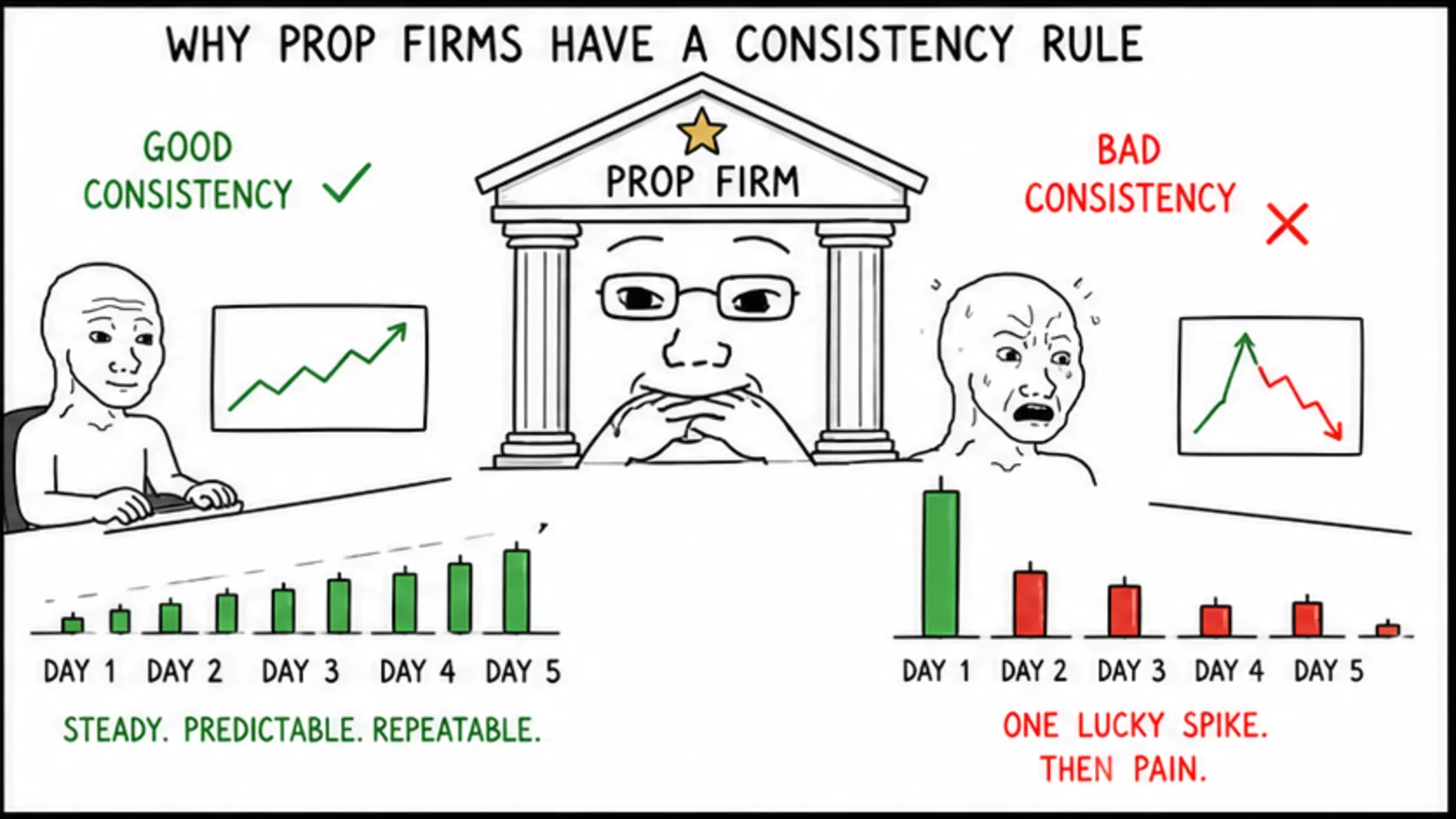
Prop firms are not charities. They are businesses that make money when traders pass evaluations and lose money when funded traders blow up. The consistency rule helps them answer one question before giving you capital: can this person produce results more than once?
A trader who makes $4,000 in one day and loses $1,000 over the next nine days looks profitable on paper. But their edge is fragile. One bad week and the firm is on the hook for losses. The pass rate data confirms this. Traders who pass with lumpy results tend to fail faster once funded.
A trader who makes $400 a day for ten days straight has a process. That is the trader the firm wants to fund. The consistency rule is designed to find that second person and filter out the first.
The business logic is straightforward. The retail prop trading industry is now valued at approximately $12 billion (Business Insider, December 2025), and FTMO alone reports over 3.5 million customers and $650 million in payouts (checked 23 October 2026). With that scale, prop firms reject roughly 90-95% of traders who attempt evaluations. The consistency rule is one of the primary mechanisms for this filtering. It is not designed to be cruel. It is designed to protect the firm from funding traders whose results are driven by variance rather than skill.
The rule also protects traders from themselves. You might think hitting a massive winning trade on day two of your challenge is a dream start. I have been there myself. It can actually make passing harder because every remaining day needs to contribute enough to dilute that one big win below the consistency threshold.
Consistency Rule Thresholds Compared: 20%, 25%, 30%, 35%
Not all consistency rules are created equal. The percentage threshold changes everything about how you need to trade. Here is a detailed breakdown of the most common ones, with the math behind each.
The 20% Consistency Rule
A 20% consistency rule means no single trading day can account for more than 20% of your total profit. This is a strict threshold. The 15% rule above is tighter still. On a $5,000 total profit, your best day is capped at $1,000.
Run your own numbers through the prop firm consistency calculator before you request a payout, not after.
Here is the math that makes this difficult. If you make $1,000 on your best day, you need at least five profitable days of $1,000 or less to create a $5,000 total. But your best day is $1,000, which is exactly 20%. So you need a minimum of five equal winning days. In practice, you need more because your other days will likely be smaller than your best day. Realistically, you are looking at seven to ten trading days to pass comfortably with a 20% rule.
This forces you to trade almost every day with similar results. One big win and you need four more equally good days to dilute it. Most day traders can work with this if they keep their lot sizes consistent, but it eliminates any chance of a hero trade doing the work.
The 25% Consistency Rule
The 25% consistency rule is a middle ground. Your best day can be up to a quarter of your total profit. On $4,000 total, that is $1,000 max for your best day.
The minimum number of profitable days for a 25% rule is four, since $1,000 divided by $4,000 is exactly 25%. But again, in practice you want more days to give yourself a buffer. A realistic minimum is five to seven profitable days.
This is where things start to feel reasonable for most trading styles. You can have a slightly better day here and there without panicking, but you still need to show up consistently. The 25% threshold gives you enough room to have a good day without the rule becoming impossible to pass.
The 30% Consistency Rule
The most common threshold. Your best day can be up to 30% of total profit. Reddit is full of people complaining about this one, calling it unfair or unnecessary. It is neither. It is the standard.
On a $5,000 profit target, your best day can be $1,500. That is a good day by any measure. If you cannot pass with a 30% threshold, the problem is not the rule. The problem is that one trade is doing all the work.
The minimum number of profitable days at 30% is four. With a $5,000 target and a best day of $1,500, you need at least 3.33 more days of profit. In practice, plan for five to six profitable days and you will have no issues.
The 35% Consistency Rule
The 35% consistency rule is more lenient. Your best day can be up to 35% of total profit. This gives swing traders and position traders more breathing room since their profits naturally cluster around fewer days.
If you are the type of trader who takes 2-3 trades per week instead of 5-10 per day, a 35% threshold is your friend. You still need consistency, but the firm acknowledges that your style produces lumpier results. The minimum profitable days at 35% is technically three, but four is a safer target.
Cross-Firm Consistency Rule Comparison Table
Here is how the major prop firms stack up on consistency rules. I have compiled this from direct research into each firm's current rules as of June 2026. Always verify the rules directly with the firm before purchasing, as they can change without notice.
The table is a snapshot; the firm-by-firm ranking sets each consistency cap beside the drawdown and payout terms it comes with.
The FTMO row was re-verified on 23 October 2026 against FTMO's live Trading Objectives: 50% best-day consistency on the 1-Step, none on the 2-Step, and 30% on Instant. The remaining rows were re-verified on 25 October 2026 against each firm's own live site or help centre. The E8 Markets row was verified against help.e8markets.com (articles 9453418 and 11865587, the latter dated 17 August 2026) and the FunderPro row against support.funderpro.com (articles 377852, updated 20 October 2025, and 527831, dated 5 March 2026), cross-checked against the funderpro.com checkout; both checked 25 October 2026. The FunderPro row also feeds the FunderPro review.
| Firm | Evaluation Rule | Funded Rule | Profit Target | Min Days |
|---|---|---|---|---|
| FTMO | 50% best day (1-Step); none (2-Step) | 50% best day (1-Step); none (2-Step) | 10% / 10%+5% | 4 (2-Step) |
| MyFundedFutures | No rule | No rule | Varies | None |
| Topstep | 55% best-day target (raises the target; no breach) | None (Standard path); 40% (Consistency path) | Varies | None to pass; 5 or 3 winning days to a payout |
| Apex Trader Funding | None | 50% at payout (30% on legacy accounts) | $6,000+ | 5 |
| FundedNext | 40% (raises the target; no breach) | Plan-dependent: none (Legacy), 40% (Rapid Pro) | 8-10% | 5 |
| The 5%ers | Program-dependent: 50% per day on listed plans; none on High Stakes | Program-dependent | 6-10% | None |
| E8 Funding | None (except E8 Zero) | Plan-dependent: 40% (E8 One), 35% (Signature), none (Pro) — payout-gated | 8% | 5 |
| Alpha Capital | None | 40% best day on on-demand payouts; 15% on Instant/Alpha Direct | 8% | 5 |
| City Traders Imperium | No rule | No rule | 10% | None |
| FunderPro | Plan-dependent: none (Classic P1/P2), 40% (One-Phase), 45% (Pro) | Same structure; Instant 15% | 8% | None |
| Funding Pips | None | 35% on the On-Demand cycle; none on Bi-Weekly | 8% | 5 |
A few things jump out from this table. First, FTMO applies a traditional best-day percentage at different thresholds per product: 50% on the 1-Step, none on the 2-Step, and 30% on Instant. Second, a clean evaluation does not always mean a clean funded account: Apex enforces a 50% consistency check at payout on new funded accounts, and Funding Pips attaches 35% to its On-Demand reward cycle. Third, one firm with no consistency rule anywhere in its published rulebook is FunderPro’s Classic account; City Traders Imperium and MyFundedFutures are similarly clean.
The firm you choose should match your trading style. If you are a day trader who produces steady results, the consistency rule is rarely a problem regardless of the threshold. If you are a swing trader who holds positions for days, seek out firms with 35%+ thresholds or no consistency rule at all.
The far end of that spectrum exists now: Vest Markets defines no consistency rule, no minimum trading days and no time limit anywhere in its rulebook, which is why it keeps showing up in these conversations even though the firm is only weeks old.
How to Calculate Your Consistency Limit (Worked Examples)
The formula is simple but the implications are not. Let me walk through the exact math for each major threshold so you can see how this plays out in practice.
20% Threshold: $100,000 Account, $10,000 Target
Your maximum allowed daily profit at 20% is your total net profit multiplied by 0.20. On a $10,000 total profit, that is $2,000. Here is a realistic passing scenario:
Day 1: +$450. Day 2: +$620. Day 3: -$180. Day 4: +$580. Day 5: +$710. Day 6: -$90.
Day 7: +$650. Day 8: +$530. Day 9: +$1,900. Day 10: +$380. Day 11: +$450. Day 12: +$400.
Day 13: +$500. Day 14: +$200.
Total profit: $7,100. Wait, that is not right. Let me recalculate. After 14 days of these results, you would have $7,100 in profit. Your best day is $1,900. $1,900 divided by $7,100 equals 26.8%.
Still over 20%. You need more days. This is exactly why the 20% rule is the hardest to pass. You need at minimum seven profitable days of similar size.
25% Threshold: $100,000 Account, $10,000 Target
At 25%, your maximum daily profit on $10,000 total is $2,500. A passing scenario:
Day 1: +$800. Day 2: +$1,200. Day 3: -$300. Day 4: +$900.
Day 5: +$1,100. Day 6: +$700. Day 7: +$2,400. Day 8: +$950. Day 9: +$1,150.
Total profit: $8,900. Best day: $2,400 (Day 7). Consistency check: $2,400 divided by $8,900 equals 27%. Over 25%. You fail.
But if Day 7 was $2,200 instead, total would be $8,700 and consistency would be $2,200 divided by $8,700 equals 25.3%. Still over. You need Day 7 to be $2,175 or less. This is the razor-thin margin the 25% rule operates on.
30% Threshold: $100,000 Account, $10,000 Target
At 30%, your maximum daily profit on $10,000 total is $3,000. Here is the passing scenario most people aim for:
Day 1: +$800. Day 2: +$600. Day 3: +$1,200. Day 4: -$300. Day 5: +$900.
Day 6: +$500. Day 7: +$2,900. Day 8: +$700. Day 9: +$1,100. Day 10: +$1,000.
Total profit: $9,400. Best day: $2,900 (Day 7). Consistency check: $2,900 divided by $9,400 equals 30.9%. Over 30%. You fail.
But if Day 7 was $2,800, total would be $9,300 and $2,800 divided by $9,300 equals 30.1%. Still over. You need Day 7 to be $2,790 or less for a pass. The 30% rule gives you more room than 25%, but you still need to manage your best day carefully.
35% Threshold: $100,000 Account, $10,000 Target
At 35%, your maximum daily profit on $10,000 total is $3,500. A passing scenario:
Day 1: +$900. Day 2: +$1,400. Day 3: -$200. Day 4: +$1,100.
Day 5: +$800. Day 6: +$3,400. Day 7: +$1,200. Day 8: +$900. Day 9: +$1,000.
Total profit: $10,500. Best day: $3,400 (Day 6). Consistency check: $3,400 divided by $10,500 equals 32.4%. Under 35%. You pass.
The 35% threshold gives you genuine breathing room. A $3,400 day on a $10,000 target is a strong result, and you still pass comfortably.
Remember the critical detail. Losing days do not dilute your best day. Only profitable days count.
If you make $3,000 on Monday, lose $500 on Tuesday, and make $500 on Wednesday, your total profit is $3,000. Your best day is $3,000. That is 100% of your total profit from one day. The losing day does not help you. You need more good days, not fewer bad days.
The 10-Day Consistency Passing Plan
This is the plan I use for every evaluation. It works for any consistency threshold because the structure scales. The key is planning your daily profit targets before you start, not after you hit a big day.
Here is the plan for a $100,000 account with a $10,000 profit target and a 30% consistency rule. Your maximum daily profit should be $2,000, which gives you a safe buffer below the $3,000 theoretical maximum.
Days 1-2: Build a cushion. Target $400-$600 per day. These are your foundation days. Small, controlled, low-risk trades.
You are proving to yourself that you can produce results. Do not swing for the fences. You are building a baseline.
Days 3-5: Accelerate slightly. Target $600-$1,000 per day. Your cumulative profit should be around $2,000-$3,000 by day five. You are one-third of the way to your target with no consistency issues.
Days 6-8: Maintain pace. Target $800-$1,200 per day. By day eight, you should be sitting at $5,000-$7,000 in total profit. Your best day should still be under $1,200, which is well below any consistency threshold.
Days 9-10: Close it out. Target whatever remains to hit $10,000 total. If you need $3,000 over two days, that is $1,500 per day. Still under the 30% maximum of $3,000. You pass with no drama.
The beauty of this plan is that it never requires a hero day. The maximum daily profit at any point is $1,500, which is 15% of the target on day one and shrinks as a percentage every day after. By the time you finish, your best day might be 12-15% of total profit. That passes every consistency rule in the industry.
If your firm requires minimum trading days, the 10-day plan also satisfies that. Most firms require 5-10 trading days. The plan gives you 10 days of active trading with no wasted time.
Consistency Rule vs Other Prop Firm Rules
The consistency rule does not exist in isolation. It interacts with other rules in ways that can either help or hurt you. Understanding these interactions is essential.
Consistency Rule vs Drawdown Limits
Drawdown limits protect the firm from catastrophic losses. The consistency rule protects the firm from lucky winners. They serve different purposes, but they can conflict. A trader who stays well within drawdown limits but has one massive winning day can still fail consistency. Conversely, a trader who passes consistency easily might be cutting it close on drawdown. You need to manage both simultaneously.
Consistency Rule vs Profit Targets
The relationship between consistency and profit targets is mathematical. The higher your profit target relative to your consistency threshold, the more days you need to trade. A 10% target with a 30% rule requires fewer days than a 12% target with a 25% rule. Choose your firm and account size based on what your trading style can realistically support.
Consistency Rule vs Daily Loss Limits
Daily loss limits can actually help your consistency ratio. If you lose money on a day, your total profit decreases, but your best day stays the same. This increases the percentage. Wait, that is wrong.
Losing days reduce your total profit, which makes your best day a larger percentage of the total. Losing days hurt your consistency, not help it. This is counterintuitive and it is why revenge trading after a loss is doubly dangerous.
Consistency Rule vs Trading Discipline
The consistency rule rewards discipline more than any other prop firm rule. A disciplined trader who follows a process naturally produces consistent daily results. An undisciplined trader who chases setups and sizes up randomly will produce lumpy results that fail consistency. The rule is essentially a measurement of your discipline. Stress is usually what breaks that discipline first, so it is worth reading how do prop traders manage stress before your next evaluation.
What Happens If You Break the Consistency Rule
The consequences depend on where you are in the process and which firm you are with.
During an Evaluation
If you breach the consistency rule during an evaluation, the challenge is typically not passed even if you hit the profit target. You may need to restart the evaluation. Some firms allow you to reset and continue trading, while others terminate the challenge entirely. The key point is that hitting the profit target is necessary but not sufficient. You must also pass consistency.
The soft breach vs hard breach distinction matters here. Some firms treat a consistency violation as a soft breach, allowing you to continue with a warning. Others treat it as a hard breach, ending your evaluation immediately. Read the fine print before you start.
On a Funded Account
On a funded account, the consequences are more severe. Depending on the firm, a consistency rule breach can result in:
- Account termination with no payout of accumulated profits
- A warning and requirement to reduce position sizes
- Forfeiture of the current profit period, with the account remaining active
- Immediate removal from the funded program
Funding Pips is one firm that enforces a 35% consistency rule on funded-account payouts via its On-Demand cycle, after an evaluation with no consistency rule at all. This means you can pass the evaluation and then have a payout blocked for violating a rule you did not have to follow during the challenge. This catches people off guard regularly.
The broader point is that consistency violations on funded accounts are treated seriously because the firm is now risking real capital. An evaluation breach costs the firm nothing. A funded account breach costs the firm actual losses. The consequences reflect that difference.
This is one of the reasons why funded traders fail at such high rates. Many traders do not realize that funded accounts have stricter rules than evaluations. Consistency is one of the most common culprits.
Consistency Rule Myths Debunked
There are several persistent myths about the consistency rule that keep trapping traders. Let me clear them up.
Myth 1: You can pass in one day if you are good enough. False. If a consistency rule is in place, passing in one day is mathematically impossible. Your single trading day would represent 100% of total profit, which exceeds every consistency threshold in existence. Even without a time limit, you need multiple profitable days.
Myth 2: Losing days help your consistency. False. Losing days reduce your total profit, which makes your best day a larger percentage of the total. Losing days hurt your consistency ratio. This is the single most counterintuitive aspect of the rule and the reason so many traders fail it.
Myth 3: The consistency rule only applies to evaluations. False. Many firms enforce consistency on funded accounts too, sometimes introducing it only at payout. Funding Pips goes from no consistency rule in evaluation to 35% on its On-Demand cycle. Always check both sets of rules.
Myth 4: Bigger accounts have easier consistency rules. Partially false. The percentage threshold is usually the same regardless of account size, but bigger accounts have larger absolute profit targets. A 30% rule on a $100,000 account is easier to pass than on a $10,000 account because you have more room to spread your profits across days. But the percentage itself does not change.
Myth 5: You can deliberately lose small amounts to lower your consistency ratio. Technically possible but extremely risky. Some traders deliberately take small losses after a big winning day to dilute their best day. This works on paper but introduces unnecessary risk and violates the spirit of the rule. If a firm catches you doing this, they may flag your account. Do not do it.
My Consistency Strategy (What Actually Works)
After years of trading prop firm evaluations and funded accounts, here is what I have learned about consistency. These are not theories. These are practices that have passed me through challenges with every major firm.
Fixed lot sizes, every trade. Every trade, same size. No scaling up because you feel confident. No doubling down because the setup looks perfect. Fixed lot sizes produce fixed-range results, and fixed-range results pass consistency checks. This is non-negotiable.
Daily profit cap, enforced ruthlessly. If your firm has a 30% rule and your total target is $10,000, your max daily profit should be around $2,000. When you hit that cap, close the platform. Walk away. The extra $500 you might make is not worth failing the challenge.
I physically close my trading platform when I hit my daily target. Not minimize. Close.
Spread trading across minimum days. Most firms require a minimum number of trading days anyway. Use all of them. Do not try to finish in three days because you will almost certainly fail the consistency rule. The 10-day plan above is my baseline. Sometimes I use all 10 days even when I could finish in 7.
Avoid news events during evaluations. News trades produce outsized moves. One NFP trade can generate more profit than ten normal days combined. That one trade will wreck your consistency ratio. I do not trade NFP, CPI, or FOMC during evaluations. The risk-reward is not worth it when consistency is in play.
Bank profits early and slow down. If you are ahead of pace, reduce your position sizes for the remaining days. You do not need to keep hitting home runs. Singles and doubles win this game. I typically reduce my lot size by 25% once I reach 70% of my profit target.
Track consistency daily. Do not wait until the end of the evaluation to check your consistency ratio. Calculate it every single day. I have a simple spreadsheet where I log my daily P&L and calculate the running consistency percentage. If it creeps above 25%, I know I need to scale back my position sizes for the remaining days.
Use the calculator. Use our prop firm consistency calculator before every evaluation. Plug in your target, your expected daily profit, and the firm's threshold. See exactly how many days you need and what your maximum daily profit should be. Planning beats reacting every single time.
The people getting funded are not dodging the consistency rule. They are building a trading approach that naturally produces consistent daily results. The consistency rule is not your enemy. It is a measurement of whether you have a process or a prayer. Build the process, and the rule becomes irrelevant.