Tax treatment depends on where you live and how you trade. UK traders should start with HMRC Self Assessment guidance; US traders should check IRS self-employed tax guidance.
You got your first payout from a prop firm. The money hit your account and it felt incredible.
Now here comes the part nobody wants to talk about: you owe taxes on that money.
I am not a tax professional and this is not tax advice. But I have been through the process of reporting prop firm income, and the basics are simpler than you think.
Key Takeaways
- Prop firm payouts are taxed as ordinary income, not capital gains. This applies in the US, UK, and most other countries.
- In the US, payouts are classified as self-employment income, meaning you pay both income tax and self-employment tax (15.3%).
- Evaluation fees, charting software, and trading education are generally deductible as business expenses.
- Most foreign prop firms do not issue tax forms. You are still responsible for reporting the income.
- Keep records of every payout, every expense, and every fee. The better your records, the easier tax time becomes.
On This Page
Income, Not Capital Gains
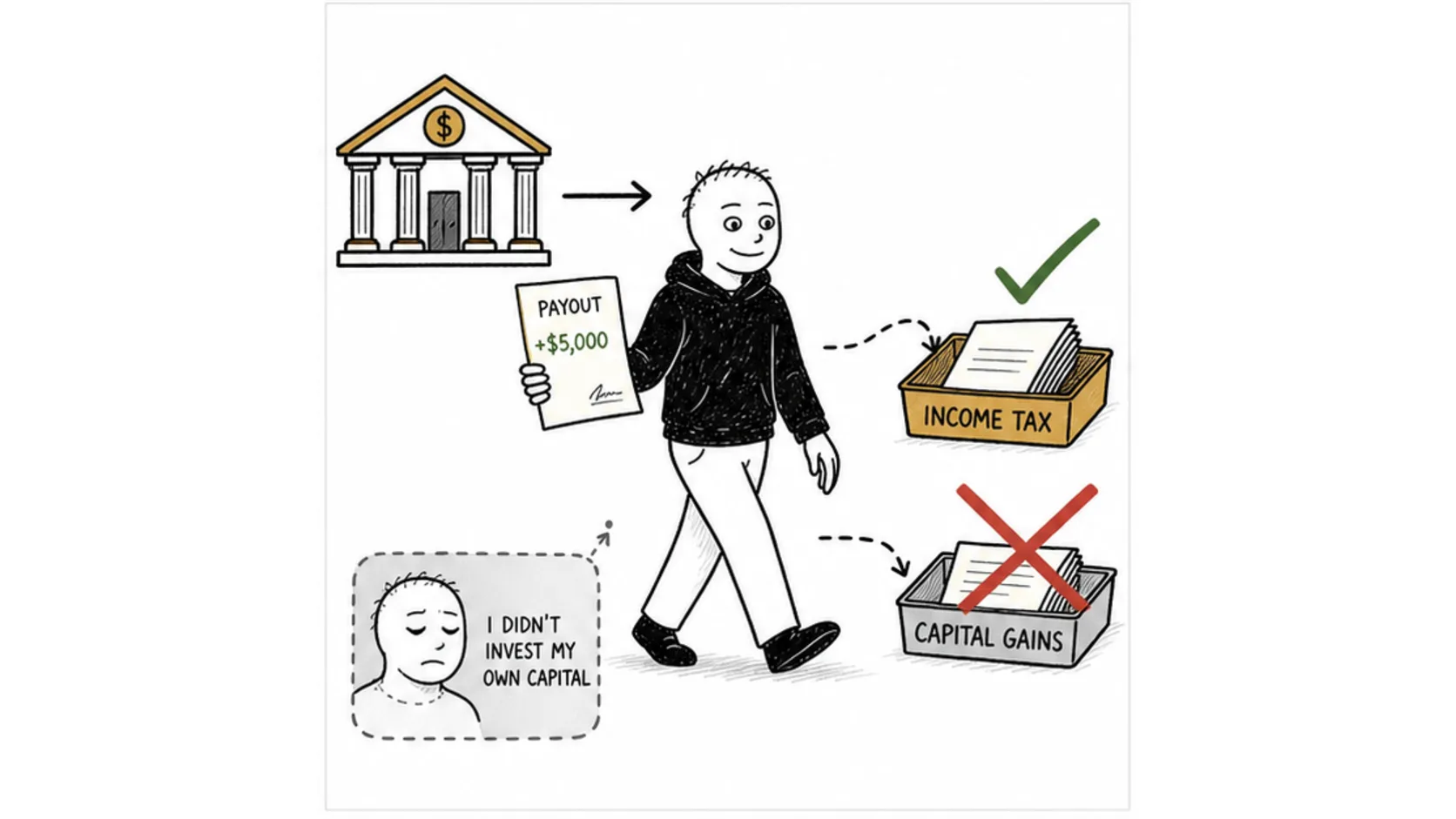
This is the single biggest misconception about prop firm taxes. Traders assume their payouts are capital gains because they came from trading.
You did not invest your own money and earn a return on it. You provided a service, trading the firm's capital, and received compensation.
In the US, this is classified as self-employment income. In the UK, it is reported as income on your Self Assessment.
The distinction matters because income tax rates are higher than capital gains rates in most brackets.
Here is a simple comparison for a US trader earning $30,000 in prop firm payouts.
- Taxed as capital gains: roughly $0 to $4,500 in federal tax (0-15% rate)
- Taxed as self-employment income: roughly $6,800 to $9,000+ including self-employment tax
The difference is significant. Do not plan your finances around capital gains rates when your payouts are classified as income.
How US Taxes Work for Prop Traders
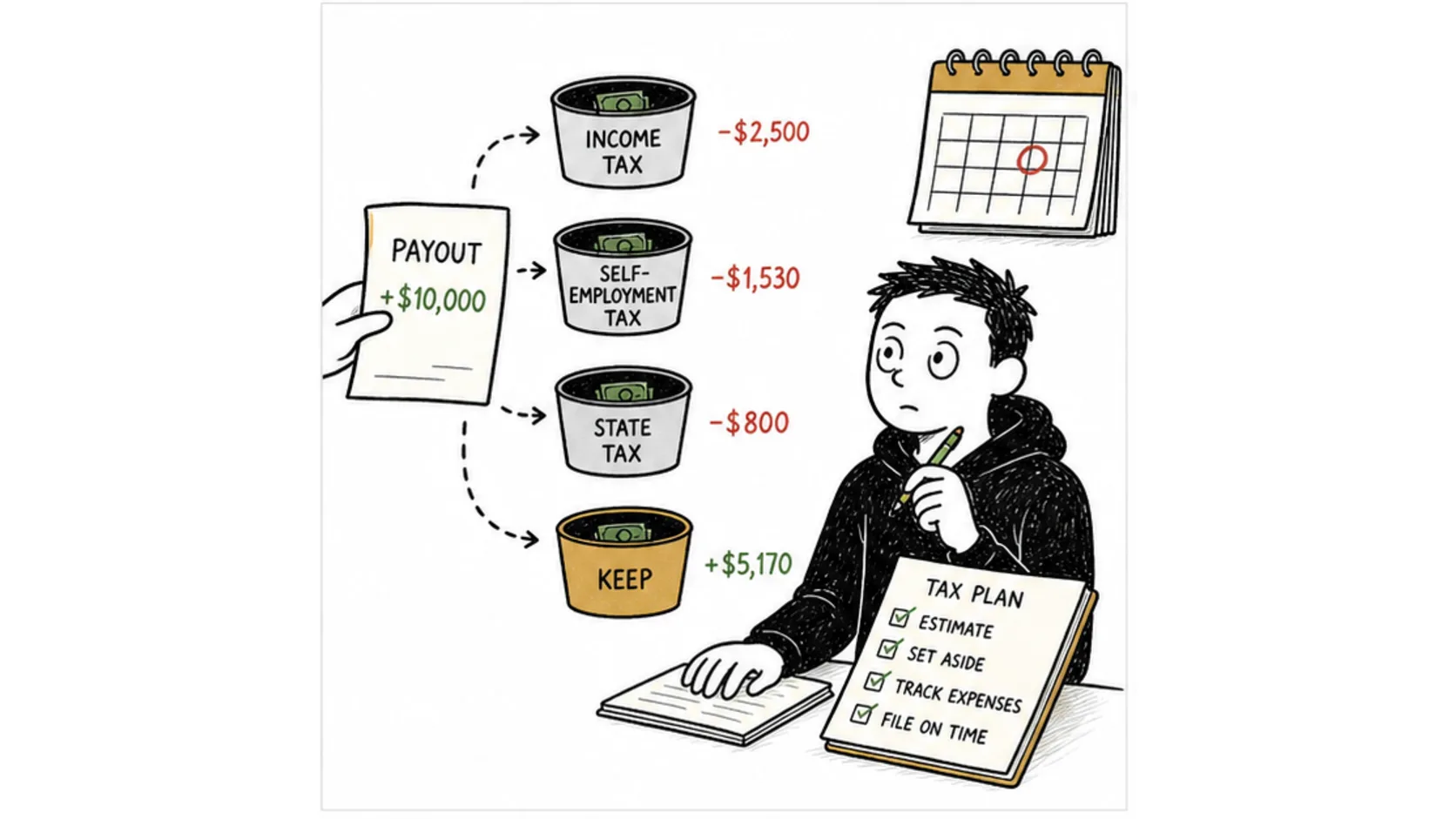
If you are based in the United States, here is how prop firm taxes break down.
Income tax. Your payouts are added to your total income for the year and taxed at your marginal rate. If you already have a job earning $60,000, a $10,000 prop firm payout pushes your total to $70,000 and gets taxed at your top bracket.
Self-employment tax. On top of income tax, you pay 15.3% self-employment tax, which covers Social Security and Medicare. This is the equivalent of the payroll tax that W-2 employees pay, except you pay both the employer and employee portions.
State tax. Depending on your state, you may owe state income tax on top of federal. Some states like Florida and Texas have no state income tax. Others like California and New York will take a significant cut.
The combined effective tax rate on prop firm income can easily reach 30-40% depending on your bracket and state. Plan for this from your first payout, not at tax time.
Quarterly Estimated Tax Payments
Prop firms do not withhold taxes from your payouts. No W-2, no automatic deductions.
If you expect to owe more than $1,000 in taxes for the year, the IRS requires you to make quarterly estimated tax payments in April, June, September, and January.
Miss these payments and you will owe penalties on top of the tax itself.
The simplest way to handle this is to set aside 25-30% of every payout into a separate savings account.
When quarterly payments come due, you already have the money ready. This is not sophisticated tax planning, it is just not being reckless.
What You Can Deduct
The good news is that prop trading comes with legitimate business expenses you can deduct against your income. This reduces your taxable income and lowers your bill.
Evaluation fees. Every dollar you spend on evaluations, challenge fees, and reset fees is deductible. Even if you failed the evaluation, the fee is still a business expense.
Charting and data subscriptions. TradingView, NinjaTrader, data feeds, and any other charting or analysis software you pay for is deductible.
Education and training. Trading courses, books, and educational materials directly related to your trading are deductible.
Home office expenses. If you have a dedicated space for trading, you may be able to deduct a portion of your rent, utilities, and internet. The home office deduction has specific requirements, so look into it carefully.
Equipment. Monitors, computers, and other hardware used for trading can be deducted or depreciated.
The firm's profit share. The percentage the firm keeps from your profits, usually 10-30%, is not your income. You only report what you actually receive. Some traders also deduct this as a commission expense, depending on how the payout is structured.
Keep receipts for everything. If you cannot prove you spent the money, the deduction will not hold up if you get audited.
UK Tax Basics
If you are based in the UK, the classification is similar. Prop firm payouts are treated as income, not capital gains.
HMRC views this as money you earned through a service, not a return on an investment. You report it on your Self Assessment tax return as either sole trader income or miscellaneous income, depending on your circumstances.
The UK personal allowance is currently £12,570. If your total income for the year, including prop firm payouts, is below this, you may not owe income tax.
National Insurance contributions may also apply depending on how you classify your trading activity. If HMRC considers you a sole trader, you pay Class 2 and Class 4 National Insurance.
The deductible expenses are broadly similar to the US: evaluation fees, software, education, and home office costs can all be claimed against your income.
If you are earning significant money from prop firms, consider speaking to an accountant who understands trading income. The classification can vary depending on your specific situation.
When Firms Do Not Send Tax Forms
Most prop firms are based outside the US, in places like Saint Lucia, Seychelles, or Dubai. These firms typically do not issue 1099s or any other US tax form.
Some US-based firms may issue a 1099-NEC if your earnings exceed the reporting threshold. But you should not rely on receiving a form from any firm.
The absence of a tax form does not mean the income is not taxable. You are still legally required to report it.
Track your payouts yourself. Log every withdrawal, the date, the amount, and the method.
Record Keeping for Tax Time
Good record keeping is the difference between a smooth tax filing and a stressful one. Here is what you need to track.
All payouts received. Date, amount, payout method, and which firm it came from. Screenshots of each payout confirmation are ideal.
All expenses paid. Evaluation fees, software subscriptions, courses, equipment. Keep receipts and note the date and purpose of each expense.
Profit and loss statements. If the firm provides monthly or weekly P&L reports, save them. They back up your income claims.
Bank or crypto statements. The money landing in your account is proof of income. Keep statements showing all incoming transfers from prop firms.
Use a simple spreadsheet or accounting software. A Google Sheet with columns for date, category, amount, and notes is enough.
Do this from day one. Trying to reconstruct six months of payouts and expenses from memory at tax time is a certified disaster.