Payout promises should be treated like any other financial claim: verify before trusting them. The FCA scam protection guidance gives a useful checklist for spotting unreliable offers.
You passed the evaluation. You got funded. Now the only question that matters is: will the firm actually pay you?
That question is not cynical. It is the right question to ask.
I have been through the payout process. I have requested withdrawals, waited for processing, and had money land in my account.
I have also watched firms delay payouts, change their terms mid-stream, and in a few cases, simply refuse to pay. Here is everything you need to know about how prop firm payouts actually work.
Key Takeaways
- Prop firm payouts are profit splits. You keep 70-90% of what you earn, the firm keeps the rest.
- Payouts are typically processed within 1-5 business days via bank transfer, crypto, or Deel.
- Payout schedules vary: some firms pay biweekly, some monthly, some on-demand.
- Firms can deny payouts for rule violations, KYC failures, or hidden terms you did not read.
- If a firm has no public payout proof, no clear payout timeline, or a history of delays, proceed with caution.
On This Page
How Prop Firm Payouts Work
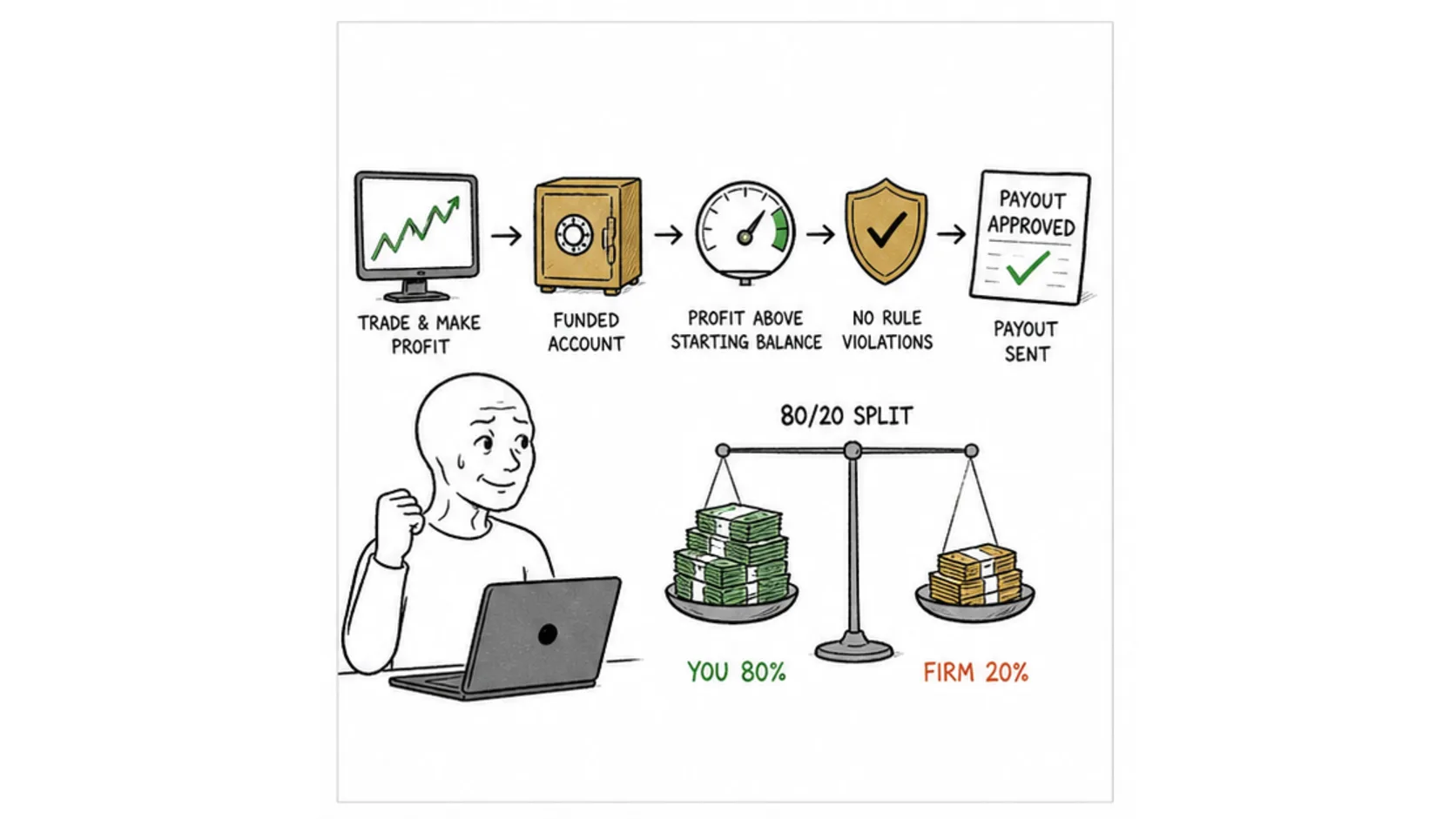
When you trade on a funded account and generate profits, you do not keep all of it. The firm takes a cut, and this is called the profit split.
Here is a simple example. You are trading a $100,000 funded account, make $2,000 in profit over two weeks, and the split is 80/20 in your favour.
The firm sends you $1,600. They keep $400. That is the deal.
Before you can request a payout, you typically need to meet a few conditions. You must be trading on a funded account, not still in the evaluation phase.
You must have generated profits above the starting balance and have no active rule violations under the firm's payout rules.
Some firms also require a minimum payout amount before your first withdrawal. This could be as low as $100 or as high as $1,000 depending on the firm and account size.
Profit Splits Explained
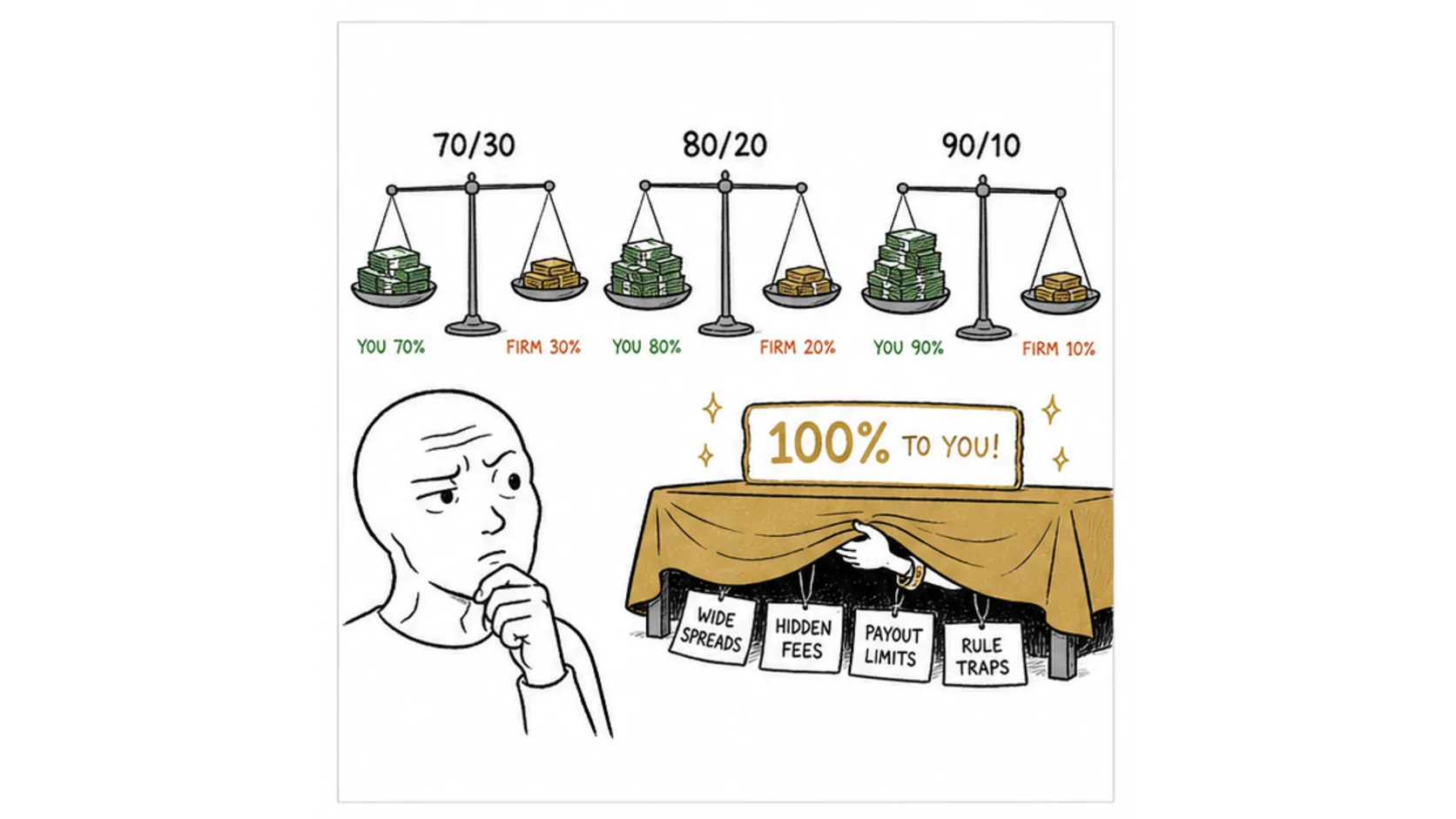
The industry standard profit split is 80/20, meaning you keep 80% and the firm takes 20%. This is the baseline. Some firms offer better splits, some worse.
Here is how different splits look on $3,000 of profit.
- 70/30 split: you receive $2,100, firm keeps $900
- 80/20 split: you receive $2,400, firm keeps $600
- 90/10 split: you receive $2,700, firm keeps $300
A 90/10 split sounds much better than a 70/30 split, and over time it is. But a generous profit split from a firm that never actually processes payouts is worth exactly zero.
The split percentage matters less than whether the firm reliably pays.
Some firms offer scaling plans where your split improves over time. You might start at 80/20 and after consistent payouts move to 85/15 or even 90/10.
This rewards loyalty and consistency, but only if the firm actually honours it.
Be suspicious of firms offering 100% payouts. No firm gives you all the profit for free.
If you see 100%, there is almost always a catch buried in the terms, like higher upfront fees, stricter drawdown rules, or a payout cap.
Payout Methods
Most prop firms offer several payout methods. The right one depends on where you live and how fast you want your money.
Bank transfer (ACH or wire). The most common method for traders in the US. ACH is slower but cheaper, usually free or a small fee.
Wire transfers are faster but cost $15-$50. Typical processing: 2-5 business days.
Cryptocurrency (USDT, BTC, ETH). The fastest method available. Some firms process crypto payouts within 24 hours.
USDT on TRC-20 or ERC-20 is the most common option. Watch out for network fees, which can eat into small payouts.
Deel. Many firms use Deel as their payout processor. Deel supports bank transfers, crypto, PayPal, and other local methods depending on your country.
Processing through Deel usually takes 2-3 business days.
PayPal. Available at some firms but less common. Fees can be higher, and some traders report PayPal freezing funds from prop firms.
If you have the option, bank transfer or crypto is usually safer.
The payout method you choose can affect how quickly you receive your money. Crypto is almost always the fastest. Bank transfers are the most reliable but the slowest.
Payout Schedules: On-Demand vs Fixed
Prop firms use two main payout schedule models, and the difference matters more than you think.
Fixed schedule payouts. The firm pays on specific dates, typically biweekly or monthly. For example, payouts on the 1st and 15th of every month. Our guide on prop firm payout frequency breaks down how each schedule affects your compounding and cash flow.
If you miss the cutoff date, you wait for the next cycle. The advantage is that batched payouts usually mean fewer processing errors.
On-demand payouts. You request a payout whenever you want, and the firm processes it within their stated timeframe, usually 24-72 hours.
This is more flexible. But watch for the fine print. Some firms advertise "on-demand" but have minimum waiting periods between requests or caps on how many payouts you can request per month.
If you are choosing between firms and payout frequency matters to you, check whether the schedule is genuinely flexible or just marketed that way.
How Long Payouts Actually Take
Here is what the payout timeline looks like in practice, from the moment you click "request payout" to the moment money lands in your account.
Day 0: You request the payout. You submit a withdrawal request through the firm's dashboard. You select your payout method and confirm the amount.
Day 1-2: Review period. The firm's finance team reviews your trading activity, checks for rule violations, and confirms your KYC documents are current.
Day 2-5: Processing. Once approved, the payout is sent to your chosen method. Bank transfers take 1-3 additional business days to clear, crypto payouts can land within hours.
The total time from request to money in your account is typically 3-7 business days for bank transfers and 1-3 business days for crypto.
Some firms are much faster. A few process crypto payouts same-day, others have automated systems that skip the manual review step for trusted traders.
If a firm consistently takes more than 10 business days, something is wrong.
Your First Payout: What to Expect
The first payout is always the slowest. The firm is verifying you for the first time, running KYC checks, and making sure everything matches.
Before requesting your first payout, make sure you have completed all KYC requirements. Have your ID and proof of address ready, and make sure the name on your account matches exactly. Understanding the specific rules for your first payout saves you from the most common delays. The anticipation can mess with your trading if you are not prepared for it.
Do not try to game the KYC process. Firms will catch mismatches, and a failed KYC check can delay your payout by weeks or get it denied entirely.
Once your first payout clears, subsequent payouts are usually faster. The firm already has your verified information, so the review step is quicker.
Why Payouts Get Denied
Payouts get denied. It happens. Here are the most common reasons. For FTMO-specific payout denial causes including the 1% risk rule and slippage cases, see our FTMO payout denied guide.
Rule violations. If you breached a risk rule during the payout period, even a soft breach, the firm may deny or reduce your payout. If you believe the denial was unfair, here is how to file a payout denial appeal.
This includes daily loss limit breaches, drawdown violations, or trading during restricted hours.
KYC failures. If your identity documents are expired, your address does not match, or there are discrepancies in your information, the firm will hold your payout until it is resolved. Here is the full breakdown of how KYC verification works and what documents you need.
Consistency rule violations. If the firm detects that your profits came from a small number of trades or a single trading session, they may flag you for inconsistent trading and withhold the payout pending review.
Hidden terms. This is the one that catches people off guard. Some firms bury conditions in their terms of service that affect payouts, like minimum holding periods or maximum payout percentages in the first month.
Read the full terms before you start trading.
If your payout is denied and you believe it was unjust, contact support with documentation. Keep screenshots of your trading activity and all rule compliance metrics.
Payout Red Flags
Not all prop firms are created equal when it comes to payouts. Here are the warning signs that a firm might not pay you reliably.
No public payout proof. Legitimate firms publish payout screenshots, processing timelines, and community testimonials. If a firm has zero public evidence, ask yourself why.
Consistently delayed payouts. Every firm has occasional delays. But if traders are reporting weeks-long delays with no communication, that is a pattern, not a glitch.
Changing payout terms retroactively. If a firm changes its payout rules and applies them to profits you already earned, run. This happened with several firms in 2024-2025, and it was always the beginning of the end.
Unrealistic profit splits. A firm offering 95/5 or 100/0 splits with no clear revenue model is not being generous. They are planning to make money somewhere else.
High-pressure sales before payouts. If the firm pushes you to buy more challenges right before your payout is due, they might be trying to offset the payout with new revenue.
Before you trust any firm with your time and money, check how to verify payout proof and read reviews from actual funded traders, not just affiliates.