Prop firm KYC verification is the identity check that stands between you and your funded account. You pass the challenge, you hit the profit target, you think you are done. Then the firm says "please verify your identity." If you are not prepared, this step can delay your funding by days or even weeks. If your documents do not match, it can block you entirely.
Key Takeaways
- KYC stands for Know Your Customer. It is the identity verification process every major prop firm requires before funding you or paying out.
- Standard documents needed: government photo ID, proof of address dated within 90 days, and sometimes a selfie with your ID.
- Most firms run KYC either at signup or after you pass the challenge. Processing takes 24-72 hours.
- KYC failures usually come from blurry documents, name mismatches, or expired IDs. All fixable if you catch them early.
- Some no-KYC prop firms exist but come with tradeoffs like smaller accounts, lower payouts, and less regulatory protection.
On This Page
What Is KYC in Prop Firms?
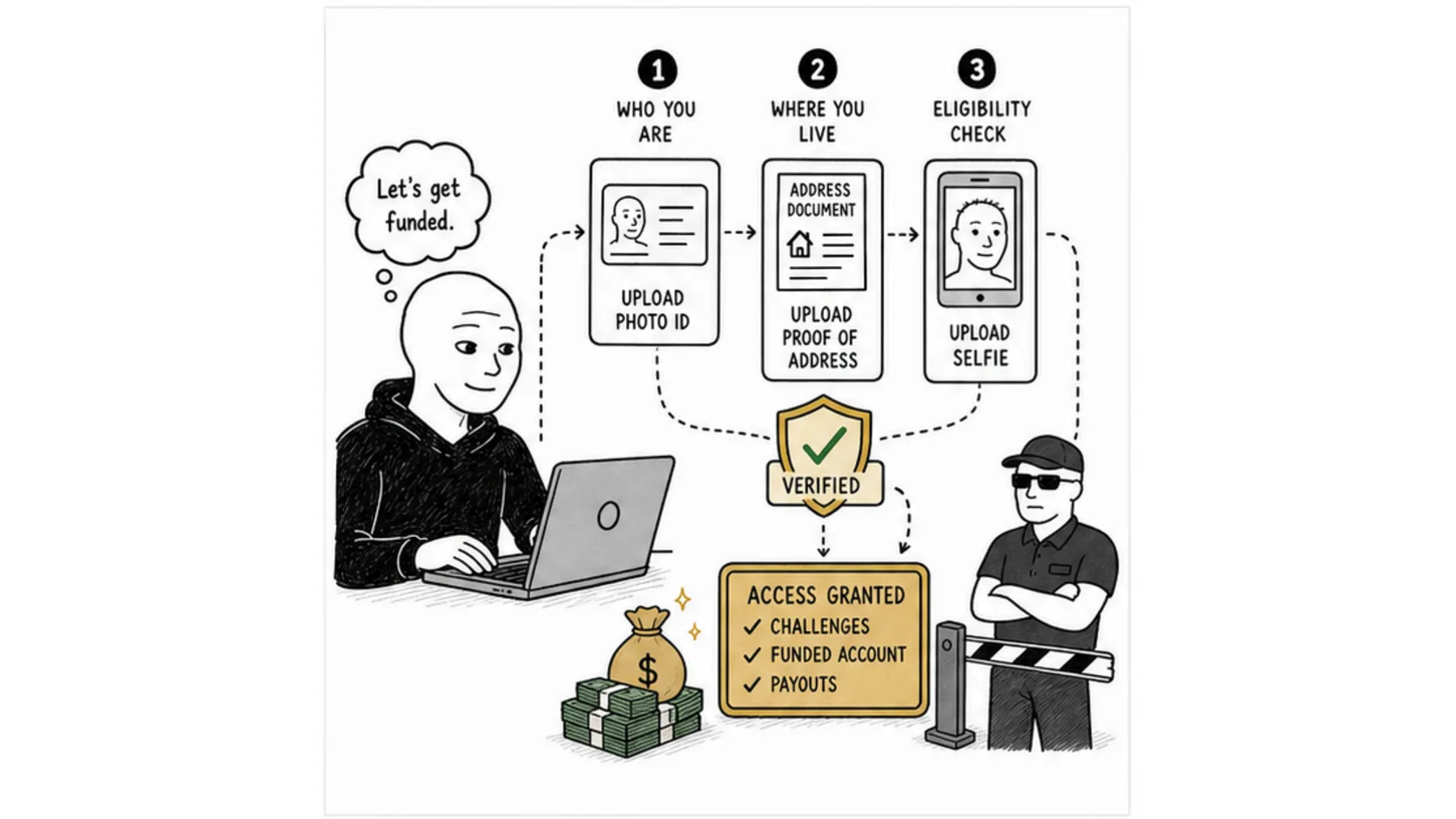
KYC stands for Know Your Customer. In the prop trading world, it is the identity verification process firms use to confirm you are who you say you are. That is it. It is not a credit check. It is not a trading skill assessment. It is purely about identity.
The firm needs to verify three things. Your identity (who are you), your address (where do you live), and your eligibility (are you legally allowed to trade). Most of this happens through document uploads.
Some firms also run AML checks, which stands for Anti-Money Laundering. This is a background screen that flags politically exposed persons, sanctioned individuals, or accounts linked to suspicious activity. If you are a regular trader with nothing weird in your background, AML passes automatically.
KYC is not unique to prop firms. Banks, crypto exchanges, brokerage accounts, and basically any financial service that handles money runs KYC. The Financial Conduct Authority in the UK and similar regulators worldwide require it. Prop firms are not inventing this requirement. They are complying with it.
The difference with prop firms is timing. Some firms run KYC the moment you create an account. Others wait until you pass the challenge and request funding. A few run it at payout time. Knowing when your firm does KYC changes how you prepare for it.
What Documents You Need for Prop Firm KYC
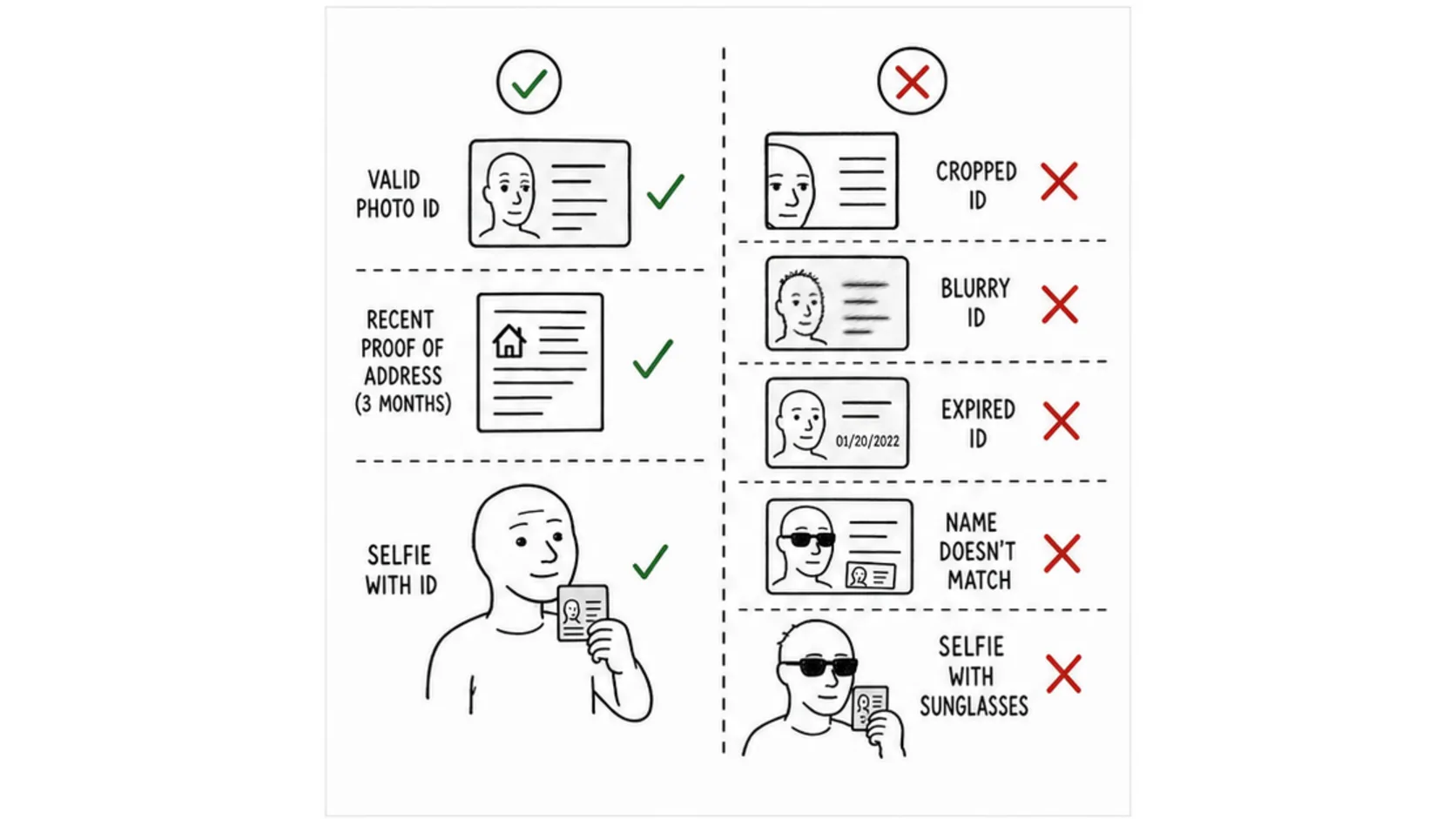
The documents required for prop firm KYC verification are standard across the industry. Here is exactly what you need and what will get rejected.
Government-issued photo ID. Passport, driver's license, or national identity card. It must be current and not expired. Some firms accept only passports. Most accept driver's licenses. Check your firm's specific requirements before uploading.
The ID photo must be clear, fully visible, and not cropped. Taking a photo of your ID with a shaky phone camera in bad lighting is the number one reason KYC gets rejected. Use a scanner or take the photo on a flat surface with good light.
Proof of address. A utility bill, bank statement, or tax document showing your name and address. It must be dated within the last 90 days. Some firms accept mobile phone bills. Most do not accept online shopping receipts or hand-written documents.
The name on your proof of address must match the name on your ID. If your ID says "Jonathan Smith" and your bank statement says "Jon Smith," some firms will reject it. Use a document where the name matches exactly.
Selfie with ID. Some firms require a selfie where you hold your ID next to your face. This proves you physically possess the document. The entire ID must be visible in the photo. Your face must be clearly recognizable. No sunglasses, no hats, no filters.
The entire KYC document preparation process takes about 10 minutes if you have everything ready. It takes days if you have to request new documents from your bank or utility provider.
When KYC Happens in the Prop Firm Process
There are three points where prop firms typically run KYC. Knowing which one applies to your firm matters because it changes your preparation timeline.
At signup. Some firms verify your identity before you even buy a challenge. This is the most straightforward approach. You upload documents, get verified, then start trading. If anything is wrong, you know immediately rather than finding out after weeks of effort.
After passing the challenge. This is the most common timing. You trade the challenge, hit the target, and then the firm asks for KYC before giving you a funded account. The risk here is that you spend weeks on a challenge only to discover a KYC problem at the finish line.
At payout. A few firms run KYC only when you request your first withdrawal. This means you could pass the challenge, get funded, trade for a month, and then hit a KYC wall when you try to collect your profits. This is the worst timing for a KYC failure.
The firms that run KYC at signup are doing you a favor, even if it feels like an inconvenience upfront. You know your identity is verified before you invest any time or money into a funded trading account.
About 65% of major prop firms run KYC after you pass the challenge, according to industry data. Roughly 25% do it at signup. The remaining 10% do it at payout. Always check the timing before you start.
Why Prop Firms Require KYC
You might be wondering why a prop firm cares about your identity when they are the ones giving you money to trade. It feels backwards. It is not.
Prop firms require KYC for three reasons, and none of them are about trusting you personally.
Regulatory compliance. Even though most prop firms operate in a regulatory grey area, they still need basic KYC to process payments, work with payment providers, and maintain banking relationships. A firm without KYC cannot use mainstream payment processors. They get stuck with crypto-only payouts and limited banking options.
Fraud prevention. KYC prevents one person from creating multiple accounts to exploit welcome bonuses, free challenges, or trial offers. It also prevents people from using stolen payment methods to buy challenges.
Payout security. The firm needs to verify that the person requesting a payout is the same person who passed the challenge. Without KYC, anyone who gets access to your account credentials could redirect your payouts.
The European Securities and Markets Authority requires KYC for financial services operating in the EU. Even prop firms registered in jurisdictions with lighter regulation still need KYC to work with international payment processors.
Think of KYC as the firm protecting both themselves and you. Yes, it is annoying. Yes, it takes time. But a firm that skips KYC is a firm that might skip other security measures too.
Common KYC Failures and How to Fix Them
KYC failures are common and almost always fixable. Here are the top reasons traders get stuck at verification and how to solve each one.
Blurry or unreadable documents. This accounts for roughly 40% of KYC rejections. The fix is obvious: use better images. Scan your documents or photograph them on a flat, well-lit surface. Do not photograph a screen showing a digital document. Upload the original file.
Name mismatches. Your ID says "Robert Johnson." Your bank statement says "Bob Johnson." The firm's system flags it as different people. The fix is to use a document where the name matches exactly, or to contact the firm's support team with both documents and explain the nickname variation. Most firms accept this if you ask.
Expired ID. Your passport expired three months ago. You did not notice because you are not traveling. Prop firms notice because their compliance software automatically checks expiry dates. Renew your ID before starting KYC. This is not something you can rush.
Address document too old. Most firms require proof of address dated within 90 days. That utility bill from eight months ago will not work. Download a recent bank statement or utility bill. Most banks let you generate a PDF statement instantly through their app.
Country restrictions. Some firms do not accept traders from specific countries due to sanctions or regulatory restrictions. If your country is on the restricted list, no amount of document quality will fix it. Check the firm's terms before buying a challenge.
Reddit threads about KYC problems reveal one consistent pattern. Traders who prepare documents before starting the challenge never have issues. Traders who scramble to find documents after passing always do.
No-KYC Prop Firms: What You Give Up
A few prop firms market themselves as no-KYC or minimal verification. You create an account, buy a challenge, and start trading with no identity documents required. Sounds convenient. Here is what you actually give up.
Smaller account sizes. No-KYC firms typically cap accounts at $25,000 to $50,000. They cannot offer larger accounts because the risk of fraud increases without identity verification. A single person could create ten accounts and manipulate the system.
Lower profit splits. Without KYC, the firm carries more fraud risk. They pass that cost to you through lower profit splits. A no-KYC firm offering 60/40 splits instead of the standard 80/20 is not being generous. They are pricing in the risk of not knowing who their traders are.
Limited payout options. No-KYC firms almost exclusively pay out in cryptocurrency. No bank transfers, no Wise, no Deel. If you want fiat currency in your actual bank account, you need KYC somewhere in the process.
Less regulatory protection. If a no-KYC firm refuses to pay you, you have limited recourse. You cannot file a complaint with a financial regulator because the firm has no regulatory relationship. There is no KYC trail proving you are a customer.
For traders in countries with strict capital controls or limited banking access, no-KYC firms can be a practical option. For everyone else, the tradeoffs rarely justify skipping a 10-minute document upload.
A firm that takes KYC seriously is a firm that takes payouts seriously. The most legitimate prop firms all require KYC because legitimate firms operate within financial compliance frameworks.
KYC Tips: Get Verified First Time, Every Time
You have three missions for KYC. Complete all three and you will never have a verification problem.
Mission one: prepare documents before you buy the challenge. Have your ID, proof of address, and a clear selfie ready before you spend a single dollar on a prop firm evaluation. If the firm runs KYC at signup, you breeze through. If they run it later, you already have everything. Either way, zero scrambling.
Mission two: make sure all names and addresses match exactly. Your ID, your bank statement, and your prop firm account registration should all show the same name and address. Even small differences like "St." vs "Street" can trigger automated rejection at some firms.
Mission three: keep digital copies of everything. Store PDFs of your ID, proof of address, and a recent selfie in a folder on your computer. When KYC comes up, you upload in two minutes and move on. This is not complicated. It is just preparation, and the same discipline you apply to risk management should apply here.
If your KYC gets rejected, do not panic. Read the rejection reason carefully. Fix the specific issue. Resubmit. Most firms allow multiple attempts. The traders who get stuck at KYC for weeks are the ones who submit the same blurry document three times and then email support asking why it keeps failing.