A prop firm challenge is not the same thing as opening a regulated brokerage account. The FCA warning list is useful when checking firms that market aggressively to retail traders.
A prop firm challenge is an evaluation you pay for to prove you can trade without blowing up an account. Pass it, and the firm gives you capital to trade and a cut of the profits.
That sounds simple. The reality is that most traders fail these challenges because they treat them like a normal trading account.
They are not. Prop firms designed these evaluations to filter out anyone who cannot follow rules, manage risk, or control their emotions.
Key Takeaways
- A prop firm challenge is a paid evaluation where you trade a demo account under strict rules to prove you can manage capital responsibly.
- Most challenges require hitting a profit target (usually 8-10%) without breaching daily loss limits or maximum drawdown rules.
- Challenge types include one-step, two-step, hybrid, and instant funding — each with different difficulty levels and fee structures. See the full one step vs two step comparison.
- Industry pass rates sit around 5-10%, meaning 9 out of 10 traders fail and lose their evaluation fee.
- Challenge fees range from $50 to $1,000+ depending on account size. The most popular $50K account typically costs $200-$400.
- You cannot lose more than the challenge fee — the fee is your maximum downside. Every other risk is simulated.
On This Page
- What Exactly Is a Prop Firm Challenge?
- How a Prop Firm Challenge Works Step by Step
- The Key Elements of Every Challenge
- Different Types of Prop Firm Challenges
- Why Prop Firms Use Evaluations
- Common Rules and Restrictions
- What Happens When You Pass
- Pros and Cons of Prop Firm Challenges
- How Much Does a Prop Firm Challenge Cost?
- What Is the Pass Rate?
- Is a Prop Firm Challenge Worth It?
- How to Prepare Before Buying
- Challenges vs Other Ways to Get Funded
What Exactly Is a Prop Firm Challenge?
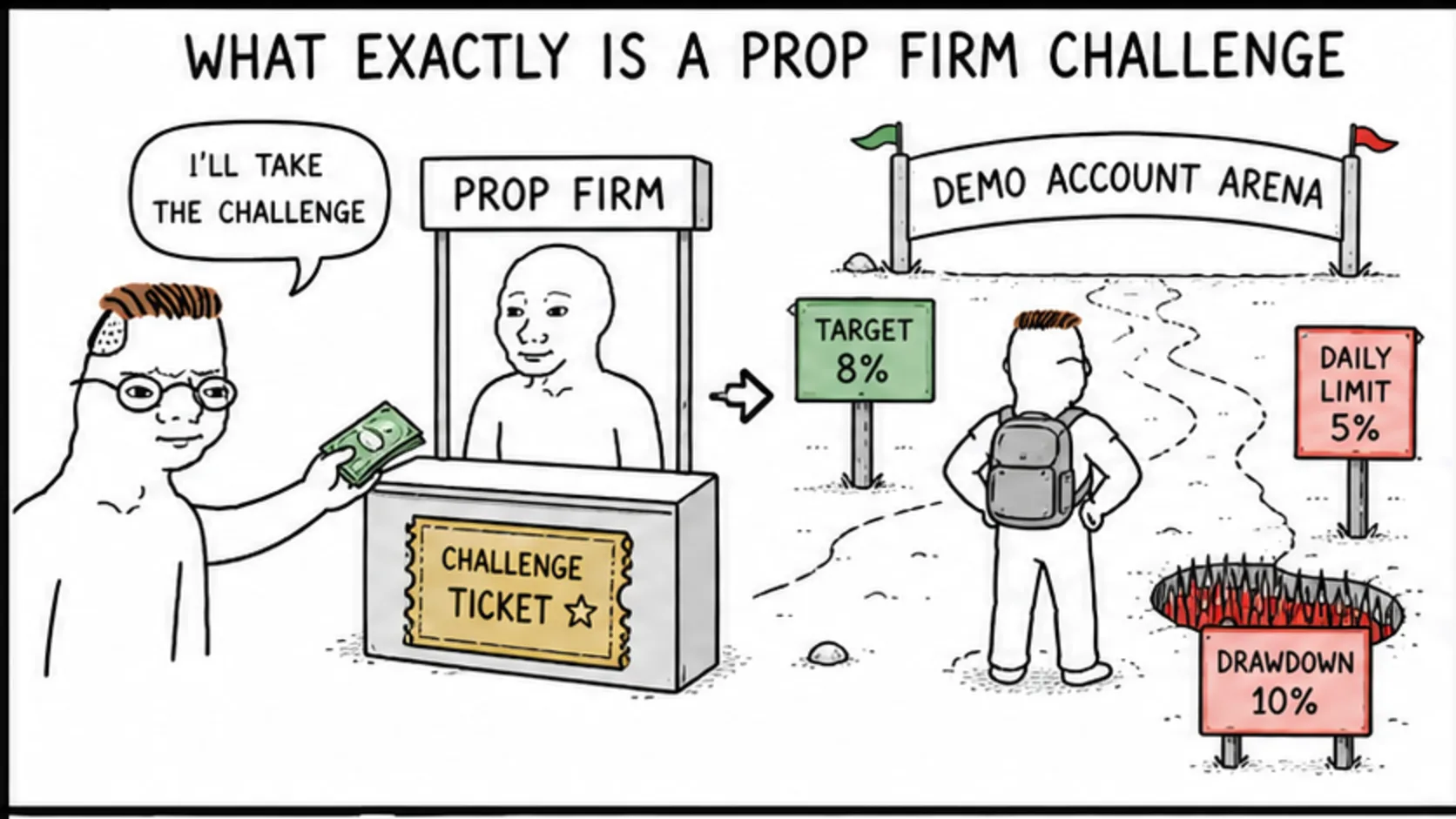
A prop firm challenge is a standardised evaluation that tests whether you can trade profitably within a set of risk rules. You pay a fee, receive platform credentials, and trade on a simulated account that mirrors live market conditions.
I like to think of it as a job interview for your trading skills, except instead of a hiring manager deciding your fate, a set of hard-coded rules does. The firm gives you a demo account, a target, and a list of restrictions.
Hit the target without breaking a single rule and you get the job. Break one rule and you are fired on the spot.
The firm sets a profit target, usually 8-10% of the account value, and a collection of risk parameters you must not breach. Hit the target without breaking any rules and you advance to the next stage or receive a funded account.
If you want to see what that looks like in practice, our FTMO funded account breakdown covers the post-pass experience.
Break a rule, any rule, and the evaluation ends immediately. No appeals, no second chances, no phone call from support.
The software detects the breach and terminates your account in milliseconds.
The challenge is not testing whether you are a good analyst. It is testing whether you can follow instructions under financial pressure.
That is a different skill entirely.
| Feature | Prop Firm Challenge | Personal Account | Funded Trader Program |
|---|---|---|---|
| Capital at risk | Challenge fee only ($50-$1,000+) | Everything you deposit | Usually no upfront cost |
| Account type | Simulated demo | Live brokerage | Varies (some live, some sim) |
| Profit target | Yes (8-10%) | No target | Varies by program |
| Rules | Strict daily/drawdown limits | None | Varies (usually looser) |
| Potential payout | 80-90% profit split | 100% (minus commissions) | Varies widely |
| Who it suits | Skilled traders without capital | Anyone with savings | Established track record |
The prop firm challenge sits between personal trading and traditional prop firm employment. You risk less capital than funding your own account, but you face stricter rules than most funded programs impose.
If you are curious about how these compare side by side, I break it down fully at prop firm challenge vs personal account and prop firm challenge vs funded trader program.
How a Prop Firm Challenge Works Step by Step
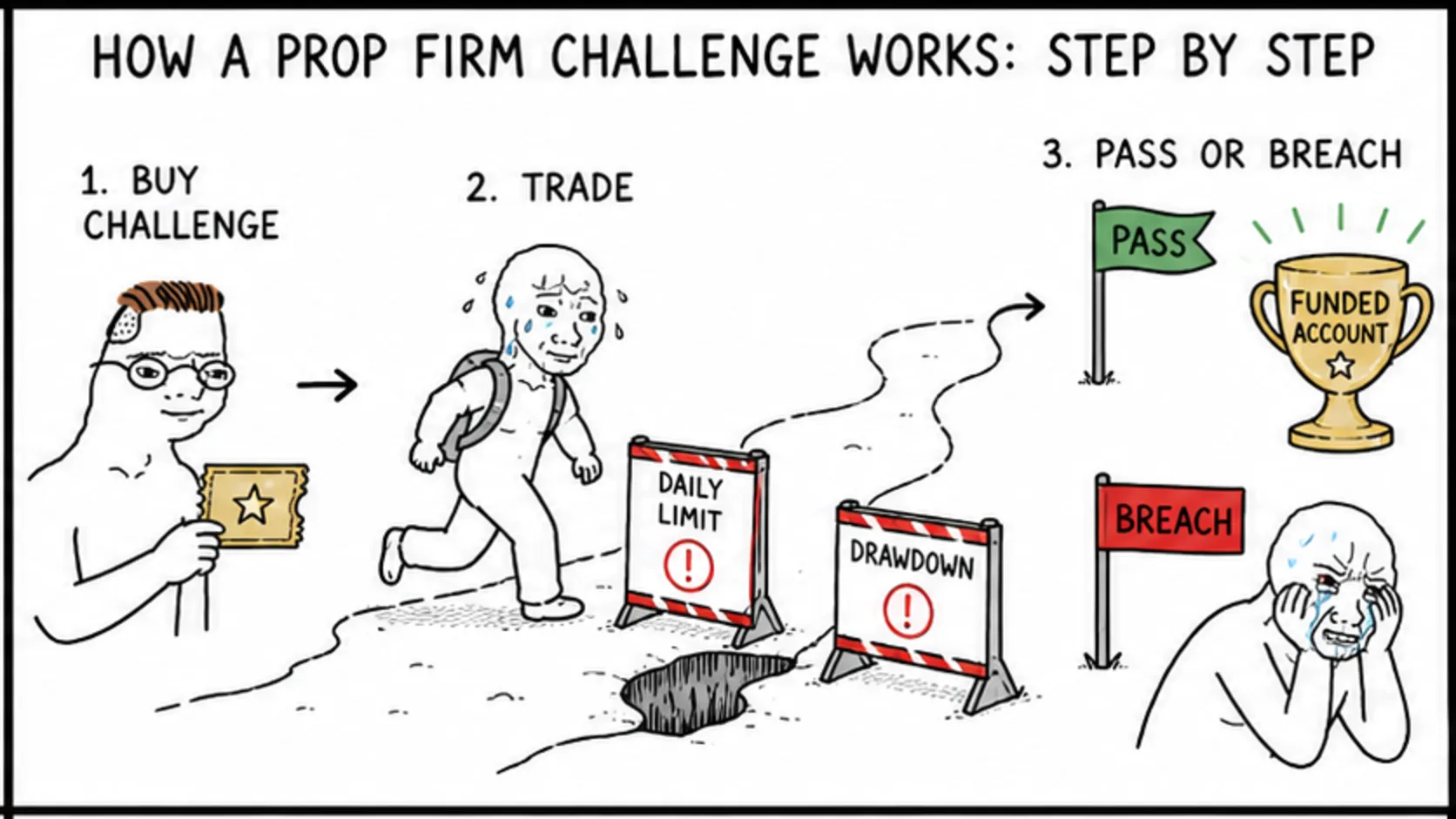
Here is exactly what happens from start to finish when you buy a prop firm challenge.
- Choose a firm and account size. Accounts range from $5,000 to $200,000. Fees scale with size — for example, FTMO account prices range from around $55 to $640 depending on the size you pick.
- Pay the evaluation fee. Your credit card or crypto payment is processed and you receive login credentials for your trading platform. The clock starts ticking immediately.
- Read every rule in detail. Before placing a single trade, study the daily loss limit, maximum drawdown, consistency rules, and any restrictions on news trading or weekend holds. I have seen traders fail within hours because they skimmed the rules.
- Trade toward the profit target. Execute your strategy while staying within every parameter. This is where discipline matters more than analysis — the market does not care about your clever thesis if you breach a drawdown rule.
- Pass or fail. Hit the profit target without a rule breach and you advance to verification or go straight to funded. Break a rule and the evaluation terminates instantly.
- Complete verification (if required). Many firms have a second phase with a lower profit target and the same or similar rules. This confirms your performance was not a fluke.
- Receive your funded account and start earning. Trade the firm's capital, earn profit splits, and request payouts on schedule.
The process is straightforward. Executing it under pressure is where things get interesting.
For a deeper breakdown of the mechanics at each stage, how prop firm challenges work in detail covers every stage with examples.
The Key Elements of Every Challenge
Every prop firm challenge has these core components, regardless of which firm you choose.
Profit target: the percentage gain you need to achieve, typically 8-10% for phase one, 5% for verification.
Daily loss limit: the maximum you can lose in a single day, usually 4-5% of the account. Hit this and your day is over.
Maximum drawdown: the total loss allowed from your starting balance or peak equity, typically 8-12%. Breach this and the account closes permanently.
Time limit: usually 30 days per phase. Some firms offer unlimited time with no extra charge.
Minimum trading days. 4-10 days to prevent single-trade gambling passes.
The specific numbers vary between firms. Here is how the three biggest names stack up on a standard challenge account:
| Parameter | FTMO | FundedNext | TopStep |
|---|---|---|---|
| Profit target (Phase 1) | 10% | 8% | N/A (Step 1: $3,000 goal) |
| Profit target (Phase 2) | 5% | 5% | N/A (Step 2: $4,500 goal) |
| Max drawdown | 10% (static) | 10% (static on some plans) | $3,000 trailing |
| Daily loss limit | 5% | 5% | No daily loss limit |
| Time limit | Unlimited | Unlimited on some plans | Unlimited |
| Min. trading days | 4 | 5 | 5 |
Notice how the numbers shift between firms. There is no universal standard. Full rule breakdowns by firm are here, and if you want to understand what those profit targets actually demand of your strategy, prop firm profit targets explained goes deeper.
Different Types of Prop Firm Challenges
Not all challenges are structured the same way. Here is the breakdown.
One-step challenges: one phase, hit the target, get funded. Faster but often with stricter drawdown rules, and good for experienced traders who do not want to prove themselves twice.
Two-step challenges: the industry standard with Phase one (evaluation with an 8-10% target) and Phase two (verification with a 5% target). More steps but usually more forgiving drawdown rules.
Hybrid models: some firms blend elements of both, such as a single phase with a higher profit target (10-12%) but looser daily rules, or two phases where the second phase has no time limit.
Instant funding: pay a higher fee and skip the evaluation entirely. You start trading a funded account immediately but with stricter ongoing rules and lower profit splits in some cases.
The type you choose should match your experience and confidence level. Beginners should stick with two-step challenges.
Experienced traders can consider one-step or instant funding. The one step vs two step comparison breaks down exactly which one fits your trading style, and instant funding vs challenge covers the trade-offs of paying more to skip evaluation.
Why Prop Firms Use Evaluations
The evaluation exists for one reason: to filter out traders who cannot manage risk. The firm makes money from evaluation fees, so there is a financial incentive to have a challenging evaluation.
But the rules themselves test real skills.
A trader who consistently follows risk parameters, avoids revenge trading, and maintains discipline under time pressure is exactly who the firm wants trading their capital. The evaluation identifies those traders.
Common Rules and Restrictions
The rules vary by firm but share common patterns. Full rule breakdowns are available here, but the key ones are daily loss limits, maximum drawdown, minimum trading days, consistency rules, news trading restrictions, and weekend holding policies.
| Rule | What It Means | Why It Matters |
|---|---|---|
| Daily loss limit | Maximum loss in a single trading day (usually 4-5%) | One bad day of revenge trading can end your challenge instantly. This is the rule that catches the most traders. |
| Maximum drawdown | Total loss allowed from starting balance or peak equity (usually 8-12%) | Breach this and the account is permanently closed. No recovery possible. |
| Consistency rule | Requires a minimum number of trading days and prevents single-trade gambling | Proves you can perform over time, not just get lucky on one trade |
| News trading restriction | No opening or closing positions within 2-5 minutes of high-impact news events | Slippage during news can blow your drawdown in seconds. Firms want to see controlled risk. |
| Weekend holding | Some firms require closing all positions before the market closes on Friday | Gap risk over the weekend can cause unexpected losses that breach your drawdown |
Read every rule before you pay. If you cannot explain the daily loss limit, maximum drawdown, and trailing drawdown to a friend, you are not ready.
The daily loss limit explained and consistency rule guide are worth reading if any of these terms are new to you.
What Happens When You Pass
After passing the evaluation (and verification if required), you receive a funded account. You trade with firm capital under ongoing rules and earn profit splits, typically 80/20 in your favour.
Payouts happen every 14-30 days depending on the firm. Here is how the process typically works.
You request a withdrawal through the firm's dashboard. The compliance team verifies your trades and confirms no rule breaches.
They calculate your profit split, and the payment arrives via bank transfer, crypto, or PayPal within 1-5 business days.
The profit split means exactly what it sounds like. If you make $2,000 profit on your funded account, an 80/20 split sends you $1,600 and keeps $400 for the firm. Some firms increase your split to 90/10 or even 100/0 after you prove consistency over multiple payouts.
What a funded trading account actually is explains the full post-pass experience, and first payout rules covers what to expect before your initial withdrawal.
The funded phase is where the money gets made. But staying funded requires the same discipline that got you through the evaluation.
Pros and Cons of Prop Firm Challenges
Pros.
- Access to large capital without saving for years. A $100K account costs $500-$600 to attempt. Building that from personal savings while maintaining living expenses could take a decade — prop firms compress that timeline to a single evaluation fee.
- Limited downside risk. The evaluation fee is the maximum amount you can lose. There is no margin call, no account going negative, no debt. Your worst-case outcome is a $500 loss, not a $50,000 loss.
- Structured rules that force discipline. The rules feel restrictive at first, but they teach habits that make you a better trader. Risk management becomes automatic when the alternative is instant account termination.
- Real profit potential for skilled traders. A trader who passes a $100K challenge and earns 80% profit splits can realistically earn $5,000-$10,000 per month. That changes the math on trading as a career.
Cons.
- High failure rate. 90-95% of traders fail. The rules are designed to be difficult, and most traders underestimate how hard it is to manage risk while chasing a target under time pressure.
- Non-refundable fees. If you fail, the money is gone. Firms are clear about this, and the fee structure means the firm profits even when you fail — which creates an obvious incentive question.
- Psychological pressure from rules and time limits. Trading with a 5% daily loss limit hanging over your head changes how you approach every trade. Some traders perform better under this pressure; many perform worse.
- Largely unregulated industry. Most prop firms operate outside traditional financial regulation. This means fewer protections if a firm changes terms, delays payouts, or closes unexpectedly.
Who should consider a prop firm challenge: Traders with a proven strategy who need capital to scale, disciplined risk managers who naturally follow rules, and people who can absorb the evaluation fee as a business expense without financial stress.
Who should not buy a prop firm challenge: Beginners who have not yet developed a profitable strategy on demo, traders who chase losses or revenge trade, anyone who cannot afford to lose the evaluation fee, and people who expect guaranteed returns from a paid product.
The prop firm challenge is a legitimate path to funded trading for people who have the skill and discipline. For everyone else, it is an expensive education.
How Much Does a Prop Firm Challenge Cost?
Fees range from $50 for a small account to over $1,000 for a $200K account, the exact price depends on the firm, the challenge type, and any active promotions.
| Account Size | Typical Fee Range | Popular Example |
|---|---|---|
| $5,000 | $50 - $85 | FTMO: $55 |
| $10,000 | $80 - $160 | FTMO: $85 |
| $25,000 | $150 - $250 | FundedNext: $210 |
| $50,000 | $200 - $400 | FTMO: $315 |
| $100,000 | $400 - $650 | FTMO: $540 |
| $200,000 | $800 - $1,200 | FTMO: $1,080 |
Fees exist for two reasons: they filter out traders who are not serious, and they fund the firm's operations, platform costs, customer support, and the technology that monitors every trade in real time.
Watch for hidden costs beyond the initial fee. Reset fees (usually 70-80% of the original price) apply when you fail and want to restart.
Some firms charge activation fees to move from evaluation to funded status.
Spread marks, swap fees, and commission structures also vary between firms and eat into your profits over time. Hidden prop firm fees explained covers every cost that catches traders off guard.
If you are shopping on price, the cheapest prop firm challenge comparison breaks down costs across 20+ firms so you can find the best value for your budget.
What Is the Pass Rate?
Industry estimates put the pass rate at 5-10%, meaning roughly 9 out of 10 traders who buy a challenge fail and lose their fee.
The real number is harder to pin down than you might expect. Firms do not publish official pass rates, and the ones that do are incentivised to make the numbers look better than they are.
Some firms include traders who fail within minutes of opening their first trade, while others only count traders who made a genuine attempt.
There is also an important distinction between pass rate and survival rate. The pass rate measures how many people clear the evaluation.
The survival rate measures how many funded traders are still profitable and receiving payouts six months later, and that number is even lower.
Most failures come from rule breaches, not from failing to hit the profit target. Traders get close to the target, get aggressive, and blow their drawdown on a single trade.
Patience kills more challenge accounts than poor analysis does. Full pass rate data and analysis breaks down the numbers by firm and account size.
Is a Prop Firm Challenge Worth It?
A prop firm challenge is worth it if you have a proven strategy, you can absorb the fee without financial pain, and you treat the evaluation as a business expense rather than a gamble.
The ideal candidate has at least 6-12 months of profitable demo trading, understands risk management at a mechanical level (not just intellectually), and has a written trading plan they actually follow. They do not need YouTube inspiration to place trades, they have a process and they execute it.
The poor candidate buys a challenge after watching a few trader success stories, has no track record on demo, and treats the evaluation fee as a lottery ticket. They go oversized on trade one, panic when the account dips 3%, and blow the drawdown by lunch.
I have seen it hundreds of times.
If you are on the fence, should beginners use prop firms explains who benefits and who gets burned, and when NOT to buy a prop firm challenge covers the warning signs that you are not ready.
How to Prepare Before Buying
Preparation is the single biggest factor that separates traders who pass from traders who waste their fee. Before you spend a cent, run through this checklist.
- Backtest your strategy for at least 100 trades. You need statistical proof your approach works — not a gut feeling from a few winning sessions.
- Demo trade for one full month. Trade the same account size you plan to challenge with. Track every trade in a journal and verify your results match your backtest.
- Read every rule of the specific firm twice. Rules vary between firms and even between challenge types at the same firm. Know the daily loss limit, drawdown type (trailing vs static), and any news trading restrictions.
- Pick the right account size. Start smaller than your ego wants. A $25K challenge is better than a $100K challenge if the $100K fee creates financial pressure.
- Write down your trading plan. Define your risk per trade, maximum positions per day, and the specific setups you will take. If you cannot write it in one page, you do not have a plan — you have a hope.
The most common mistake I see is traders buying a challenge after watching YouTube success stories. The algorithm shows you winners.
It does not show the hundreds who lost their fee that same week.
Build skills first, then buy the challenge, not the other way around. When to buy a prop firm challenge gives you a framework for timing your purchase, and how to build a trading journal helps you track performance properly.
Challenges vs Other Ways to Get Funded
The prop firm challenge is not the only path to trading with someone else's capital. Here is how it compares to the main alternatives.
Instant funding skips the evaluation entirely. You pay a higher upfront fee and start trading funded capital immediately. The trade-off is stricter ongoing rules and lower profit splits at many firms.
Instant funding vs challenge compares the numbers.
Traditional prop firms (like Jane Street or Optiver) hire traders as employees with a salary, training, and firm capital. You trade their strategies, not your own.
The barrier to entry is a maths or finance degree, not a $300 evaluation fee. Retail prop firms vs traditional prop firms explains the structural differences.
Trading competitions let you compete against other traders for prize money without paying an evaluation fee. The upside is free entry at some competitions.
The downside is that most offer one-off prizes, not ongoing funded accounts.
The challenge model dominates because it balances accessibility with proof of skill. You pay a fee, you prove you can trade, and you get capital.
That pipeline has funded more retail traders than any other method in the past three years.