Prop challenges sit outside normal broker account structures, so it helps to understand the regulatory baseline. The CFTC forex advisory explains common risks around retail trading promotions.
Here is the core question: how do prop firm challenges work? Let me break down every stage from purchase to payout.
Most traders search for a magic strategy that guarantees a pass. It does not exist.
What does exist is a systematic approach to challenges that dramatically improves your odds when you follow it.
Key Takeaways
- Prop firm challenges operate in phases: evaluation, verification, and funded trading. Each phase has its own rules and targets.
- Everything is enforced by software. There is no human reviewing your trades or making judgment calls on rule breaches.
- The evaluation is a simulated environment that mirrors live market conditions. No real money is traded during the evaluation.
- Payouts happen every 14-30 days after the firm verifies your compliance with all rules for the period.
- Pass rates sit around 5-10%, but the number is misleading because most failures come from rule violations, not poor trading.
- Common failure causes include overtrading, ignoring minimum trading days, and not reading rules before starting.
On This Page
- The Basics: What a Challenge Actually Is
- Phase One: The Evaluation
- Phase Two: The Verification
- The Funded Account Phase
- How Rule Enforcement Works
- The Platform Mechanics
- The Payout Process
- How Much Does a Prop Firm Challenge Cost?
- What Is the Pass Rate?
- Common Mistakes That Fail Challenges
- How to Prepare for Your First Challenge
The Basics: What a Challenge Actually Is
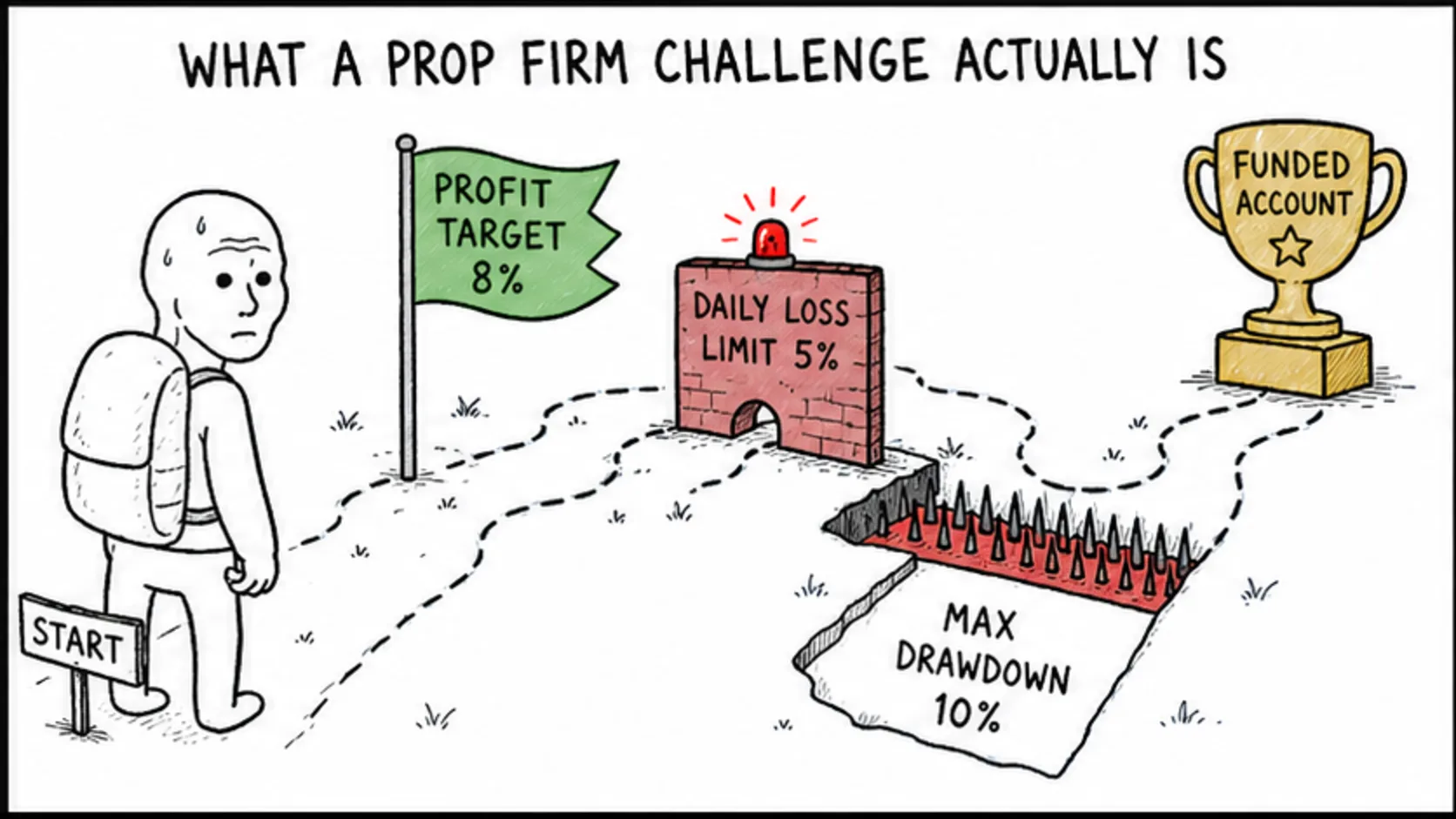
A prop firm challenge is an evaluation you pay for to prove you can trade profitably without blowing up an account. Think of it as an audition.
You pay a fee (typically $50 to $500 depending on account size), get access to a simulated trading account, and try to hit a profit target without breaking any risk rules. Pass, and you get a funded trading account with real profit splits.
Fail, and you lose the fee.
If the price tag stings, there are cheaper challenges out there that still get the job done. And if you keep failing, our what to do after failing your FTMO challenge guide has a step-by-step recovery plan that applies to any firm.
Most challenges have two phases. Phase one is the main evaluation with a higher profit target.
Phase two is verification with a lower target to confirm your results were not a fluke.
Pass both and you are funded.
Here is how the most common challenge sizes stack up. These are typical parameters across the industry, individual firms may vary slightly, but this gives you a solid baseline.
| Account Size | Typical Fee | Profit Target | Max Drawdown | Daily Loss Limit |
|---|---|---|---|---|
| $25,000 | $150–$250 | 8% ($2,000) | 10% ($2,500) | 5% ($1,250) |
| $50,000 | $200–$350 | 8% ($4,000) | 10% ($5,000) | 5% ($2,500) |
| $100,000 | $300–$550 | 8% ($8,000) | 10% ($10,000) | 5% ($5,000) |
The fee scales roughly with account size, but the percentage-based rules stay consistent. A $25K account is not easier than a $100K account, the math is proportional.
The bigger the account, the more absolute dollars you need to make and the more absolute dollars you can lose before breaching.
Phase One: The Evaluation
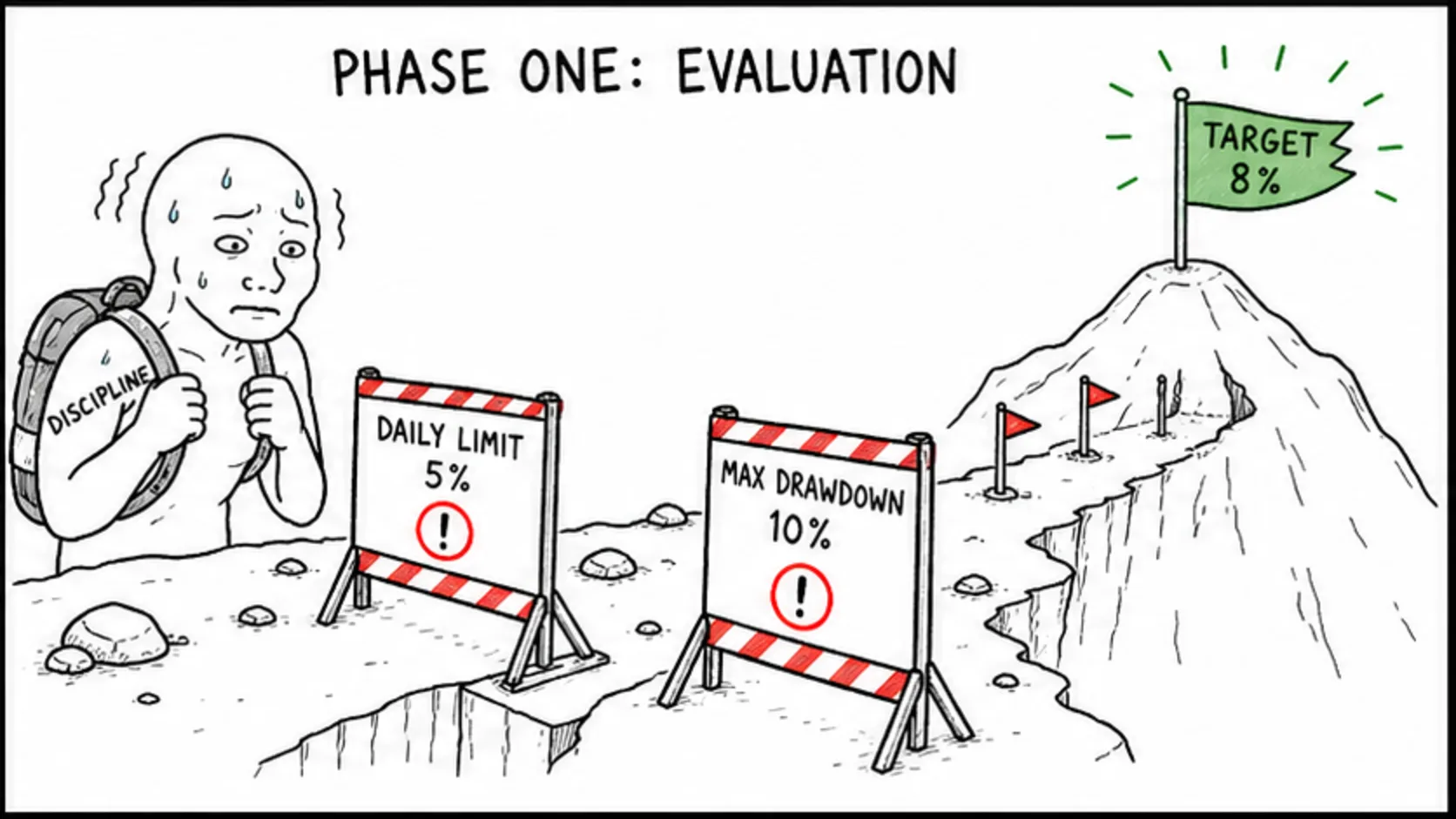
This is where most traders fail, and it is not because the trading is hard. It is because the rules are strict and the pressure is real.
Typical evaluation parameters: 8-10% profit target, 5-10% max drawdown, 3-5% daily loss limit, and a time limit of 30 calendar days (with 5-10 minimum trading days). These numbers vary by firm, but the structure is consistent across the industry.
On a $100,000 account with an 8% target, you need to make $8,000 in profit without your equity dropping below $90,000 (assuming 10% max drawdown) or losing more than $5,000 in a single day (assuming 5% daily loss limit).
That sounds manageable until you are on day 18, sitting at $6,200 profit, and the market goes quiet for a week.
The clock is ticking. The pressure builds.
This is where discipline matters more than strategy.
Let me walk through the math on a $50K account so the numbers feel concrete. A typical $50K challenge has an 8% profit target, meaning you need to make $4,000.
With a 5% daily loss limit, your maximum loss on any single day is $2,500. And with a 10% max drawdown, your equity cannot drop below $45,000 at any point.
If I risk 1% per trade ($500) and aim for a 2:1 reward-to-risk ratio, each winning trade nets me $1,000. That means I need four clean winning trades to pass, which sounds easy until you factor in the losing trades that eat into your drawdown buffer.
One more thing worth flagging here: the difference between trailing and static drawdown matters enormously in phase one. A static drawdown fixes your floor at a set dollar amount below your starting balance.
A trailing drawdown follows your equity as it rises, locking in higher lows. Trailing drawdowns are far more punishing because you cannot give back profits without closing the gap to your limit.
Phase Two: The Verification
The verification phase is easier on paper. Lower profit target (usually 5%), same risk rules, and a similar time limit.
The firm wants to see that your evaluation results were not a fluke.
Some firms skip verification entirely and go straight to funded. Others make you do two phases.
A few even have a third phase. Read the firm's structure before you buy.
The biggest mistake traders make in verification is treating it like a victory lap. It is not.
Same rules apply. Same discipline required.
Traders who relax in phase two sometimes fail because they start sizing up or taking lower-quality setups.
The split between one-step and two-step challenges is worth understanding because it directly affects how you approach the evaluation. In a one-step challenge, there is a single phase with one profit target, pass it and you are funded.
In a two-step challenge, you need to pass two consecutive phases. My take: one-step challenges look simpler on the surface, but they often compensate with tighter rules or lower drawdowns.
Two-step challenges give you a second chance to prove consistency, which can actually work in your favour if you trade methodically.
The Funded Account Phase
Once you pass both phases, you get a funded account. This is where you trade firm capital and split profits.
Typical splits range from 70-90% in your favour.
The rules are usually the same as the challenge, sometimes slightly relaxed. Some firms increase your account size over time if you perform consistently.
Others offer add-on accounts or scaling plans.
Payouts happen every 14-30 days depending on the firm. You request a withdrawal, the firm processes it, and the money lands in your account.
Some firms pay within 24 hours. Others take up to a week.
Here is the part Reddit does not like to talk about. A $50,000 funded account with an 80% split, making 5% per month, pays you $2,000 per month.
That is solid. But it is not the $10,000 per month some people on social media are promising you.
Set realistic expectations or you will overtrade trying to hit imaginary targets.
How Rule Enforcement Works
Rule enforcement is automated. There is no human reviewing your trades in real time.
Software monitors your equity, drawdown, and daily P&L continuously.
If you breach any rule, your account is closed instantly with no warning or appeals.
The system detects the breach and terminates your access.
This means floating losses count. If you have an open position that pushes your equity past the max drawdown line for even one second, you are done.
It does not matter if the trade eventually comes back into profit. The breach happened.
This catches beginners off guard constantly. They think unrealised losses do not count.
They do. The firm monitors equity, not just balance.
To understand why this distinction matters: equity-based monitoring tracks your account value including open positions, while balance-based monitoring only looks at closed trades.
Every reputable prop firm uses equity-based monitoring because it reflects your true account state. If your balance is at $52,000 but you have a $3,000 floating loss, your equity is $49,000, and that is what the drawdown rules measure against.
What happens with floating drawdown breaches is brutal. The system closes your positions at market price and the account is shut down.
There is no graceful exit. Your losing trade gets realised at the worst possible moment.
This is why managing your maximum drawdown is not just about avoiding breaches. It is about protecting yourself from catastrophic forced exits. If you want the full picture on how breaches play out in practice, I wrote about soft breach vs hard breach scenarios and what each means for your account.
The Platform Mechanics
Most prop firms use MetaTrader 4, MetaTrader 5, or cTrader as their trading platforms. Some have moved to DXtrade or Match-Trader.
You get login credentials after purchasing the challenge. The platform looks and feels like a regular trading account, because it is one.
The difference is the firm's risk rules are layered on top.
Your trades are executed on a simulated environment, not a live market. This is a point of controversy in the industry, but it is how most retail prop firms operate.
Your trades mirror live market prices, and the firm pays you from their own funds based on your simulated performance.
Here is how the four main platforms compare when it comes to prop firm challenges. The platform you end up using often depends on the firm, not your preference, but understanding the differences helps you adapt faster.
| Feature | MT4 | MT5 | cTrader | DXtrade |
|---|---|---|---|---|
| EAs / Bots | Full support | Full support | Allowed (limited) | Varies by firm |
| Mobile App | Excellent | Excellent | Good | Good |
| Charting | Basic | Improved | Advanced | Modern web-based |
| Speed / Latency | Good | Good | Fast execution | Depends on broker |
| Availability | Most firms | Most firms | Many firms | Growing |
If you plan to run automated strategies, check whether your firm's platform supports EAs before you buy, not all do.
And if you trade on the go, I have broken down prop firm VPS options for running bots 24/7 and prop firm mobile trading for managing positions from your phone.
The Payout Process
Payouts work like this. You request a withdrawal through the firm's dashboard.
The firm reviews your trading activity to confirm no rule violations. If everything checks out, they send you the money.
Most firms pay via crypto, bank transfer, or Deel. Processing times range from 24 hours to 7 business days.
Firms with longer processing times are not necessarily scamming you, but if a firm takes more than two weeks, start asking questions.
You keep your profit split minus any fees. Some firms publish FTMO payout proof to build trust with potential traders.
Some firms refund your evaluation fee with the first payout. Others do not.
Read the terms before you sign up so you know exactly what to expect.
The most common reasons payout requests get delayed: rule violations discovered during the post-payout review, incomplete KYC verification, requesting a payout during the first trading cycle before the minimum trading days are met, and withdrawal amount exceeding the firm's per-cycle cap.
Firms like FTMO and MyForexFunds publish their review timelines. If your firm does not, treat that as a red flag.
I wrote a deeper breakdown of how the payout review process works and a comparison of prop firm payment methods so you know what to expect.
Most of the firm's revenue comes from evaluation fees, not from trading losses. They need far more people to fail evaluations than to pass and request payouts.
The business model works because the failure rate is high. Whether that is a problem for you depends on whether you plan to be in the failing majority or the passing minority.
How Much Does a Prop Firm Challenge Cost?
The short answer: anywhere from $50 to $600 depending on account size and firm. Here is a breakdown of typical fees across the most common account sizes.
| Account Size | Typical Fee Range | Avg. Cost |
|---|---|---|
| $10,000 | $50–$100 | $75 |
| $25,000 | $150–$250 | $200 |
| $50,000 | $200–$350 | $275 |
| $100,000 | $300–$550 | $425 |
| $200,000 | $500–$900 | $700 |
Those are the headline fees. The less obvious costs catch more traders off guard.
Reset fees, charged when you fail and want to restart, typically run 70-100% of the original challenge price. Activation fees for your funded account range from $0 to $150 depending on the firm.
Some firms charge inactivity fees if you go a certain number of days without placing a trade. And a few charge data feed fees for accessing instruments beyond major forex pairs.
I covered all of this in detail in my guide on hidden prop firm fees and in a comparison of the cheapest prop firm challenges currently available.
What Is the Pass Rate?
Industry estimates put the pass rate at 5-10%. That means 90-95% of traders who attempt a challenge fail.
But that number is misleading. Most failures are not from bad trading. They are from rule breaches.
A trader who makes 7% on a challenge but breaches the daily loss limit on day 12 still counts as a failure. The raw pass rate lumps together traders who never had a chance with traders who simply made one rule mistake.
I dug into this properly in my breakdown of prop firm pass rates and the broader prop firm survival rate.
Here is what I have seen from my own experience and from talking to other funded traders: traders who prepare properly, trade with a written plan, and respect the drawdown limits pass at a significantly higher rate than the industry average. The 5-10% figure includes everyone who bought a challenge on a whim, had no strategy, and blew up within a week.
Common Mistakes That Fail Challenges
These are the five reasons I see traders fail challenges most often, and most of them have nothing to do with market analysis.
Overtrading after hitting 80% of target. You are sitting at 6.4% on an 8% target, and you start forcing trades because you want to cross the finish line.
This is exactly when traders blow up. The last 20% of the target requires more discipline than the first 80%.
Ignoring minimum trading days until day 25. Most firms require 5-10 minimum trading days. Hit your profit target on day 6 but need 10 trading days? You are stuck managing an open position for four more days with the risk of giving back profits.
Start trading early so you hit minimum days well before your target.
Over-leveraging on "sure" setups. I have been guilty of this myself. A setup looks perfect, so you size up.
One loss at 3x your normal risk can wipe out a week of careful trading. Trade the same size throughout, consistent risk per trade is the single biggest factor in challenge survival.
Not reading rules before starting. Different firms have different rules on news events, weekend holding, and specific instruments. Assumptions kill accounts.
Fifteen minutes of reading the rules before you start could save you $300. For a full rundown of beginner prop firm mistakes, I have covered every error I have made and observed.
How to Prepare for Your First Challenge
I recommend at least one month of demo trading before you spend money on a challenge. Not because demo trading is identical to prop firm trading, but because it forces you to build discipline without financial risk.
Before you purchase your first challenge, write a trading plan. Not a vague idea of what you will trade, a specific document that covers your entry criteria, exit rules, maximum risk per trade, and how you will handle drawdown periods.
If you do not have a plan, you are gambling with an entry fee. I put together a practical guide on building a prop firm trading journal that works for challenge prep.
Start with a small account size. I know the $100K account is tempting because the profit potential looks bigger, but a $25K challenge costs less than $250 and teaches you the same lessons.
Pass a small one first, build confidence, and scale up. My step-by-step walkthrough of how to pass a prop firm challenge covers the full preparation process from start to finish.