The one step vs two step prop firm challenge debate comes down to this: do you want one hard hurdle or two easier ones? A one step challenge has a single phase with a higher profit target and tighter rules, but you only need to pass once. A two step challenge splits the evaluation into two phases with lower targets per phase, but you have to survive both. The right choice depends entirely on how you trade, and picking the wrong one is an expensive mistake.
Key Takeaways
- One step challenges have a single evaluation phase with a profit target of 8-10%, while two step challenges split into two phases with 8% then 5% targets.
- One step challenges are faster to complete but have stricter drawdown and loss limits.
- Two step challenges give you more room per phase but require you to pass twice, which adds psychological pressure.
- Consistent, low-risk traders usually perform better on one step challenges. Traders who need flexibility tend to prefer two step.
- The funded account you receive is typically the same regardless of which challenge type you passed.
On This Page
How One Step and Two Step Challenges Work
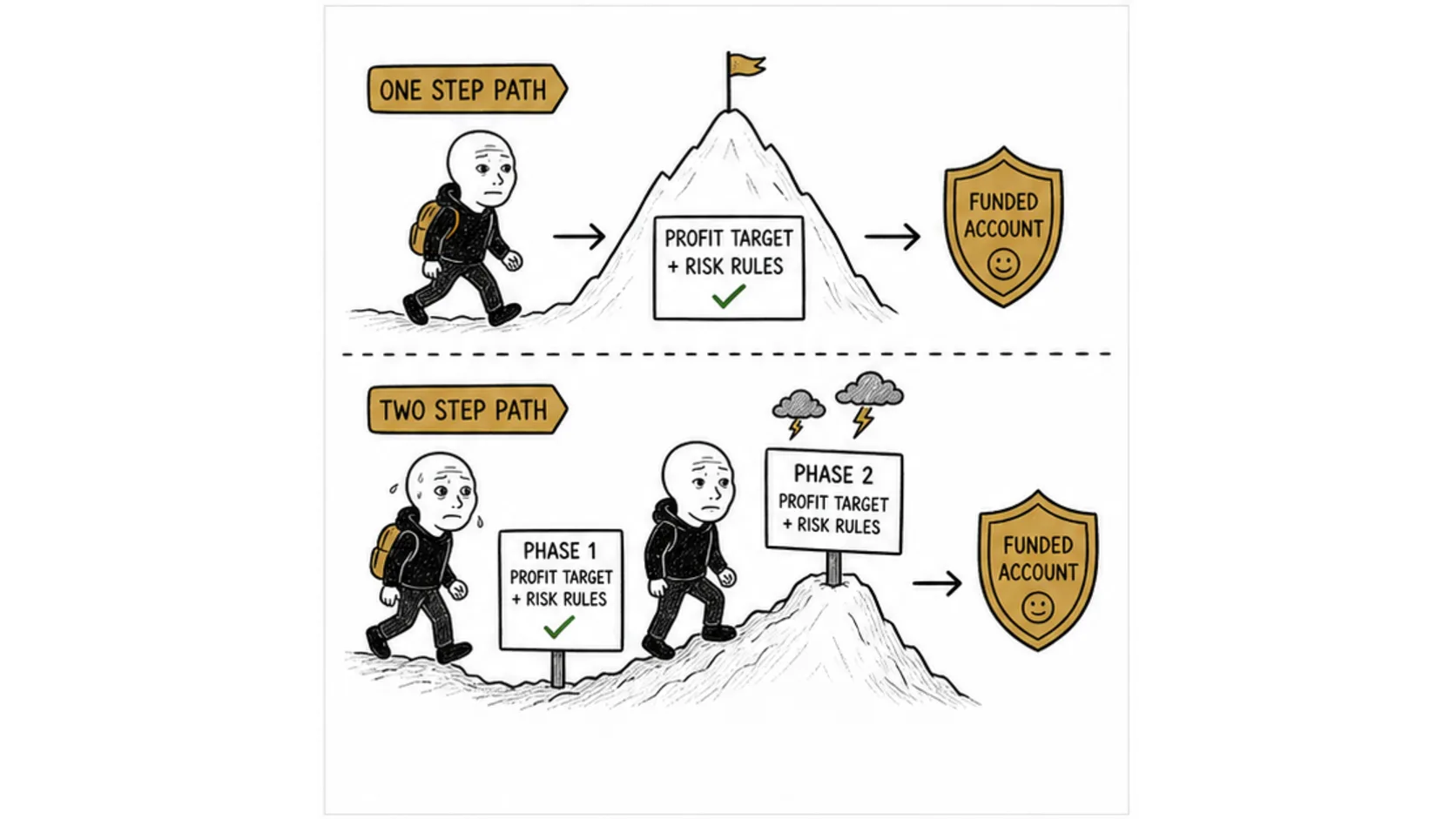
Before comparing them, you need to understand what each one actually is.
A prop firm challenge is the evaluation process you go through to prove you can trade profitably and manage risk. The firm gives you a simulated account with specific rules, and if you meet the profit target while staying inside all the rules, you get a funded account.
One step challenge. A single evaluation phase. You have one profit target to hit, one set of rules to follow, and one time limit. Pass this and you are funded. Fail and you start over.
Two step challenge. Two evaluation phases, usually called phase one and phase two. Phase one has a higher profit target, typically around 8%. Phase two has a lower target, typically around 5%. You must pass both phases to get funded.
The logic behind two steps is simple. Phase one proves you can make money. Phase two proves you can do it consistently. It sounds reasonable until you are sitting in phase two, one bad trade away from having to restart the entire process.
According to data from prop firm communities on Reddit, roughly 60% of traders who pass phase one of a two step challenge go on to fail phase two. The psychological weight of knowing you are one phase away from funding causes traders to trade differently, and usually worse.
Side by Side Comparison
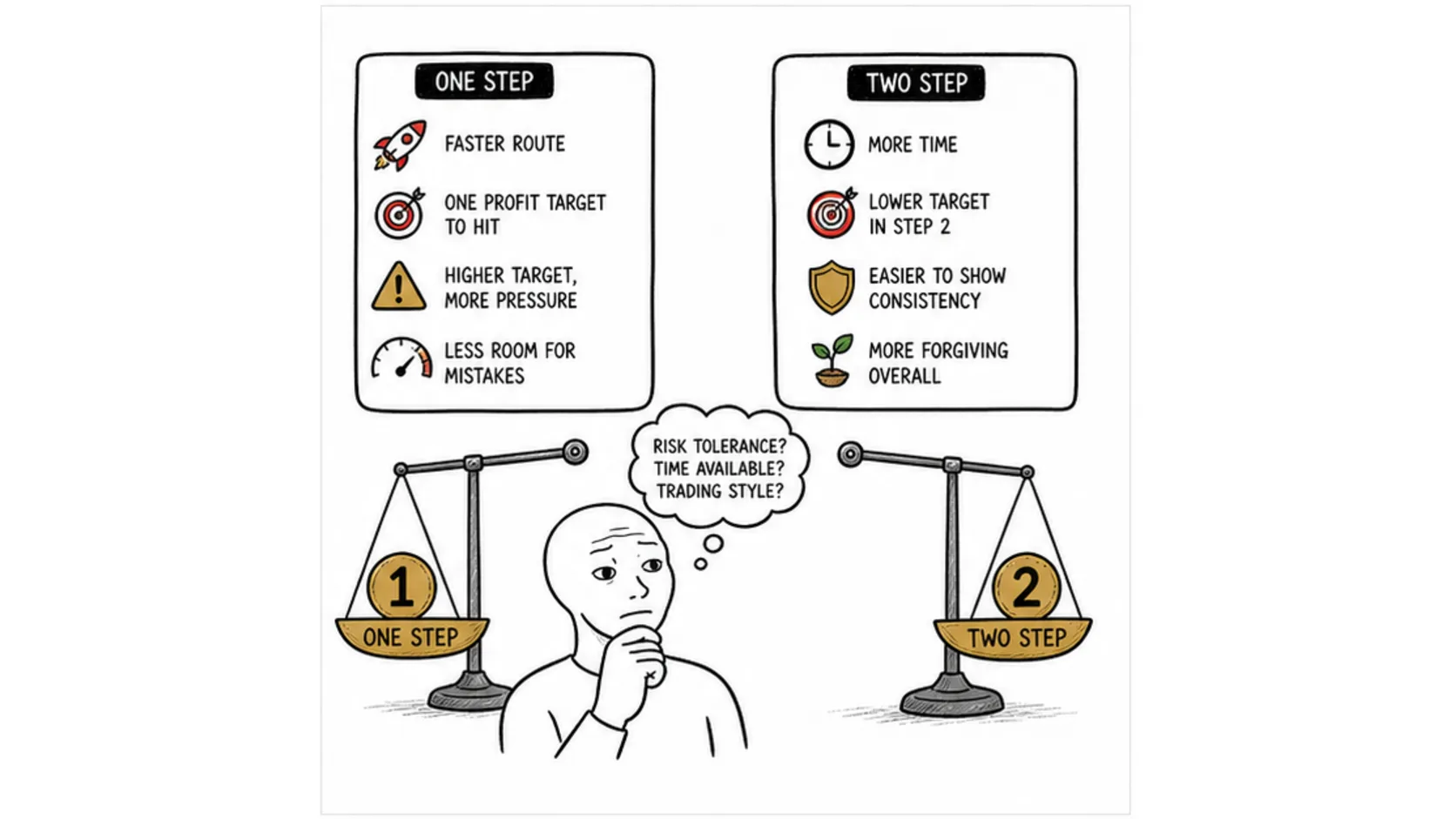
Here is the comparison at a glance. Every rule and parameter laid out so you can see exactly what you are signing up for.
| Feature | One Step Challenge | Two Step Challenge |
|---|---|---|
| Number of phases | 1 | 2 |
| Profit target | 8-10% (single phase) | Phase 1: 8%, Phase 2: 5% |
| Max drawdown | Typically stricter (4-6%) | Usually looser (8-10%) |
| Daily loss limit | Tighter (3-4%) | More generous (4-5%) |
| Time limit | Unlimited or 30 days | Unlimited or 30+60 days |
| Challenge fee | Usually higher | Usually lower |
| Speed to funded | Faster (one phase) | Slower (two phases) |
| Psychological load | Single push, higher stakes | Two pushes, lower stakes each |
| Refund policy | Fee refunded on first payout | Fee refunded on first payout |
The table tells most of the story. One step is more compressed. Two step is more spread out. Neither is universally better.
One Step Challenges: The Full Breakdown
One step challenges are the fast track. One phase, one profit target, one set of rules. Get it done and you are funded.
The profit target. Typically 8-10% of the account balance. On a $100,000 account, you need to make $8,000 to $10,000 in profit. That sounds like a lot, and it is. But you have no second phase to worry about.
The drawdown rules. This is where one step challenges get painful. Because you only have one phase, the firm tightens the drawdown to compensate. Typical max drawdown is 4-6%, compared to 8-10% on a two step challenge.
On a $100,000 account with a 5% drawdown, your hard floor is $95,000. Drop below that at any point and the challenge is over.
The daily loss limit. Usually 3-4% on one step. Tighter than two step. You cannot afford a big losing day because the drawdown budget is smaller.
The advantage. Speed. If you are a strong trader having a good couple of weeks, you can go from challenge purchase to funded in 10-15 trading days. No phase two to sweat through.
The disadvantage. Less room for error. A few bad trades can eat through your drawdown quickly, and there is no second phase where the rules get easier.
Learning how to pass a prop firm challenge on one step requires tighter risk management from day one. For a deeper look at how FTMO structures its 1-step and 2-step options, see our FTMO 1-step vs 2-step comparison. You need to be disciplined immediately, not just after you have built a buffer.
Two Step Challenges: The Full Breakdown
Two step challenges are the traditional model. Phase one with a higher target, phase two with a lower target. Pass both and you are funded.
Phase one. Profit target of typically 8%. Same as the one step challenge, but the rules are usually more forgiving. Higher max drawdown, higher daily loss limit.
On a $100,000 account, you need $8,000 profit with maybe $8,000 to $10,000 of drawdown room. That gives you more breathing space than a one step challenge.
Phase two. The profit target drops to about 5%. On a $100,000 account, that is $5,000. Easier target, but the rules often stay the same or get slightly tighter.
The real challenge of phase two is not the target. It is the psychology. You already proved yourself in phase one. You are one phase away from funded money. And that knowledge makes traders do weird things. They size down too much, they skip good setups, they overthink every entry.
The advantage. More forgiving rules per phase. Phase two has a lower profit target, so you do not need to hit home runs. Consistency matters more than explosive gains.
The disadvantage. You have to pass twice. The firm gets two chances to filter you out, and the psychological toll of phase two is real. Many traders pass phase one easily and then fail phase two because they changed their trading style.
Which One Is Actually Easier to Pass
It depends on what kind of trader you are. That is not a dodge — the right choice really does come down to your trading style.
If you are a consistent trader with low drawdowns and steady daily returns, one step is probably easier. You trade your normal game, hit the target, and you are done. No phase two mind games.
If you are a trader who has good weeks and bad weeks, or who sometimes needs a few losing days before finding your rhythm, two step is safer. The rules are more forgiving per phase, and you have room to recover from a rough patch.
Here is what the data suggests. The pass rate for one step challenges is roughly 8-15%. The pass rate for two step challenges, combining both phases, is roughly 5-10%.
One step has a higher pass rate. But that does not mean it is easier. It means fewer people buy one step challenges because they are more expensive, and the people who do buy them tend to be more experienced.
The European Securities and Markets Authority has noted that the complexity of multi-phase evaluations can be misleading for retail traders, who may not fully understand the cumulative difficulty of passing multiple phases.
The Beginner Answer
If you are new to prop firms and have never taken a challenge before, start with a two step challenge on a smaller account size. FTMO offers both 1-Step and 2-Step challenges — see our FTMO review for a full comparison of which path suits your trading style.
Why? Because the rules are more forgiving. You get a bigger drawdown budget, a higher daily loss limit, and a lower profit target in phase two. All of these things make your first challenge less stressful.
The cost of the challenge fee is usually lower for two step as well, which means if you fail, it hurts less financially.
You will learn more from a two step challenge because you experience the discipline required over a longer period. Phase two teaches you consistency in a way that one step cannot replicate.
Once you have passed one or two two step challenges and understand how your trading translates to the prop firm environment, then consider switching to one step for speed.
The Advanced Trader Answer
If you have already passed challenges before, you have a funded track record, and you know your numbers cold, go one step.
One step saves you time. You trade your plan, manage risk, hit the target, and you are funded in half the time. No phase two mind games. No second hurdle. Just clean execution.
The tighter rules are not a problem for you because you already trade within those limits. Your daily loss is well under 3% on your worst days. Your max drawdown never comes close to 5%.
If any of that is not true, you are not advanced enough for one step yet. Stay on two step until your numbers prove otherwise.
Your risk management plan should dictate your challenge choice, not your ego. If your max historical drawdown over 60 days is 7%, do not pick a one step challenge with a 5% drawdown limit. The math does not work.
The Real Recommendation
Here is what I would actually do, stripped of all the nuance and caveats.
If this is your first challenge: two step, $25K or $50K account, cheapest reputable firm you can find. Your goal is to learn the process, not to get rich on the first try.
If you have passed a challenge before but failed the funded phase: two step again, but this time focus on the funded account rules more than the challenge rules. The challenge is the easy part. The psychology of the funded account is where you fell apart.
If you have been funded before and want to scale: one step, $100K account, whatever firm offers the best payout terms. You know what you are doing. Go fast.
If you are a scalper or day trader with tight risk management: one step. Your equity curve is smooth enough to survive tighter rules, and the speed advantage matters.
If you are a swing trader or position trader who needs wider stops: two step. The bigger drawdown budget per phase matches your trading style. Do not fight it.
And whatever you choose, read the challenge tips guide before you start. The difference between passing and failing is rarely the challenge type. It is the preparation.
The best challenge type is the one that matches how you actually trade. Not the one that sounds easier. Not the one with the lower fee. The one that lines up with your risk profile, your strategy, and your discipline level.