Any challenge strategy has to respect leveraged-market risk first. The Commodity Futures Trading Commission warns traders not to underestimate how quickly losses can build.
I have been through more prop firm evaluations than I care to count. Some I passed. Some I blew on day two because I could not follow my own rules. After 15 years of this, I have distilled everything into one guide that covers the strategy, the risk management, the mental game, and the specific tips that separate funded traders from the 90% who fail their first attempt.
Most traders search for a magic strategy that guarantees a pass. It does not exist. What does exist is a systematic approach that dramatically improves your odds when you follow it.
Key Takeaways
- Your challenge strategy should be simpler than your normal trading. Focus on your highest-probability setups only.
- Position sizing is more important than entry timing. Risk 0.5-1% per trade and let the math do the work.
- Break the profit target into daily goals. On a $50K account with an 8% target, you need roughly $200 per day over 20 days.
- The 3-5-7 rule is a good concept, but the numbers are too loose for prop firms. Tighten them to 1-2-4.
- Stop trading after three consecutive losses. Pressure management matters more than trade selection.
On This Page
- What Actually Matters in a Challenge Strategy
- Position Sizing: The Strategy Within the Strategy
- Trade Selection: Only Your Best Setups
- Daily Targets: The Math That Makes It Work
- Handling Losing Streaks
- Adapting to Market Conditions
- The 3-5-7 Rule: Does It Actually Work?
- Can You Make $100 a Day Daytrading?
- Which Strategy Types Actually Work for Challenges?
- What Win Rate Do You Actually Need?
- The 12 Challenge Tips That Actually Matter
- The Recipe for Passing Every Time
- Frequently Asked Questions
What Actually Matters in a Challenge Strategy?
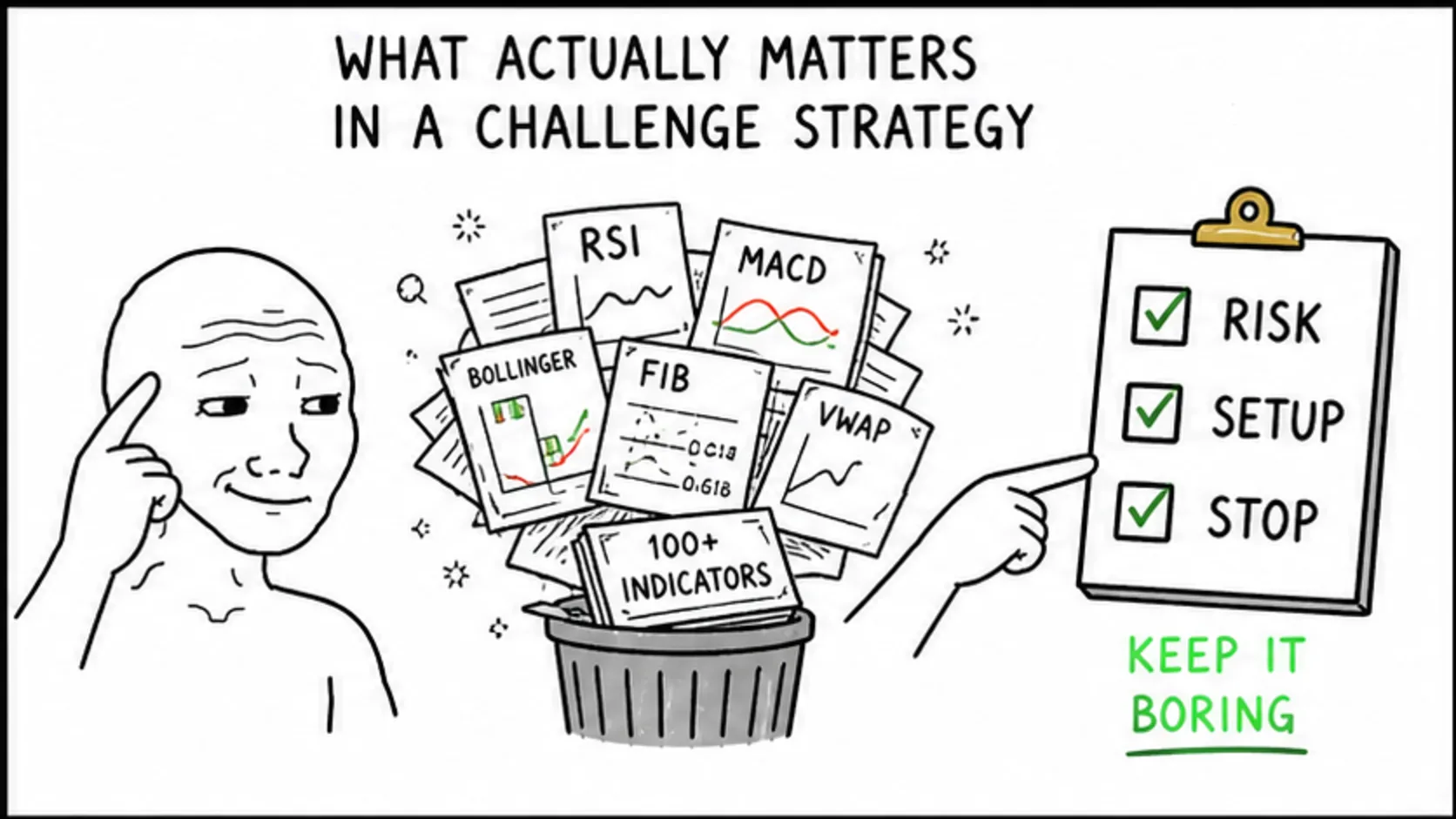
The most important thing about a prop firm challenge strategy is not the specific entries or exits. It is the framework around them. The traders who understand how prop firm challenges actually work before they start have a massive advantage over those who just pay the fee and hope.
Before you even think about placing a trade, you need to understand the rules, the math, and the psychology of what you are about to do. Most traders skip this part and fail on day three. If you are brand new, start with our explainer on what a prop firm challenge actually is.
Read every rule the firm publishes. Know your daily loss limit, your maximum drawdown, and whether the drawdown is trailing or static. Our FTMO drawdown rules breakdown walks through exactly how their mechanics work. If you cannot explain these to a friend, you are not ready.
The three things that matter most are position sizing, trade selection, and psychological discipline. Entry quality matters, but it ranks third. I have watched brilliant technical analysts blow challenge accounts because they sized too aggressively after a winning streak. The framework beats the setup every time.
Position Sizing: The Strategy Within the Strategy
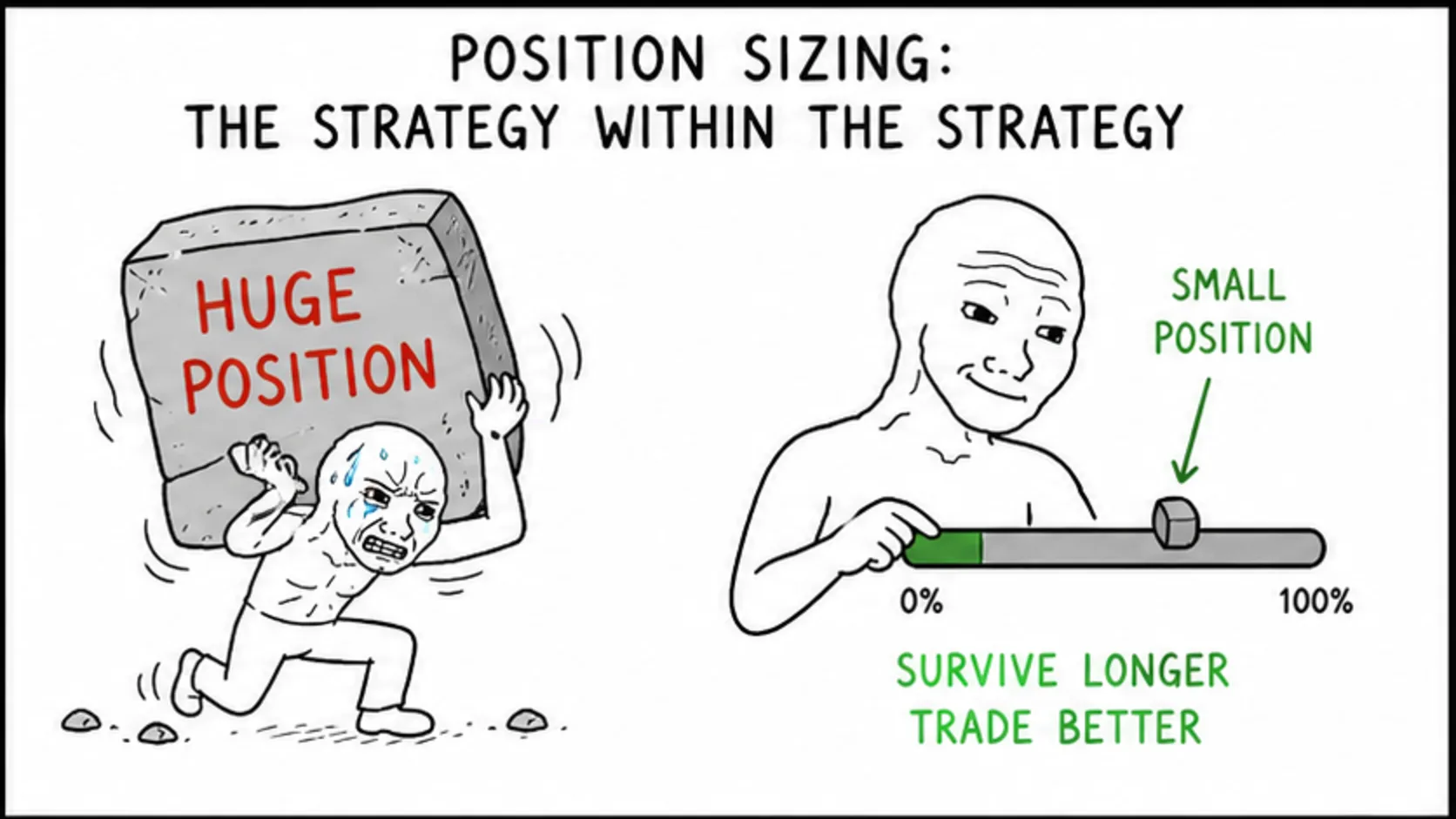
Position sizing is the strategy within the strategy. Get this right and you can pass with almost any reasonable trading approach. Get it wrong and the best analysis in the world will not save you.
Risk 0.5-1% per trade. Always. This is non-negotiable for challenges. On a $10,000 account, that is $50-$100 per position. On a $50,000 account, $250-$500. On a $100,000 account, $500-$1,000.
Those numbers should feel boring. If they feel exciting, you are risking too much.
Let me show you why this works with real math. Say you have a $50,000 account and you risk 1% per trade. You take five consecutive losses, which is a brutal losing streak. That is five trades at $500 each, totaling $2,500 in drawdown. Your account sits at $47,500.
You have used 5% of your maximum drawdown on five straight losses. You are still alive, still trading, and still in the challenge.
Now picture the same scenario with 3% risk per trade. Five losses at $1,500 each means $7,500 gone. Your account is at $42,500. You have burned through 15% of your drawdown in five trades, and most firms set total drawdown at 8-10%. Your challenge is effectively over. One bad streak and done.
| Account Size | 0.5% Risk (per trade) | 1% Risk (per trade) | 5 Losses at 0.5% | 5 Losses at 1% |
|---|---|---|---|---|
| $10,000 | $50 | $100 | 2.5% drawdown | 5% drawdown |
| $25,000 | $125 | $250 | 2.5% drawdown | 5% drawdown |
| $50,000 | $250 | $500 | 2.5% drawdown | 5% drawdown |
| $100,000 | $500 | $1,000 | 2.5% drawdown | 5% drawdown |
That is the margin of safety you need. The market does not care about your analysis. It cares about your position size relative to your account. This is the single biggest differentiator between traders who consistently pass evaluations and those who keep paying challenge fees.
Trade Selection: Only Your Best Setups
During a challenge, you should only be trading your A+ setups. Not B setups. Not C setups with a good feeling. Your absolute best entries. Nothing else.
If your A+ setup does not appear on a given day, do not trade. There is no penalty for zero trades. There is a huge penalty for forcing suboptimal entries.
I learned this the expensive way during my third FTMO evaluation back in 2019. I took four B-grade setups in one day trying to be productive. Lost on all four. My challenge was over by lunch.
The challenge is a marathon, not a sprint. You have 20-30 trading days to hit an 8% or 10% target. Missing one day of trading is infinitely better than taking a bad trade that costs you 2% of the account. Build a checklist of what makes an A+ setup, then refuse to deviate from it.
Here is what my personal A+ checklist looks like. The setup must align with the higher timeframe trend. It must hit a key level I have pre-identified. It must have a clear invalidation point for my stop loss. If all three boxes are not checked, I do not click the button. No exceptions during a challenge.
Daily Targets: The Math That Makes It Work
Break the profit target into daily goals. This reframing is what turned my own challenge passing rate from about 30% to over 70%. When you stop thinking about a big scary number and start thinking about a small daily milestone, everything changes.
Here is the math across common account sizes with an 8% profit target. On a $10,000 account, you need $800 total. Over 20 trading days, that is $40 per day. Over 25 days, $32 per day.
On a $50,000 account, you need $4,000 total. Over 20 days, $200 per day. Over 25 days, $160 per day.
On a $100,000 account, you need $8,000 total. Over 20 days, $400 per day. Over 25 days, $320 per day.
| Account Size | 8% Target | $ per Day (20 days) | $ per Day (25 days) | % per Day |
|---|---|---|---|---|
| $10,000 | $800 | $40 | $32 | 0.4% |
| $25,000 | $2,000 | $100 | $80 | 0.4% |
| $50,000 | $4,000 | $200 | $160 | 0.4% |
| $100,000 | $8,000 | $400 | $320 | 0.4% |
Notice something? The daily percentage is the same across every account size. That is because the target is always 8% regardless of account size. A 0.4% daily return is not intimidating for any of these accounts. One decent trade with conservative sizing can hit it.
If your firm uses a 10% target instead of 8%, the daily numbers increase by 25%. A $50K account with a 10% target needs $250 per day over 20 trading days. Still achievable. Still boring. Still the right approach.
The key is stringing together consistent days without the bad ones wiping out the good ones. Two winning days of $200 followed by one losing day of $300 puts you at $100 net over three days. That is positive progress. The moment you try to make it all back in one trade, the math breaks.
Handling Losing Streaks and Pressure
Losing streaks are inevitable. What separates funded traders from failed evaluations is how they respond to them. Not whether they happen, but what you do when they do.
When you hit three losses in a row, stop trading for the day. Do not try to make it back. Do not increase your size. Close the platform and come back tomorrow. I cannot stress this enough.
Three small losses on a well-sized account means almost nothing. Three losses followed by a revenge trade that blows your daily loss limit means your challenge is over, and it is one of the most common FTMO beginner mistakes we see traders make.
The pressure builds in specific ways during a challenge. You lose two trades and start thinking you need to make it back before the day ends. You check your equity curve obsessively. You start adjusting stop losses mid-trade because the position is moving against you. Every one of these behaviours comes from the same root cause: you are focused on the result instead of the process.
Managing trading stress is a skill you can build. Before your challenge starts, define your daily stop and your daily target in advance. Write them down. When you hit either one, you are done for the day. This removes the decision-making entirely. You are not negotiating with yourself at 3pm about whether to take one more trade.
Pressure also comes from the financial investment. You paid $500 or more for this evaluation. That creates a psychological weight that does not exist on demo. The solution is not to ignore the money. It is to accept that the fee is a sunk cost before you begin.
You will not get it back whether you pass or fail. Trade the account, not the fee.
Adapting to Market Conditions
Market conditions change. Your challenge strategy needs to account for that without abandoning your core approach. This is where prop firm discipline becomes critical. You must follow your rules even when conditions tempt you to break them.
If volatility spikes, reduce position size. If the market goes quiet and your setups are not appearing, wait. Do not invent new setups because you are bored. I spent an entire week during a Funded Next evaluation sitting on my hands because the market was choppy.
Frustrating? Yes. Did I pass that challenge? Also yes. Because I did not give back my profits forcing bad trades.
Risk management adapts to conditions. Your entry criteria should not. If the setup meets your criteria, take it. If it does not, do not. The market will always be there tomorrow. Your challenge account will not be if you breach the drawdown.
News events deserve special mention. High-impact releases like NFP, CPI, and FOMC widen spreads dramatically. Your stop can slip and a perfectly planned trade becomes a challenge-ending loss. There is always another setup tomorrow. Avoid trading during major news events unless your strategy is specifically designed for volatility expansion.
The 3-5-7 Rule: Does It Actually Work?
You have probably seen the 3-5-7 rule floating around trading TikTok and YouTube. The idea is straightforward: risk no more than 3% per trade, no more than 5% per day, and no more than 7% per week. It sounds sensible. It is. But it was designed for personal accounts, not prop firm challenges.
For prop firm challenges, the 3% per trade part is too aggressive. On a $100K account, that is $3,000 risk on a single position. One bad trade and you have used up a third of your daily loss limit on most firms. On a $50K account, 3% means $1,500 risk. Most firms set daily loss limits at 4-5% of initial balance, which is $2,000-$2,500 on that same account. You would be risking over half your daily allowance on one trade.
| Parameter | Original 3-5-7 | Prop Firm Tightened | Why the Change |
|---|---|---|---|
| Per Trade Risk | 3% | 0.5-1% | One bad trade must not threaten your challenge |
| Daily Loss Limit | 5% | 1.5-2% | Leave room for the firm's actual limit |
| Weekly Drawdown | 7% | 3-4% | Protect against trailing drawdown mechanics |
Here is a better version for challenges. Risk 0.5-1% per trade instead of 3%. Keep daily losses under 2% instead of 5%. Keep weekly drawdown under 4% instead of 7%. These tighter numbers give you a buffer between your personal stop and the firm's hard limit. That buffer is the difference between living to trade another day and getting a notification that your account is closed.
The original 3-5-7 rule was designed for personal accounts where you can always deposit more money. In a prop firm challenge, one breach and your evaluation is gone. There is no second chance. If you want to practise risk management without risking a fee, some firms like FTMO offer a free trial to test the experience first.
So does the 3-5-7 rule work? The concept is sound. The numbers are too loose for prop firms. Tighten them up and you have something useful. Think of it as the 1-2-4 rule and you are on the right track.
Can You Make $100 a Day Daytrading?
This question comes up constantly in search results, and I have answered it honestly below because it directly relates to challenge math. Yes, $100 per day is achievable. No, it is not easy, and most people who ask this question are framing the problem incorrectly.
On a $50,000 funded account, $100 per day is a 0.2% return. That is one small winning trade with conservative lot sizing. Completely realistic for a trader with a working strategy and proper risk management. On a $10,000 account, $100 per day is a 1% return, which is ambitious but possible. On a $100K account, $100 per day is a 0.1% return, which is practically a rounding error.
But the question itself reveals the wrong mindset. You should not be targeting a dollar amount per day. You should be targeting your A+ setups and letting the numbers work out.
Some days you make $300. Some days you lose $150. Some days you make nothing because no setup appeared. Over 20 days, if your strategy has an edge, the net result is positive.
Traders who fixate on a daily dollar target tend to force trades on slow days to hit their number. That is how you blow challenges. The most profitable traders I know could not tell you what they made yesterday. They could tell you whether they followed their rules. Trade your plan, not your daily quota.
Which Strategy Types Actually Work for Challenges?
This comes up constantly on Reddit and in every trading forum: what strategy works best for prop firms, scalping, day trading, or swing? Let me rank them honestly based on what I have seen over 15 years of evaluations.
Day trading. Solid tier. Open positions during your session, close them before you sleep. You control overnight risk, you can manage your daily loss limit in real time, and you get clean data on your session performance. This is what most funded traders do, and for good reason.
Scalping. Mid tier for challenges. Works great if you have a tested edge and tight execution. But scalping generates more trades, which means more chances to revenge trade after a loss. The emotional discipline requirement is higher. If you scalp, you need an iron-clad daily stop limit and the self-awareness to walk away when you are tilted.
Swing trading. Garbage tier for most challenges. Not because swing trading is bad. It is not.
But most challenges have 20-30 day limits and trailing drawdowns that punish overnight holds. One bad gap while you sleep and your challenge is over. Some firms are better for swing traders, but they are the minority.
The verdict. Day trading is the sweet spot for most prop firm challenges. You are awake, you are in control, and you can react to drawdown situations in real time.
What Win Rate Do You Actually Need?
A question nobody answers honestly. Let me fix that right now with actual numbers instead of vague encouragement.
If your strategy has a 1:1 risk-to-reward ratio, you need a 50%+ win rate to be profitable. If your strategy has a 1:2 risk-to-reward, you only need 34% to break even. If your strategy runs at 1:1.5, you need approximately 40% to break even. These are mathematical facts, not opinions.
For prop firm challenges, a win rate between 40-60% with a risk-to-reward of 1:1.5 or better is the sweet spot. This gives you enough winning trades to build consistent equity while keeping individual losses small enough to survive losing streaks.
Do not fixate on win rate alone. A trader winning 70% of trades with tiny profits and huge losses will blow a challenge faster than a trader winning 40% of trades with proper risk management. I have seen it happen dozens of times. High win rate feels good. It means nothing without the right reward-to-risk ratio behind it.
The metric that matters is expectancy: (win rate x average win) minus (loss rate x average loss). If that number is positive, your strategy has an edge. If it is not, no amount of discipline will save you. Calculate your expectancy before you pay for a challenge. If it is negative on your last 50 trades, you are not ready.
The 12 Challenge Tips That Actually Matter
I have compressed everything I have learned into 12 actionable tips. These are not theoretical. They come from real evaluations I have taken, real money I have lost, and real patterns I have observed in the traders I mentor.
1. Read every rule before paying. Know your daily loss limit, maximum drawdown, and whether the drawdown is trailing or static. This is the single most common reason traders fail on day one. They did not read the rules.
2. Risk 0.5-1% per trade, max. Set a personal daily loss limit at 50% of the firm's limit. If the firm allows 5% daily drawdown, you stop at 2.5%. That buffer is your insurance policy.
3. Trade only your A+ setups. The challenge is not the time to experiment with new patterns or indicators. Use the strategy you already have tested on demo.
4. Stop trading after hitting your daily profit target. Overtrading kills more challenges than bad analysis. When you are up for the day, close the platform. Tomorrow is another day.
5. Break the target into daily goals. A $4,000 profit target on a $50K account sounds massive. $200 per day sounds achievable. Same number, different psychology.
6. Never revenge trade. Three losses in a row means you are done for the day. No exceptions. The urge to make it back is the most dangerous feeling in trading. Building discipline against revenge trading takes conscious effort.
7. Avoid trading during major news events. NFP, CPI, FOMC. Spreads widen, slippage increases, and reasonable stops get hit. There is always another setup tomorrow.
8. Use a trade journal. Review every trade at the end of the day. Note what worked, what did not, and whether you followed your rules. The traders who improve fastest study their own behaviour.
9. Do not change your strategy mid-challenge. If your approach is not working, it is almost always a position sizing or trade selection problem. Not a strategy problem. Adjust your risk, do not rebuild your system.
10. Trade one session and stop. Do not sit in front of charts for 12 hours looking for reasons to enter trades. Trade your best session, then walk away. Fatigue leads to mistakes.
11. Accept that losing is part of the process. Every funded trader has blown challenge accounts. The difference is they learned from each one and kept going. Your challenge fee is tuition, not an investment.
12. Protect the account above all else. Passing is not about hitting the profit target fast. It is about not breaching the drawdown. Play defense first. The offense follows naturally when you are calm and controlled.
The Recipe for Passing Every Time
The recipe is simple. Risk small, trade your best setups, protect the account above all else, and let time do the work. That is it. There is no secret sauce, no hidden indicator, no Telegram group with a magic signal.
Most traders know this. Most traders do not do it. That is the gap between passing and failing. The 12 tips above are the complete framework. Position sizing, trade selection, daily targets, and psychological discipline. Execute those four things consistently and the math is on your side.
The traders who get funded are not smarter than you. They just execute the boring stuff consistently. They risk 0.5-1% instead of 3%. They wait for A+ setups instead of forcing trades. They stop after three losses instead of revenge trading into a blown account. That is the entire edge.
Now you know it too. Once you pass, here is what actually happens next.