You passed your prop firm challenge. Congratulations. Passing is not the finish line. It is the starting line. What happens when you pass a prop firm challenge depends on the firm, the account type, and whether you are prepared for the part that actually matters: not losing the funded account.
Key Takeaways
- Most firms either fund you directly or require a second verification phase with a lower profit target before giving you real capital.
- KYC identity verification happens between passing and funding, and it can take 24-72 hours.
- Your funded account has the same or similar risk rules as the challenge. You can absolutely lose it.
- Your first payout typically requires 14-30 days of profitable trading on the funded account.
- The biggest risk after passing is psychological. Traders change their behavior the moment they get funded.
On This Page
What Happens After You Pass a Prop Firm Challenge?
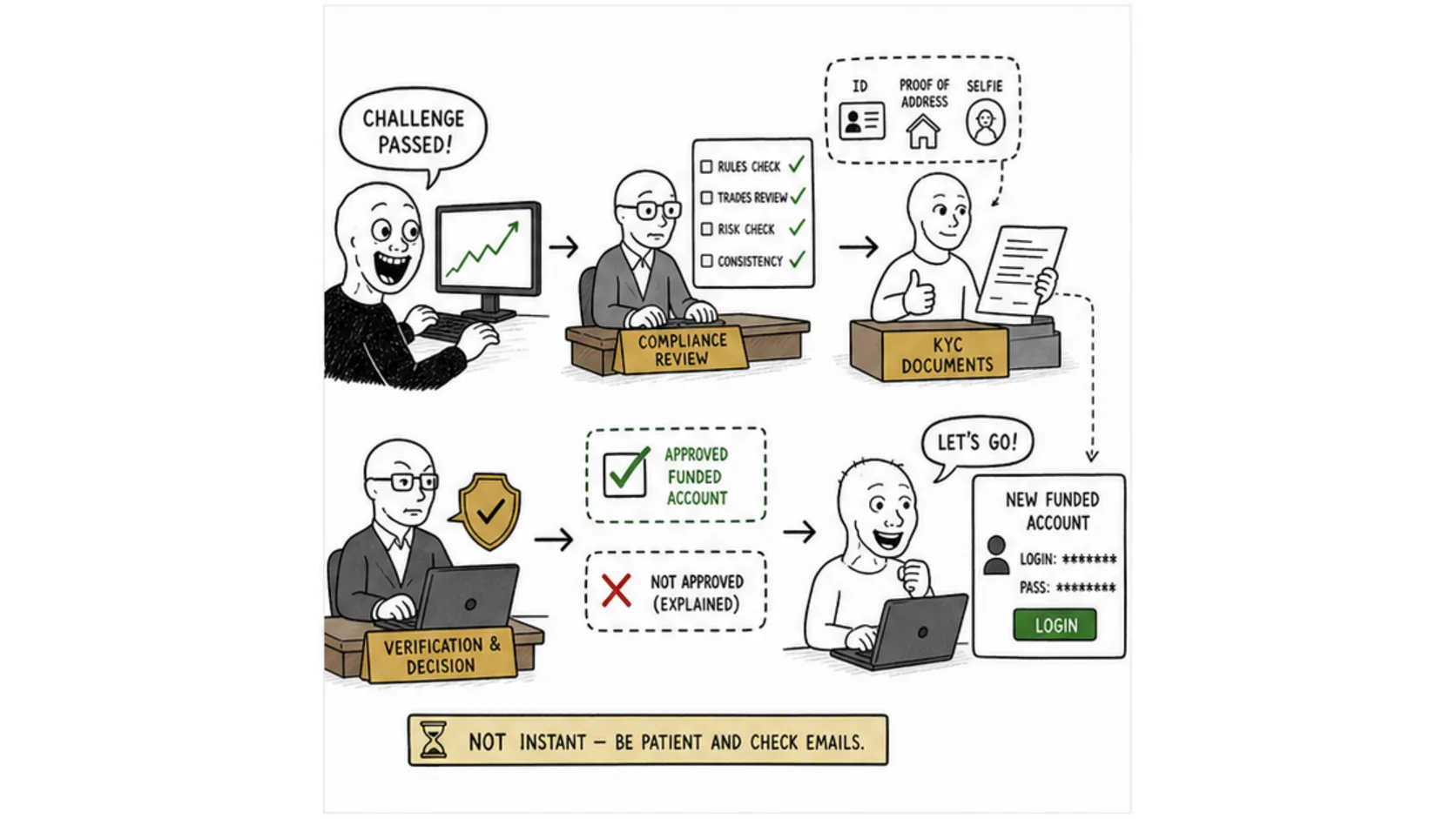
The exact sequence depends on the firm, but here is the general process that covers 90% of prop firms.
You hit the profit target. You stay within the drawdown. You meet the minimum trading days. The platform shows "Challenge Passed." Now the firm takes over.
Step one: the firm reviews your account. They check for rule compliance, unusual trading patterns, and that you did not exploit any loopholes. This usually takes a few hours but can take up to 24 hours.
Step two: KYC verification. If you have not already submitted identity documents, this is when the firm asks for them. Government ID, proof of address, sometimes a selfie holding your ID. More on this in the KYC section below.
Step three: you either get funded directly or enter a verification phase. Two-step challenge firms like FTMO (Read my FTMO Review on PassPropTradingFirms) require a second phase. One-step firms fund you immediately after passing.
Step four: you receive your funded account credentials. New login, new account, new rules to respect.
None of this happens instantly. Even the fastest firms take 24-48 hours from the moment you pass to the moment you are trading funded capital. The slow ones can take a week if KYC gets backed up.
The Verification Phase: What Most Firms Do Next
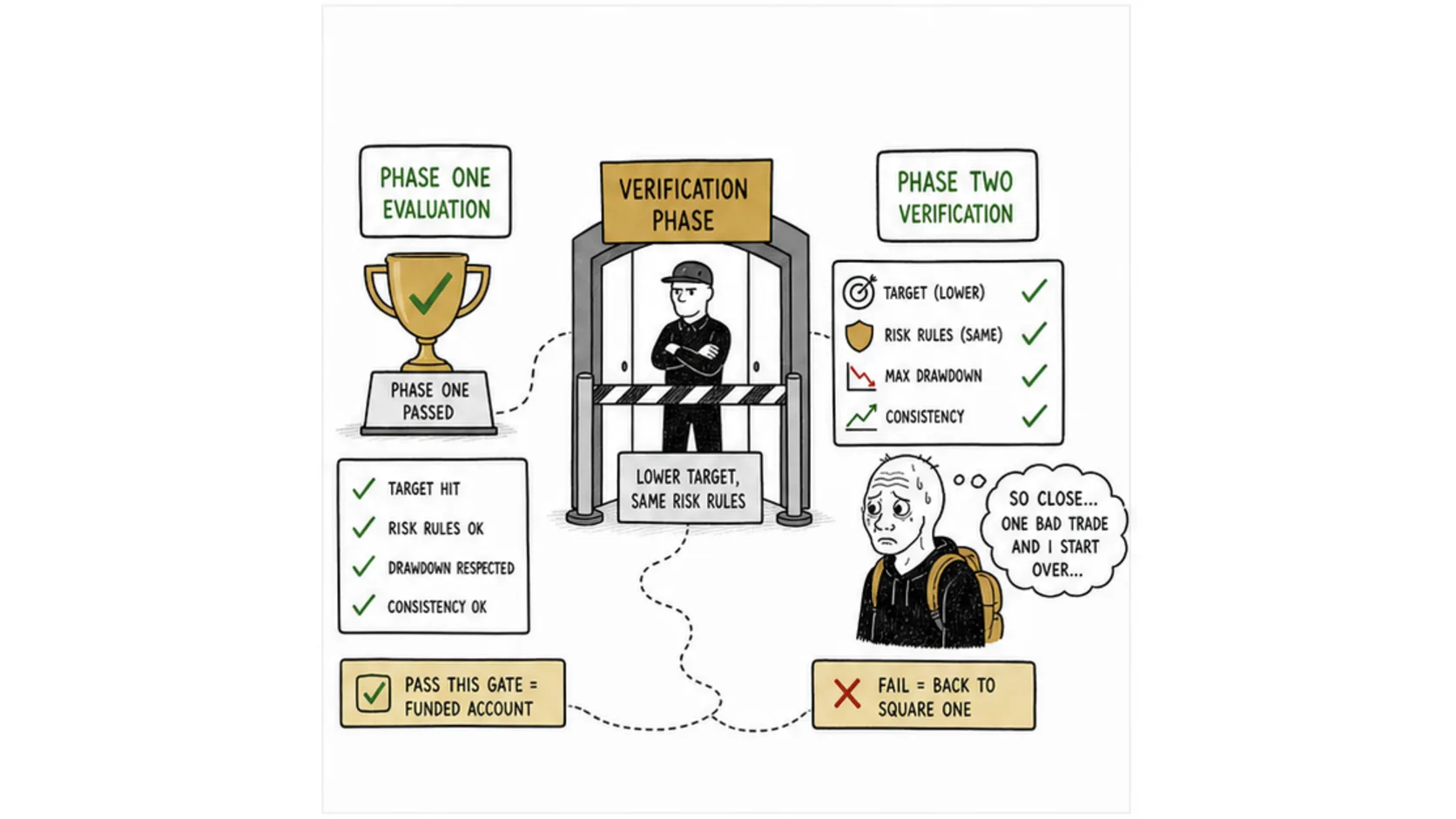
If your firm uses a two-step challenge model, passing phase one does not mean you are funded yet. You have to pass phase two, usually called the verification phase.
The verification phase is easier on paper but psychologically brutal. Here is why.
The profit target is typically half of phase one. Phase one required 10%, phase two asks for 5%. Same drawdown rules, same daily loss limit, same minimum trading days. On paper, this should be simple. You already proved you can do it.
In practice, traders fall apart in verification because the pressure changes. Phase one felt like an experiment. Phase two feels like the real thing. You are one step away from actual money. And that is exactly when people start making stupid decisions.
The fix is simple. Trade exactly the same way you did in phase one. Same strategy, same position size, same risk management. The verification phase is not the time to experiment. It is the time to repeat what already worked.
One-step challenge firms skip verification entirely. You pass once, you get funded. This is faster, but these challenges often have stricter drawdown rules or higher entry fees to compensate for the reduced filtering.
About 70% of traders who pass phase one also pass phase two, according to data from several major prop firms. The 30% who fail are not worse traders. They just could not handle the pressure shift.
KYC and Identity Verification
Before any prop firm hands you funded capital, they need to verify who you are. This is standard across the industry and it is non-negotiable.
Typical KYC requirements include a government-issued photo ID (passport or driver's license), a proof of address document (utility bill or bank statement dated within the last 90 days), and sometimes a selfie holding your ID next to your face.
Some firms run KYC when you first sign up and buy the challenge. Others wait until after you pass. If your firm does it after you pass, do not let this be the thing that delays your funding. Have your documents ready before you even start the challenge.
The Financial Conduct Authority requires prop firms operating from the UK to perform KYC checks. Even firms outside regulated jurisdictions still run KYC because it protects them from fraud. A trader who cannot verify their identity does not get funded, full stop.
KYC processing takes 24-72 hours at most firms. If there are discrepancies between your documents and your account information (wrong name spelling, different address), it can take longer. Get it right the first time.
Getting Your Funded Account: The Actual Transition
Once you pass the challenge and clear KYC, the firm sends you new credentials for your funded account. This is a separate account from your challenge account.
The funded account matches the size you purchased. If you bought a $50,000 challenge, your funded account is $50,000. If you bought $100,000, you get $100,000. The firm provides the capital. You trade it.
Here is the part that surprises people. Your funded account is usually a demo account that mirrors live market conditions. The prices are real, the spreads are real, the execution is similar. But the money is not technically live trading capital in the traditional sense.
This does not mean the payouts are fake. The firm tracks your performance and pays you from their actual funds based on the profits you generate on the demo. It is a model that works for the firm because it limits their direct market exposure while still rewarding profitable traders.
The key thing to understand about your funded trading account is that the rules are real even if the account type surprises you. Breach the drawdown on your funded account and you lose it, same as the challenge.
Some firms do offer live accounts for their highest-performing traders, but that is typically after months of consistent payouts and scaling. Your first funded account will almost certainly be a simulated environment.
How Profit Splits and Payouts Work After Passing
You passed the challenge. You got funded. Now you want to know about the money. Here is how prop firm payouts actually work.
Profit splits range from 70/30 to 90/10 depending on the firm and account type. The industry standard is 80/20, meaning you keep 80% of the profits you generate and the firm keeps 20%. Some firms offer up to 90/10 for consistent performers or premium account tiers.
You do not get paid the moment you make a profit. Every firm has a minimum payout cycle. The most common is bi-weekly (every 14 days). Some firms pay monthly. A few offer on-demand payouts after you establish a track record.
Before your first payout, most firms require you to hit a minimum profit threshold. This could be as low as $100 or as high as $1,000 depending on the account size and firm. Check your specific firm's payout rules before you start counting money.
Payout methods vary. Bank transfer, cryptocurrency (USDT is common), Deel, Wise, and PayPal are the main options. Processing time ranges from 24 hours to two weeks. The fastest firms process same-day. The slow ones make you wait.
The average funded trader requests their first payout within 30 days of getting funded. Roughly 40% of funded traders never request a second payout because they blow the account before they get there. The payout system works, but only if you survive long enough to use it.
The Rules That Change (and the Ones That Do Not)
The transition from challenge to funded account comes with some rule changes. Some make your life easier. Some stay exactly the same. Knowing which is which prevents surprises.
What usually stays the same:
- Maximum drawdown. The trailing or static drawdown limit that governed your challenge typically carries over to the funded account unchanged.
- Daily loss limit. If your challenge had a 5% daily loss cap, your funded account almost certainly has the same cap.
- Trading instruments. The markets you were allowed to trade during the challenge are usually the same on the funded account.
What might change:
- The consistency rule. Some firms drop this requirement on funded accounts. During the challenge, they wanted to see balanced trading. On the funded account, they care about profitability, not how you got there.
- Position size limits. Funded accounts sometimes allow larger positions, especially if you are on a scaling plan.
- News trading restrictions. A few firms loosen news trading rules on funded accounts, though most keep them strict.
- Weekend holding rules. Some firms allow holding over the weekend on funded accounts but not during challenges.
The biggest mistake traders make is assuming all challenge rules apply to the funded account. They do not. The second biggest mistake is assuming none of the challenge rules apply. They still do for the important ones.
Read the funded account rules document before your first trade. Not after. Before. This is not optional reading.
Why Most Traders Blow Their First Funded Account
Most people do not fail prop firm challenges because they cannot trade. They fail because they string together 20 good days and then torch the account on one impulsive session.
After passing, this gets worse, not better. The average funded trader blows their first account within 6 weeks. Not because the market destroyed them. Because they started trading like they owned the place the second they got the green light.
You spent weeks grinding through a challenge with tight risk management. Position sizes carefully calculated. Stop losses respected. Every trade planned. Then you get funded and something shifts in your brain.
"I made it. I can relax now." No. Wrong. This is a certified account-nuke moment.
The funded account is harder than the challenge because the stakes feel different. During the challenge, you were proving something. On the funded account, you are earning something. And earning feels like it should be faster, bigger, more aggressive.
This is exactly backwards. The strategy that got you through the challenge is the only strategy you should use on the funded account. Same size, same entries, same exits, same risk per trade. If it worked for 30 days, it works for 30 more.
The traders who last on funded accounts are not smarter than you. They are not using a secret strategy. They just refused to change anything about how they traded. That discipline is the edge.
Scaling Plans: How Your Account Can Grow
Here is the good news. If you survive the first few months on a funded account, most firms offer scaling plans that increase your capital over time.
Scaling works like this. You trade profitably for 3-4 consecutive months while staying within risk rules. The firm increases your account size, typically by 25-50%. Keep performing, and the account keeps growing.
Some firms cap scaling at 2x the original size. Others let it grow to 4x or more. A $50,000 account that scales to $200,000 over a year is not unusual for consistently profitable traders.
The catch is that scaling requires consistency, not just profit. You cannot scale if you breach rules, even if you end the month in profit. One drawdown breach resets the scaling clock at most firms.
Scaling is the long-term play. It is how funded traders turn a $50,000 account into a six-figure income. But it requires treating every month like the challenge. No lapses, no revenge trades, no "I can afford to lose this one."
The firms with the best scaling plans are not always the ones with the biggest marketing budgets. Look at the scaling criteria before you buy the challenge, not after you get funded. Your risk management strategy should already account for the scaling requirements.