Funded accounts often use simulated or controlled trading environments rather than ordinary brokerage accounts. The NFA BASIC registry is useful when checking any firm or broker claiming US futures-market oversight.
Funded trading accounts work through a simple arrangement. A prop firm gives you capital to trade. You keep a share of the profits. The firm keeps the rest. If you lose money while following the rules, the firm takes the hit. That is the deal.
But understanding the mechanics of how this arrangement actually functions, from evaluation to funded account to payout, is what separates traders who use funded accounts effectively from traders who keep paying evaluation fees and getting nothing back.
Key Takeaways
- Funded trading accounts involve passing an evaluation, receiving capital, and earning profit splits on your trading gains.
- The lifecycle has three stages: evaluation, verification, and funded trading.
- Daily loss limits, maximum drawdown, and consistency rules protect the firm's capital.
- Profit splits of 70-90% are paid every 14-30 days on your cumulative gains.
- The average funded account lasts less than 60 days, but traders who survive 90 days have significantly better long-term outcomes.
On This Page
- The Deal: How the Arrangement Works
- The Hidden Economics: How Prop Firms Actually Make Money
- The Lifecycle of a Funded Account
- Phase One: The Evaluation
- Phase Two: Verification
- Phase Three: The Funded Account
- The Risk Rules That Govern Everything
- Scaling Plans: How Your Account Grows Over Time
- How Payouts Work
- What Happens After Your First Payout
- Real vs Simulated Accounts
- Why Most Funded Accounts Die Within 60 Days
- Funded Account vs Demo vs Personal Live Account
- Funded Account Types: Forex, Futures, and Stocks
- What Happens After You Pass: The Complete Walkthrough
- Funded Account Survival Data: How Long Do They Last?
- Funded Account Tax Basics
- Common Funded Account Myths Debunked
- Frequently Asked Questions
The Deal: How the Arrangement Works
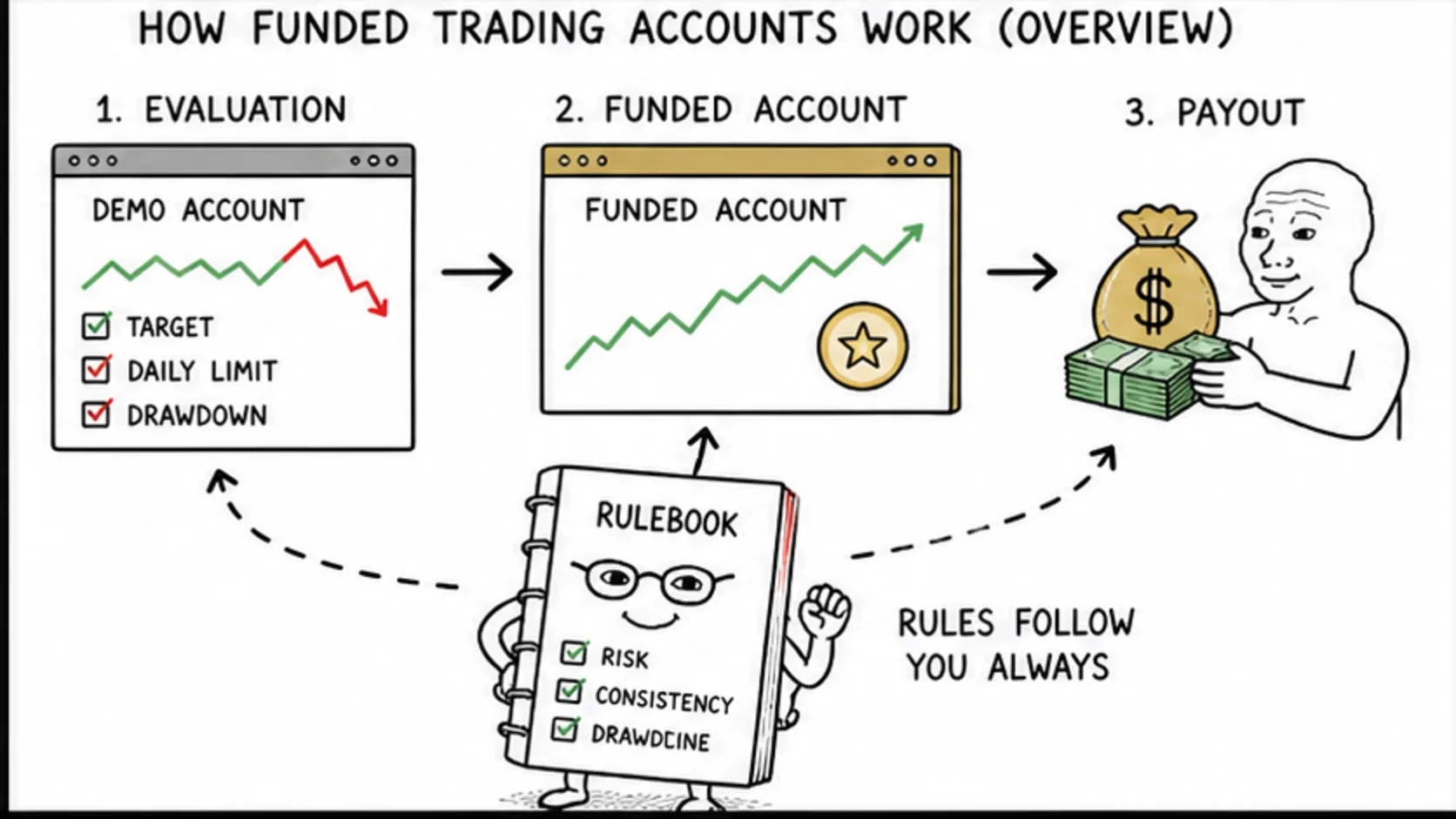
The arrangement between trader and prop firm is built on one core principle. The firm provides the capital, the trader provides the skill, and both sides share the upside.
You pay an evaluation fee upfront. This fee typically ranges from $50 for small accounts to $600 for large ones. FTMO's account pricing is a useful benchmark for comparing costs. The fee covers the cost of administering the evaluation and, candidly, contributes to the firm's revenue from the majority of traders who fail. I have paid more in evaluation fees than I care to add up, and every single one taught me something I did not know before.
If you pass, the firm gives you access to a trading account. Everything you earn above the starting balance is split between you and the firm. The standard split is 80/20 in the trader's favour. Some firms go higher.
If you lose money while following the rules, the firm absorbs the loss. Your personal financial exposure ends at the evaluation fee you already paid. You cannot be charged for trading losses.
The firm protects itself through strict risk parameters. These parameters are not suggestions. They are hard limits built into the platform. Hit them and your trading stops. Understanding how prop firm challenge rules actually work is the difference between getting funded and donating your fee.
The Hidden Economics: How Prop Firms Actually Make Money
If you do not understand the business model, you are trading blind. Prop firms make money from two sources: evaluation fees from traders who fail, and their share of profits from traders who pass.
The pass rate across the industry hovers around 10-15%. That means 85-90% of every evaluation fee is pure revenue for the firm. On a $400 evaluation, the firm keeps the full amount from roughly 9 out of 10 traders. Do the math on a firm processing thousands of evaluations per month and the numbers become obvious.
The prop firm business model depends on volume. Firms need a steady stream of new traders buying evaluations. This is why marketing is aggressive, why affiliate deals are generous, and why "discount codes" are everywhere.
Does this mean the model is a scam? No. The arrangement is transparent. You know the rules, you know the fee, you know the profit split.
The firm is betting most traders will fail. You are betting you will not. Both sides understand the terms.
The key is that the firms are not trying to trick you. They have simply engineered a system where the odds tilt heavily in their favour. Your job is to be in the small percentage where the math works differently.
The Lifecycle of a Funded Account
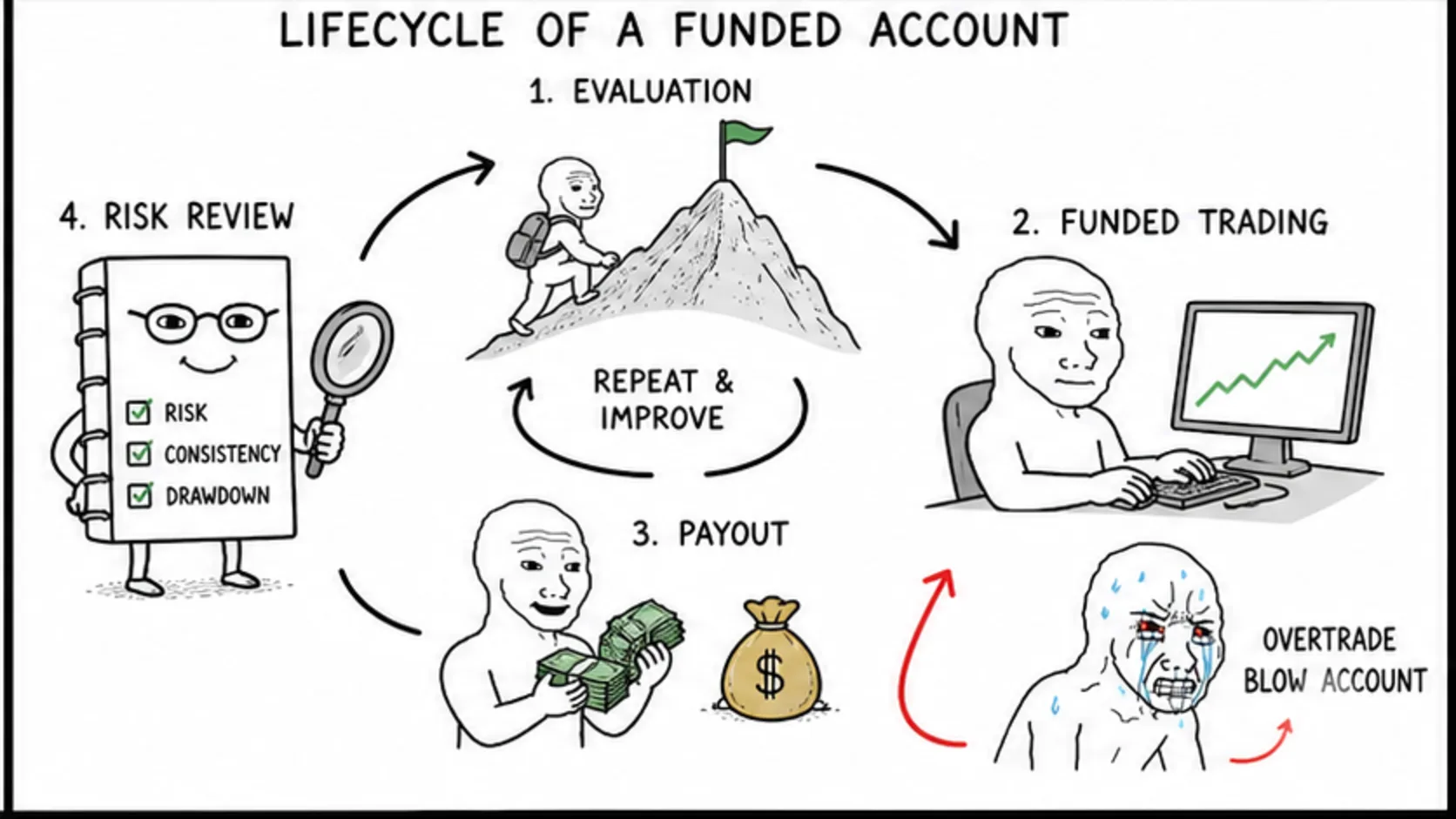
A funded account goes through three distinct stages. Not every firm uses all three, but the structure is common enough that understanding it prepares you for most firms.
Stage one is the evaluation. You prove you can hit a profit target while managing risk. Stage two is verification, a shorter confirmation that your results were not a fluke. Stage three is the funded account itself, where you trade the firm's capital and earn profit splits. Some newer firms now sell stage three directly: Vest Markets' instant accounts, for example, are live from purchase with a 95% split, no profit target, and the drawdown floor as the only rule.
Each stage has its own rules, its own pressure points, and its own failure rate. Let us walk through them.
Phase One: The Evaluation
The evaluation is the gatekeeper. It is where 90% of traders get filtered out, and the filtering mechanism is designed to catch anyone who cannot manage risk under pressure.
You receive a simulated trading account with a specific balance. You have a profit target to hit, typically 8-10% of the account value. On a $100,000 account, that means making $8,000 to $10,000 in gains.
You must hit this target without breaching the daily loss limit, the maximum drawdown, or any other risk parameter. Some firms also require a minimum number of trading days to prevent one lucky trade from passing you.
The evaluation has no partial credit. You either pass all rules simultaneously or you fail. There is no "almost" in prop firm evaluations.
Most firms offer evaluations with no time limit. This is a massive advantage. Take your time. Trade small. Let your edge accumulate slowly. The traders who rush are the ones who fail.
Phase Two: Verification
Not every firm requires verification, but many do. Verification is a shorter evaluation with a smaller profit target designed to confirm you actually know what you are doing.
The verification target might be 5% instead of 10%. The rules are usually the same or slightly more relaxed. The time frame might be shorter.
The point of verification is simple. The firm wants to make sure your evaluation results were not the product of one good trade, one lucky market move, or one desperate all-in that happened to work out.
Think of verification as the firm asking, "Can you do that again?" If you can, you are through to the funded account. If you cannot, you are not ready, and the firm just saved itself from funding an inconsistent trader.
Phase Three: The Funded Account
Once you clear all phases, you receive your funded account. This is where the arrangement becomes real. You trade with the firm's capital under their ongoing rules.
The funded phase rules are typically the same or slightly more relaxed than the evaluation rules. Your daily loss limit and maximum drawdown still apply, but the profit target is gone. You are no longer trying to hit a specific number. You are trying to produce consistent gains over time.
Every dollar you make above the starting balance accrues to your account. On a regular payout schedule, usually every 14 to 30 days, the firm calculates your gains, takes their percentage, and sends you your share.
As long as you stay within the rules and do not breach the risk parameters, the account remains yours to trade. Some firms offer scaling plans that increase your account size based on consistent performance over time.
The Risk Rules That Govern Everything
The risk rules are the architecture of every funded account. They are not guidelines. They are hard limits enforced by the trading platform. Understanding them is non-negotiable.
Daily loss limit. The maximum amount your account can lose in a single trading day. On a $100,000 account with a 5% daily loss limit, that is $5,000. Lose $5,001 and your account closes. No warnings, no grace period.
Maximum drawdown. The maximum distance your account can fall from either the starting balance or the highest balance reached. This can be static or trailing. A trailing drawdown follows your profits upward, which means the floor rises as you make money. This catches many traders off guard.
Consistency rule. Some firms, including FTMO whose challenge rules are among the most detailed, cap how much you can earn in a single day relative to your total profits. If one day accounts for more than 30-40% of your total gains, you may need to keep trading to dilute that day's impact.
Weekend holding rules. Some firms restrict holding positions over the weekend. Others allow it with reduced position size requirements. Know which type you are dealing with.
Scaling Plans: How Your Account Grows Over Time
Scaling plans are the upside most traders forget to ask about. A scaling plan is the firm's way of rewarding consistent performance with more capital and better terms.
The typical structure works like this. You hit your profit target for a set period, usually monthly or quarterly, while staying within all risk rules. The firm increases your account size. Some firms add $25,000 per tier. Others add $50,000 or more.
FTMO scales accounts up to $2 million through their Funding Challenge. Other firms cap out lower, but the principle is the same. Trade well, get more money, trade well again, get more again.
The best part of scaling plans is what happens to your profit split. Some firms increase your percentage as you scale. You might start at 80/20 and move to 90/10 after hitting certain milestones. I have seen this structure work well for traders who treat their funded account like a job, not a lottery ticket.
Scaling plans are not automatic. You must meet specific criteria: minimum trading days, profit targets, no rule breaches during the qualifying period. Miss one target or break one rule and the scaling resets. Consistency is the word that matters here.
Most traders never reach scaling because they cannot stay funded long enough. They blow the account, buy another evaluation, blow it again. The traders who do scale are the ones who mastered the fundamentals first. If you are still working on passing your first evaluation, scaling is a future problem. But understanding that the path exists keeps you motivated.
How Payouts Work
Payouts are the reason you are here. They are also simpler than most people expect.
The firm calculates your gains since the last payout. If your account balance is higher than it was at the start of the payout period, you have a profit. The firm takes their percentage, typically 10-20%, and sends you the rest.
Payout methods vary by firm but commonly include bank transfer, crypto, and Deel. Processing times range from same-day to two weeks depending on the firm.
Some firms require a minimum number of trading days between payouts. This prevents traders from making one trade and immediately withdrawing. Plan for this and build it into your expectations.
What Happens After Your First Payout
Your first payout is a milestone. It proves the system works. For a full walkthrough of the funded journey from passing to payout, see our what happens after you pass the FTMO challenge guide. But what comes next is where most traders make their biggest mistake.
I have seen it happen dozens of times. Trader passes evaluation. Trader gets funded. Trader produces solid returns for the first two weeks. First payout hits their bank account. Trader thinks, "I am unstoppable." Trader sizes up aggressively, takes reckless trades, and blows the account within a month.
The first payout psychology is a real thing. You go from demo money to real money and the emotional shift is enormous. Your first instinct will be to protect that money at all costs, which paradoxically makes you trade worse because you are afraid of losing what you already have.
The second instinct, usually arriving after the first payout, is to start trading bigger. You feel validated. You think you have cracked it. The market does not care about your feelings. It will take your account exactly as fast as it did before you got paid.
Here is what I do after every payout. I reduce my position size by 20% for the next five trades. It resets my mindset. It reminds me that the money is real and the rules still apply. Then I gradually work back to my normal sizing. This discipline is the reason I am still funded after years of trading.
The funded account is not a victory lap. It is the starting line. The traders who treat it that way are the ones still getting paid six months later. Everyone else is back in the evaluation queue, wondering what went wrong.
Real vs Simulated Accounts
This topic confuses a lot of people. Some funded accounts use real capital in live markets. Others use simulated accounts that mirror live prices exactly but where the firm's actual money is not directly at risk in the market.
In both cases, the trading experience is identical. Your orders fill at market prices. Your P&L moves in real time. Your profit split is real money deposited into your account.
The difference is an accounting one on the firm's side, not a functional one on yours. If you want the full breakdown, our guide on simulated vs live prop firm accounts explains exactly how each model works and which firms use which approach.
Whether the account is live or simulated, your job is the same. Follow the rules, produce gains, get paid.
Why Most Funded Accounts Die Within 60 Days
I promised you the mechanics, and the marketing copy skips this bit. The average funded account lasts less than 60 days before a rule breach closes it.
The reasons funded traders fail are predictable, and most of them map directly to the beginner mistakes FTMO traders keep repeating. They size up after a win. They revenge trade after a loss. They forget the daily loss limit exists because they were focused on the profit target. They hold through a weekend when the rules said they should not.
The pattern is always the same. The trader was disciplined enough to pass the evaluation. They were patient enough to manage risk. Then they got funded and decided the rules did not apply to them anymore. They had "earned" the right to trade aggressively. They had not.
I watch this happen because I have done it myself. My first funded account, I was profitable for three weeks, then I took a massive position on a news event because I was up and felt invincible. Hit the daily loss limit in twenty minutes. Account closed. Fee wasted.
The daily loss limit is not there to punish you. It is there to save you from yourself. The maximum drawdown is the same. These rules are not obstacles to overcome. They are guardrails that keep you funded long enough to actually earn money.
The prop firm does not want you to fail for the evaluation fee. A profitable trader generates far more revenue over time through profit splits than a single evaluation fee. The firm wants you to succeed. The rules exist to filter out the traders who cannot handle the pressure.
Funded trading accounts work because the firm has engineered a system where risk is bounded on both sides. Your risk is capped at the evaluation fee. Their risk is capped by the daily loss limit and maximum drawdown. Everything inside those boundaries is where trading happens.
Funded Account vs Demo vs Personal Live Account: What Is the Difference?
The three account types look similar from a distance but function very differently once you sit down to trade. A funded account combines the capital of a professional desk with the rules of a gaming tournament. You get the upside of large capital and the downside of zero tolerance.
Here is the side-by-side breakdown that most firms will not give you because it makes the comparison look obvious.
| Feature | Funded Account | Demo Account | Personal Live Account |
|---|---|---|---|
| Capital source | Prop firm's money | Virtual (fake) money | Your own money |
| Your financial risk | Evaluation fee only ($50-$600) | Zero | Everything you deposit |
| Profit split | 70-90% to you, 10-30% to firm | No profit (it is fake money) | 100% is yours |
| Risk rules | Strict daily loss, max drawdown, consistency | None | None (but your broker may margin call you) |
| Emotional pressure | High (real money, strict rules, time pressure) | Zero (nothing at stake) | Moderate to high (your own money at risk) |
| Withdrawal access | Every 14-30 days on profit splits only | No withdrawals (not real money) | Anytime (but you lose the capital to trade with) |
| Account scaling | Yes, after consistent performance (most firms) | No | Only if you deposit more |
| Rule enforcement | Automatic. Break a rule and the account closes instantly. | No enforcement | Broker enforces margin requirements only |
| Best for | Traders with proven skill who need capital | Beginners learning to trade | Traders with sufficient capital and no desire for rules |
If you have $5,000 to trade, you can make 5% a month and earn $250. If you pass a funded evaluation on a $100,000 account and make 5% a month at an 80/20 split, you earn $4,000. Same skill, 16x the income. That is why funded accounts exist.
But that income comes with constraints. The rules are not optional. The drawdown limit is not negotiable. The consistency requirement does not care about your feelings. If you want freedom, trade your own money. If you want capital, follow the rules.
For a deeper comparison of the funded account versus personal account decision, see our full guide on prop firm vs personal account trading.
What Funded Account Types Exist: Forex, Futures, and Stocks?
Funded accounts are not one-size-fits-all. The asset class you trade determines which firms you can work with, which platforms you will use, and which regulatory frameworks apply. Most traders only know about forex funded accounts because that is where the marketing money goes. But futures and stock funded accounts are growing fast.
Forex funded accounts are the most common. You trade currency pairs and sometimes metals or indices through CFDs on MT4 or MT5. Most prop firms offer forex accounts. The evaluation typically requires hitting 8-10% profit with a 5% daily loss limit and 10% maximum drawdown. The competition is fierce, which means the best firms compete on profit splits and rule flexibility.
Futures funded accounts operate on a different model. You trade contracts like the E-mini S&P 500, NASDAQ, crude oil, or gold on platforms like NinjaTrader or Tradovate. Futures firms are regulated by the CFTC in the US, which adds a layer of legitimacy that forex firms often lack. Payout splits at futures firms can go as high as 90/10 or even 100/0 on some programs.
Stock funded accounts are the newest category. Fewer firms offer them, and the rules tend to be different because equities have different risk characteristics (you can hold overnight, dividends matter, short selling has locate requirements). If you want to trade individual stocks with a funded account, your options are narrower but growing.
For the full breakdown of each asset class, see our guides on what is a forex prop firm, what is a futures prop firm, and futures prop firms explained.
What Happens After You Pass: The Complete Walkthrough
Passing the evaluation is not the finish line. It is the starting line. What happens in the first 30 days after you get funded determines whether you are still trading in 90 days or back in the evaluation queue. I have been through this process multiple times, and the steps are more specific than most people realise.
Step 1: Account activation. After you pass, the firm sends you login credentials for your funded account. This usually takes 24-48 hours. Some firms charge an activation fee (typically $0-$100) before you can start trading. Check this before you pass so you are not surprised.
Step 2: Your first funded trades. Here is what changes from the evaluation. The profit target is gone. You are no longer trying to hit 10%. You are trying to produce consistent gains over time without breaching any rules. The emotional shift is massive.
The numbers on your screen are real money now. Your brain knows it even if the trading platform looks identical.
Step 3: Building a buffer. The first two weeks after funding are the most dangerous. I aim to build a 3-4% buffer above my starting balance before I even think about my normal position sizing. This buffer is your breathing room. It means a couple of losing days do not put you near the drawdown limit.
Step 4: First payout request. Most firms require a minimum number of trading days before you can request your first payout, usually 10-20 days. When you are eligible, you submit a payout request through the firm's dashboard. Some firms require KYC verification at this stage. Processing takes anywhere from same-day to two weeks depending on the firm and payment method.
Step 5: Ongoing management. After your first payout, the funded account becomes routine. You trade, you get paid, you repeat. If you are on a scaling plan, hitting consistent targets will increase your account size. If you are not, you focus on protecting what you have and growing it steadily.
For the full step-by-step process of getting to this point, see our how to get a funded trading account guide. And for the funded trader perspective on what daily life looks like, see what is a funded trader.
Funded Account Survival Data: How Long Do They Actually Last?
This is the section that separates marketing from reality. The prop firm industry does not publish survival statistics voluntarily because the numbers are not flattering. But based on industry analysis and trader community data, here is what the data shows.
The pass rate across major prop firms sits between 10-15% for the initial evaluation. That means 85-90% of traders who buy an evaluation never make it to a funded account. For a deeper look at these numbers, see our prop firm pass rates breakdown.
Of the traders who do pass and receive a funded account, the average lifespan is less than 60 days before a rule breach closes the account. The most common causes are breaching the daily loss limit during a volatile session, hitting the maximum drawdown after a losing streak, and violating consistency rules by trying to rush toward a payout.
The survival curve is steep. After 30 days, roughly 50% of funded accounts are still active. After 60 days, that drops to around 30%. After 90 days, only 20% of funded traders remain.
But here is the critical insight: traders who survive past the 90-day mark have a dramatically higher chance of staying funded for a year or more. The first 90 days are the filter. If you can get through them, the odds shift in your favour.
Smaller accounts ($10,000-$25,000) tend to survive longer than larger accounts ($100,000+). The reason is simple. The psychological pressure on a $100,000 account is enormous. Every pip move feels like real money because it is. Traders on smaller accounts tend to trade more conservatively, which paradoxically produces better long-term results.
For the full data breakdown, see our prop firm survival rate analysis.
Funded Account Tax Basics: What You Need to Know
Taxes on funded account income are not complicated, but they catch people off guard because most traders do not think about them until the IRS does. The short version: you are an independent contractor, not an employee, and your profit splits are taxable income.
Funded traders are classified as independent contractors in most jurisdictions. This means you receive a 1099 form (in the US) for your payouts, and you are responsible for self-employment taxes on top of your regular income tax. Set aside 25-35% of every payout for taxes. Do not spend it. Do not "invest" it. Put it in a separate account and forget it exists.
Your evaluation fees, platform subscriptions, data fees, and home office expenses may be tax-deductible as business expenses. The specifics depend on your country and your tax bracket. The US Qualified Business Income deduction may also apply to prop firm trading income, though this provision is subject to legislative changes.
This section is a brief overview, not tax advice. For complete guidance on prop firm taxation in your specific country, see our guides on prop firm taxes, US tax basics, UK tax basics, and independent contractor classification.
Common Funded Account Myths Debunked
There are more myths about funded accounts circulating on YouTube and Discord than there are about Bigfoot. I have heard every one of them, usually from someone who has never passed an evaluation. Here are the four that cause the most damage.
Myth 1: "Funded accounts use real money from day one." This is not accurate for the majority of funded accounts. Most firms use simulated accounts that mirror live market conditions. Your trading experience is identical either way, your profit splits are real, and your payouts are real money. The distinction matters for your understanding of the business model but not for your trading. For the full explanation, see do prop firms use demo accounts.
Myth 2: "You can withdraw whenever you want." No. You cannot. Payouts follow a schedule, typically every 14-30 days. Some firms require a minimum number of trading days between payouts.
Some have minimum withdrawal amounts. You do not have an ATM. You have a structured payout system. Plan around it.
Myth 3: "The firm wants you to fail so they keep your fee." This is backwards. A single evaluation fee is worth $200-$600. A profitable trader generating consistent profit splits is worth thousands per year.
The firm wants you to succeed. They just also want to filter out the traders who cannot handle risk. These are not the same thing. Read the full breakdown at do prop firms want you to fail.
Myth 4: "Bigger accounts are always better." A $200,000 account sounds impressive until you realise the drawdown is proportionally smaller relative to the psychological pressure. If you cannot trade profitably on a $25,000 account, you will not trade profitably on a $200,000 one. Scale comes after consistency, not before it. Our guide on prop firm account sizes explained covers the math behind choosing the right size.