Do prop firms use demo accounts? Yes. Almost every retail prop firm on the internet runs your funded trades on a simulated server, not the live market. Your payouts are real cash. The demo part is the mechanism, not the outcome, and once you understand why firms do this, you will stop worrying about it and start focusing on what actually matters.
Key Takeaways
- The vast majority of retail prop firm accounts are demo environments with enforced risk rules.
- Simulation lets firms offer large account sizes without risking real capital on untested traders.
- Payouts are funded from the firm's revenue, not from your trading profits directly.
- The trading experience, platform, and rules are identical whether the account is demo or live.
- Some firms offer free trial demo accounts so you can test their platform before buying a challenge.
On This Page
The Short Answer
Yes, prop firms use demo accounts. The evaluation phase you pay for is a demo. The funded account you receive after passing is also a demo. The $100,000 balance on your screen exists on a simulated trading server, not in a real market.
And this is exactly what you signed up for, even if nobody explained it to you clearly.
The firm is not hiding this. The entire business model depends on it. They charge you an evaluation fee, test whether you can follow risk rules on a simulation, and pay you a share of your simulated profits from their own pocket if you succeed.
You trade fake money. You earn real money. That is the deal. And for thousands of funded traders collecting payouts every month, it works.
How Demo Prop Firm Accounts Actually Work
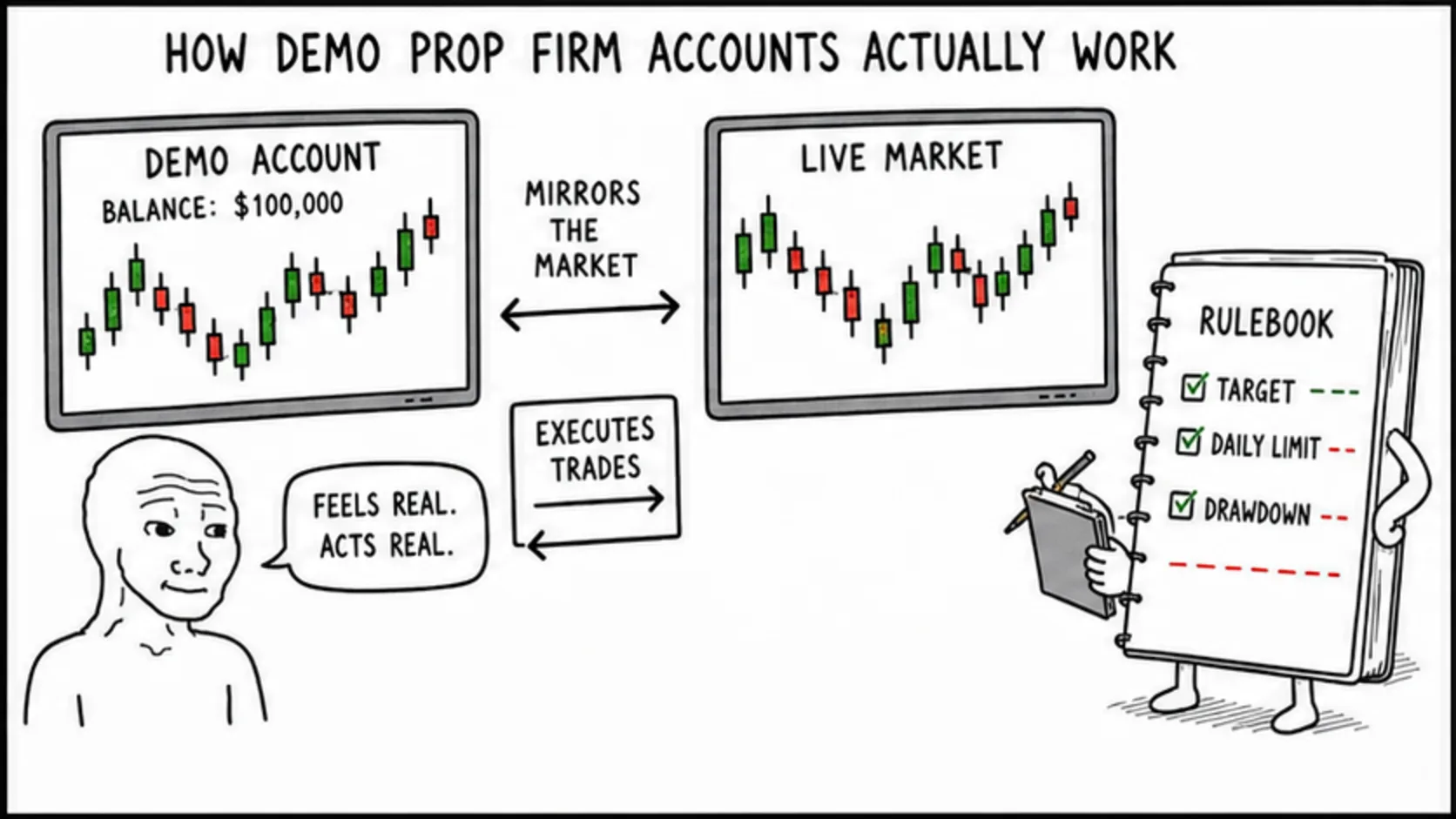
Let me walk you through what happens on the firm's side when you open a position on your funded account.
You click buy on EUR/USD. The platform shows your entry price, your stop loss, your take profit. You see the trade running on your chart. Your drawdown updates in real time. Your daily loss limit ticks closer to the boundary.
None of this touches the real forex market.
Your trade is processed by a simulated trading server. This server mimics live market conditions. It feeds you real-time prices from liquidity providers. It calculates your profit and loss based on actual market movement. But the actual execution, the buying and selling of currency pairs, happens inside a closed environment controlled by the firm.
Think of it as a very sophisticated paper trading account with enforcement mechanisms bolted on. The drawdown rules, the daily loss limit, the consistency requirements. All of these are tracked and enforced by the simulation server.
Break a rule and the system closes your account automatically. There is no human sitting there watching your trades. The server handles everything.
Why Prop Firms Use Demo Instead of Live Capital
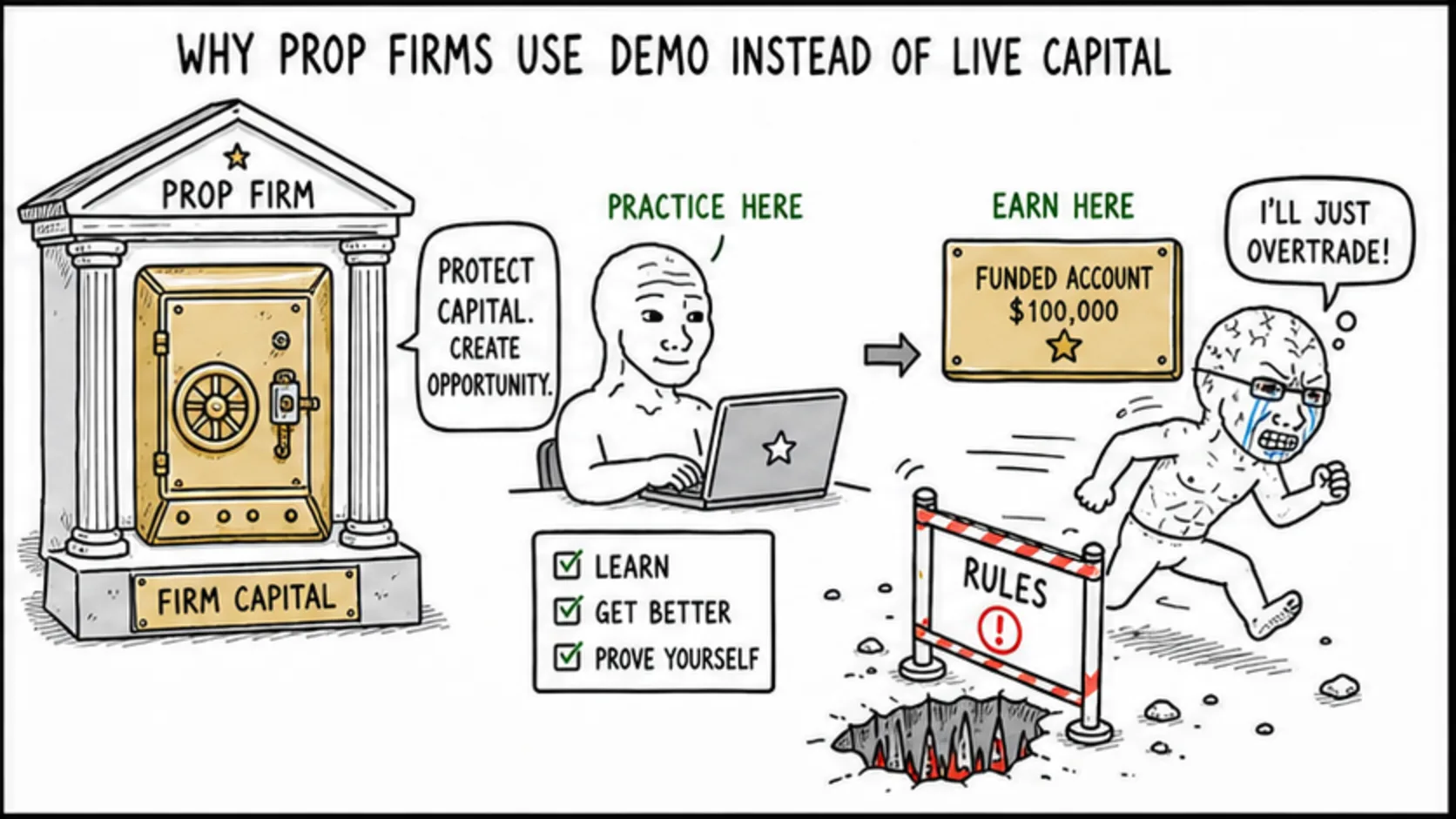
You already know the answer to this if you think about it for ten seconds. But let me spell it out anyway.
Giving $100,000 of real capital to a stranger who paid $400 for an evaluation is financial suicide. The European Securities and Markets Authority reports that 85% of retail forex traders lose money. Prop firms would be bankrupt within weeks if they wired real funds to every trader who passed their challenge.
The demo model eliminates this risk entirely. Your losses cost the firm nothing. Your blown account costs the firm nothing. The only real money at stake is your evaluation fee and the payouts the firm sends to profitable traders.
The firm's revenue comes from evaluation fees. They collect thousands of them every month. A portion goes to payouts for profitable traders. The rest covers operating costs and profit. It is a volume business, and the volume works because the risk is zero.
This is not a scam. It is a statistical arbitrage. The firm bets that enough people will fail evaluations to fund the payouts for the ones who succeed. So far, that bet has been very profitable for the firms that run it honestly.
The Difference Between Evaluation Demo and Funded Demo
Both phases use simulated accounts. But they are not the same thing.
Evaluation Demo
This is what you pay for. The firm gives you a simulated account with a profit target and a set of challenge rules. Hit the target without breaking the rules, and you advance. Miss the target, and your evaluation fee is gone.
The evaluation demo is the filter. It is designed to remove traders who lack discipline, risk management, or patience. The profit target is achievable. The time limit is generous. The rules are strict. Most people fail because they cannot follow the rules for 30 consecutive days, not because the challenge is unfair.
Funded Demo
Once you pass, you receive a funded account. It is still simulated, but now the rules change slightly. You no longer have a profit target to hit. Instead, you trade for profit and request payouts on a schedule determined by the firm.
Your funded account comes with its own set of rules. Drawdown limits, daily loss limits, minimum trading days between payouts. Break these and your funded status is revoked.
The funded demo is where the money is made. Your profits on the simulation trigger real payouts from the firm. You never touch real capital. The firm never risks real capital. Everyone gets what they came for.
Do Demo Accounts Change Your Trading Experience?
Here is the part most people do not expect. No, they do not.
The platform is the same. MetaTrader 4, MetaTrader 5, cTrader, TradingView, Rithmic, Tradovate. Whatever platform your firm offers, it looks and behaves identically whether the account is demo or live. Same charts. Same indicators. Same order types. Same execution speed for most practical purposes.
The risk management rules are the same. Your stop loss works the same way. Your lot sizing works the same way. Your position sizes are calculated the same way.
The only difference is psychological. And this is where you need to be honest with yourself.
Some traders take demo less seriously than live. They loosen their stops. They increase their lot sizes. They revenge trade because "it is not real money." Then they fail the evaluation and complain that the challenge was rigged.
The challenge was not rigged. You just did not treat it like it was real. And that is on you.
Treat the demo like it is a live account with your own money on the line. Because in a very real sense, it is. Your evaluation fee was real. Your time is real. Your payout will be real. The simulation is just the arena.
Which Prop Firms Offer Free Demo Trials
Separate from the evaluation and funded account discussion, some firms let you try their platform on a demo account before you buy anything. This is genuinely useful and you should take advantage of it.
Free demo trials let you test the trading platform, feel the execution speed, and see how the firm's dashboard works. They do not count as evaluations and they do not lead to funding. They are just practice.
Some prop firms offer trial challenges where you get a few days on a small account to see if you like the experience. Others give you unlimited demo access to their platform. Either way, it is worth doing before you commit real money to an evaluation.
You would not buy a car without test driving it. Do not buy a prop firm challenge without comparing the best prop firms and testing the platform first.
When Demo Should Actually Bother You
There is exactly one scenario where the demo nature of your prop firm account should concern you, and it has nothing to do with whether the money is real.
It should bother you if the firm uses the demo environment to manipulate your trading experience.
Some less reputable firms have been accused of widening spreads on demo accounts beyond what exists in the live market. Others allegedly introduce slippage or requotes that would not happen on a real account. These tactics make it harder to pass evaluations and increase the firm's revenue from failed challenges.
This is why you need to watch for red flags before choosing a firm. Check whether the demo environment matches live market conditions. Compare the spreads on your demo account to what you see on a live broker account for the same instrument at the same time. If they are materially different, find another firm.
The Commodity Futures Trading Commission and Financial Conduct Authority do not regulate most retail prop firms because prop firms are not brokers and do not handle client deposits. This means you are relying on the firm's own integrity when it comes to demo conditions.
Choose firms with transparent track records and real payout proof. That is your best protection.
What Simulated Execution Actually Looks Like
You click buy on EUR/USD at 1.08500. Your order fills instantly. The price moves 10 pips in your favour and you see your profit ticking up in real time. Feels like live trading, right? It does. But behind the scenes, something very different is happening.
On a simulated prop firm account, your order never reaches any liquidity provider or exchange. The platform's server takes your order, records the entry price from the live market feed, and tracks your P&L based on that price. When you close the trade, the server calculates the difference and updates your balance. No real currency was bought or sold. No counterparty took the other side of your trade.
Slippage on simulated accounts works differently too. Some firms programme realistic slippage into their execution engine to mimic live conditions. Others give you essentially perfect fills at the price you clicked. This matters because if you develop a strategy that relies on getting filled at exactly your click price, it may not work on a live account where slippage is real and sometimes significant.
I have noticed that on some prop firm platforms, my limit orders fill more consistently than they did on my live broker account. That is not because I suddenly got better at trading. It is because the simulation engine is more forgiving than the real market. Understanding this difference keeps you from overestimating your strategy's performance.
Stop loss execution is another area where simulated and live diverge. On a live account, a gap through your stop means you get filled at the next available price, which can be significantly worse than your intended stop. On some simulated accounts, the stop fills exactly at the price you set, even if the market gapped past it. This creates a false sense of security about your risk management.
If your prop firm's platform fills your stops perfectly every single time, even during major news events, you are getting simulated treatment. That is fine for passing challenges, but it means your live results could look different from your demo results when you eventually trade with real capital.
Can Demo Account Performance Predict Live Results?
This is the question that matters most, and the honest answer is: partially, with caveats.
Your technical analysis skills transfer directly from demo to live. If you can read charts, identify setups, and time your entries on a simulated account, those skills work on live markets too. The chart does not care whether the money behind your positions is real or simulated.
Your risk management skills also transfer. If you can maintain consistent position sizing, respect your daily loss limit, and avoid revenge trading on a demo account, you have demonstrated discipline that will serve you well with real money on the line.
What does not transfer cleanly is emotional management. I have seen traders who were robots on demo become complete wrecks on live accounts. The physiological response to real financial risk changes your decision making in ways that no amount of demo practice can prepare you for. Your hands shake. Your heart races. You second guess setups you would have taken without hesitation on demo.
Execution quality is another gap. The simulated fills you got on your prop firm account may not match what you experience on a live broker. Wider spreads, more slippage, and requotes are all part of live trading that simulations tend to underrepresent.
The best predictor of live success is not your demo win rate or your demo profit factor. It is your demo consistency. If you can follow your rules for 60 straight trading days without a single violation, you have the discipline to handle live trading. If you broke your own rules repeatedly on demo, where there was no real money at stake, live trading will expose those weaknesses brutally.
Treat your demo performance as a best case scenario. Expect your live results to be 20 to 30% worse due to emotional factors and execution differences. If your demo performance still looks profitable after that haircut, you are ready.