Everything you have been told about prop firms using real money is either wrong, incomplete, or designed to sell you a challenge fee. Most funded accounts are simulated. Your payouts are real cash. That is the deal, and once you understand why, the entire business model makes perfect sense.
Key Takeaways
- Most retail prop firms use simulated trading accounts, not real capital in live markets.
- Your payouts are real cash. You trade fake money, earn real money.
- Firms use three main models: simulated-only, hybrid trade mirroring, and direct live funding.
- You cannot lose more than your evaluation fee. The firm absorbs all trading losses.
- Whether the account is real or simulated does not change your trading strategy or risk rules.
On This Page
- What Does "Real Money" Mean in Prop Trading?
- The Three Funding Models Prop Firms Use
- Why Most Prop Firms Never Give You Real Capital
- Do Payouts Actually Arrive in Your Bank?
- Which Prop Firms Actually Use Real Money?
- Real vs Simulated: Does It Change How You Trade?
- What This Means for Your Next Challenge
- Frequently Asked Questions
What Does "Real Money" Mean in Prop Trading?
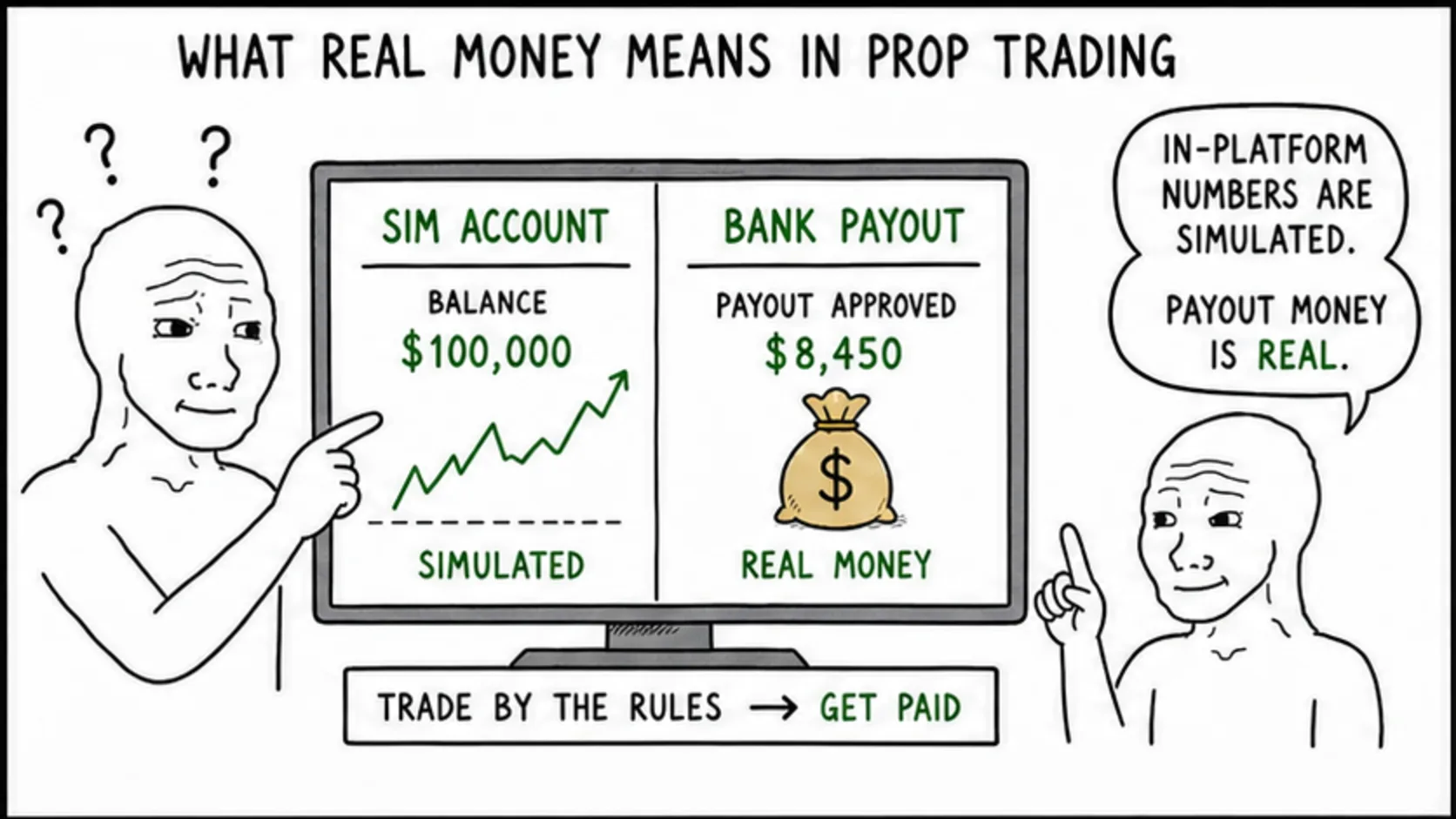
When people ask if prop firms are real money, they are usually asking two different questions at the same time. Question one: is the account I am trading on connected to the real market with real capital? Question two: will I actually receive real cash payouts if I am profitable?
These are not the same question. And the answer to each one is different. Your jaw will drop when you realise how many people conflate the two, buy a challenge, pass it, get funded, and then panic when they discover their "funded account" is a simulation running on a server in someone's office.
The simulation is not a secret. It is the entire business model. The way prop firms actually operate depends on collecting evaluation fees, filtering out undisciplined traders, and paying out to the few who survive the process.
According to the European Securities and Markets Authority (ESMA), 85% of retail traders lose money on their own accounts. Prop firms flip that dynamic. They do not need you to lose. They need the 90% who lack discipline to fail the evaluation and go away quietly.
The Three Funding Models Prop Firms Use
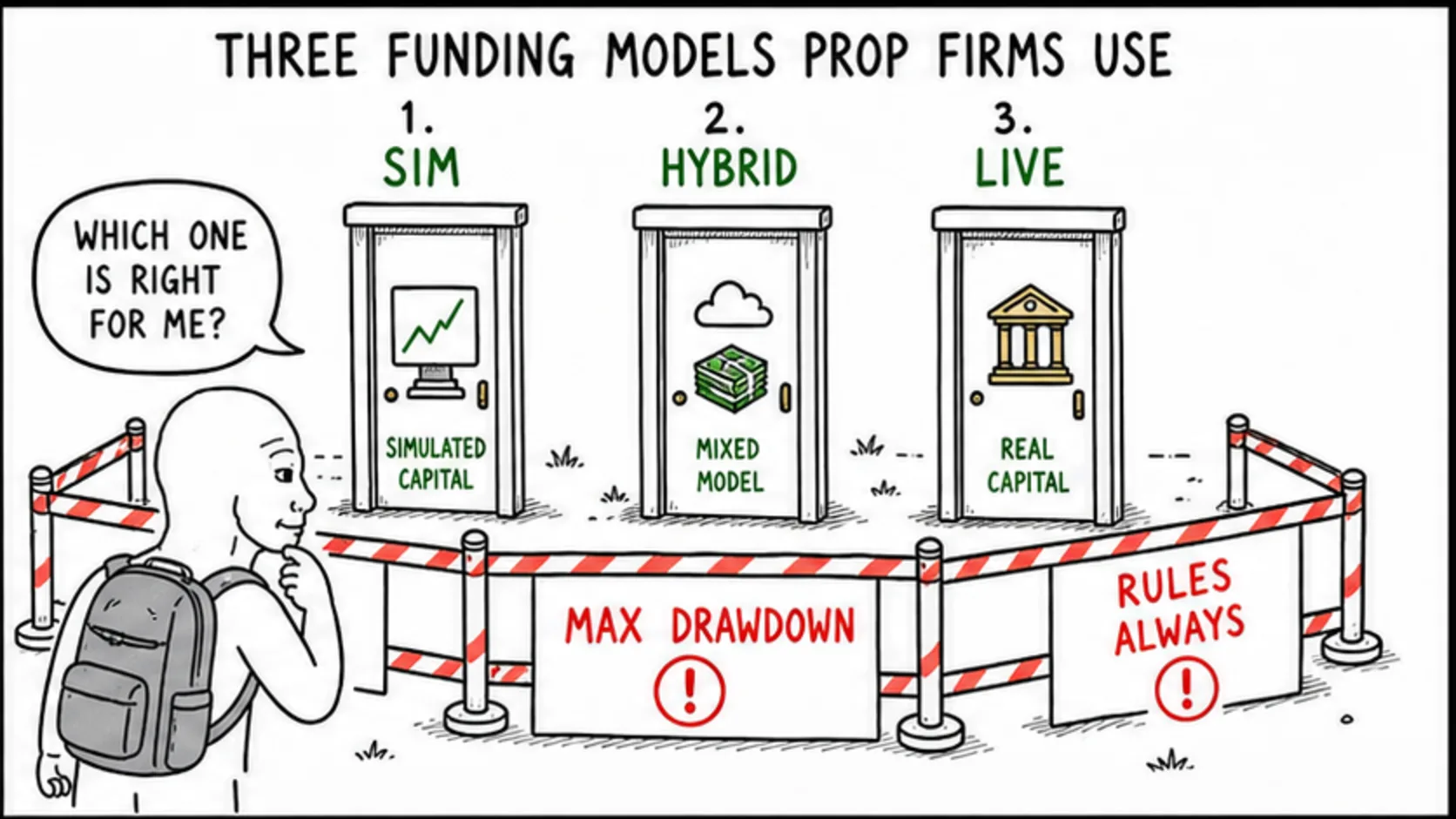
Not all prop firms use the same approach. There are three distinct models, and understanding which one your firm uses tells you everything about whether "real money" is involved.
Model 1: Simulated and Payout
This is the most common model in the retail prop firm space. Your trades happen on a simulated server. Nothing touches the live market. The firm tracks your performance against their rules, and if you stay within limits and generate a profit, they pay you a percentage of that profit from their own funds.
Think of it like this. You are playing a very expensive video game. The game has strict rules. If you beat the game, the casino pays you real cash. The game itself never involved real chips on a real table.
This is the model used by the majority of retail prop firms, including some of the biggest names in the industry. Your $100,000 funded account is a simulation. Your $4,000 payout is a wire transfer.
Model 2: Hybrid Trade Mirroring
Some firms take your simulated trades and mirror them onto a real live account in the background. You see a demo environment. They see a real market execution.
This is where things get interesting from a business perspective. The firm only risks real capital on traders who have already proven themselves through the evaluation. They are not gambling on you. They are investing in you after you have shown you can manage risk.
The revenue model behind prop firms makes this possible. They collect thousands of evaluation fees, use a portion to fund the profitable traders' live accounts, and keep the spread. It is a numbers game, and the numbers work in their favour.
Model 3: Direct Real-Money Accounts
A small number of firms give you direct access to a live trading account after you pass their evaluation. These are rarer, usually more expensive, and often come with tighter risk parameters.
Traditional proprietary trading firms in financial centres like London and Chicago trade real institutional capital. But those firms hire traders through interviews and assessments, not online evaluation challenges. They are a different species entirely.
The retail prop firm world is mostly Model 1 with a sprinkle of Model 2. Model 3 is the exception, not the rule.
Why Most Prop Firms Never Give You Real Capital
Here is the part nobody wants to say out loud. Giving a stranger $100,000 of real capital after they pay a $500 evaluation fee is financial suicide. The firm would be destroyed in weeks.
The Bank for International Settlements reports that daily forex turnover exceeds $7.5 trillion. The prop firm industry is a rounding error in that market. Firms are not sitting on billions of dollars of risk capital waiting to hand it out to retail traders who passed a 30-day demo.
Instead, they built a model where the risk is capped at zero. You trade on a simulation. If you blow the account, nothing happens in the real market. The firm loses nothing. You lose your evaluation fee. That is the entire transaction.
When you generate a profit on the simulation, the firm pays you from its operating revenue. Think of it as a performance bonus funded by the 90% of traders who failed evaluations that month. Harsh but accurate.
This is not a scam. It is a business. Whether prop firms are legitimate depends on whether they actually pay out when you earn, not whether the account is simulated. A firm that uses simulated accounts and pays you reliably is more trustworthy than one that claims to trade live capital but denies your payout over a rule technicality.
Do Payouts Actually Arrive in Your Bank?
This is the question that actually matters. Not "is the account real?" but "is the money real?"
The answer is yes. For established firms, payouts are real, verifiable, and documented. FTMO has publicly reported paying out over $200 million to funded traders since its founding. Topstep has processed thousands of payouts to futures traders. FundedNext publishes payout certificates.
But here is where you need to pay attention. The payout process is where firms can make your life difficult. Payout rules vary massively between firms. Some pay within 24 hours. Others make you wait 30 days. Some require a minimum number of trading days between payouts. Others claw back profits if they decide you violated a rule they never properly explained.
You need to verify each firm before you buy. Check payout proof on their website. Look for third-party verification, not just screenshots. Search Reddit and Trustpilot for payout complaints.
The funded traders making consistent money from prop firms are not special. They are disciplined, they follow rules, and they chose a firm that actually pays.
Which Prop Firms Actually Use Real Money?
Let me tier this for you, because the answer depends entirely on what type of firm you join.
Traditional Institutional Prop Firms
These are the real deal. Jane Street, DRW, Optiver, FCA-regulated proprietary trading houses in London, CFTC-registered firms in Chicago. They trade real capital. They hire through interviews, not online challenges. You get a salary, a desk, and a profit share. You do not pay an evaluation fee.
If you are asking "are prop firms real money" and you are thinking about these firms, the answer is yes. Every dollar is real. Every loss is real. Every gain is real.
Established Retail Prop Firms
FTMO, FundedNext, The5ers, Topstep. These are the top prop trading firms by ranking and they use simulated accounts for the vast majority of funded traders. Some offer live accounts at higher scaling tiers after you have proven yourself over multiple payout cycles.
The payouts are real. The accounts are simulated. Your profit split is real. Your trading environment is a sophisticated demo. That is the deal, and it works fine if you understand it going in.
Newer or Smaller Firms
Some newer firms claim to use real money from day one. Treat these claims with extreme caution. A firm that launched six months ago and is offering $200,000 live accounts for a $300 evaluation fee is either lying, undercapitalised, or running a model that will collapse when too many traders withdraw at once.
Check their track record. Look for red flags like no payout proof, vague terms, or a social media presence that looks more like a lifestyle brand than a trading company.
Real vs Simulated: Does It Change How You Trade?
Here is the thing. It should not change a single thing about how you trade.
Your risk management strategy should be the same whether the account is simulated or live. Your daily loss limit is enforced by the firm either way. Your maximum drawdown is tracked in real time either way. Break the rules and your account gets closed, simulated or not.
The only difference that matters is psychological. Some traders perform differently when they know the money is real. They either tighten up and trade better, or they freeze and trade worse.
If you are the type who needs real money on the line to take it seriously, the simulated model might actually be worse for you psychologically. You might get sloppy knowing it is "just a demo." That is a you problem, not a firm problem.
Treat your funded account like it is real money. Because your payouts are real money. The simulation is just the mechanism. The outcome is cash.
The concept of a funded trading account is the same regardless of the underlying model. You prove yourself, you get access to capital, you follow the rules, you get paid.
What This Means for Your Next Challenge
You have three missions before you even think about whether the money is real.
Mission one: pick a firm that actually pays out. Check payout proof. Read real trader experiences. Skip the Instagram screenshots and go find actual withdrawal confirmations from bank statements and crypto wallets.
Mission two: pass the evaluation without breaking a single rule. Your challenge strategy should be boring, consistent, and designed around not losing rather than winning big. Most traders fail because they try to hit the profit target in three days instead of twenty.
Mission three: once funded, trade the same way you did in the evaluation. Do not change a thing. The traders who blow funded accounts are the ones who suddenly size up the moment they see "funded" next to their account number.
Whether the account is real or simulated does not matter if you never reach payout. Focus on the process.