Approval usually includes identity checks and trading-rule review. For the identity side, FCA anti-money-laundering guidance explains why financial services run KYC checks.
You want to get approved for a funded trading account. You have seen the screenshots of payouts, the YouTubers flashing their funded account dashboards, and you want in.
Fair enough. But before you throw money at the first prop firm that pops up in your Instagram feed, you need to understand what "approval" actually means in this industry.
Getting approved for a funded trading account is not like getting approved for a mortgage. There is no credit check, no interview, no panel of judges reviewing your application.
Approval means one thing: you passed their evaluation without breaking their rules. That is it.
Key Takeaways
- Getting approved means passing a prop firm evaluation. There are no background checks, qualifications, or interviews involved.
- The core requirements are hitting a profit target while staying within daily loss limits and maximum drawdown rules.
- Evaluation types include one-step, two-step, and instant funding. Each has different approval criteria and fee structures.
- After passing the evaluation, you complete KYC verification and sign a funded trader agreement before receiving your account.
- The most common reason traders fail to get approved is not lack of trading skill. It is breaking risk management rules under pressure.
On This Page
What "Approval" Actually Means
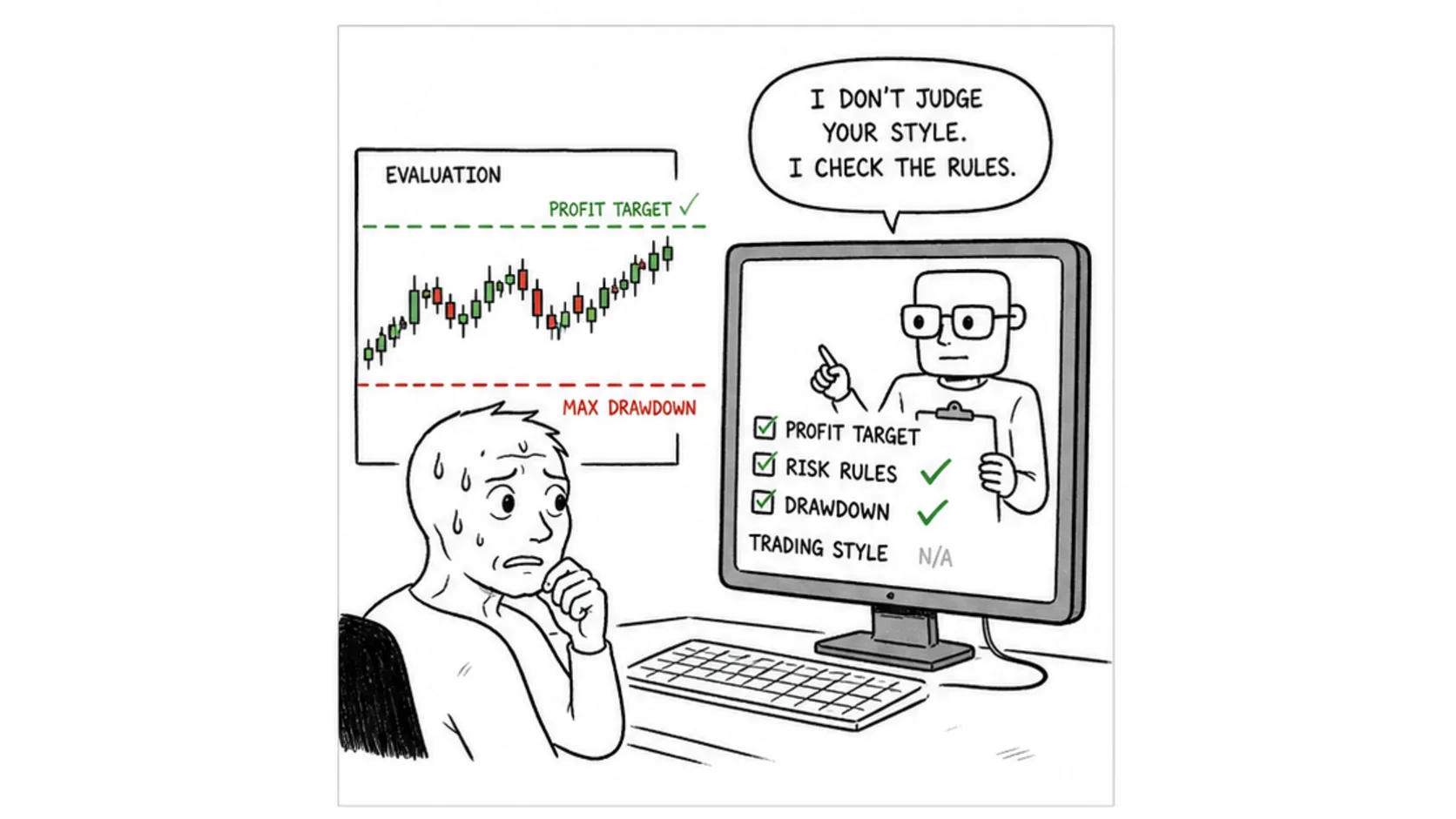
Prop firm approval is not subjective. This surprises a lot of people.
The firm is not sitting there looking at your trading style and deciding if you are "good enough." They have a set of mechanical rules, and if you follow them while hitting the profit target, you get approved.
Think of it like a driving test where the examiner is a computer. It does not care if you are nervous, it does not care if you had a good morning, it checks whether you stayed in the lines.
That is the funded account approval process in a nutshell.
The firm wants to know one thing: can you manage risk? Anyone can make 10% in a week if they size up like a maniac and get lucky.
The evaluation is designed to filter out the gamblers and approve the people who can protect capital first and make money second.
The Three Types of Evaluation
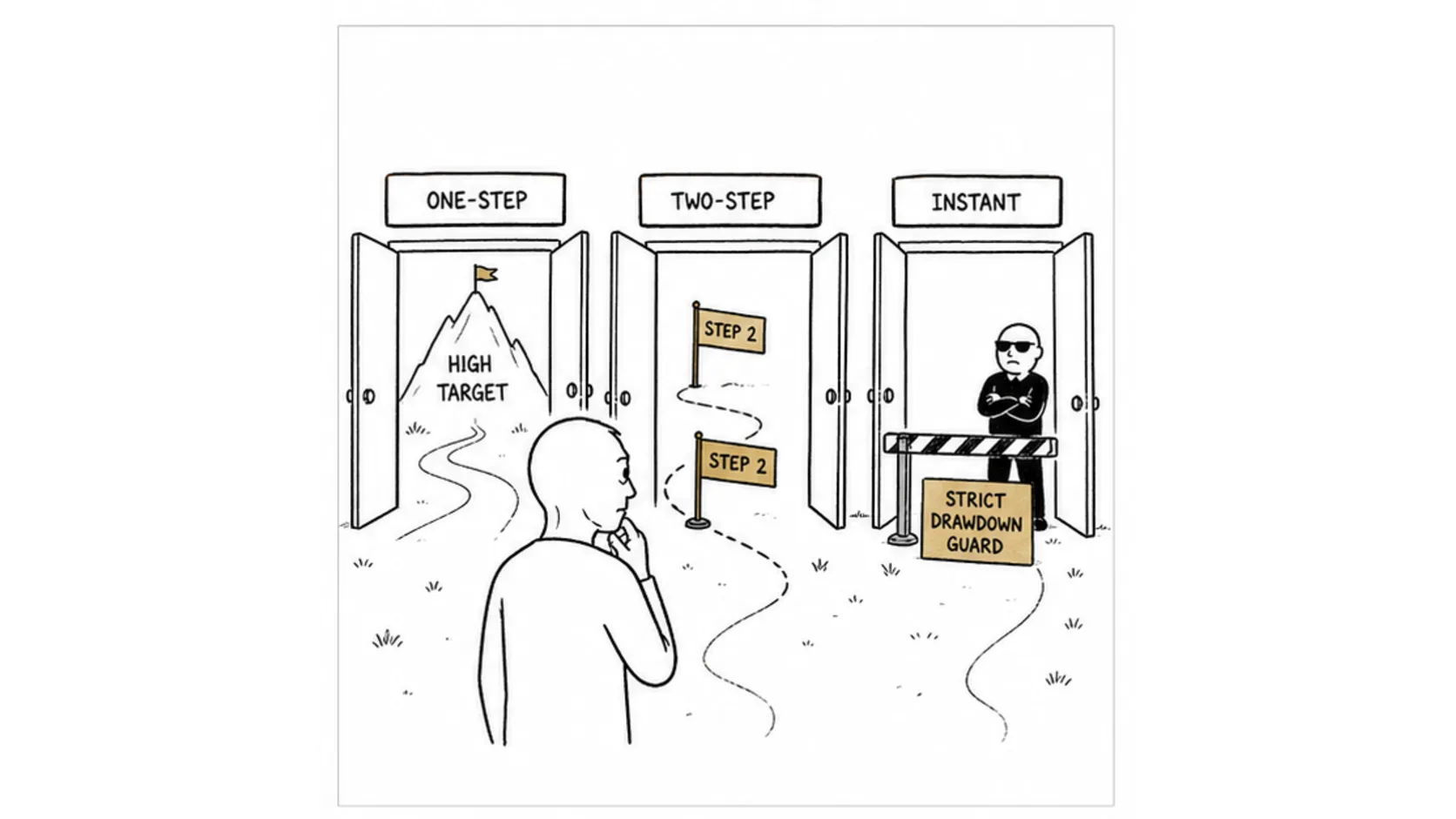
Before you can get approved, you need to choose how you want to get there. Prop firms generally offer three paths to funded account approval.
One-step evaluation. One phase, one profit target, hit it while following the risk rules and you are in.
Simpler, but the profit target is usually higher, around 8-10%. The trailing drawdown on these tends to be tighter, so you need to be sharp.
Two-step evaluation. Phase one has a profit target, usually 8-10%. Phase two is the verification, usually a lower target around 5%.
You have to pass both. More work, but the rules tend to be slightly more forgiving on drawdown.
Instant funding. No evaluation at all. You pay a higher fee upfront and get a funded account immediately.
The catch is that the drawdown rules are stricter from day one. This is for experienced traders who already know they can perform, not beginners looking for a shortcut.
If you are just starting out with prop firms, go with the two-step. It gives you room to learn the firm's rules without the pressure of a single-chance evaluation.
If you have already passed evaluations before, the one-step is faster and cheaper. The instant funding route is for people who are already consistently profitable.
The Five Core Requirements
Every prop firm has slightly different numbers, but the approval criteria are always built on the same five pillars. Miss any one of these and your approval is gone, no matter how good everything else looks.
1. Profit target. You need to grow the account by a specific percentage. On a $100,000 account with an 8% target, that means reaching $108,000.
Some firms require 10%, some require as little as 6%. The target is non-negotiable. You either hit it or you do not.
2. Daily loss limit. This is the most important rule in the entire evaluation. Your account cannot lose more than a set amount in a single trading day.
On a $100,000 account, this is usually $3,000 to $5,000. Breach it once, even by $1, and the evaluation is over. The daily loss limit is not a suggestion, it is a hard kill switch.
3. Maximum drawdown. This is the absolute floor of your account. If your balance drops below this level at any point, the evaluation is failed.
Some firms use a static drawdown, like $90,000 on a $100,000 account. Others use a trailing drawdown that follows your account up as you make profits, which is sneakier and catches people off guard.
4. Minimum trading days. Some firms require you to trade on a minimum number of separate days, typically 5 to 10. This stops you from passing on one lucky trade.
Not all firms have this requirement, but if yours does, factor it into your plan.
5. Consistency rule. This one catches people by surprise. If your single best trading day accounts for too much of your total profit, the firm may deny approval.
The threshold is usually around 30-40% of total profit. The consistency rule exists to prove you can win across many days, not just have one monster session.
The Full Approval Process, Step by Step
Here is exactly what happens from the moment you decide to go for a funded account to the moment you are approved. No skipping steps.
Step one: Choose your account size and evaluation type. Pick something that matches your budget and trading style.
A $25,000 account evaluation might cost $100-$200. A $100,000 account evaluation costs $400-$600. Do not pick a size that makes you nervous.
Step two: Pay the evaluation fee. This is your only financial risk. One payment, no recurring charges.
If you pass, you never pay this again. If you fail, the fee is gone. Some firms offer resets at a discount, but the cheapest reset is still money you did not need to spend.
Step three: Read every rule before your first trade. I am serious. Open the firm's rules page and read it twice.
Know the exact time zone your daily loss limit resets in. Know whether your drawdown is calculated from balance or equity. If you cannot explain the rules to a friend without checking, you are not ready.
Step four: Trade the evaluation. This is where the actual work happens. Risk 0.5% to 1% per trade, only take your best setups.
Stop after two consecutive losses. Revenge trading during an evaluation is a certified account-nuke moment. You already know this. You just do not do it.
Step five: Hit the target without breaching any rules. This is approval.
The firm's system automatically detects when you have met all criteria. There is no manual review. The algorithm checks the boxes and you move forward.
What Happens After You Pass
Passing the evaluation does not mean you are immediately trading. There are a few administrative steps between "I passed" and "I have a funded account."
KYC verification. The firm will ask you to verify your identity. This usually means submitting a photo ID and proof of address.
It is standard anti-money-laundering compliance, and it usually takes one to two business days. You are not getting a funded account without it.
Funded trader agreement. You sign a contract outlining the ongoing rules for your funded account. Read it.
The rules for a funded account are sometimes different from the evaluation rules, usually more relaxed but not always.
Account setup. The firm creates your funded trading account and sends you credentials. This can take anywhere from a few hours to a couple of days depending on the firm.
From passing to trading, the whole process typically takes two to five business days. If a firm takes more than a week, that is a red flag.
Why Most Traders Never Get Approved
The failure rate for prop firm evaluations is high. Not because the profit targets are unreasonable, but because the risk rules are designed to expose poor discipline.
Here are the five most common reasons traders fail to get approved.
Overleveraging to hit the target fast. You are not getting bonus points for finishing early. Risking 3-5% per trade to hit the target in three days is gambling, not trading.
The traders who get approved treat the evaluation like a marathon, not a sprint.
Ignoring the drawdown rules. Some traders focus entirely on the profit target and forget that the drawdown rules are always active.
You can be up 7%, give back 4% on a bad trade, and suddenly your trailing drawdown is breathing down your neck. Track your drawdown with every trade, not just your profit.
Revenge trading after a loss. You take a stop-out, get angry, and immediately re-enter with a bigger position to "win it back." This is the single most common way traders blow their evaluation.
After a loss, reduce your size or stop trading for the day. The market is not going anywhere.
Trading during news events. Many firms restrict trading around major economic releases like NFP or CPI. The spread can widen massively and stop-losses get skipped.
Check if your firm has news restrictions and respect them. You can breach a rule through no fault of your strategy.
Not having a written plan. If you cannot write down your entry criteria, exit criteria, and risk per trade before the evaluation starts, you are not ready.
Trading without a plan in a funded evaluation is like driving blindfolded and hoping the road is straight. It is not.
The people who get approved for funded trading accounts are not smarter than you. They are not better analysts. They just follow the rules, manage their risk, and do not self-destruct when things get uncomfortable.
That is the entire secret.