Are futures prop firms legit or scams? The established ones are legit. Firms like Topstep and Earn2Trade have been paying funded futures traders for years, with verified payout records and transparent rules. But the futures prop firm space has also attracted its share of operators who launched six months ago, copied someone else's website, and are collecting fees until the whole thing falls apart. The trick, as always, is knowing which is which before you hand over your money.
Key Takeaways
- Established futures prop firms are legitimate businesses with verified payout histories, transparent rules, and responsive support teams.
- Futures prop firms differ from forex prop firms in important ways: exchange-traded markets, tighter regulation of underlying brokers, and different risk dynamics.
- Scam futures prop firms show the same red flags as scam forex firms: no payout proof, changing rules, aggressive affiliate marketing, and no independent reviews.
- The National Futures Association regulates futures brokers but not prop firm evaluations, creating a regulatory grey zone.
- Always verify a futures prop firm's payout history and read independent reviews before buying a trading combine or evaluation.
On This Page
What Makes Futures Prop Firms Different
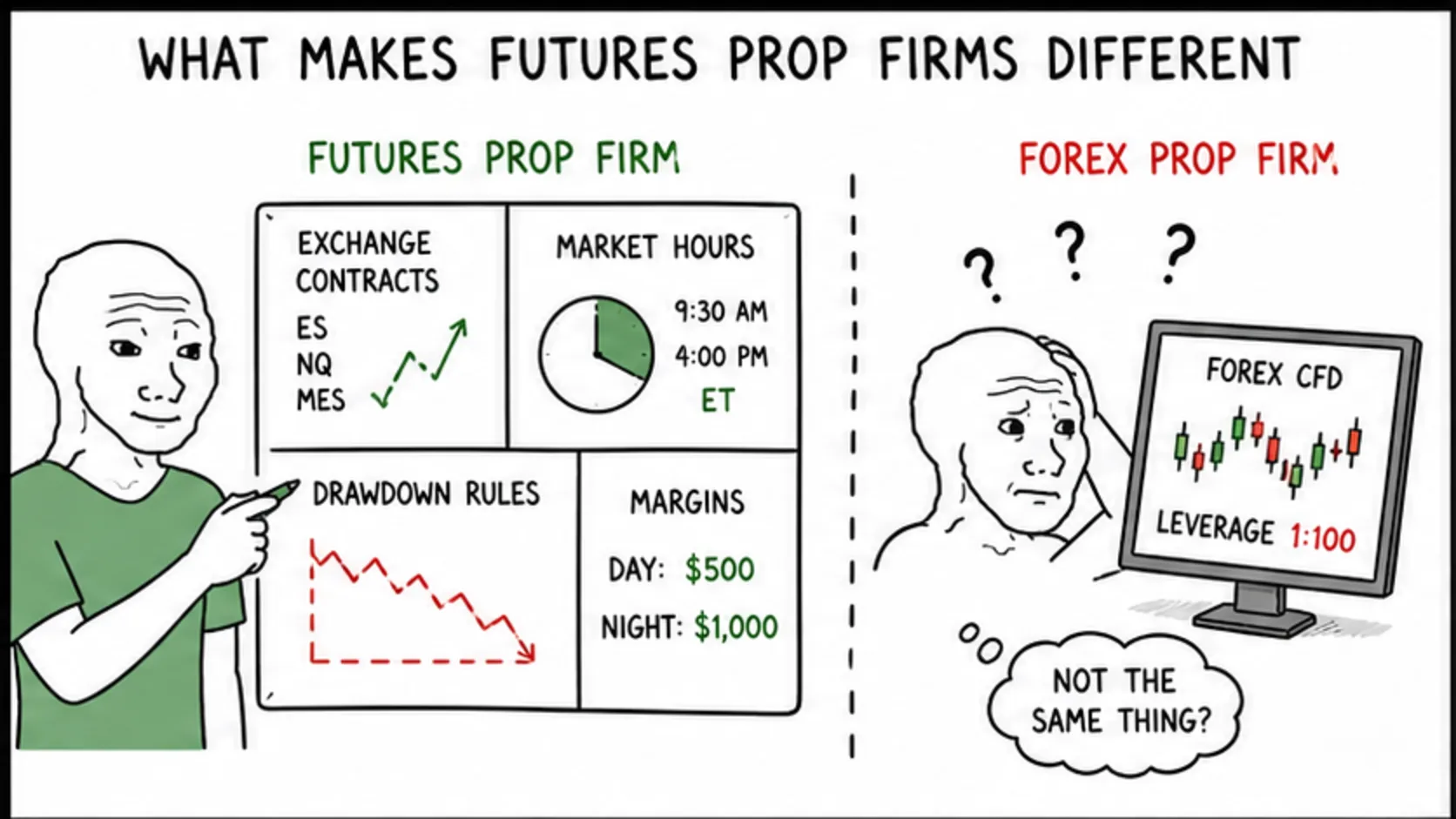
Before you can figure out whether futures prop firms are scams, you need to understand how they differ from forex prop firms. Because the differences matter.
Futures markets are exchange-traded. Every contract goes through a centralised exchange like the CME Group, which includes the Chicago Mercantile Exchange, the Chicago Board of Trade, and others. This means there is a central counterparty clearing every trade. The market structure is transparent. The data is public. The contracts are standardised.
Forex, by contrast, is an over-the-counter market. Your broker is your counterparty. The pricing depends on which broker you use. The market structure is more opaque. This creates different risks and different opportunities for prop firms.
Forex prop firms tend to use MetaTrader or cTrader with simulated pricing. Futures prop firms use platforms like NinjaTrader, Rithmic, or TradingView connected to actual exchange data feeds. The simulated environment in futures is generally closer to real market conditions because the underlying data comes from a real exchange, not from a broker's price feed.
This does not make futures prop firms automatically more legitimate. It means the trading environment is structurally different, and you should evaluate futures prop firms on their own terms, not by importing assumptions from the forex prop firm world.
The Legitimate Futures Prop Firms
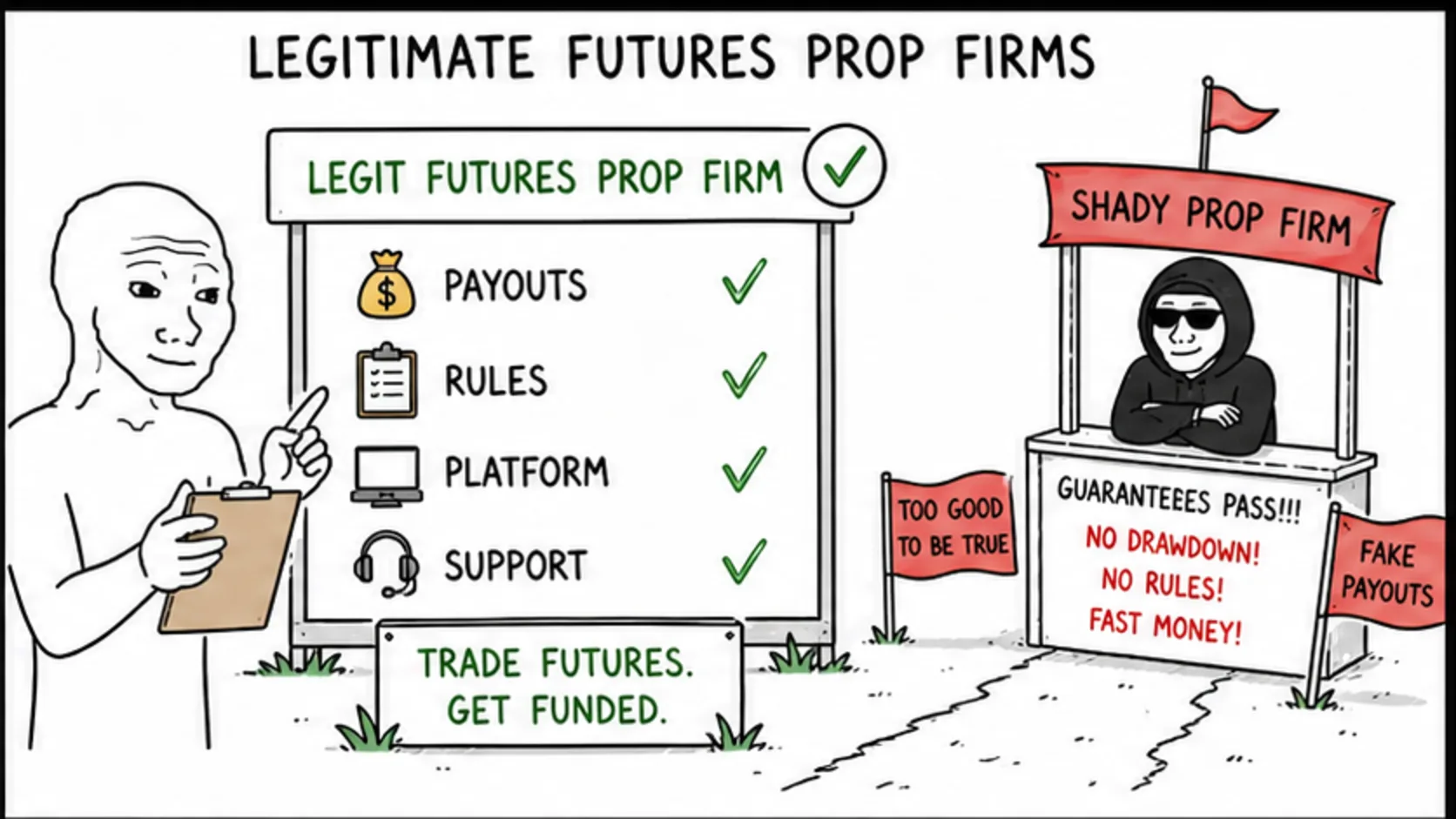
Let me name some names, because this topic deserves specificity.
Topstep. Founded in 2012. One of the oldest futures prop firms still operating. They have paid out tens of millions to funded traders over the years. Their Trading Combine evaluation has clear rules, daily loss limits, and a straightforward path to funding. They are headquartered in Chicago, near the actual futures exchanges. Solid tier. Real business with a real track record.
Earn2Trade. Founded in 2018. Their Gauntlet Mini evaluation is well-established in the futures community. Clear rules, public payout statistics, and a reputation for actually paying traders. Solid tier. Not as long a track record as Topstep, but enough to be trustworthy.
Apexo Trader. Newer entrant but with transparent rules and growing community presence. Worth watching. Mid tier. Fine for experienced traders who understand the risk of using a newer firm.
The point is not to give you a definitive ranking. The question of whether prop firms are legit depends on the specific firm. If you want to know whether a futures prop firm is legit, look at how long they have been paying traders and whether their payout records are verifiable. The established ones have been around for years, have paid out real money, and operate with enough transparency that you can verify their claims before you buy.
Why Futures Prop Firms Get Called Scams
Same story as forex prop firms, different instrument.
A trader buys a futures combine for $150. They get a $50,000 account with a $1,000 daily loss limit. On day four, they take a big position in the E-mini S&P 500, the market moves against them, and they hit their daily loss limit. Account closed. Combine over.
The trader heads straight to Reddit and posts that the firm is a scam. But the firm is not a scam. The trader breached a clearly stated rule. The daily loss limit on a $50,000 account at $1,000 is 2% of the account balance. That is a reasonable risk parameter. If you cannot trade within a 2% daily loss boundary, the problem is your risk management, not the firm.
According to the Commodity Futures Trading Commission, futures trading carries substantial risk of loss. The CFTC regularly warns that the vast majority of individual traders lose money in futures markets. Prop firms add strict rules on top of an already difficult activity. When people fail, they blame the firm instead of their own preparation.
That said, some futures prop firm complaints are completely valid. Firms that change rules mid-combine, deny payouts without clear justification, or operate with no visible payout history deserve scrutiny. The challenge is separating valid complaints from sour grapes, and that requires reading the details of each case.
How Futures Prop Firm Scams Work
Futures prop firm scams follow the same basic playbook as forex prop firm scams, with one important twist. Because futures markets are exchange-traded and the data is public, it is harder for a scam firm to manipulate the trading environment. What they manipulate instead is the payout process.
Here is the pattern. A new futures prop firm launches with competitive pricing and heavy affiliate marketing. Their website looks professional. Their rules seem fair. They process a few early payouts quickly to build trust and generate positive reviews. Influencers start promoting them.
More traders sign up. More evaluation fees flow in. The firm pays out some funded traders from the pool of incoming fees. Everything looks normal.
Then the cracks appear. Payouts start taking longer. Customer support gets vague. New rules appear that were not in the original terms. Traders who were about to request withdrawals find their accounts flagged for "irregular trading activity" with no explanation of what that means.
Eventually the firm either collapses entirely or rebrands under a new name. The operators disappear with whatever money is left, and a few months later a suspiciously similar firm appears with a fresh coat of paint.
Does anyone actually make money trading futures through prop firms? Yes. The established firms have verifiable payout records. But the scam firms exist in the same space, and they target the same traders. Your job is to tell them apart.
Red Flags Specific to Futures Prop Firms
You already know the general prop firm red flags. Here are the ones specific to futures.
No clear explanation of the funded account structure. Legitimate futures prop firms explain exactly what happens when you pass. Do you trade a simulated account or a live account? What platform do you use? What are the ongoing rules? If the firm cannot answer these questions clearly before you pay, that is a problem.
Unrealistically low combine prices. A $150,000 futures combine for $49. The CME charges real money for data feeds and exchange access. A legitimate firm has real costs. If the price seems impossibly low, the firm is either subsidising aggressively to build market share or it is not planning to be around long enough for the economics to matter.
No connection to a real futures clearing merchant. Futures brokers are regulated by the NFA. The prop firm itself is not a broker, but it needs a relationship with one to provide exchange access. If the firm cannot tell you which futures commission merchant clears its trades, or if the name they give you does not appear in the NFA registry, walk away.
Promises of "live" accounts that are actually simulated. Some firms advertise that funded traders trade "live" accounts. In reality, most retail prop firms, futures included, use simulated accounts. There is nothing inherently wrong with this, but misrepresenting it is dishonest. If the firm claims live trading, ask for proof.
Pressure to buy add-ons during the combine. Reset fees, extension fees, coaching packages, premium plans. If the firm's business model seems to rely on selling you upgrades during your evaluation rather than funding profitable traders, that tells you where the money is coming from. A futures trading combine scam often looks profitable on the surface but makes its real money from reset fees and extensions.
How to Verify a Futures Prop Firm
Three missions. Non-negotiable.
Mission one: check the payout history. Look for public payout certificates, funded trader testimonials with specific details, and consistent payment dates going back at least six months. Check the firm's social media for payout announcements. Legitimate firms celebrate payouts publicly.
Check Reddit specifically in r/FuturesTrading and r/Daytrading. The futures trading community is smaller and more tight-knit than the forex community. Bad actors get identified quickly. If a firm has been around for a year and nobody on r/FuturesTrading has heard of it, that is a signal.
Mission two: verify the firm's infrastructure. What trading platform do they use? NinjaTrader, Rithmic, and TradingView are the standard platforms for legitimate futures prop firms. What data feeds do they provide? CME Group data is the baseline. If the firm uses a platform nobody has heard of or provides no information about their data feeds, proceed with caution.
Mission three: read the terms and conditions. Every word. Look for the same red flags as any prop firm: retroactive rule changes, vague payout conditions, and termination clauses that give the firm unlimited discretion. The terms are the contract. If you would not sign a lease or an employment contract without reading it, do not pay a prop firm without reading theirs.
Futures vs Forex Prop Firm Scams
Quick comparison because the differences matter.
| Factor | Futures Prop Firms | Forex Prop Firms |
|---|---|---|
| Market type | Exchange-traded (CME) | Over-the-counter |
| Price transparency | High (centralised) | Varies by broker |
| Broker regulation | NFA/CFTC regulated | FCA/ESMA regulated |
| Prop firm regulation | Unregulated | Unregulated |
| Typical platforms | NinjaTrader, Rithmic | MetaTrader, cTrader |
| Typical account sizes | $25K to $250K | $5K to $1M+ |
| Typical evaluation cost | $50 to $500 | $50 to $600 |
The key takeaway is that neither side is more or less prone to scams. The scam dynamics are similar. The difference is in the market structure and the regulatory environment around the underlying brokers. Both types of prop firm evaluations are unregulated. Both attract legitimate operators and bad actors. Evaluate each firm on its own merits.
Are futures prop trading firms legit or scams? The established ones are legit. Topstep, Earn2Trade, and others have proven track records. But the barrier to entry is low, and new firms launch constantly. Some of those new firms are genuine businesses. Some of them are not. The difference is always in the payout history, the rule transparency, and the track record over time. Do your research. Verify everything. And never pay a fee you cannot afford to lose.