Are futures prop firms regulated? Here is where things actually stand. Futures prop firms face more regulatory heat than any other type of prop firm, and most of them still are not directly regulated. The Commodity Futures Trading Commission has taken enforcement action against several of them. The National Futures Association has issued warnings. Yet the industry keeps growing because the core business model sits in a gap between what regulators oversee and what they do not. Here is what you need to know.
Key Takeaways
- Most retail futures prop firms are not directly regulated by the CFTC or NFA because they use simulated trading accounts.
- Futures prop firms face more regulatory pressure than forex prop firms because futures trade on regulated exchanges like the CME Group.
- The CFTC charged several firms between 2023 and 2024 with operating as unregistered futures commission merchants.
- Your evaluation fee is your maximum financial risk, but you have zero regulatory protection if a firm denies your payout or collapses.
- Firms with transparent simulated account policies and proven payout histories are safer than newer untested alternatives.
On This Page
- Why Futures Prop Firms Face More Regulatory Pressure
- The CFTC and NFA: How Futures Regulation Works
- The Enforcement Actions That Shook the Industry
- Why Most Futures Prop Firms Are Not Regulated
- Simulated Accounts: The Regulatory Loophole
- What You Lose Without Regulatory Protection
- How to Verify a Futures Prop Firm Is Legitimate
- Frequently Asked Questions
Why Futures Prop Firms Face More Regulatory Pressure
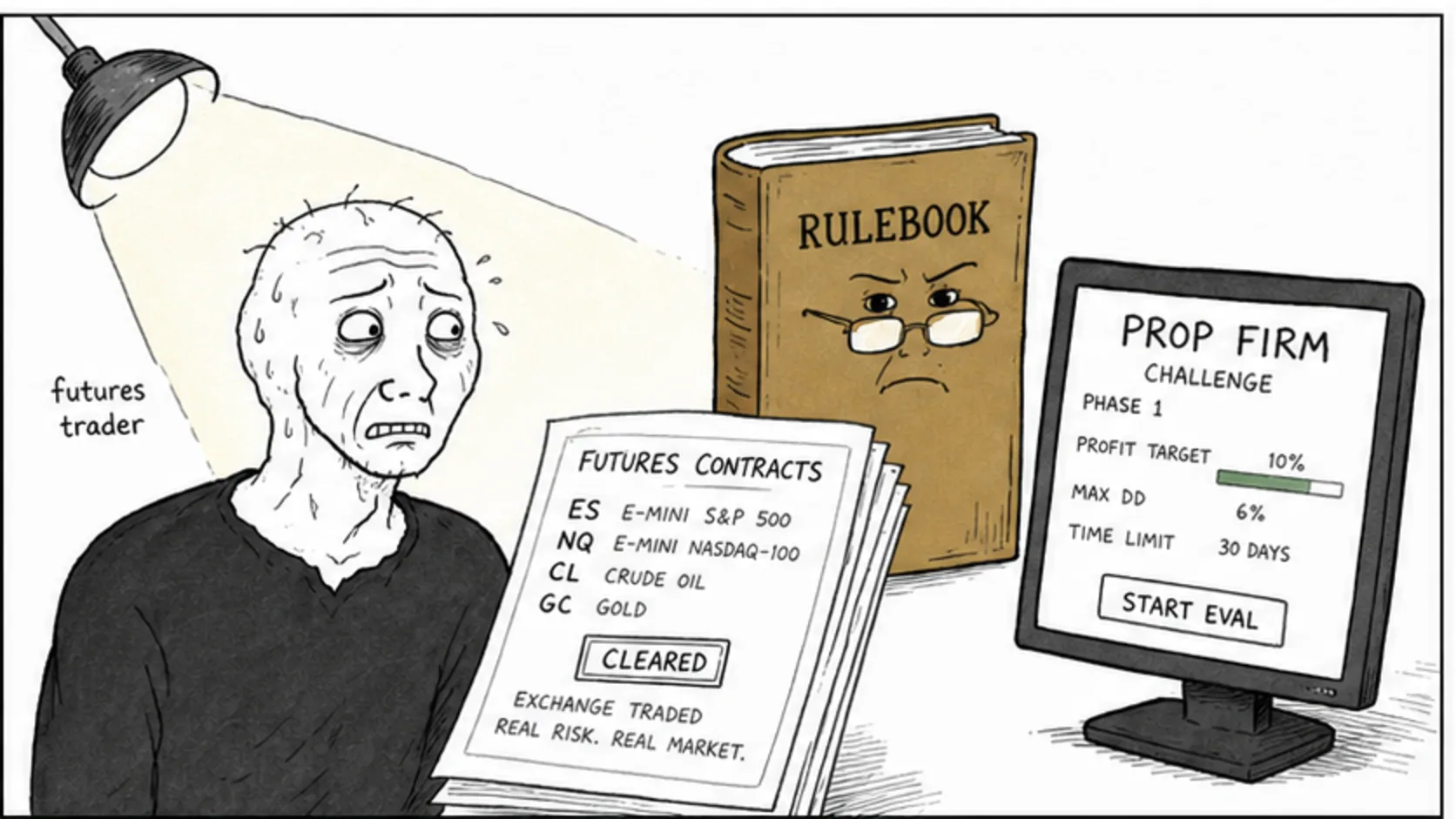
Futures prop firms get more attention from regulators than forex prop firms for one simple reason. Futures trade on actual regulated exchanges.
The CME Group handles over $1.5 quadrillion in notional value annually across its markets. Every single futures contract trades on an exchange that is overseen by the CFTC. The price feeds are real. The clearing houses are real. The regulatory framework around futures is one of the tightest in the financial industry.
This creates a problem for futures prop firms that does not exist for forex prop firms. Forex prop firms can point to the fact that forex trades over the counter, with no central exchange and no single global regulator. Futures prop firms do not have that excuse.
When a futures prop firm offers access to E-mini S&P 500 contracts, crude oil futures, or Treasury bond futures, it is tapping into a market that the CFTC polices aggressively. Regulators notice when someone starts offering access to their regulated markets without playing by their rules.
The result is that futures prop firms operate in a more hostile regulatory environment. Some have adapted. Others got shut down. A few are still figuring out where the line is.
The CFTC and NFA: How Futures Regulation Works
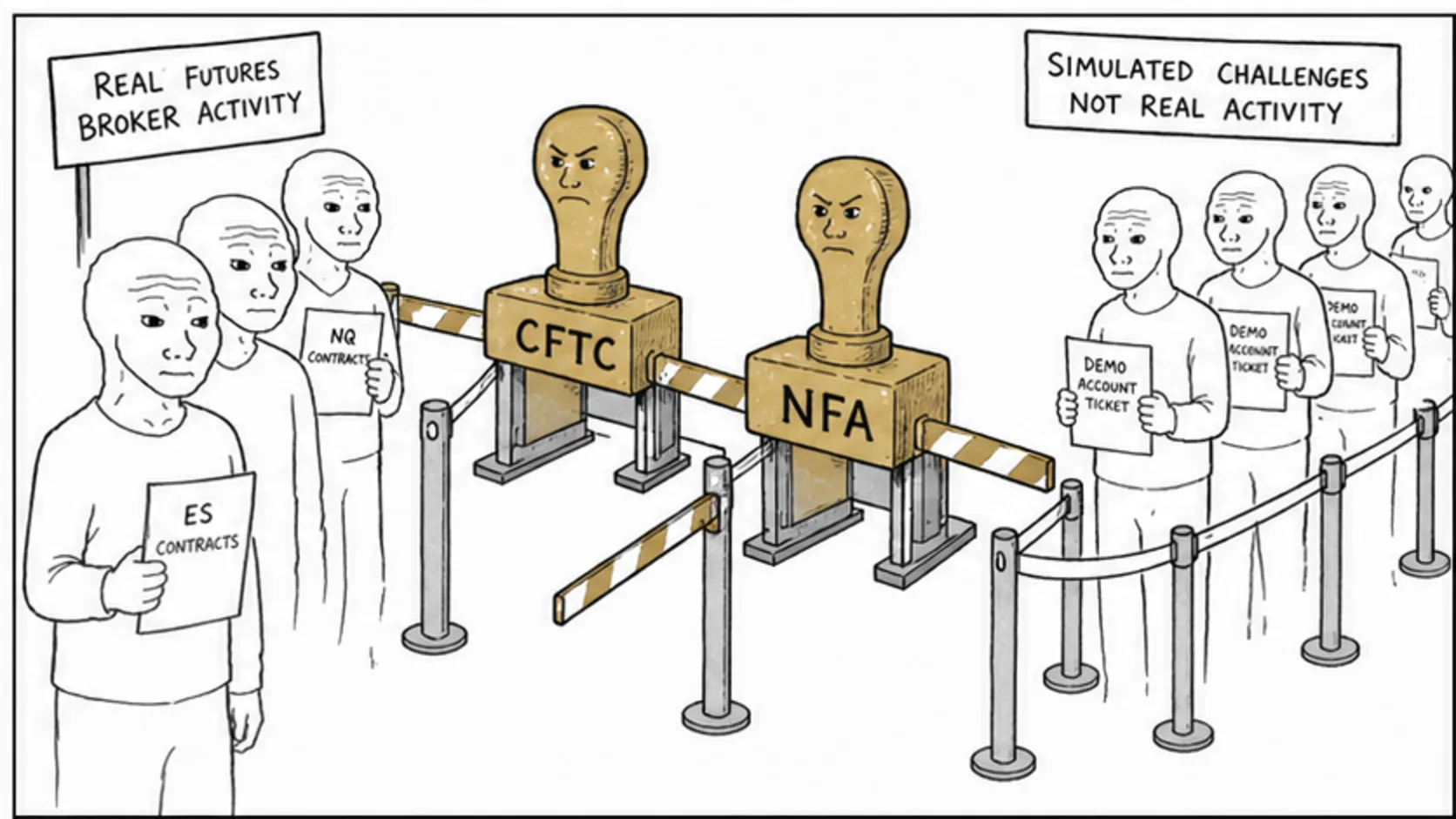
Before you can understand why futures prop firms are not regulated, you need to understand who regulates futures in the first place.
The CFTC is the primary federal regulator for futures and options markets in the United States. It oversees exchanges, clearing organisations, and the firms that execute trades on behalf of clients.
The NFA is the self-regulatory organisation for the US futures industry. It sets capital requirements, enforces rules, and audits member firms. If you want to be a futures commission merchant, an introducing broker, or a commodity trading advisor, you register with the NFA.
The NFA currently oversees more than 2,500 member firms. Being an NFA member means you are subject to regular audits, capital requirements, and strict rules about how you handle client money.
Here is the catch. Retail futures prop firms are not registered with either body. They are not futures commission merchants. They are not introducing brokers. They are not commodity trading advisors.
Their argument is that they do not need to be, because they are not executing real trades with real money for most of their traders. The evaluation and funded accounts use simulated environments. No real futures contracts change hands. No real clearing occurs.
The CFTC has not fully accepted this argument, which is exactly why enforcement actions started appearing in 2023.
The Enforcement Actions That Shook the Industry
Between 2023 and 2024, the CFTC dropped the hammer on multiple futures prop firms. The charge was consistent across all cases: operating as unregistered futures commission merchants.
A futures commission merchant is a firm that accepts orders to buy or sell futures contracts and accepts money or other assets from customers to support those orders. The CFTC argued that some prop firms were effectively doing this, even if they called it an evaluation.
The penalties were not gentle. Firms faced fines, were forced to restructure their operations, and in several cases had to stop accepting US traders entirely. The message from the CFTC was clear: if you look like a futures commission merchant and act like one, you need to register as one.
This is why some futures prop firms are safer than others. The firms that survived the CFTC crackdown are the ones that restructured properly and became transparent about using simulated accounts.
What changed for traders? Several things. Many firms stopped accepting US clients overnight. Some introduced new account structures that clearly separated simulated trading from any regulated activity. Platform choices shifted as firms moved away from broker connections that could trigger regulatory scrutiny.
If you are a US-based trader, you felt this directly. The list of futures prop firms that accept Americans is shorter today than it was three years ago, and the ones that remain operate under tighter constraints.
Why Most Futures Prop Firms Are Not Regulated
After all that regulatory drama, why are most futures prop firms still unregulated? Because they restructured to stay outside the regulatory perimeter.
The key distinction is simulated versus live execution. If a prop firm only offers simulated trading, where no real futures contracts are bought or sold on an actual exchange, the CFTC and NFA do not have clear jurisdiction.
The evaluation you pay for is technically a software service. You are paying for access to a trading simulation platform that uses real market data feeds. The funded account is also simulated. No real money is at risk in the market.
This is different from a futures commission merchant, which takes real money from clients and executes real orders on regulated exchanges. The prop firm does neither of these things for the vast majority of its traders.
Some futures prop firms do offer live funded accounts for their top performers. These accounts trade real contracts on real exchanges. When a firm crosses this line, it enters regulated territory and must comply with CFTC and NFA rules.
This is why you will see some firms advertising that their top accounts are traded on live exchanges with real capital. They are being transparent about exactly where the regulatory line is. The simulated accounts do not carry the same regulatory requirements, and most traders never reach the live account tier.
Simulated Accounts: The Regulatory Loophole
Simulated accounts are the reason the entire retail futures prop industry exists. They are also the reason it is not regulated.
When you trade on a simulated account, your orders are not routed to the CME, the CBOT, or any other exchange. They are processed by the prop firm's own software. The price data comes from real exchanges, which makes the simulation feel authentic, but no actual transactions occur.
The European Securities and Markets Authority has flagged this model as a potential consumer protection concern, noting that traders may not fully understand the difference between simulated and live execution. US regulators have similar concerns but have focused on enforcement rather than rule-making.
Is this a loophole? Yes. Is it a secret? No. Every prop firm discloses that accounts are simulated in their terms and conditions. The issue is that most traders do not read the terms, and the marketing material rarely highlights this detail prominently.
The simulation itself is not inherently bad. The trading environment is realistic enough to test your skills. The problem is what happens when you expect regulatory protection that does not exist.
What You Lose Without Regulatory Protection
You already know the drill from the forex prop firm article. But let me spell it out for futures specifically.
No compensation scheme. If a regulated futures broker fails, you have protections under CFTC rules and SIPC coverage up to $500,000. If a futures prop firm fails, you have nothing. Your evaluation fee is gone. Your unrealised profits are gone.
No dispute resolution. If a regulated broker treats you unfairly, you can file a complaint with the NFA. They will investigate, and the broker must respond. If a prop firm denies your payout, your only option is the firm's own internal process, which they control entirely.
No capital requirements. Regulated FCMs must maintain minimum capital levels to protect clients. Prop firms have no such requirement. A prop firm could be running on fumes financially while taking evaluation fees from thousands of traders.
No audit oversight. The NFA audits its member firms regularly. Prop firms are not audited by any financial regulator. Their internal operations, payout reserves, and financial health are entirely opaque.
Your maximum risk is still capped at the evaluation fee. That is the one saving grace. But if a firm owes you a payout and refuses to pay, you are on your own.
How to Verify a Futures Prop Firm Is Legitimate
Three missions. Same format, different specifics.
Mission one: check their regulatory status explicitly. Go to the NFA BASIC system and search for the firm's name. If they are registered, you will find them. If they are not registered, that is expected for most prop firms, but at least now you know.
If a prop firm claims to be regulated and you cannot find them on the NFA registry, that is a red flag. Legitimate firms do not invent regulatory status.
Mission two: verify their payout history independently. Do not rely on the firm's own testimonials page. Look for payout discussions on Reddit, Trustpilot, and independent review sites.
A firm that has been paying traders consistently for three years has a better track record than a firm that launched six months ago, regardless of what either one claims on their website.
Mission three: confirm they use simulated accounts and understand what that means. This does not make the firm illegitimate. It means you need to adjust your expectations about what protections you have.
If a firm claims their accounts are live, ask them to name the clearing firm and the FCM they use. If they cannot or will not answer, the accounts are almost certainly simulated regardless of what the marketing says.
Futures prop firms are not going anywhere, but the regulatory landscape is shifting. The CFTC has shown it will act when firms cross the line. Until comprehensive regulation arrives, you need to do your own homework. Check the NFA registry, verify payout histories independently, and always know exactly what type of account you are trading on. The firms that survived the CFTC crackdown earned their spot. The ones that did not are gone. Choose accordingly.