Are futures prop firms safe? Financially, yes. Your maximum loss is the evaluation fee you paid for the trading combine. You cannot lose more than that. Operationally, it depends on the firm. Your data could be mishandled. Your payout could be unfairly denied. The firm could collapse. These are real risks. But they are manageable risks if you know what to look for and what to avoid. Here is the full breakdown.
Key Takeaways
- Your financial risk with a futures prop firm is capped at the evaluation fee, typically $50 to $500. You cannot lose more than you pay.
- The main risks are operational: unfair payout denials, rule changes, firm collapse, and data security.
- Futures prop firms use simulated accounts, which means the firm is not risking real capital on your trades.
- Established firms with years of payout history and transparent rules are significantly safer than new entrants.
- Always verify a firm's safety by checking payout records, reading terms and conditions, and researching independent reviews before you buy.
On This Page
The Financial Safety of Futures Prop Firms
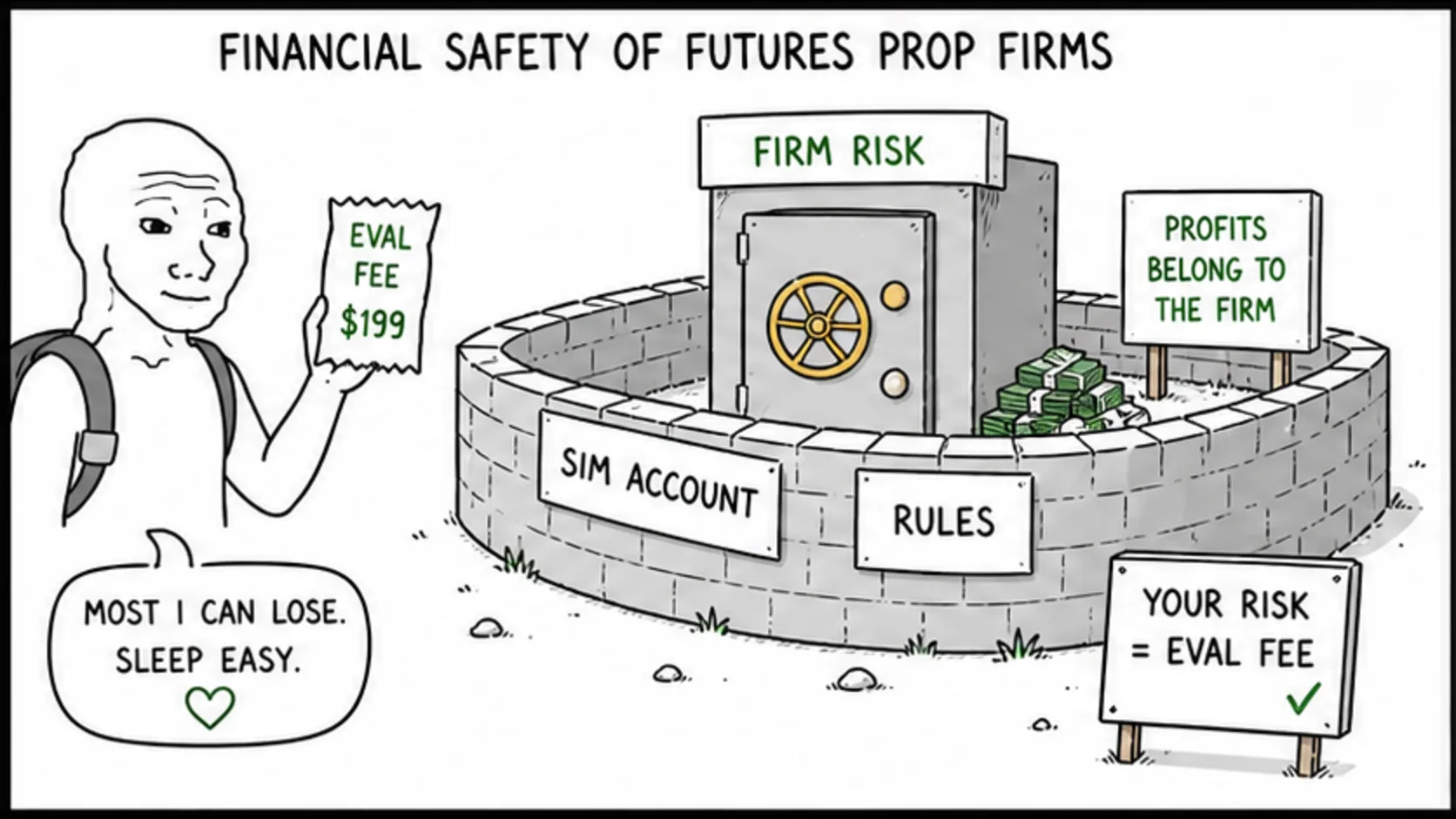
Let me start with the good news because there is plenty of it.
Your downside is capped. When you buy a futures trading combine, you pay a fee, typically between $50 and $500 depending on the account size. That fee is your maximum possible loss. You cannot go into debt to a prop firm. The firm absorbs any trading losses you generate on the account. If you blow the account on day three, you lose the fee. That is it.
Compare that to trading your own futures account. A single E-mini S&P 500 contract requires roughly $12,000 in margin. If the market gaps against you, you could lose thousands in minutes. With a prop firm, you are trading simulated capital. The real financial risk is the evaluation fee.
This asymmetric risk profile is the single strongest argument for the safety of futures prop firms. You get access to significant capital with a capped downside. For traders who do not have $50,000 or $100,000 of their own to risk, this is a legitimate opportunity.
The Commodity Futures Trading Commission warns that futures trading involves substantial risk of loss and is not suitable for all investors. Prop firms do not eliminate that risk from the trading itself. What they eliminate is your personal financial exposure to trading losses. You still need to be a competent trader. You just do not need to be a wealthy one.
The Operational Risks Nobody Warns You About
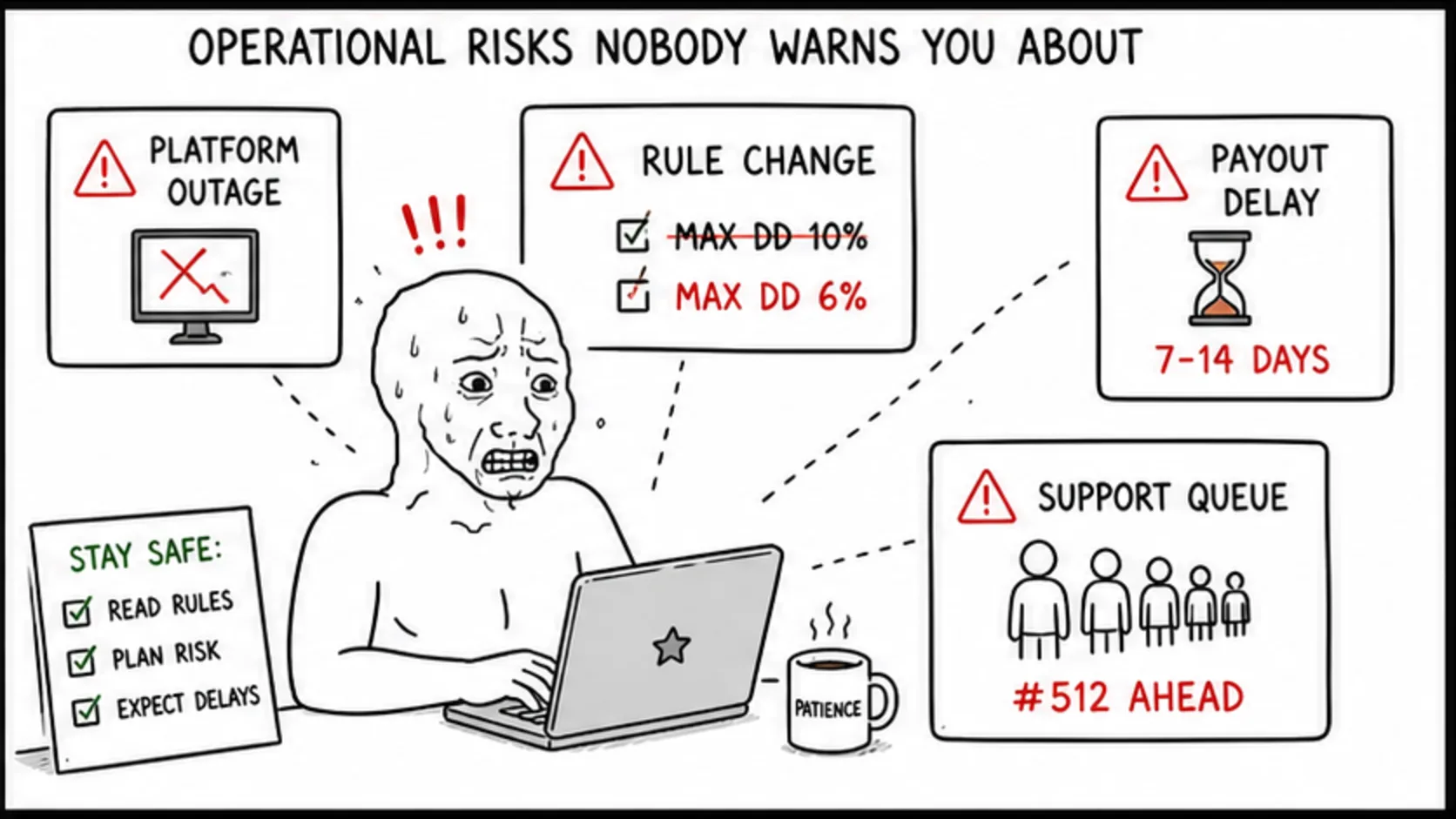
Now the stuff that actually catches people out.
Payout denial. This is the single biggest operational risk. You pass the combine, get funded, make $3,000 in simulated profits, request your payout, and the firm says no. Maybe they claim you violated a rule. Maybe they say your trading style was "inconsistent." Maybe they cite a clause buried in the terms and conditions that you did not read carefully enough.
Is this common? With established firms, no. With newer or less reputable firms, it happens more than anyone would like to admit. The reasons prop firms deny payouts range from legitimate rule violations to genuinely unfair application of vague terms. The problem is that you have very little recourse either way, because the industry is unregulated.
Rule changes. The firm updates its rules mid-challenge or mid-funded-account. What was allowed yesterday is now a violation. The trailing drawdown calculation changes. The consistency requirement tightens. If the terms give the firm the right to modify rules at any time, you agreed to that possibility when you signed up.
Platform issues. The trading platform goes down during a volatile session. You cannot close your position. Your stop loss does not trigger. You hit your daily loss limit because of a technical failure that was not your fault. Most terms and conditions state that technical issues are your responsibility. Read that sentence again. Technical issues are your responsibility. Even when they are not your fault.
Account termination. The firm closes your funded account for reasons that feel arbitrary. Maybe they say your trading pattern flagged a risk review. Maybe they decided your strategy is not compatible with their risk parameters. There is usually no appeal process.
Are Your Trades Real or Simulated?
Most retail futures prop firms use simulated accounts. Your trades are not executed on a real exchange. They are executed in a simulated environment that mirrors real market conditions.
Is this safe? In some ways, yes. You are not trading real money, so you cannot generate real losses. The firm is not risking its capital on your trades. The entire system is a risk management exercise.
In other ways, it is a source of concern. Simulated execution does not perfectly replicate live market conditions. Slippage, fill speed, and order book depth can differ. A strategy that works perfectly in simulation may perform differently in live trading. This is true of all prop firms, not just futures ones, but it matters when you are evaluating how "safe" the setup is.
Some futures prop firms do offer live funded accounts after an initial period of simulated trading. These accounts trade real contracts on real exchanges with real capital. If you are concerned about the gap between simulation and reality, ask the firm specifically whether funded accounts are live or simulated. Get the answer in writing.
The CME Group handles roughly $1.5 quadrillion in notional value annually across its futures and options markets. The data feeds that futures prop firms use come from these real exchanges, which makes the simulated environment closer to reality than forex prop firms that use broker-generated price feeds.
What Happens If the Firm Goes Bust
Here is the scenario nobody wants to think about.
You have a funded account. You have been trading profitably for three months. You have $5,000 in unrealised profits that you are about to withdraw. Then the firm announces it is closing. Or worse, the website just goes offline.
What happens to your money?
If the money was in a simulated account, there is no actual money. The profits were simulated. The firm owed you a payout based on those simulated profits, but if the firm has disappeared, there is nobody to pay you. Your evaluation fees are gone. Your unrealised profits are gone. Any pending payouts are gone.
You have essentially no recourse. The industry is unregulated. There is no ombudsman. There is no compensation fund. There is no government agency that will chase down a collapsed prop firm to recover your $5,000 in simulated profits.
Are futures prop firms legit? Most of the established ones are. But even legitimate firms can fail. Business failure is not the same as fraud, but the financial outcome for you is identical.
This is why diversification matters even within prop firms. If you have three funded accounts across three different firms, the collapse of one does not wipe you out. If all your prop trading income depends on a single firm, you are carrying concentrated risk that you cannot control.
Data Security and Personal Information
When you sign up for a futures prop firm, you hand over personal information. Your name, email, sometimes your address and phone number. Some firms require identity verification for funded accounts, which means copies of your government-issued ID.
How safe is your data?
With established firms, reasonably safe. They invest in proper security infrastructure, use encrypted connections, and have privacy policies that comply with data protection regulations like GDPR.
With newer or less established firms, it is a gamble. A prop firm that launched six months ago and is run by three people may not have the same security standards as a firm that has been operating for a decade. If their database gets breached, your personal information, including copies of your ID, could end up in the wrong hands.
Before uploading sensitive documents, check whether the firm's website uses HTTPS, whether they have a published privacy policy, and whether they explain how they store and protect personal data. If none of this information is available, think carefully about whether you trust them with a copy of your passport.
The National Futures Association requires registered futures commission merchants to meet specific cybersecurity standards. However, prop firms themselves are not registered with the NFA. Only their underlying brokers are. This means the prop firm's own data handling practices are largely self-regulated.
How to Choose a Safe Futures Prop Firm
Three missions. You know the drill by now.
Mission one: prioritise firms with a track record. The longer a firm has been operating and paying out, the safer it is. A firm that has been around for five years has survived market crashes, competitive pressure, and regulatory scrutiny. A firm that launched five months ago has proven nothing.
Check how long they have been processing payouts. Look for firms with at least two years of consistent payment history. If prop firms are worth your time and money, they should be able to demonstrate that traders have been earning from them over a meaningful period.
Mission two: read the terms and conditions with a focus on safety. Look for clauses about payout timelines, account termination conditions, rule modification rights, and dispute resolution. The terms tell you exactly what the firm can do to you. Read them before you agree to them.
Mission three: start small. Buy the cheapest combine the firm offers on your first attempt. Test their process, their platform, their support, and their payout system with the minimum financial commitment. Once you have verified that they operate as advertised, you can consider larger account sizes.
Are futures prop firms safe? Financially, your risk is capped at the fee. Operationally, the risks are real but manageable with the right firm. The established futures prop firms have years of track record, transparent rules, and proven payout histories. The newer firms might be fine, but they carry more risk. Choose accordingly, never risk more than you can afford to lose, and always verify before you trust.