Futures prop trading firms buffer rules are the extra profit cushion your firm requires before letting you touch your money. You hit the profit target. You think you are done. Then the firm says "you need a buffer." Most traders find out about this rule at the exact moment they try to withdraw. Do not be most traders.
Key Takeaways
- A buffer is the extra profit margin a futures prop firm requires above the trailing drawdown line before approving a payout.
- Buffer rules are separate from your profit target and your max drawdown. They are an additional gate between you and your money.
- Flexible buffers adjust based on performance or time, while fixed buffers stay at a set dollar amount or percentage.
- Keeping 1.5x to 2x the minimum buffer is the standard advice from funded traders who actually get paid.
- Some futures prop firms have no buffer requirement at all, but they compensate with stricter drawdown or scaling rules.
On This Page
- What Is a Buffer in Futures Prop Trading?
- How Buffer Rules Work in Practice
- Why Futures Prop Firms Use Buffer Rules
- Flexible Buffer Rules vs Fixed Buffer Requirements
- How Much Buffer Should You Keep?
- How Buffer Rules Interact With Trailing Drawdown
- 5 Strategies to Build and Protect Your Buffer
- Futures Prop Firms With No Buffer Rules
What Is a Buffer in Futures Prop Trading?
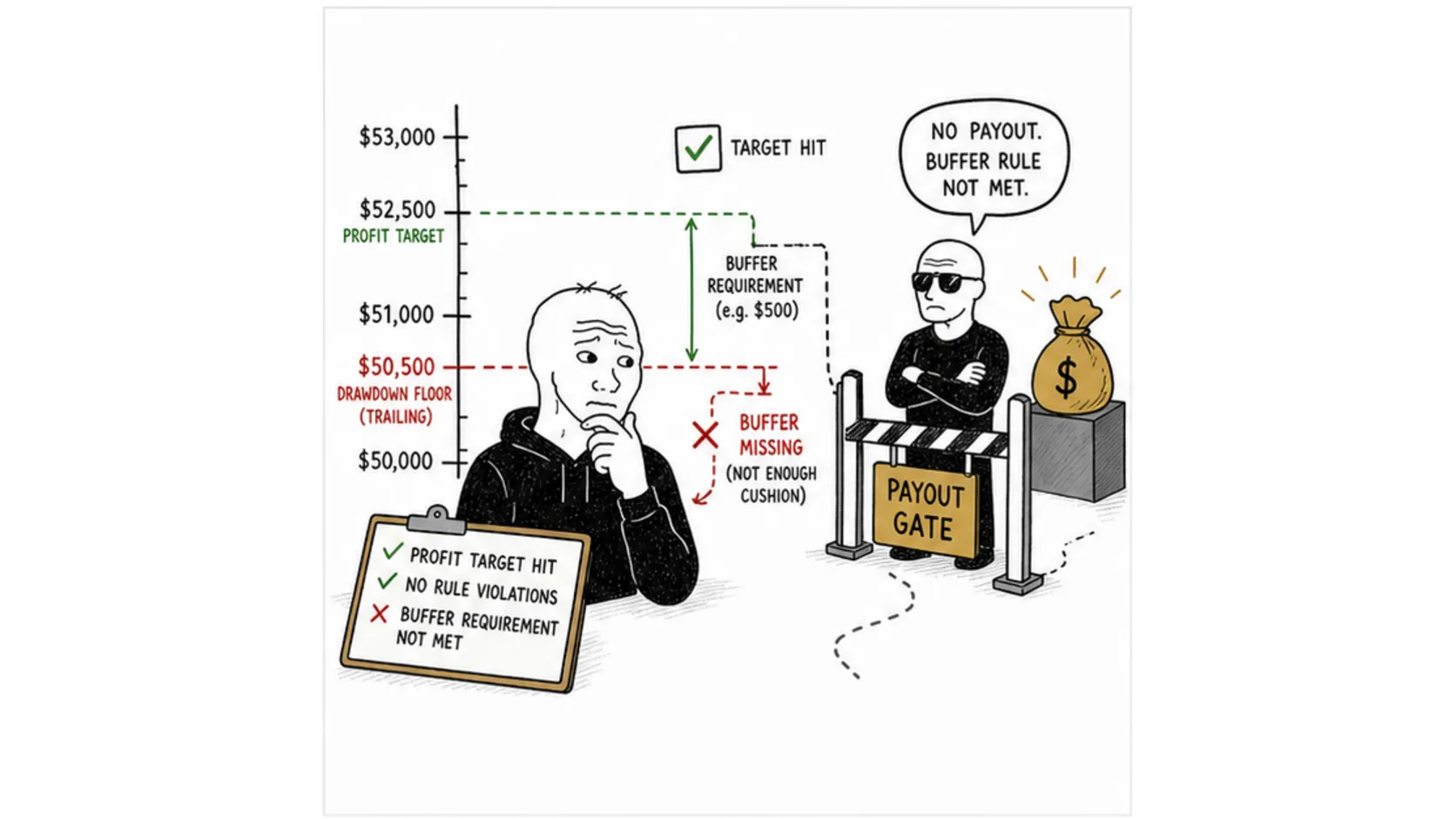
A buffer in futures prop trading is the profit cushion the firm requires you to maintain above the drawdown line before you can request a withdrawal. It is not the profit target. It is not the drawdown limit. It is a third rule that sits on top of both.
Think of it like this. Your firm gives you a $50,000 account. The trailing drawdown rule says you cannot lose more than $2,500 from your peak. The profit target says you need to make $3,000 to pass. The buffer rule says you need an extra $500 on top of that before you can withdraw.
So your actual target is not $3,000. It is $3,500. That $500 is the buffer. And until you have it, your payout request sits in limbo.
This catches people off guard constantly. Reddit threads are full of traders asking "what is a buffer in prop firms?" at the worst possible time, which is after they have already hit their target and tried to withdraw. You should know this rule exists before you buy the challenge.
Buffers exist almost exclusively in the futures prop firm space. Forex prop firms like FTMO generally do not use them. Futures firms like Apex Trader Funding, Topstep, and Earn2Trade often do. The National Futures Association does not mandate buffers, they are entirely a firm-level risk policy.
How Buffer Rules Work in Practice
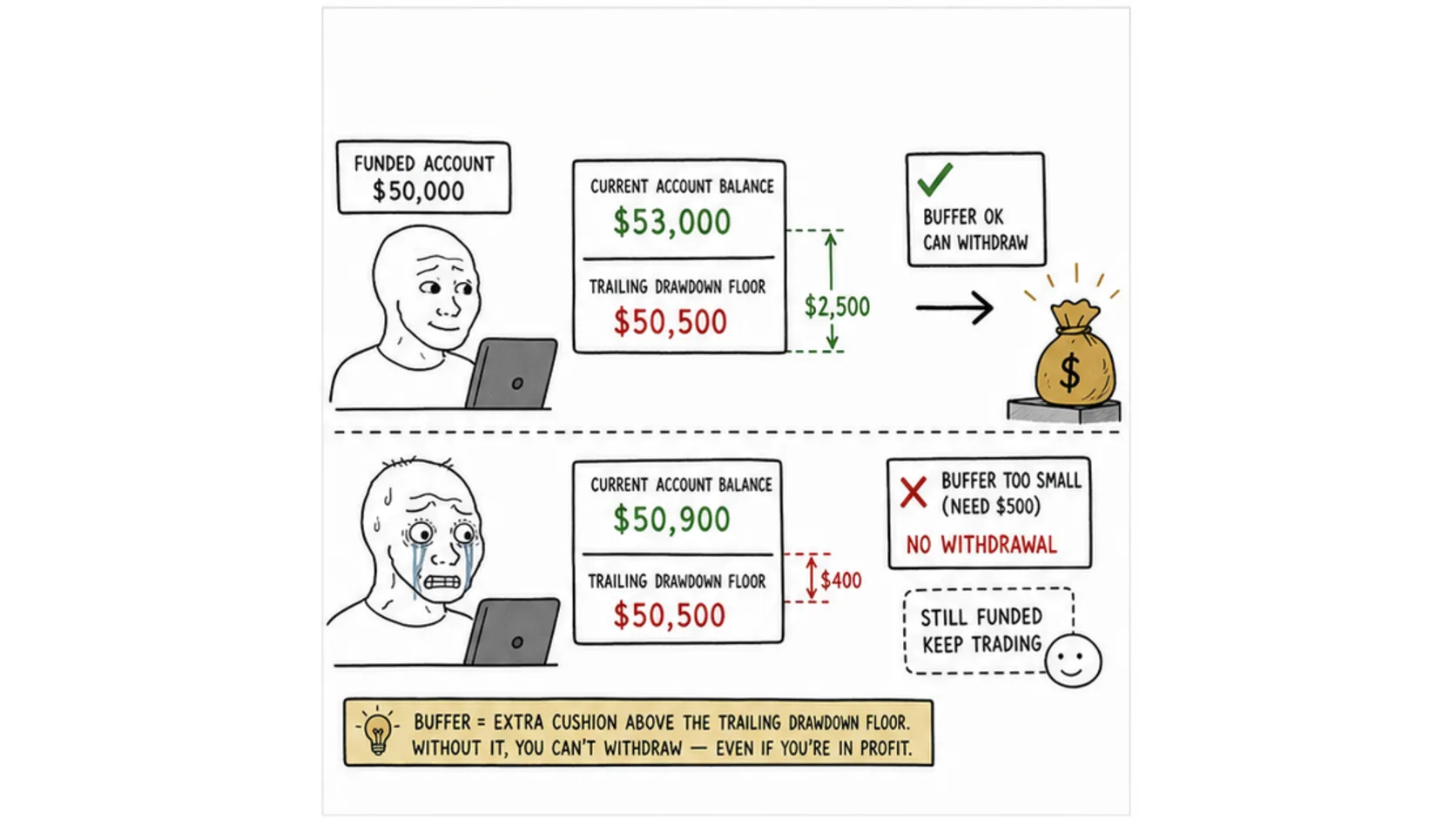
Here is how the buffer actually works in numbers. You need to see this in action because reading the definition and watching it play out are two very different experiences.
You have a $50,000 funded account. The firm's buffer rule is $500. Your trailing drawdown is $2,500. You have already hit your profit target of $3,000, so your account sits at $53,000.
Your trailing drawdown has followed you up to $50,500. That means if your account drops below $50,500 at any point, you breach. Your current equity is $53,000, which gives you $2,500 above the floor. The firm requires a $500 buffer. You have $2,500. You are fine.
Now imagine the market goes against you for two days. You lose $2,100. Your equity drops to $50,900. Your trailing drawdown floor is still at $50,500 because you did not make a new equity high. You are only $400 above the floor now.
The firm requires a $500 buffer. You have $400. Your payout request is denied. You have not breached the account. You are still funded. But you cannot withdraw until you rebuild that buffer back above $500.
This is the part that confuses people. The buffer is about payout eligibility, not account survival. You can be a fully funded trader in good standing and still not be allowed to withdraw. Two separate rules, two separate thresholds.
According to data compiled across major futures prop firms, roughly 60% of first-time payout requests get delayed due to insufficient buffer, not because the trader lost the account, but because they did not maintain enough headroom above the trailing line.
Why Futures Prop Firms Use Buffer Rules
From the firm's perspective, the buffer is a security deposit. They are handing you real capital to trade with. If you make $3,000 and immediately withdraw all of it, your account drops back to $50,000, which is right on the edge of the trailing drawdown.
One bad trade and you breach. Now the firm has paid you $3,000 and also lost the account they funded. That is a terrible deal for them.
The buffer ensures you leave enough profit in the account to survive normal market volatility even after your payout is processed. It is the firm saying "you can have your money, but you need to leave a deposit."
This is similar to how the Commodity Futures Trading Commission requires futures brokers to maintain minimum margin levels. The prop firm is applying the same concept to your funded account. They need you to have skin in the game at all times.
Firms that offer instant funding or very low evaluation requirements tend to have larger buffers because they are taking on more risk by skipping the evaluation phase. Firms with strict evaluations often have smaller buffers because the evaluation itself already filtered out the reckless traders.
The buffer also discourages what firms call "hit and run" behavior. Without a buffer, a trader could pass the challenge, withdraw everything, let the account blow, and move to the next firm. The buffer makes that strategy unprofitable because you cannot withdraw 100% of your profits.
Flexible Buffer Rules vs Fixed Buffer Requirements
Not all buffer rules are the same. Some firms use a fixed dollar amount. Others use a flexible system that changes based on how you trade. Understanding which one you are dealing with changes your entire approach to withdrawals.
Fixed buffers are straightforward. The firm says "you must maintain $500 above the trailing drawdown at all times." That number does not change whether you have been trading for one week or six months. Simple, predictable, easy to plan around.
Flexible buffer rules adjust based on factors like your trading history, the account size, or how long you have been funded. A firm might start you at a $500 buffer but reduce it to $200 after three consecutive profitable months. Or they might increase it if your trading style is high volatility.
Futures prop firms flexible buffer rules sound great on paper. Lower buffer means easier withdrawals, right? Except flexible buffers can also work against you. If your performance drops, the firm can increase your buffer requirement. You thought you had $500 to maintain, now it is $800.
For scalpers and day traders who take lots of small trades, fixed buffers are usually better. Your P&L swings are smaller and more predictable, so a fixed buffer gives you a clear line to stay above.
For swing traders holding positions overnight, flexible buffers can be an advantage. Your volatility is higher by nature, and a flexible system might recognize that and adjust accordingly. Some firms even base the buffer on the end of day vs intraday drawdown calculation method they use.
Neither system is inherently better. The key is knowing which one your firm uses before you start trading, not after you try to withdraw.
How Much Buffer Should You Keep?
This is the question that shows up on Reddit every single week. "Funded future traders, how much of a buffer do you leave?" The answers vary, but the consensus among funded traders who actually get paid consistently is clear.
Keep 1.5x to 2x the minimum buffer requirement. If the firm requires $500, aim to maintain $750 to $1,000 above the trailing drawdown line at all times. This gives you room for a bad day without losing payout eligibility.
Here is a tier breakdown for buffer sizing on a typical $50,000 futures prop account:
- Minimum buffer ($500 on a $50K account). You are walking a tightrope. One average losing day wipes out your withdrawal eligibility. You have not lost the account, but you are back to grinding. This is what most traders do because they want to withdraw as much as possible, as fast as possible. It is aggressive and it frequently backfires.
- Comfortable buffer ($750 to $1,000). You can absorb one bad trading day and still request a payout. This is the sweet spot. You are not leaving too much money on the table, and you are not living on the edge of payout denial.
- Fortress buffer ($1,000+). You can take two or three consecutive losing days and still withdraw. This is for traders who are building long-term consistency and do not mind leaving extra profit in the account for safety.
The traders who complain about buffer rules on Reddit are almost always running at the minimum. The traders who never mention buffers because they are not a problem are running at 1.5x to 2x. That pattern tells you everything.
How Buffer Rules Interact With Trailing Drawdown
This is where people get genuinely confused. The buffer and the trailing drawdown are not two separate systems running in parallel. They are stacked. The buffer sits on top of the trailing drawdown floor.
The trailing drawdown follows your highest equity point and sets a floor beneath it. The buffer rule says you must be a certain amount above that floor to withdraw. When your trailing drawdown moves up, your buffer requirement moves with it.
Let us walk through five trading days to see how this plays out.
Day one: $50,000 account, $2,500 trailing drawdown (5%), $500 buffer. Trailing floor is $47,500. You need to be at $48,000 to withdraw. You start trading.
Day two: You make $1,500. Equity $51,500. Trailing floor moves to $48,925. Buffer threshold is now $49,425. You are $2,075 above it. Comfortable.
Day three: You make another $1,000. Equity $52,500. Trailing floor moves to $49,875. Buffer threshold is $50,375. You are $2,125 above. Still fine.
Day four: You lose $2,200. Equity $50,300. Trailing floor stays at $49,875 (no new high). Buffer threshold is still $50,375. You are now $75 below the buffer threshold. Payout denied. You are still $300 above the trailing floor, so the account is safe, but you cannot withdraw.
Day five: You make $800. Equity $51,100. Still no new equity high, so trailing floor stays at $49,875. Buffer threshold $50,375. You are $725 above it. Payout eligible again.
Notice what happened on day four. The trader did not breach the account. They did not even come close to the trailing drawdown floor. They just dipped below the buffer threshold. Two completely different problems that require two completely different solutions.
Most traders only track their trailing drawdown distance. They think "I am $300 above the floor, I am fine." But if your buffer requirement is $500, being $300 above the floor means you are $200 short of withdrawal eligibility. Track both numbers separately or you will be caught off guard.
5 Strategies to Build and Protect Your Buffer
You have five missions for buffer management. Not suggestions. Missions.
Mission one: Size down after hitting profit target. Once you have reached your profit target plus the buffer, reduce your position size. You are no longer trying to grow. You are trying to maintain. The shift from offense to defense is what separates consistently funded traders from one-hit wonders. Drop to 50% of your normal size and protect what you have built.
Mission two: Set a personal daily loss cap below the buffer threshold. If your buffer is $500, set your personal daily stop at $300. If you hit $300 in losses, you are done for the day. No exceptions. This guarantees you can never lose the full buffer in a single session. The daily loss limit the firm gives you is the ceiling. Your personal cap should be well below that.
Mission three: Take partial profits. When a trade is running in your favor, close half at 1R and let the rest run. This locks in real profit that builds your buffer. Do not let winners ride into losers. A $400 winner that becomes a $200 loser did not just cost you $200. It cost you $600 in buffer momentum.
Mission four: Avoid high-volatility events when your buffer is thin. CPI, NFP, FOMC. These events create massive spikes that can wipe out a thin buffer in minutes. If your buffer is sitting at minimum, flat the account during news events. No exceptions. There will always be another trade. There will not always be another buffer.
Mission five: Track your buffer daily. Open a spreadsheet. Column one: date. Column two: current equity. Column three: trailing floor. Column four: buffer threshold. Column five: your distance from the threshold. Update it after every trading session. This takes 30 seconds and prevents the "I thought I had enough buffer" surprise.
Futures Prop Firms With No Buffer Rules
Some futures prop firms do not require a buffer at all. You hit the profit target, you request your payout, no extra cushion needed. Sounds perfect, right?
Not so fast. Firms without buffer requirements almost always compensate with stricter rules somewhere else. Tighter trailing drawdowns. Lower maximum drawdown limits. Higher evaluation standards. Smaller profit splits. The buffer is gone, but the difficulty is redistributed.
Reddit threads about "what are futures trading prop firms that do not have a buffer" reveal an interesting pattern. Traders flock to no-buffer firms thinking they are easier. Then they discover the trailing drawdown is 3% instead of 5%. Or the daily loss limit is so tight that one bad morning ends your challenge.
The firm is going to manage their risk one way or another. If they do not use a buffer, they use something else. Your job is to understand the full rule set, not just cherry-pick the rule you like.
No-buffer firms can work well for highly consistent traders with small drawdowns. If your typical trading day involves losing $100 to $200 on a bad day, a tight trailing drawdown without a buffer might actually be easier. You never need to worry about the buffer because your equity curve is smooth enough that the drawdown rule alone is not a threat.
But if your trading style involves larger swings, the buffer version is often more forgiving. A $500 buffer gives you an extra $500 of breathing room above the drawdown line. Without it, every dollar of drawdown counts directly against you.
Choose based on your actual trading style, not based on which rule sounds easier on paper. A rule that sounds easy but does not match how you trade will cost you more in the long run.
Understanding futures prop trading firms buffer rules is not optional. It is part of the game. Every futures prop firm buffer requirement exists for a reason. Your job is to know the rule, plan for it, and trade around it. The trailing drawdown buffer is just one more line on your spreadsheet, but ignoring it is the fastest way to go from funded to frustrated.