Prop firm news trading rules are some of the most misunderstood restrictions in the industry. Prop firms that allow news trading exist, but they are the minority. Most firms restrict it. Some traders do not even know the rules exist until their profits get wiped for trading during a restricted window. Others know the rules exist but cannot figure out exactly which news events are restricted and when the window opens and closes. Here is the complete breakdown.
Key Takeaways
- Most prop firms restrict trading around high-impact news events like NFP, CPI, and FOMC rate decisions.
- News trading windows typically close 2-5 minutes before the release and reopen 2-5 minutes after.
- Trading during a restricted window usually results in those profits being deducted from your account.
- Some firms allow holding through news but prohibit opening new positions during the window.
- The restriction exists because news trading creates slippage and unpredictable risk that does not reflect genuine trading skill.
On This Page
Why Prop Firms Restrict News Trading
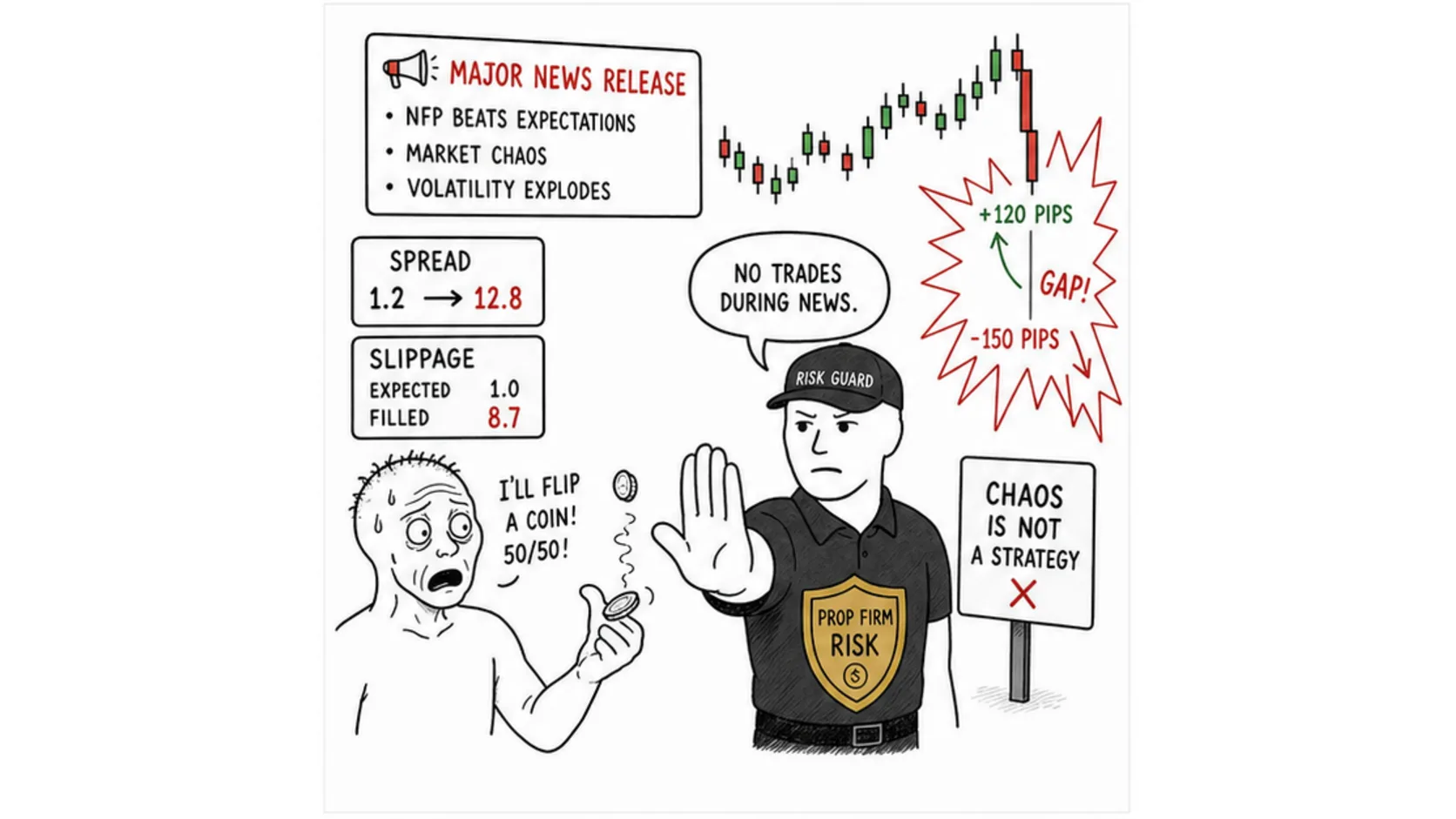
News trading during high-impact economic events is restricted by most prop firms for one reason. It creates market conditions that do not reflect your actual trading ability.
When NFP drops or the Federal Reserve announces a rate decision, the market does not move based on analysis. It moves based on raw supply and demand imbalances that last for seconds. Spreads widen from 0.2 pips to 15 pips in an instant. Slippage eats your stop loss before your broker can execute it. Price gaps 30 pips in a direction nobody predicted.
If you happen to be on the right side of that gap, you just made 30 pips in three seconds. That looks like brilliant trading. It was not. It was a coin flip during chaos. The firm knows this. And they do not want to pay you for chaos.
The Commodity Futures Trading Commission monitors market behavior during news events because the volatility creates opportunities for manipulation. Prop firms restrict news trading for the same reason from a different angle. They want to see that you can trade consistently under normal conditions, not that you got lucky during a 60-second window of insanity.
Another reason firms restrict news trading is the spread. During news events, spreads widen massively. If you open a position during a 15-pip spread, the firm takes on immediate execution risk that has nothing to do with your directional analysis. They are not restricting you to be annoying. They are protecting their capital from a risk they cannot control.
What Counts as a News Event
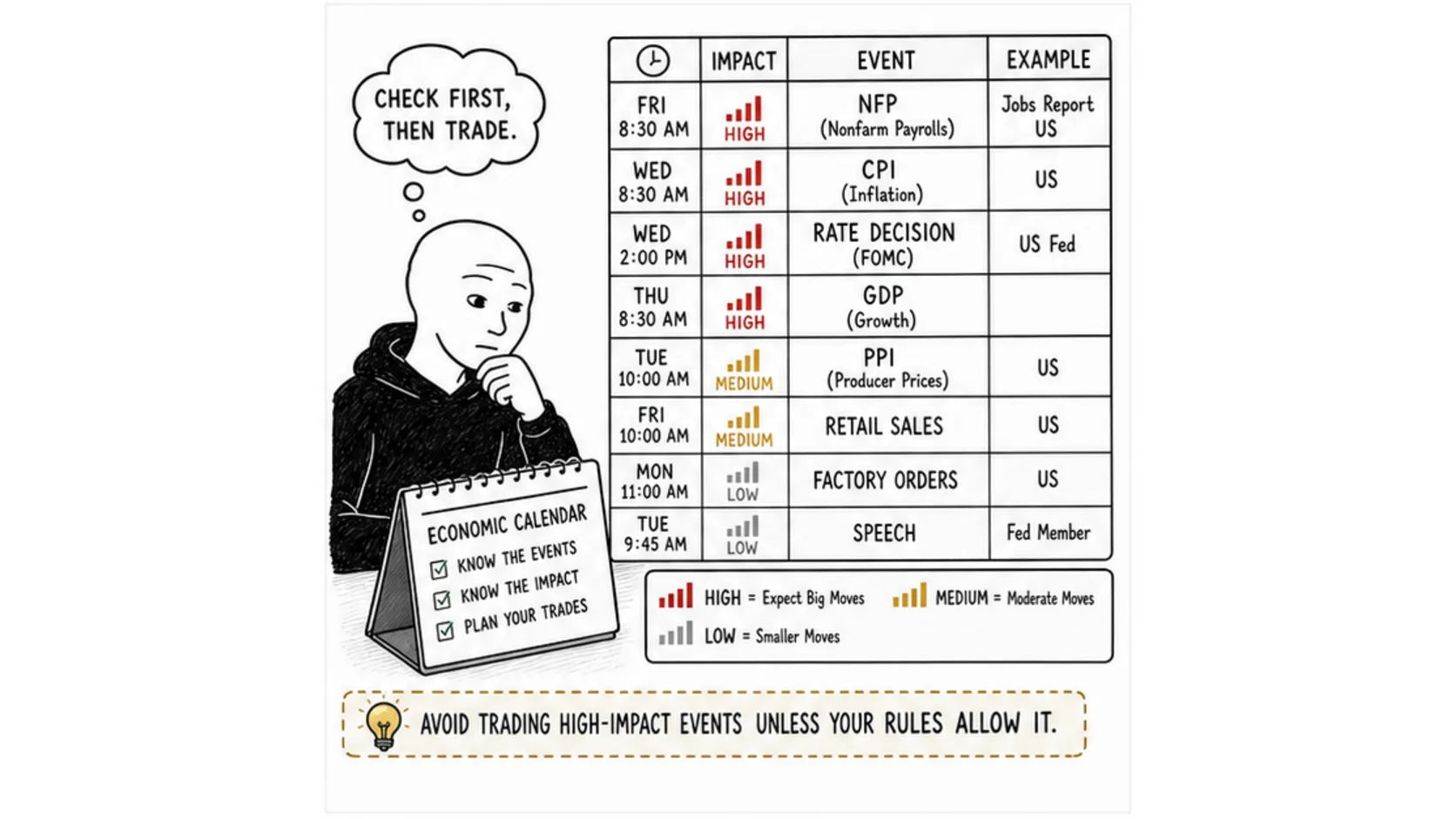
Not every economic data release counts as a restricted news event. Firms typically categorize news into three tiers based on impact level.
High-impact events (restricted by most firms):
- Non-Farm Payrolls (NFP), released first Friday of each month
- Consumer Price Index (CPI), monthly inflation data
- Federal Reserve interest rate decisions (FOMC), eight times per year
- Federal Reserve chair press conferences
- Gross Domestic Product (GDP) quarterly reports
- European Central Bank rate decisions
Medium-impact events (restricted by some firms):
- retail sales figures
- Purchasing Managers Index (PMI) reports
- Jobless claims (weekly)
- Consumer confidence indices
- Trade balance reports
Low-impact events (almost never restricted):
- Minor economic indicators from smaller economies
- Corporate earnings reports
- Political speeches that are not central bank related
- Sector-specific data releases
The key is impact level. If the data release has the potential to move the market 20+ pips in seconds, most prop firms consider it restricted. If it typically causes a 3-5 pip reaction, it usually falls outside the restriction window.
Some firms provide a calendar of restricted events in their rules documentation. Others reference the Forex Factory calendar and tell you to check the red-folder (high-impact) events. A few firms keep it vague and judge on a case-by-case basis, which is the worst version because you never know for sure.
How News Trading Windows Work
The news trading window is the time period around a restricted event during which you cannot open (and sometimes cannot hold) positions. Understanding the exact timing is critical because being off by 30 seconds can cost you your profits.
A typical news window looks like this. The restricted period starts 2-5 minutes before the scheduled release time and ends 2-5 minutes after. During this window, you cannot open new positions on the affected instruments.
For example, NFP releases at 8:30 AM Eastern. If your firm has a 3-minute window, you cannot open new positions from 8:27 AM to 8:33 AM Eastern on any instrument that NFP typically impacts (EUR/USD, GBP/USD, gold, S&P 500 futures).
Some firms extend the window further. I have seen firms with 10-minute pre-news and 10-minute post-news restrictions. Others restrict the entire day of a major release for certain instruments. The variation is massive, so you need to check your specific firm's rules.
Here is where traders get caught. The scheduled release time is when the data drops. But the market can start moving 30-60 seconds before the official release if the data leaks or if algorithmic traders get early access. Your firm's window starts at the scheduled time, but the actual volatility can begin earlier. If you are in a position when the pre-release movement starts, you are already in the danger zone even if the official window has not opened yet.
The safest approach is to be flat (no open positions) at least 10 minutes before any high-impact news event. This gives you a comfortable buffer and eliminates any ambiguity about whether you were inside or outside the window.
Which Firms Allow News Trading
The answer to which prop firms allow news trading is not a simple yes or no. It exists on a spectrum.
Strict no-news firms. These firms prohibit any trading during high-impact events. No opening, no holding, no exceptions. If your position is open during a restricted window, the profits get deducted. Some of these firms extend the restriction to funded accounts and challenges alike.
Conditional firms. These firms allow news trading with conditions. You might need to hold your position for a minimum time before the news release. Or you can hold through news but not open new positions. Or the restriction only applies to certain instruments. This is the most common category.
No-restriction firms. A small number of firms place no restrictions on news trading at all. You can open, close, and hold positions through any event. These firms usually compensate with wider drawdown rules or lower profit splits to account for the additional risk.
Firms that restrict news trading on their challenges but allow it on funded accounts are fairly common. The logic is that the challenge is a test of consistency. News trading is not consistent. Once you prove yourself on the challenge, they loosen the reins. If you are specifically looking for news trading allowed prop firm accounts, check the funded account rules separately from the challenge rules.
The firms most likely to allow news trading are futures prop firms, since futures markets handle news volatility differently than forex. Futures prop firms with end-of-day drawdown rules tend to be more lenient because the daily reset smooths out intraday news spikes.
Holding Through News vs Opening New Positions
This distinction matters more than almost anything else in prop firm news trading rules. Most firms treat these two actions differently.
Opening new positions during the window. This is almost universally prohibited. If you open a trade during the restricted window, most firms will deduct any profit from that trade. Some firms will close the trade automatically. A few firms treat it as a rule violation that can lead to account termination if repeated.
Holding existing positions through the window. This varies by firm. Many firms allow you to hold positions that were opened before the window started. You just cannot open new ones. Other firms require you to close all positions before high-impact events. The difference is critical.
If your firm allows holding, you still carry the risk of a massive slippage event hitting your stop loss during the news release. Your stop might be 10 pips away but the price gaps 25 pips through it. You lose 25 pips instead of 10 because the market moved faster than the execution.
Even if your firm allows holding through news, the smart play is usually to close before the event. The risk-reward of holding through NFP or FOMC is terrible. You are exposing your account to a 30-second chaos window for a trade that has nothing to do with your actual strategy.
The daily loss limit does not care why you lost the money. A news-induced slippage spike counts against your daily loss limit the same as any other loss. Protect yourself.
What Happens If You Break the News Trading Rule
The consequences for violating news trading rules range from a slap on the wrist to account termination, depending on the firm and the severity.
Profit deduction. The most common consequence. The firm identifies trades opened during the restricted window and deducts the profit from those trades from your account balance. You keep the account, you lose the money you made during the violation.
This sounds fair until you realize the trade might have also been part of a larger strategy. You opened five positions, one was during the news window, and the firm deducts the profit from that one. The other four are fine. The net effect is annoying but manageable.
Warning. Some firms issue a warning on the first violation and deduct profits. The warning goes on your account record. A second violation carries heavier penalties.
Account termination. Repeated violations or large-scale news trading abuse can result in the firm closing your account. This is rare for a single incident but happens if a trader consistently trades during restricted windows and argues about it with support.
Payout denial. Some firms deny your payout request if they find news trading violations during the review process. The profits from news trades are removed from your payout calculation. If those profits made up a significant portion of your total, your payout shrinks dramatically.
The simplest way to avoid all of this is to maintain a personal calendar of restricted events and be flat 10 minutes before each one. No exceptions. There will always be another trade. There will not always be another funded account.
Whether prop firms that allow news trading are better or worse depends on your style. If you are a news trader by nature, find a firm that explicitly allows it. Do not try to sneak news trades past a firm that restricts them. The prop firm news trading rules exist whether you agree with them or not, and the consequences for breaking them are not worth the risk.
Trading Strategies Around News Windows
News restrictions do not mean you cannot trade around news events. They mean you need a strategy for dealing with them. Here are three approaches that work.
The pre-news setup. Enter your position 30-60 minutes before the release with a clear bias. Set your stop loss and take profit. Close the trade before the restricted window opens. You capture the pre-news momentum without exposing yourself to the chaotic release itself.
This works because markets often trend in the expected direction before the news drops. If CPI is expected to come in hot, the dollar often starts strengthening 30-60 minutes before the release. You ride that momentum and exit before the window.
The post-news fade. Wait for the news to release. Wait for the restricted window to close. Then look for a fade or continuation setup based on the market reaction. The initial spike often overextends and creates a clean reversal trade 5-15 minutes after the event.
This is a legitimate strategy because you are trading the market's reaction to the data, not the chaos of the release itself. The spread has normalized. The slippage risk is gone. You are trading in normal conditions with new information.
The avoid-and-wait. Do nothing. Sit on your hands during the entire news cycle. Check your maximum drawdown distance, review your trades, grab coffee. Let the event pass and resume your normal trading the next session.
This is the most underrated approach. The traders who make it through prop challenges are not the ones who trade every opportunity. They are the ones who know when not to trade. A missed trade costs nothing. A blown account costs everything.