Some prop firms allow EAs. Some do not. Most sit somewhere in the middle, permitting automated trading with restrictions that catch people off guard. If you are planning to use an Expert Advisor to pass a prop firm evaluation, you need to know exactly what each firm allows before you pay for anything.
The short version: forex prop firms running MetaTrader are your best bet for EA trading. Futures prop firms are mostly a dead end for automated strategies.
Key Takeaways
- Most prop firms do allow EAs, but many restrict how you can use them during evaluations and funded accounts.
- Firms that use MetaTrader 4 or MetaTrader 5 are the most EA-friendly because the platforms natively support Expert Advisors.
- Using an EA does not exempt you from any risk rules. The daily loss limit and drawdown still apply.
- Some firms explicitly ban EAs during evaluations but allow them on funded accounts, or vice versa.
- Futures prop firms rarely support EAs because platforms like NinjaTrader and Rithmic use different automation frameworks.
On This Page
What Is an EA in Prop Trading?
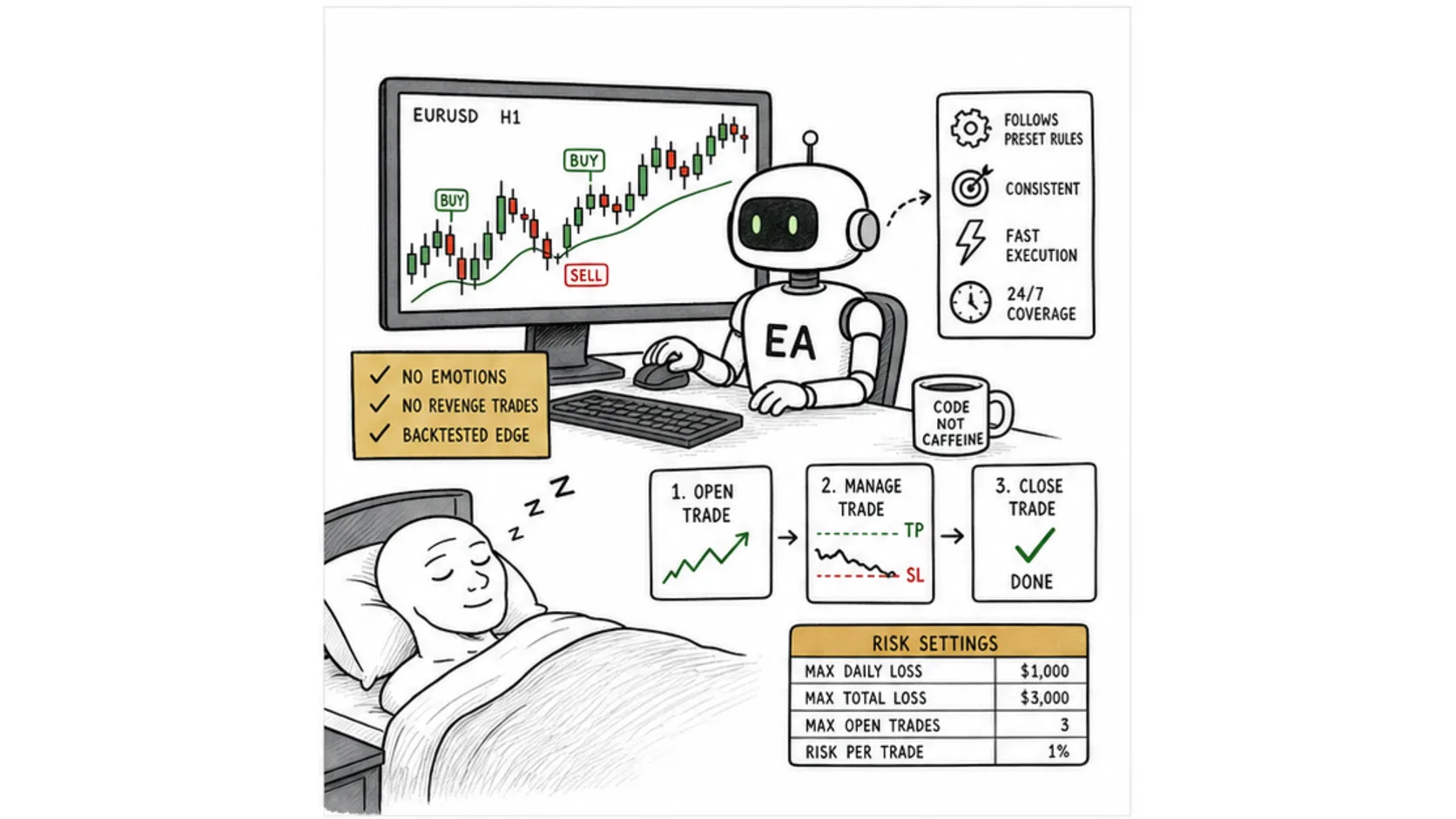
An EA, or Expert Advisor, is an automated trading program that runs on MetaTrader platforms. It opens, manages, and closes trades based on pre-set rules without you sitting at the screen.
On MetaTrader 4 and MetaTrader 5, EAs are built into the platform. You attach one to a chart, configure the parameters, and it trades for you. Grid traders, scalpers, trend followers, news bots, they all exist as EAs.
Prop traders use EAs for a few reasons. Consistency. An EA follows rules exactly, no emotional trades, no revenge trading, no "I think the market is going to reverse" mid-session panic. Speed. EAs execute in milliseconds. And 24-hour coverage. An EA trades the Asian session while you sleep.
The problem is that some EAs are garbage. They overfit to historical data, blow up on live markets, and fail every risk management rule the prop firm enforces. The EA itself is not a solution. A good EA combined with proper risk parameters is.
Which Prop Firms Allow EAs
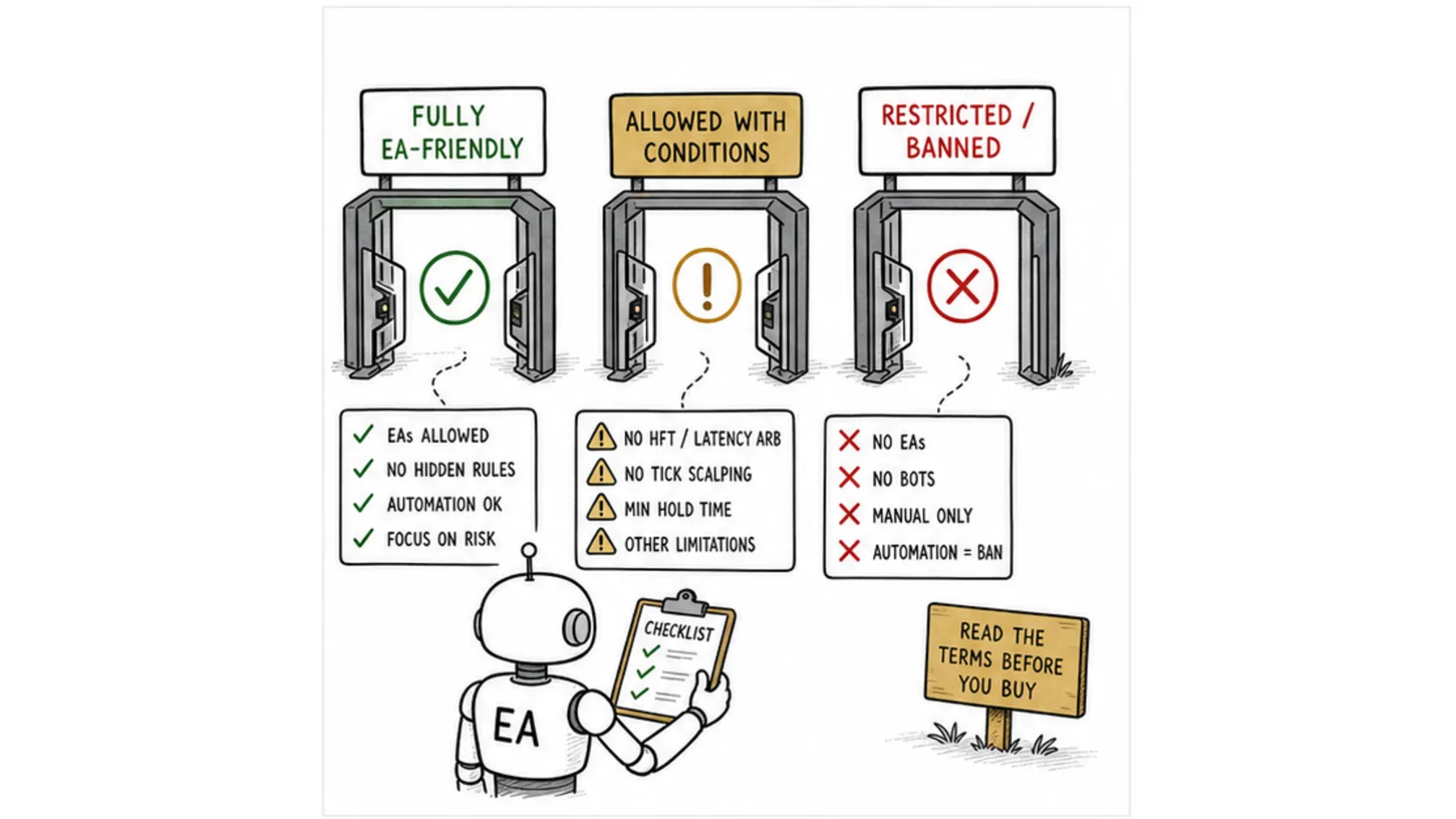
The EA-friendly prop firms fall into a few tiers. Here is the landscape.
Fully EA-friendly. These firms explicitly allow EAs on both evaluations and funded accounts. FTMO permits EAs with some restrictions on Martingale strategies. FunderPro actively promotes EA usage. Funding Pips allows EAs on most account types. These are established firms with verifiable payout records.
EA-allowed with conditions. MyFundedFX allows EAs but restricts certain strategy types during evaluations. The 5ers permits EAs on some programs but not all. Lux Trading Firm allows automated trading if you declare it during registration.
EA-restricted or banned. Some firms detect EA usage through trade analysis and will flag accounts that show automated patterns. Others explicitly state in their terms that automated trading is not permitted during evaluations. Always read the terms and conditions before buying an evaluation if you plan to use an EA.
| Firm | Evaluation EA | Funded EA | Platform |
|---|---|---|---|
| FTMO | Yes (restricted) | Yes | MT4/MT5 |
| FunderPro | Yes | Yes | MT4/MT5 |
| Funding Pips | Yes | Yes | MT4/MT5 |
| MyFundedFX | Conditional | Yes | MT4/MT5 |
| The 5ers | Program-dependent | Yes | MT5 |
Rules and Restrictions on EA Trading
Even firms that allow EAs impose restrictions. Here is what to watch for.
No Martingale strategies. Most EA-friendly firms ban Martingale or grid-based strategies that double position size after losses. These strategies can pass evaluations during low-volatility periods and then destroy funded accounts when volatility spikes. Firms know this. They check for it.
No high-frequency scalping. Some firms restrict EAs that open and close positions within seconds. The reasoning is practical: these strategies strain server resources and can exploit latency differences between the firm's price feed and the actual market.
Trade copying restrictions. Using an EA to copy trades from another account, whether your own or a signal provider, is restricted at some firms. The consistency rule may also apply, limiting how similar your trades can look to other accounts on the same firm. If copy trading is your thing, here are the firms that actually allow it.
Minimum holding time. A few firms require positions to be held for a minimum duration, typically 30 seconds to 2 minutes. This rules out tick scalpers and latency arbitrage EAs.
All standard risk rules still apply. Your EA is not exempt from the daily loss limit, the maximum drawdown, or any other rule. If the EA breaches a rule, the account is gone. The firm does not care whether a human or a robot placed the trades.
Can You Pass a Prop Firm Challenge With an EA?
Yes. People do it. But the success rate for EA users is not higher than manual traders, and in some cases it is lower. Here is why.
An EA that works on a backtest does not guarantee it works on a prop firm evaluation. Prop firm evaluations have time limits, profit targets, and risk rules that constrain your strategy. A profitable EA on a regular broker account might fail an evaluation because it cannot hit the profit target within the time window without exceeding the drawdown.
The EAs that work best for prop firm challenges are trend-following or mean-reversion strategies with built-in risk management. They take modest profits per trade, cut losses quickly, and avoid trading during high-impact news events. They are not exciting. They are consistent. And consistency is exactly what passes prop firm challenges.
Grid and Martingale EAs are the ones that blow up evaluations. They work for weeks, building small profits, and then one bad market day wipes out the account and breaches every rule simultaneously. Avoid them for prop firm trading.
EAs on Futures Prop Firms
Futures prop firms are a different story. The platforms they use, NinjaTrader, Tradovate, Rithmic, do not support EAs in the same way MetaTrader does.
NinjaTrader has its own automation framework using C# scripts, but these are not EAs in the MetaTrader sense. Futures prop firms that use NinjaTrader may allow automated strategies, but you need to build them specifically for that platform.
Rithmic and Tradovate have API access for algorithmic trading, but the barrier to entry is higher. You need programming knowledge, API credentials from the firm, and a strategy built for futures contract specifications.
Most futures prop traders trade manually. The ones who automate tend to be experienced algo traders who built their own systems. If you are looking for a plug-and-play EA experience on futures, it does not really exist.
Platform Compatibility for EA Trading
Your EA choice is limited by the platform the prop firm offers.
MetaTrader 4. The original EA platform. Largest library of pre-built EAs, easiest to set up, most prop firm documentation refers to MT4 EA usage. If your EA runs on MT4, you have the widest range of firms to choose from.
MetaTrader 5. More powerful than MT4 but with a smaller EA ecosystem. MT5 supports more order types and better backtesting. Most forex prop firms offer MT5 alongside or instead of MT4.
cTrader. Supports automated trading through cBots (cTrader bots). Not as many pre-built options as MetaTrader, but the platform is gaining traction with prop firms. If your strategy runs as a cBot, check which firms offer cTrader.
DXtrade and Match-Trader. Newer platforms used by some prop firms. EA support varies. Check with the firm directly before assuming your EA will work.
What Happens If You Use an EA Without Permission
Firms detect EA usage through trade analysis. Identical trade patterns across multiple accounts, sub-millisecond execution speeds, and perfectly consistent position sizing are dead giveaways. Some firms also monitor for known EA signatures.
If you use an EA on a firm that bans them, the consequences range from a warning to immediate account termination and forfeiture of any profits. Most firms terminate the account without a second chance.
Is it worth the risk? No. There are enough EA-friendly firms that you do not need to sneak an automated strategy onto one that bans it. Pick one of the firms we rated highest for EA compatibility that welcomes your trading style.
Choosing the Right EA for Prop Firm Trading
If you are going to use an EA for prop firm trading, pick one that aligns with the evaluation rules rather than one that promises the highest returns.
Look for EAs that: have built-in daily loss limits, trade during specific sessions (not 24/7), use fixed lot sizing or low-risk percentage sizing, and have a track record on live accounts, not just backtests.
Avoid EAs that: use Martingale or grid strategies, promise 100% monthly returns, trade during news events, or require you to disable stop-losses to work properly.
The best EA for prop firm trading is boring. It takes 10-20 pips per trade, risks 0.5-1% per position, and runs for a few hours during the London or New York session. It is not going to make you rich overnight. It is going to pass the evaluation without drama, which is the entire point.
Test your EA on demo first. Run it for at least four weeks with the exact same parameters you plan to use on the evaluation. If it cannot survive four weeks on demo without breaching risk rules, it will not survive the evaluation either.