Every prop firm has terms and conditions. Most traders never read them. That is not an exaggeration. The majority of traders who message me about denied payouts skipped the T&Cs entirely and then act surprised when the firm enforces a rule that was sitting there in black and white the whole time. This prop firm checklist fixes that. Print it. Use it. Every single time you consider a new firm.
Key Takeaways
- Always read the full terms and conditions before buying any prop firm challenge. The most important payout-denial triggers are buried in the fine print.
- The five critical areas to check are drawdown calculations, daily loss limits, payout conditions, hidden fees, and whether rules can change retroactively.
- Legitimate firms use clear, specific language. Vague terms like "at the firm's discretion" are designed to give the firm an escape route.
- Most traders who get denied payouts violated a term they never read. Do not be one of them.
- If the terms are hard to find, hard to understand, or seem deliberately confusing, that is a red flag on its own.
On This Page
- Your Terms and Conditions Checklist
- Drawdown: How Is It Calculated?
- Daily Loss Limit: What Exactly Counts?
- Profit Target and Challenge Structure
- Payout Conditions: When and How You Get Paid
- Hidden Fees and Extra Charges
- Rule Change and Retroactive Enforcement
- Trading Restrictions You Must Check
- Account Breach and Termination Conditions
- What Typical Prop Firm Rules Look Like
- Frequently Asked Questions
Your Terms and Conditions Checklist
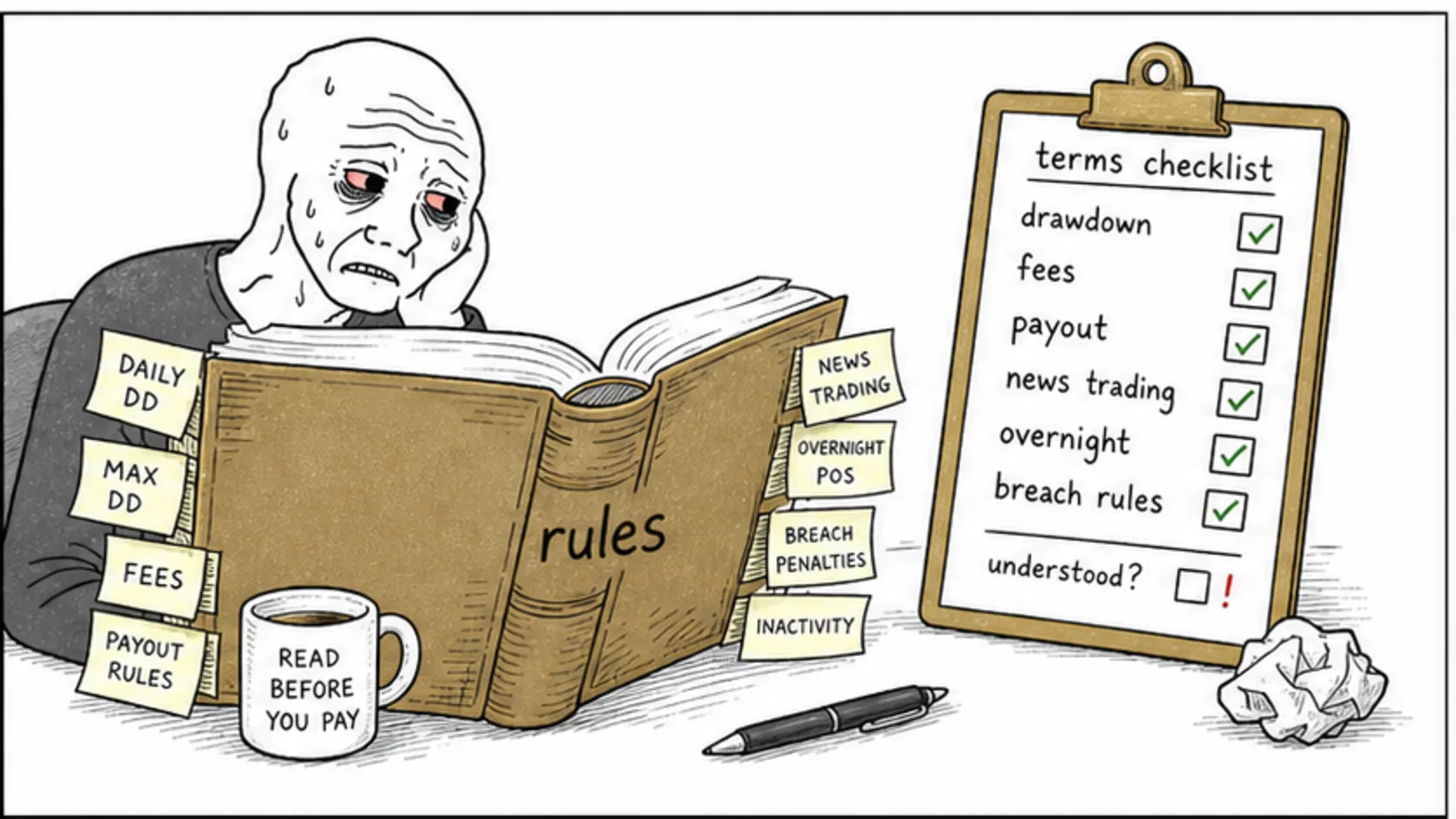
You are looking for eight specific things in the T&Cs. Eight. Not "general vibes." Not "the pricing page looked fine." Eight concrete items that determine whether you get paid or get your account closed.
Drawdown calculation method. Daily loss limit definition. Profit target and challenge structure. Payout conditions and timeline. Hidden fees beyond the challenge price. Whether rules can change retroactively. Trading restrictions during the challenge and funded phase. Account breach and termination conditions.
If the firm's T&Cs do not clearly address all eight of these, you are signing a contract with blank spaces. Those blank spaces will be filled in by the firm, not you, when it matters most.
Drawdown: How Is It Calculated?
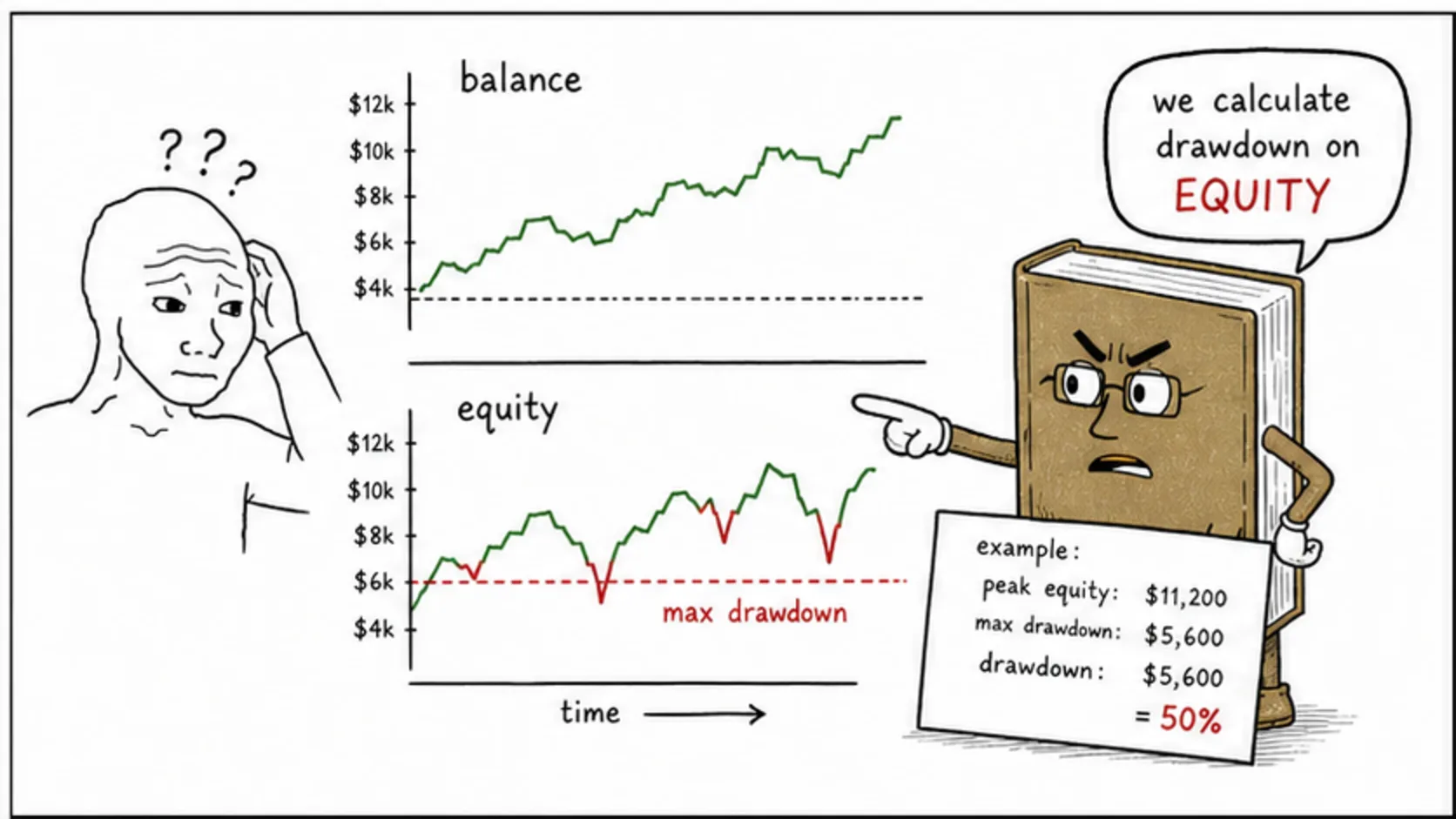
This is where most traders get caught. The firm says "10% maximum drawdown" and you think, fine, I lose 10% and I am out. But how that 10% is measured makes a massive difference.
Static drawdown is calculated from your starting balance. If you start with $100,000, your drawdown limit is $10,000 below that number, full stop. It does not move. Your maximum allowed balance is always $90,000.
Trailing drawdown follows your highest balance or equity. If you grow the account to $108,000 and then drop back to $97,200, you just breached a 10% trailing drawdown even though you are still above your starting balance. The drawdown ceiling trailed up behind you and you did not notice.
Which one does the firm use? Static or trailing? Is it based on balance or equity? When is the high-water mark reset? These details are in the T&Cs. If the firm does not explain this clearly, assume it is trailing, because that is what favours the firm.
Here is the painful math. A 10% trailing drawdown on a $100,000 account where you grow to $108,000 means your floor is now $97,200, not $90,000. You have $1,200 less room than you think. This is exactly the kind of detail that catches traders on day 28 of a 30-day challenge.
Daily Loss Limit: What Exactly Counts?
The firm says 5% daily loss limit. Straightforward, right? Wrong. The question is what counts toward that limit and when the clock resets.
Some firms calculate the daily loss limit based on starting daily balance. Your day starts at $100,000, you can go down to $95,000. Clear. Simple. Other firms calculate it based on the highest equity point during the day. Your balance starts at $100,000, you run it up to $103,000, then back to $97,850. You are at a net loss from the day's high, and the firm counts that against your daily limit.
Check if swaps and commissions count toward the daily loss. Some firms include them. Some do not. Some say nothing, which means they can include them whenever they want.
Check when the daily reset happens. Is it midnight server time? Midnight your local time? 5pm EST? If you are in a different timezone and the daily reset happens mid-session for you, a losing trade might count against two different days.
Profit Target and Challenge Structure
What is the profit target? What phase is it for? How many phases are there? The T&Cs should state this in numbers, not words like "competitive" or "industry standard."
A typical two-phase challenge has an 8% target in phase one, a 5% target in phase two. A one-phase challenge usually requires 8-10% in a single stage. The number of phases changes your risk calculation significantly because you have to survive twice as long without breaching the rules.
Check if the profit target includes or excludes commissions and swaps. If you need to make $8,000 profit but commissions cost $800, you actually need $8,800 in gross trading profits. On a $100,000 account, that is the difference between an 8% target and an 8.8% target.
Is there a consistency rule? Some firms require that no single trade accounts for more than a certain percentage of your total profit. If one big winner carried your entire challenge, the firm may reset you or extend your evaluation. This is not hidden, it is in the T&Cs. You just have to read them.
Payout Conditions: When and How You Get Paid
You passed the challenge. You are funded. You made money. Now the terms that actually matter kick in.
How soon can you request your first payout? Some firms require 30 days of trading. Some let you withdraw immediately. Some require a minimum number of trades before the first withdrawal. This should be stated clearly.
What is the profit split? The standard range is 70-90%. Anything below 70% is not competitive. Anything above 90% is suspicious, because the firm needs to make money too.
What withdrawal methods are available? Bank transfer, crypto, PayPal, Deel? Are there withdrawal fees? How long does processing take? If the T&Cs say "payouts processed within 7-14 business days" with no specifics, the firm is giving itself a lot of runway.
Also check whether the firm complies with basic consumer protection standards in its operating jurisdiction. The European Securities and Markets Authority publishes guidelines on fair treatment that, while not directly regulating prop firms, set a useful benchmark for transparent terms.
Is there a scaling plan? How does account growth work? At what balance does the firm increase your buying power or adjust your drawdown limits? The scaling plan terms determine how much you can earn long term, not just on the first payout.
Hidden Fees and Extra Charges
The challenge price is not the only fee. This is where the T&Cs separate the honest firms from the ones that nickel-and-dime you to death.
Is there an activation fee after you pass the challenge? Some firms charge $50-200 to activate your funded account. This should be disclosed before purchase, not after you pass. If the T&Cs mention activation fees that were not on the pricing page, that is a bait-and-switch.
Are there monthly platform fees? Data feed charges? Account maintenance fees? Some firms charge a monthly fee on funded accounts that eats into your profit. Check if these are waived for active traders or charged regardless.
What about account reset fees? If you breach a rule during the challenge, can you reset the account for a fee, or do you have to buy a new challenge entirely? Reset fees are typically 50-70% of the original challenge price. Know this number before you need it.
Withdrawal fees. Processing fees. Currency conversion fees. Every fee the firm can charge you should be listed in the T&Cs. If you find a fee that is not listed anywhere but the firm charges it anyway, document it and dispute it.
Rule Change and Retroactive Enforcement
This is the clause that burns experienced traders. You bought under Rule Set A. You traded under Rule Set A. You passed under Rule Set A. Then the firm switches to Rule Set B and says your funded account now operates under the new rules.
Legitimate firms apply rule changes prospectively. New rules for new purchases. Existing accounts keep the rules they signed up for, at least until the current challenge or funded cycle completes. Shady firms apply changes retroactively, including to trades you already placed.
Retroactive rule changes are one of the most common reasons for payout denial. The firm introduces a new rule about news trading or hedging, applies it to last week's trades, and denies your payout for violating a rule that did not exist when you made the trade.
Find this clause in the T&Cs. Search for "right to modify" or "terms may change" or "at our discretion." Every firm has some version of this. The question is whether changes apply going forward or backward. If the T&Cs do not specify, ask support in writing and keep the response.
Trading Restrictions You Must Check
The T&Cs will list what you cannot do. These restrictions vary between firms and between challenge types, so check carefully.
News trading restrictions. Some firms prohibit trading within a window around major economic events. The window can be 2 minutes, 30 minutes, or several hours. Check whether the firm defines "major news" specifically or leaves it vague.
Overnight and weekend holding rules. Can you hold positions past the New York close? Over the weekend? Some firms require all positions to be flat by Friday 5pm EST. Others allow weekend holds with a larger margin requirement.
Copy trading and EA rules. Does the firm allow automated trading? Can you use expert advisors or copy another trader's signals? Some firms prohibit all automated strategies. Others allow EAs but restrict specific types like grid or martingale.
Minimum trade duration. Some firms require trades to be open for a minimum time. The 2-minute rule is increasingly common, preventing sub-2-minute scalping. This matters if your strategy involves fast entries and exits during volatile sessions.
Maximum lot size per trade. Some firms cap position size relative to account balance. If your strategy uses large lot sizes relative to the account, this cap can prevent you from trading the way you normally would.
Account Breach and Termination Conditions
What happens when you break a rule? The T&Cs should spell this out clearly. Not vaguely. Not "subject to review." Specifically.
What constitutes a hard breach that closes the account permanently? Typically, exceeding the maximum drawdown or daily loss limit. Is there any appeal process? Can you prove the breach was caused by a platform error? Some firms will reinstate accounts after technical glitches. Others will not.
What constitutes a soft breach that results in a warning or trade closure? Some firms will close your open positions when you approach the daily loss limit rather than waiting for you to breach it. This is actually protective, but you need to know it happens.
Can the firm terminate your funded account without cause? Read the termination clause carefully. If the T&Cs say the firm can close your account "at any time for any reason," you have zero protection. Legitimate firms list specific grounds for termination.
What happens to your unpaid profits if the firm closes your account? Do you lose everything, or do you get paid for the period you were entitled to? This matters more than you think, because it determines whether a late account closure costs you nothing or costs you thousands.
What Typical Prop Firm Terms and Conditions Look Like
Not sure if the terms you are reading are normal or suspicious? Here is a quick comparison of what established firms typically offer, so you can spot anything that deviates significantly.
Daily loss limit: 4-5% of account balance. If a firm offers no daily loss limit, ask how they protect against a single bad day wiping the account. If they say "we trust our traders," they are either very confident or very desperate for your fee.
Maximum drawdown: 8-12% of starting balance or equity. Static is more forgiving. Trailing is more restrictive. Either is fine as long as it is clearly defined.
Profit target: 8-10% for one-step challenges, 8% then 5% for two-step. Anything below 6% for a single phase is suspiciously easy. Anything above 12% is designed to make you fail and rebuy.
Profit split: 70-90% to the trader. The industry standard is around 80%. Higher splits usually come with tighter rules. Lower splits should come with easier challenges.
Minimum trading days: 4-5 days is standard. Zero minimum days means you can pass in one trade, but the firm is relying on volume of participants, not the difficulty of the challenge. Thirty or more minimum days means a longer grind with more exposure to rule breaches.
If a firm deviates dramatically from these norms in multiple categories, the terms are either a genuine innovation or a trap. The safest bet is to assume trap until proven otherwise.
Your prop firm terms and conditions checklist is the one thing standing between you and a denied payout. Use it. Every time. No exceptions.