Some prop firms allow copy trading. Most do not. And the ones that say they do often have conditions that make it more trouble than it is worth. If you are planning to copy trades across prop firm accounts, you need to understand exactly what is allowed and what will get your account terminated.
Prop firms monitor for copy trading aggressively. They can detect it through trade correlation, IP address tracking, and execution timing analysis. Getting caught means losing your funded account, your profits, and sometimes getting banned from the firm entirely.
Key Takeaways
- Most prop firms prohibit external copy trading between different firm accounts, but some allow internal copy trading within their own platform.
- Prop firms detect copy trading through trade correlation analysis, IP address monitoring, and execution timing patterns.
- The firms that allow copy trading usually restrict it to their own master-slave account structure, not third-party trade copiers.
- Getting caught copy trading at a firm that prohibits it results in account termination and forfeiture of all profits.
- Always check the specific firm's terms before using any trade copying software or strategy.
On This Page
What Is Copy Trading at Prop Firms?
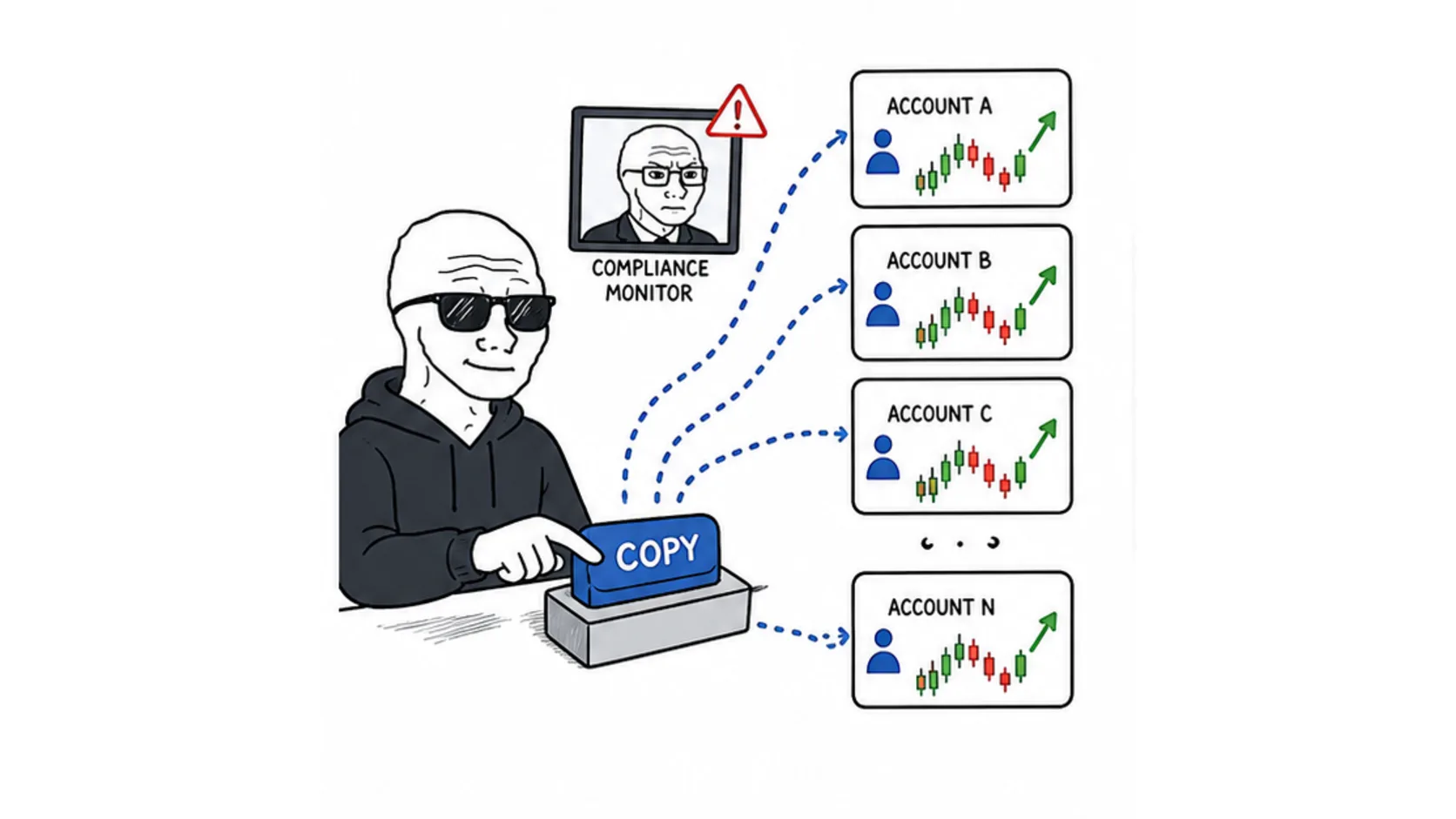
Copy trading at prop firms means replicating trades from one account to another. This can happen in two ways.
Internal copy trading is when you copy trades between accounts you hold at the same firm. You have a master account and one or more slave accounts. Every trade on the master gets replicated on the slaves automatically.
External copy trading is when you copy trades between accounts at different firms. You trade on one firm's platform and a trade copier replicates those positions on another firm's platform. This is the version that gets people into trouble.
The reason copy trading matters in the prop firm world is simple. Firms want to evaluate your trading ability, not your ability to copy someone else's. If 500 traders are all executing identical trades, the firm cannot tell who is actually skilled and who is just following a signal.
Copy trading prop firms have specific rules about this because it affects their risk management. If hundreds of accounts are all doing the same thing at the same time, a single bad trade blows up hundreds of accounts simultaneously. That is a risk no firm wants.
How Prop Firms Detect Copy Trading
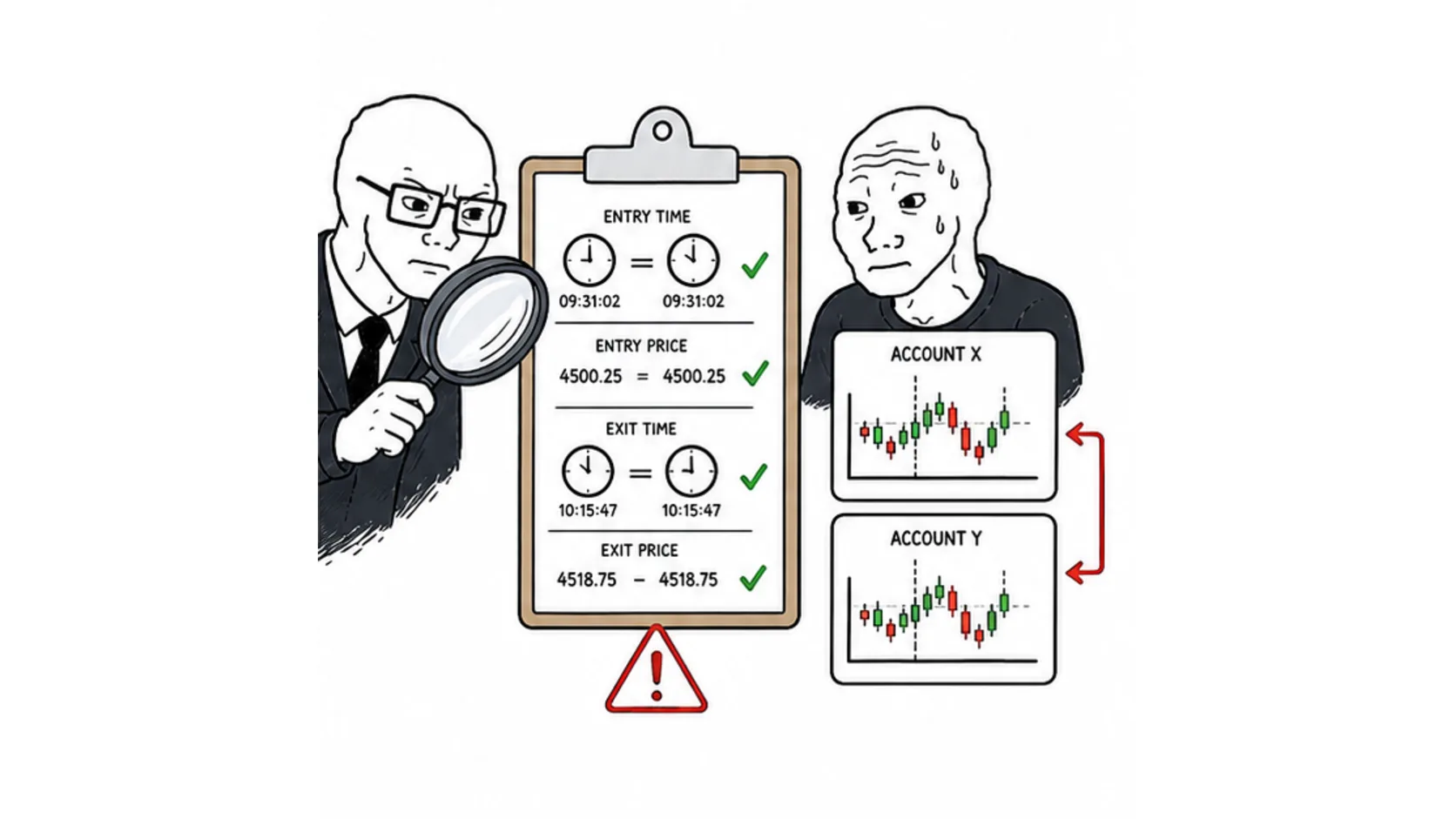
Here is the part most people underestimate. Prop firms are very good at detecting copy trading, and they are getting better at it every month.
Trade correlation analysis. The firm compares your trades against every other account on their platform. If your entry times, direction, instrument, and position sizing match another account with high correlation, they flag it.
This is not manual. It is automated software running continuously. The algorithm looks for patterns that are statistically unlikely to occur independently. Two accounts opening the same position on the same instrument within milliseconds of each other is not coincidence.
IP address and device tracking. Prop firms log your IP address when you connect to their platform. If multiple accounts log in from the same IP, or the same device fingerprint, that is an immediate red flag.
Some traders try to bypass this with VPNs. The firms know this and often block known VPN IP ranges. Using a VPN to hide copy trading activity is a good way to get flagged faster, not slower.
Execution timing patterns. Even if your entries are not perfectly synchronized, the firm can detect copy trading through timing patterns. If your trades consistently follow another account's trades by a fixed delay, that pattern shows up in the data.
Position sizing correlation. If you and another account both risk exactly 2% of your respective account balances on the same pair at the same time, that correlation compounds the other signals. The firm does not need one piece of evidence. They need a pattern.
Internal Copy Trading: When Your Firm Allows It
Some copy trading prop firms allow internal copy trading. This means you can copy trades between your own accounts at the same firm. The firm controls the infrastructure, so they know exactly what is happening.
The typical setup is a master-slave structure. You trade on your master account and the firm's platform automatically replicates those trades to your other accounts. No third-party software needed.
Firms that allow this usually have conditions. Your master account must pass the evaluation first. You cannot copy from someone else's account. You are copying your own trades to your own accounts.
The position sizing on slave accounts is usually proportional. If your master account is $100,000 and your slave is $50,000, the slave takes half the position size. This keeps risk proportional across accounts.
Internal copy trading is the safe version. The firm knows about it, they facilitate it, and they will not penalize you for using it. The key is checking whether your firm offers this feature before you assume it exists.
External Copy Trading Between Prop Firms
This is where things get dangerous. External copy trading means using a trade copier to replicate positions from one firm's platform to another firm's platform.
You have a $100,000 account at Firm A and a $100,000 account at Firm B. You trade on Firm A, and a trade copier sends those same trades to Firm B. Double the position, double the profit potential.
Sounds clever. It is also against the rules at almost every prop firm that has not explicitly permitted it.
The problem is not the technology. Trade copiers like TradingView alerts, local trade copiers, and bridge software all work technically. The problem is that firms detect it, and the consequences are severe.
Account termination. If the firm catches you, they close your account. Not pause it. Close it permanently.
Profit forfeiture. Any profits you have earned, even legitimate ones, may be confiscated. The firm's terms usually state that rule violations void all pending payouts.
Platform ban. Many firms share information about rule violators. Getting caught copy trading at one firm can make it harder to get accepted at others.
Which Prop Firms Allow Copy Trading
The list of prop firms that allow copy trading changes frequently. Firms update their terms, and what was allowed last quarter may be banned this quarter. Always verify directly with the firms ranked highest for transparent terms before you start.
That said, here is the general landscape.
Firms that typically allow internal copy trading: FTMO (Read the PassPropTradingFirms FTMO rules review), FundedNext, and a few others permit copying trades between your own accounts on their platform. You must be the account holder for all accounts involved.
Firms that prohibit all copy trading: Most firms, especially newer ones, explicitly ban both internal and external copy trading in their terms. They want every account to be independently managed.
Firms with unclear policies: Some firms do not explicitly address copy trading in their terms, which creates a grey area. Do not assume silence means permission. If the terms do not say you can copy trade, assume you cannot.
The firms that do allow copy trading usually restrict it to their own ecosystem. They might also have separate rules about automated trading and signal services that affect what you can and cannot do.
The Risks of Copy Trading at Prop Firms
Let me be direct about what happens when copy trading goes wrong at prop firms.
Payout denial. This is the most common outcome. You pass the challenge, earn profits, request a payout, and the firm's compliance team reviews your trading history. If they detect copy trading patterns, your payout gets denied.
You spent weeks or months building the account. You followed every other rule. One copy trading violation voids everything. The firm keeps the evaluation fee and the profits.
Retroactive account closure. Some firms do not catch copy trading immediately. They catch it during a payout review, sometimes weeks or months later. At that point, your funded account gets closed and any unpaid profits are forfeited.
Multiple account bans. If you are copy trading across multiple firms and one firm catches you, that firm may notify the others. Prop firms in the same network sometimes share compliance data.
Latency problems. Trade copiers introduce execution delay. The master account fills at one price, but by the time the slave account receives and executes the order, price has moved. In volatile markets, this slippage can be significant enough to change the outcome of the trade.
How to Copy Trade Safely If Your Firm Allows It
If you have confirmed that your firm allows copy trading, here is how to do it without creating problems for yourself.
Use the firm's built-in copy trading feature. If your firm offers internal copy trading through their platform, use that. Do not use third-party trade copiers when a built-in option exists. The firm's own system is guaranteed to be compliant with their rules.
Only copy your own trades. Copying from another trader's account, even with their permission, is almost universally prohibited. The master account must be yours and you must be the one making the trading decisions.
Keep position sizes proportional. If you are copying between a $50,000 account and a $25,000 account, the position sizes should reflect that difference. Equal position sizes on unequal accounts distort your risk profile and can trigger consistency rule violations.
Manage latency. If you are using an external copier between firms that both allow it, test the latency first. Run both accounts on demo and measure how long it takes for the slave to replicate the master's trades. If latency is more than a few hundred milliseconds, your risk management is compromised.
Document everything. Keep records of your firm's copy trading policy at the time you started. Screenshots of their FAQ, terms page, or support tickets confirming that copy trading is permitted. Policies change, and having proof that it was allowed when you started protects you if the firm retroactively changes its stance.
Copy trading at prop firms is not inherently wrong. The issue is doing it at firms that prohibit it or doing it in ways that violate the specific terms of firms that allow it. Know the rules, follow them, and you will not have a problem.