You want to trade with a prop firm on MetaTrader 5. Good choice. MT5 is the most capable platform available for prop firm trading right now. It handles forex, futures, and stocks. It runs EAs natively. It has depth of market, better charting than MT4, and a programming language that is not stuck in 2005.
The problem is finding the right MT5 prop firm. Not every prop firm offers MT5. Some still only run on MT4. Others use cTrader or proprietary platforms. And US traders face a whole additional layer of complexity because MetaQuotes has restricted MT5 access in the United States.
Key Takeaways
- Most major prop firms offer MT5 as a platform option. FTMO, FundedNext, and FunderPro all support it.
- US traders face restrictions on MT5 due to MetaQuotes licensing issues, not because prop firms block them.
- MT5 supports EAs, custom indicators, and algorithmic trading natively, making it the preferred platform for automated prop firm traders.
- Setting up MT5 with a prop firm requires login credentials from the firm. Download MT5 from the firm's recommended source, not the generic MetaQuotes site.
- MT5 is gradually replacing MT4 in the prop firm space, but some firms still only offer MT4 for forex trading.
On This Page
Why Traders Want MT5 for Prop Firm Trading
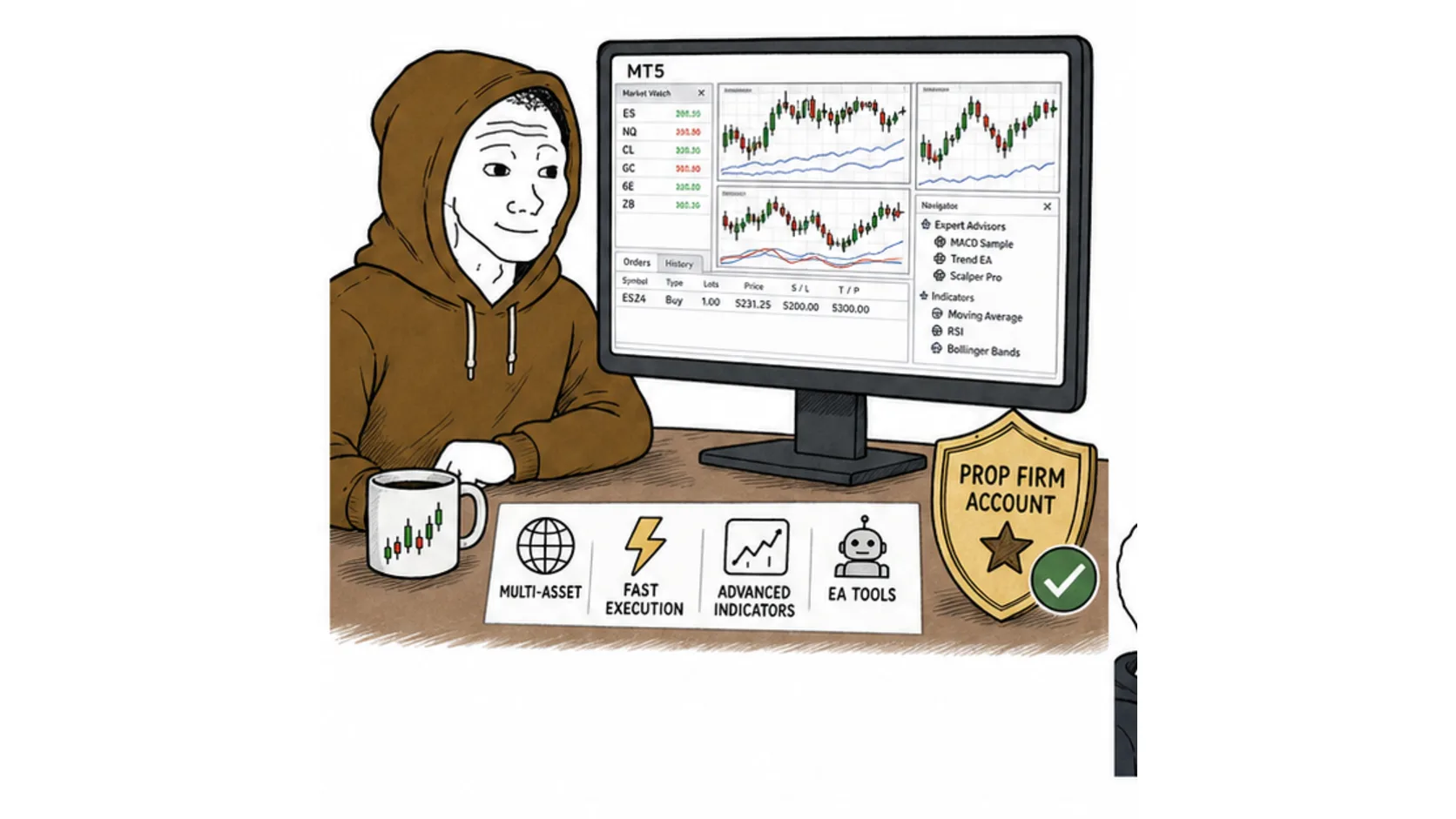
MT5 is not just a slightly newer version of MT4. It is a different platform built from scratch. Here is why it matters for prop firm traders.
Multi-asset support. MT5 handles forex, futures, stocks, and indices. If your prop firm offers multiple asset classes, you can trade all of them from one platform. MT4 is forex-only. This matters because more prop firms are adding futures and indices to their offerings.
Better execution model. MT5 uses a depth of market (DOM) model that shows you actual liquidity at different price levels. MT4 uses a simplified request-based model. For prop firm trading where every pip matters, especially during challenges, the DOM gives you better visibility.
MQL5 is better than MQL4. The programming language for MT5 EAs and indicators is more capable. Object-oriented programming, faster backtesting, and better debugging tools. If you are building or buying EAs for your prop firm challenge, MT5 is the more powerful environment.
Faster backtesting. MT5's strategy tester uses multi-threaded optimization and can test on multiple currency pairs simultaneously. MT4 tests one pair at a time on a single thread. For EA development and optimization, the speed difference is significant.
Hedging support. MT5 supports both netting and hedging account models. MT4 only supports hedging. If your prop firm uses netting accounts, you need MT5.
Which Prop Firms Offer MT5
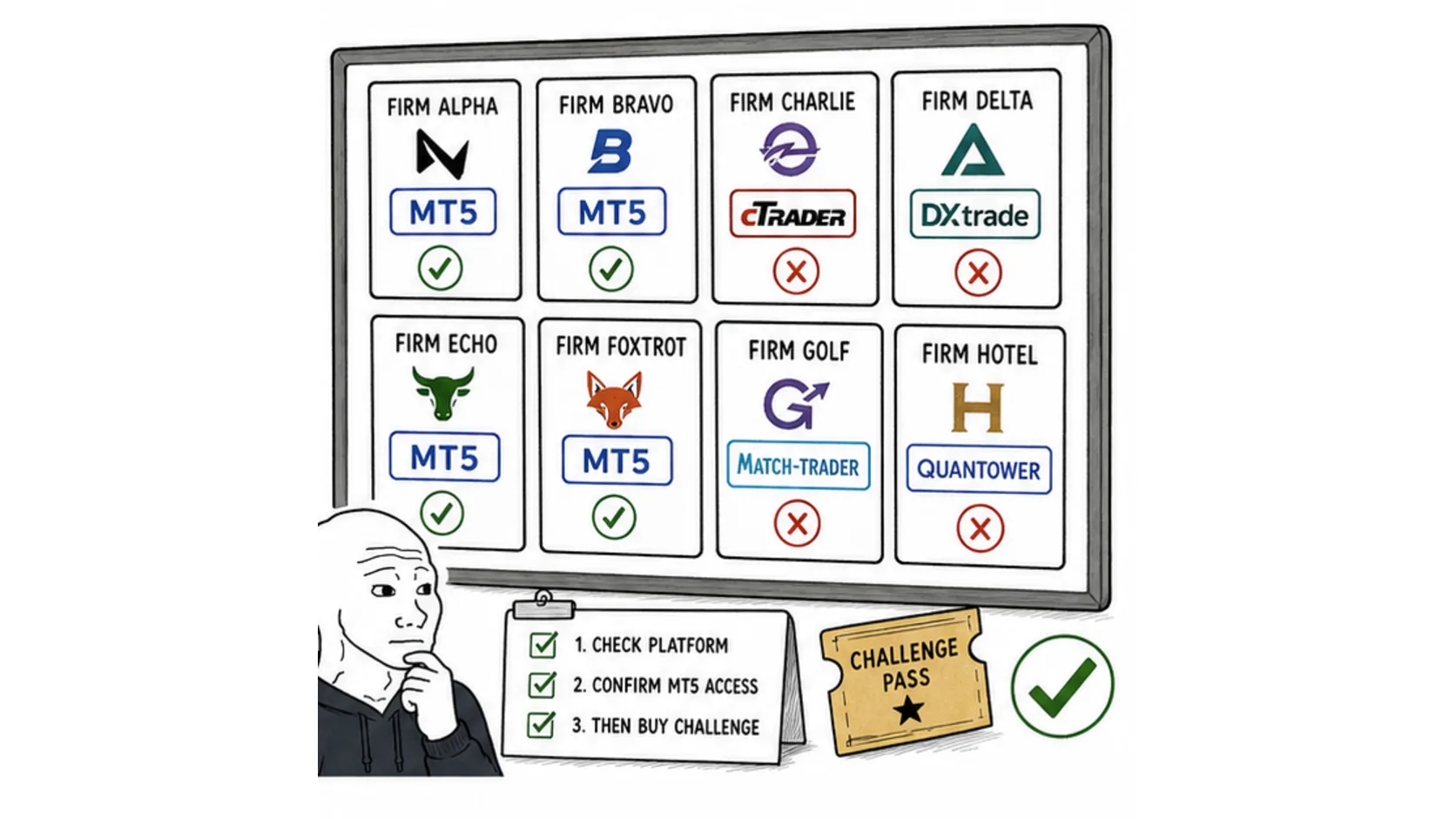
The landscape of MT5 prop firms shifts regularly as firms add and remove platform options. Here is the current state of the major players.
| Firm | MT5 Available | MT4 Also Available | US Traders |
|---|---|---|---|
| FTMO | Yes | Yes | Restricted |
| FundedNext | Yes | Yes | Limited |
| FunderPro | Yes | Yes | Yes |
| The5ers | Yes | Yes | Restricted |
| MyForexFunds | Varied | Yes | No |
Notice that most of the big names offer both MT4 and MT5. The industry is transitioning toward MT5 as the default, but MT4 is still widely available because many traders have years of custom indicators and EAs built for it.
Some smaller and newer firms offer MT5 exclusively, skipping MT4 entirely. This trend will continue as MetaQuotes eventually phases out MT4 support.
The US Trader Problem with MT5
Here is why this is confusing. MetaQuotes, the company behind MT4 and MT5, has made a specific business decision that affects US traders directly.
MetaQuotes, the company that develops MT4 and MT5, has restricted US-licensed brokers from offering MetaTrader platforms. This is not a prop firm decision. It is a MetaQuotes business decision related to regulatory requirements from the Commodity Futures Trading Commission and the National Futures Association.
What this means in practice. If you are a US resident, you cannot download MT5 and connect it to a US-regulated forex broker. The platform itself is not banned. But the brokers that would normally provide the server connection cannot legally offer it to US clients.
Prop firms operate in a different regulatory space than retail brokers. Some prop firms have found ways to offer MT5 to US traders through partner brokers or international licensing structures. Others have not.
The situation is different in the UK, EU, Australia, and most other regions, where MT5 is freely available. If you are outside the US, this is not your problem.
If you are a US trader looking for an MT5 prop firm, check whether the firm explicitly accepts US clients AND offers MT5 as the platform. Some firms accept US clients but only on non-MT5 platforms like NinjaTrader or Tradovate for futures trading.
How to Connect Your Prop Firm to MT5
Setting up MT5 with your prop firm is straightforward. Here is the process.
Step 1: Purchase your evaluation. Sign up for the prop firm challenge and select MT5 as your platform during registration. Some firms ask you to choose at sign-up. Others let you switch later.
Step 2: Receive your credentials. After purchase, the firm sends you an email with your MT5 login number, password, and server address. The server address is specific to the firm, not the generic MetaQuotes server.
Step 3: Download MT5. Download from the firm's recommended link if they provide one. If not, download MT5 from the official MetaQuotes website. Do not download from random third-party sites. The software is free from MetaQuotes directly.
Step 4: Log in. Open MT5, go to File, then Login to Trade Account. Enter your login number, password, and the server address from your prop firm. If the server does not appear in the dropdown, type it manually.
Step 5: Verify the connection. Once logged in, you should see your account balance in the terminal window and live charts loading. If you see a connection error, double-check the server address and credentials. Contact the firm's support if it still does not work.
One important note. Some prop firms provide a modified version of MT5 with their branding and specific server configurations pre-installed. If your firm offers this, use their version. It saves you from manual server configuration issues.
EAs on MT5 Prop Firms: What You Can and Cannot Do
Most MT5 prop firms allow EAs. But the rules vary by firm, and the consequences of getting it wrong are the same as any other rule violation.
Firms that typically allow EAs on MT5: FTMO (Check my FTMO review on PassPropTradingFirms), FundedNext, The5ers, and FunderPro all permit automated trading during evaluations. You can run MQL5 EAs, use custom indicators, and automate your trading strategy.
Strategies that are usually banned: Martingale, grid trading, and any strategy that averages down indefinitely. These violate risk management rules at nearly every prop firm. Your EA might be technically allowed, but if it uses a banned strategy, your account gets closed.
What you need to configure: Your EA must respect the firm's daily loss limit, max drawdown, and position size restrictions. Set the EA's internal limits to 60-70% of the firm's actual limits to create a safety buffer for slippage and gap risk.
EA disclosure: Some firms require you to declare that you are using an EA. Others do not. Either way, they can detect EA usage through platform logs and execution patterns. Hiding it at a firm that requires disclosure is a rule violation.
MT5 vs MT4 for Prop Trading
The MT4 versus MT5 debate in the prop firm space comes down to one question. Do you need features that MT4 cannot provide?
If you only trade forex pairs and use standard indicators and EAs built for MT4, MT4 is fine. It works. It is stable. The MQL4 ecosystem has thousands of free and paid indicators and EAs. Many prop firm traders never need anything beyond what MT4 offers.
If you trade futures, indices, or stocks, you need MT5. MT4 does not support these asset classes. If your prop firm offers futures and you want to trade them, MT5 is your only MetaTrader option.
If you build or modify your own EAs, MT5 is the better development environment. MQL5 is more powerful, the strategy tester is faster, and the debugging tools are better. For traders building custom strategies to pass prop firm challenges, the development experience on MT5 is significantly better.
The trend is clear. MT5 is replacing MT4. MetaQuotes has been pushing the transition for years. New prop firms increasingly launch with MT5 as their primary or only MetaTrader option. If you are starting fresh with prop firm trading, learn MT5.
How to Choose the Right MT5 Prop Firm
Before you buy an MT5 prop firm evaluation, run through this checklist.
Does the firm actually offer MT5? Check their platform options. Do not assume. Some firms advertise "MetaTrader" but only offer MT4.
Does the firm accept traders from your country? If you are a US resident, this is critical. Many MT5 prop firms do not accept US clients or offer alternative platforms instead.
Does the firm allow EAs on MT5? Most do, but verify. If you plan to use automated trading, confirm the firm's EA policy before paying for an evaluation.
What are the drawdown rules? Check whether the firm uses a trailing drawdown or static drawdown. This affects how your EA needs to be configured and which strategies are viable.
What is the challenge structure? One-step, two-step, or instant funding. The number of phases affects your total cost and the time it takes to get funded. Understand the challenge structure before committing.
What server does the firm use? Server location affects execution speed. If the firm's server is on the other side of the world from you, latency could affect your trading, especially for scalping strategies.
MT5 prop firms are not all the same. The platform is the same, but the rules, execution quality, challenge structure, and payout terms vary significantly between the top-ranked prop firms on our list. Pick based on the total package, not just the fact that they offer MT5.