Are prop firms legal in the UK? Yes. Buying a prop firm evaluation, trading on a funded account, and receiving payouts are all perfectly legal for UK residents. The Financial Conduct Authority has not banned prop firms, restricted UK traders from using them, or issued any ruling that makes the practice illegal. What the FCA has done is warn that most prop firms are not regulated, which means you have limited protection if something goes wrong. That is a very different thing from being illegal. Here is the complete picture for UK traders.
Key Takeaways
- Prop firms are legal in the UK. Buying evaluations, trading, and receiving payouts are not prohibited activities.
- Most retail prop firms are not regulated by the FCA, which means no FSCS protection, no Financial Ombudsman access, and no regulatory complaint process.
- Prop firm income is taxable in the UK. You must declare it to HMRC, whether as income tax, capital gains tax, or corporation tax.
- Most prop firms accept UK traders, unlike the US where many firms have restricted access due to CFTC enforcement.
- London has a long history of traditional proprietary trading firms, but these are different from the online retail prop firms most traders use today.
On This Page
Why Prop Firms Are Legal in the UK

Let me clear this up immediately because the confusion is understandable.
Prop firms are legal in the UK for the same reason they are legal everywhere else. They do not hold client deposits, they do not execute trades on live markets for most accounts, and they sell evaluations, not financial products. This puts them outside the scope of most financial services regulation.
The UK financial services sector contributes roughly £100 billion annually to the economy and is overseen by the FCA. But the FCA's remit covers firms that hold client money, provide investment advice, or execute trades on regulated markets. Prop firms doing none of these things sit in a gap.
The business model is straightforward. You pay a fee for an evaluation. If you pass, you get access to a funded account. The account is simulated in most cases. Your payout comes from the firm's revenue, not from trading profits on a live market.
Nothing in UK law prohibits this. The Consumer Rights Act 2015 applies to the purchase of the evaluation as a service, which means you have basic consumer protections around the transaction itself. But those protections do not extend to the trading activity or the payout process.
The FCA Position on Prop Firms
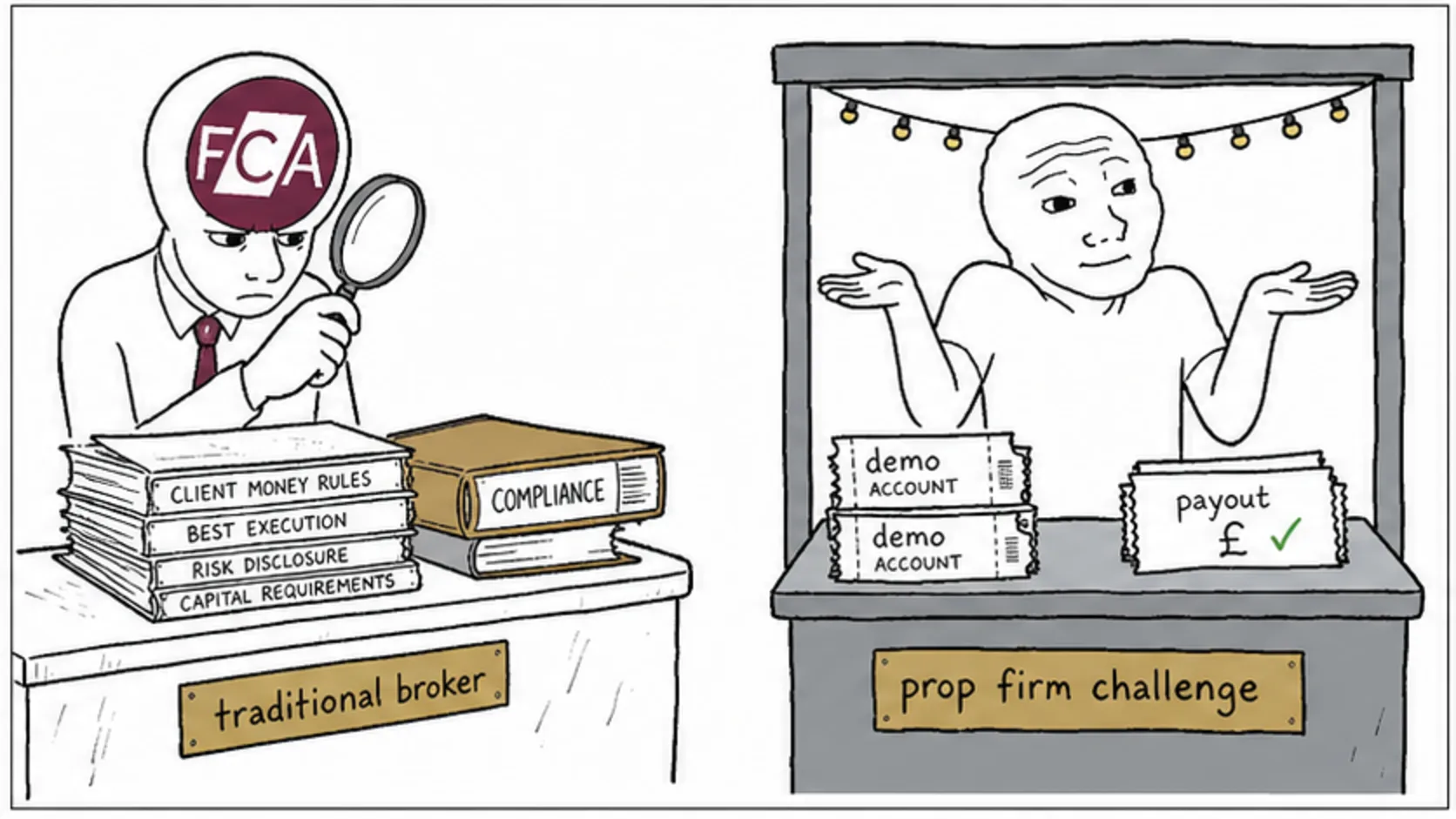
The FCA has not ignored prop firms entirely. It has issued warnings, and those warnings are worth understanding.
The FCA oversees more than 50,000 financial services firms in the UK. Its primary concern with prop firms is that traders may believe they are dealing with a regulated entity when they are not. The FCA has warned consumers to check whether a firm appears on the Financial Services Register before handing over money.
No major retail prop firm appears on the Financial Services Register. This is not because they are hiding. It is because they do not carry out activities that require FCA authorisation.
The FCA's position mirrors regulators in other jurisdictions. Prop firms using simulated accounts are not providing regulated financial services. The FCA has signalled that this could change if the industry grows to a point where consumer harm becomes significant, but no rule changes have been proposed yet.
If a prop firm claims to be FCA regulated, check the register. If they are not on it, the claim is false. This is a straightforward test that takes about thirty seconds.
What FCA Regulation Actually Covers
Here is what FCA regulation would give you if a prop firm were actually regulated. And here is what you are missing.
The Financial Services Compensation Scheme covers up to £85,000 per person if an FCA-authorised firm fails. If a prop firm collapses owing you money, you get nothing from the FSCS because the firm is not authorised.
The Financial Ombudsman Service can investigate complaints against FCA-authorised firms and force them to pay compensation. If a prop firm denies your payout unfairly, you cannot go to the Ombudsman. You are stuck with the firm's own internal complaint process.
FCA authorisation requires firms to segregate client money from their own operating funds. Prop firms do not need to do this because they do not hold client deposits in the traditional sense. Your evaluation fee goes straight into their operating revenue.
This does not make prop firms illegitimate. It means the safety net that exists for regulated financial products does not exist for prop firm evaluations. You need to factor this into your risk assessment before buying.
How HMRC Taxes Prop Firm Income
This is the part that catches people out. You have been warned.
Prop firm payouts are taxable income in the UK. HMRC does not care that the trading was done on a simulated account or that the money came from a company registered overseas. If you receive money, it is income, and it needs to be declared.
How it gets taxed depends on your situation. If you trade as an individual, prop firm income is typically classified as either income from trading or capital gains, depending on the frequency and nature of your activity.
If you trade through a limited company, which some UK traders choose to do, the company pays corporation tax on profits. You then pay yourself through salary or dividends, each with their own tax implications.
The evaluation fees you pay are generally deductible as a business expense if you are trading as a self-employed individual or through a company. This reduces your taxable profit, but you need to keep proper records.
HMRC has become increasingly aware of prop firm income. The UK tax authority has access to information from payment processors and banks. Do not assume that because the prop firm is based in another country, the money is invisible to HMRC. It is not.
YouTube videos claiming that offshore prop firms shield you from UK tax are wrong. Your tax liability is based on your residency, not the location of the company paying you. If you live in the UK and earn money, HMRC wants to know about it.
Traditional Prop Firms vs Retail Prop Firms in London
London has a long history of proprietary trading. Firms like Jane Street, Optiver, and DRW have London offices. These are traditional prop firms that hire traders as employees, provide real capital, and pay salaries plus bonuses.
These traditional firms are completely different from the online retail prop firms most traders interact with. Traditional prop firms employ you. Retail prop firms sell you an evaluation. Traditional prop firms trade real money on live markets. Retail prop firms use simulated accounts.
Traditional prop trading as a career path involves interviews, assessments, and employment contracts. You get a salary, benefits, and professional development. Retail prop firms offer none of this.
The confusion between these two types of firms is why some people ask whether prop firms are legal in the UK. They hear about traditional prop trading in London and assume all prop firms operate the same way. They do not. The online retail prop firm model is a completely different product.
Both are legal. Both serve different purposes. Just do not confuse one for the other.
Which Prop Firms Accept UK Traders
Good news on this front. Unlike US traders, who face a shrinking list of available firms, UK traders have access to most of the top-ranked prop trading firms.
FTMO (Read the FTMO review on PassPropTradingFirms), FundedNext, The5ers, FundingPips, and most other major firms accept UK traders without restrictions. The evaluation process, rules, and payouts work the same as for traders in other non-restricted countries.
The reason for this is simple. The regulatory pressure that hit US-facing firms came from the CFTC, a US regulator. The FCA has not taken equivalent action against prop firms serving UK traders, so there has been no exodus of firms from the UK market.
If prop firms make sense for your trading goals, being based in the UK actually puts you in a strong position. You have access to more firms than US traders, and the lack of CFTC-style enforcement means the available options are unlikely to shrink in the near term.
Some firms do have country restrictions that go beyond regulatory pressure. Always check the firm's terms for your specific location before purchasing, but the UK is generally not on any restricted list.
What UK Traders Should Watch Out For
Three missions for UK traders specifically.
Mission one: sort out your tax situation before you start earning. Speak to an accountant who understands trading income. The money you spend on professional tax advice will save you significantly more than trying to figure it out yourself after HMRC comes asking questions.
Keep records of every evaluation fee, every payout, and every expense related to your prop firm trading. HMRC can ask to see up to six years of records. If you do not have them, you are in trouble.
Mission two: treat the FCA register as your first check before buying from any firm. If a prop firm claims to be regulated and is not on the register, that is a lie, and you should not give them money. If they do not claim to be regulated, that is fine, but you know exactly where you stand.
Mission three: understand that consumer protection in the UK is limited to the basics. The Consumer Rights Act covers the purchase itself, but it does not guarantee payouts, protect against rule changes, or compensate you if the firm fails.
The UK is one of the best jurisdictions for prop firm traders right now. You have access to most firms, no regulatory restrictions on participating, and a clear tax framework. Just make sure you declare your earnings, verify every firm before you buy, and never risk more than you can afford to lose. The legal side is straightforward. The tax side is where people get burned.
UK Tax on Prop Firm Payouts: Self-Assessment Guide
If you are a UK resident earning prop firm income, you need to register for Self-Assessment with HMRC and declare every penny. Here is the practical guide I wish someone had handed me when I got my first payout.
First, register for Self-Assessment. If you do not already file a tax return, you need to register by 5 October following the tax year in which you first received prop firm income. Miss this deadline and HMRC can fine you. The registration is done online through the HMRC website and takes about 15 minutes.
Next, understand how your income gets classified. For most prop firm traders, the income falls into one of three categories. Income from self-employment if HMRC views your trading as a business activity. Capital gains if you are trading less frequently and holding positions for longer periods. Or miscellaneous income if it does not clearly fit either category. The classification matters because the tax rates and available deductions differ.
Self-employment income is taxed at your marginal rate, which ranges from 20% to 45% depending on your total earnings. You also pay National Insurance contributions on profits above the threshold. For the 2025/26 tax year, Class 2 National Insurance is charged at a flat rate for profits above the small profits threshold, and Class 4 is charged as a percentage of profits above the lower profits limit. These rates change annually, so check the current HMRC guidance.
Capital gains has its own annual exemption. If your total gains are below the annual exempt amount, you may not owe any tax. But most prop firm traders trade frequently enough that HMRC would classify the activity as trading rather than investing, making capital gains treatment unlikely.
Evaluation fees are deductible as business expenses. Charting software, trading courses, internet costs, and home office expenses can all be claimed. Keep records of everything for at least six years. I use a simple spreadsheet that logs every payout and every expense with dates and amounts. It took 20 minutes to set up and has saved me hours of stress at tax time.
If your prop firm income is substantial, consider forming a limited company. Corporation tax is currently 19% for companies with profits under £50,000 and up to 25% for larger profits. You can pay yourself through a combination of salary and dividends, which can be more tax efficient than sole trader income depending on your total earnings.
FCA Actions Against Prop Firms
The FCA has not ignored the prop firm industry entirely. While it has not banned prop firms or issued industry-wide enforcement, it has taken specific actions that UK traders should know about.
In late 2024, the FCA issued a public warning about firms claiming to be regulated when they were not. This was aimed broadly at the online trading space, but several prop firms were named indirectly. The warning reminded consumers that if a firm is not on the Financial Services Register, it is not FCA regulated, regardless of what its marketing materials suggest.
The FCA also took action against firms that were using misleading marketing to attract UK traders. Some prop firms had been advertising guaranteed returns, risk-free trading, and "employment opportunities" that were actually just evaluation purchases. The FCA's intervention led several firms to change their UK-facing marketing language.
The 2024 crackdown did not make prop firms illegal in the UK. What it did was force more transparency about what prop firms actually are. Firms are now more careful about the claims they make, and several have added explicit disclaimers that they are not regulated by the FCA and that traders do not have access to the Financial Ombudsman Service or FSCS.
I view the FCA's involvement as positive for legitimate traders. It pushes bad actors out of the space and makes it easier to identify which firms are operating honestly. The firms that welcome regulatory scrutiny are the ones worth your evaluation money. The ones that moved their operations to obscure jurisdictions after the FCA actions are the ones to avoid.
The regulatory landscape could still change. The FCA has signalled that it is monitoring the prop firm industry and could introduce formal regulation if consumer harm increases. For now, the status quo continues. Prop firms are legal, mostly unregulated, and available to UK traders who understand the risks and their tax obligations.