You breached your funded account. It happens to more traders than you think. The funded account you worked weeks to earn is gone, or at risk. Here is exactly what happens next, what you can recover, and what you cannot.
Key Takeaways
- A soft violation is a warning. A hard penalty terminates your account. Know which rules trigger which.
- Exceeding max drawdown or daily loss limit are the most common hard breaches that end funded accounts.
- Most firms let you buy a new evaluation or reset after a breach, but it costs money.
- You do not owe the firm money if you breach. You lose the account, not your personal funds.
- Multiple soft warnings can escalate to a hard breach. Track your rule compliance daily.
On This Page
- Soft Breach vs Hard Breach: The Critical Difference
- Rules That Cause Hard Breaches
- Rules That Trigger Soft Violations
- What Actually Happens When You Violate a Rule
- Can You Recover After a Violation
- The Financial Impact of Breaching
- How to Prevent Losing Your Funded Account
- What to Do After You Breach
Soft Breach vs Hard Breach: The Critical Difference
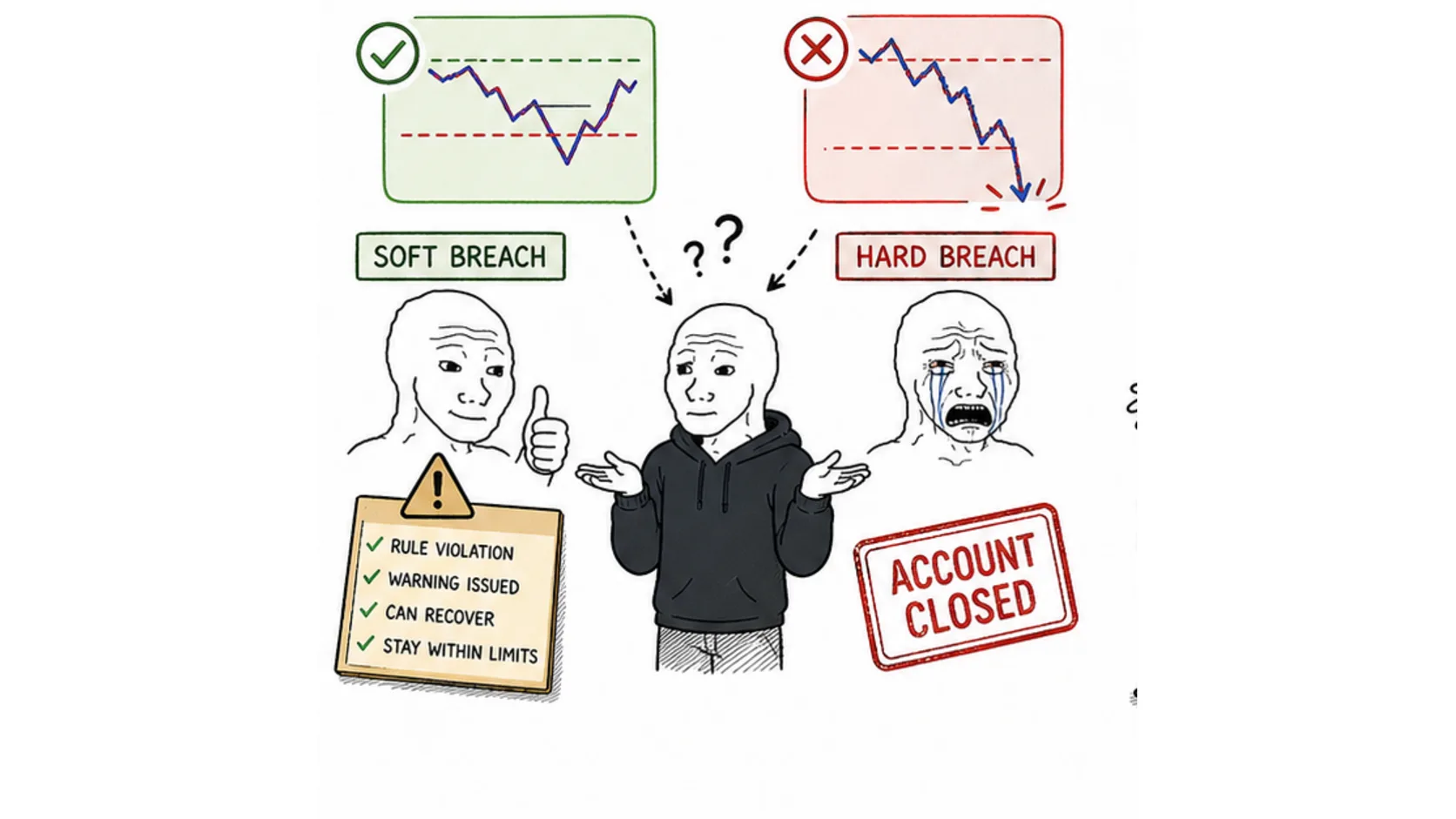
Not all breaches are equal. Understanding the difference between a soft breach and a hard breach is the single most important thing you can learn as a funded trader.
Soft breach. A warning-level violation. The firm notifies you, possibly closes your open positions, and adds the breach to your record. Your account continues operating. You get another chance.
Hard breach. A termination-level violation. The firm closes your account immediately. Your funded status is revoked. All unrealised profits are forfeited. You are done.
Think of it like driving. A soft breach is a speeding ticket. Annoying, costly, but you keep your licence. A hard violation is a DUI. Licence gone, car impounded, starting over.
Which rules trigger which type of breach depends on the firm. There is no universal standard. But the general pattern is consistent across the industry.
Rules That Cause Hard Breaches
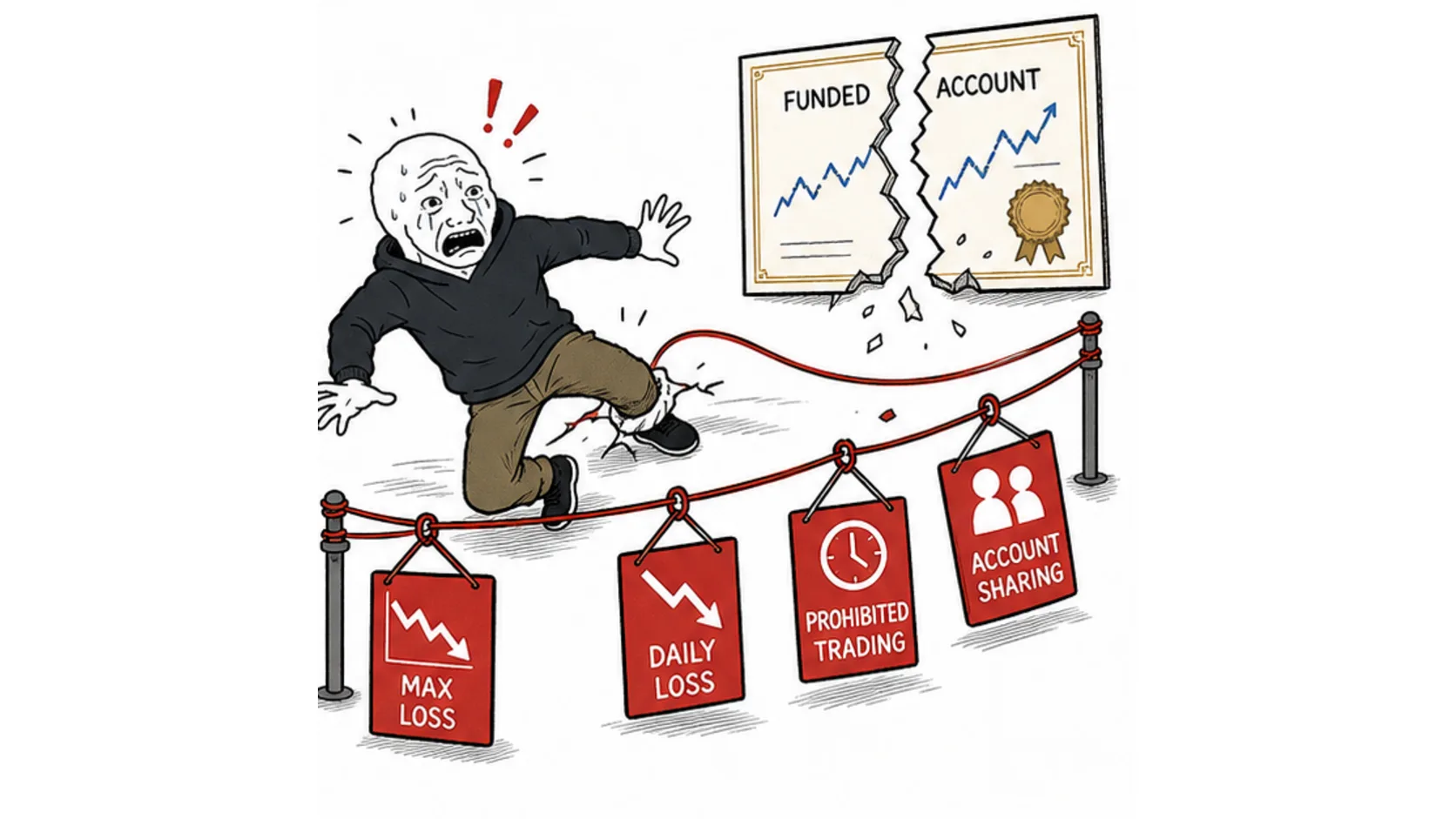
These are the account killers. Violate any of these and your funded account is terminated.
Exceeding the maximum drawdown. This is the big one. Every funded account has a maximum drawdown limit, usually 5% to 10% of the starting balance or equity high. If your account balance drops below this threshold, the account is automatically closed.
On a $100,000 account with a 5% max drawdown, your account is breached if your balance falls below $95,000. That is a hard breach at every firm. No exceptions, no appeals.
Violating the daily loss limit. The daily loss limit caps how much you can lose in a single trading day. Typical limits are 3% to 5% of your starting balance. Breach it and the account is done.
On a $100,000 account with a 5% daily loss limit, if you lose $5,000 in one day, that is a hard breach. The firm closes your positions and terminates the account.
News trading violations at strict firms. At firms with zero-tolerance news trading policies, trading during restricted events is an instant hard breach. Not every firm treats news trading this way, but the ones that do will terminate your account without a second chance.
Account sharing or fraud. If the firm detects that someone else is trading on your account, or that you are using shared accounts, that is an immediate hard breach. This includes VPN masking and IP address rule violations.
Rules That Trigger Soft Violations
Soft warnings are minor infractions, not death sentences. But they add up.
Consistency rule warnings. If one trading day accounts for too much of your total profit, the firm might flag you for inconsistent trading. This is a soft warning at most firms. You get a warning and your payout might be reduced, but you keep the account.
Minor position size violations. Some firms have maximum lot sizes. If you slightly exceed the limit, you might get a warning rather than termination, especially if it is your first offence.
Weekend holding violations. Firms that prohibit holding positions over the weekend might issue a warning if you forgot to close a position before Friday's session end. Repeat offenders get escalated.
Hitting the daily loss limit at firms with soft enforcement. Some futures prop firms use soft breaches for the first daily loss limit hit. They close your trades for the day but let you continue trading the next day. Hit it again and it becomes a hard breach.
The key point: a soft violation is not free. It goes on your record. Multiple soft warnings escalate. Three soft violations at most firms equals one hard penalty.
What Actually Happens When You Violate a Rule
Here is the step-by-step of what happens after a breach, from the moment the rule is triggered to the moment your account status changes.
For a hard breach.
The firm's system detects the violation automatically in most cases. Your open positions are closed at market price.
Your account is flagged as closed.
You receive an email notification stating which rule was violated, when it happened, and that your funded account has been terminated. The dashboard shows your account status as "breached" or "inactive."
Any unrealised profits are forfeited. If you had a pending payout, it is cancelled.
If you had already received payouts, those are yours to keep. The firm does not claw back money already paid.
For a soft breach.
You receive a warning email. Your open positions might be closed for the remainder of the trading day.
Your dashboard shows the violation in your compliance record.
You can continue trading, usually starting the next trading day. But the breach is logged, and repeated violations will trigger harsher consequences.
Some firms require you to acknowledge the warning before you can resume trading.
Others just notify you and let you continue.
Can You Recover After a Violation
Whether you can recover depends entirely on the type of breach and your firm's policies.
Hard breach recovery. Almost never. Once you breach the max drawdown or daily loss limit, the account is gone. No appeal, no reset, no second chance on that specific account.
Some firms offer a paid reset option. You pay a fee (usually 50% to 80% of the original evaluation cost) and get a new funded account with the same size. This is not recovering the old account. It is buying a new one at a discount.
Soft breach recovery. Always. Soft warnings are minor infractions. Your account continues operating. The recovery is automatic. You trade the next day with the breach on your record.
The payout impact of soft breaches. Even if your account survives a soft breach, your next payout might be affected. Some firms reduce profit splits or delay payouts for accounts with recent breaches. Read the terms carefully.
The Financial Impact of Breaching
Let us be clear about what you actually lose when you break a rule on your funded account.
You do not owe the firm money. This is the most common misconception. When you lose a funded account, you do not get a bill. The firm's capital took the loss, not yours. You lose the account, not your personal savings.
The evaluation fee you paid is gone regardless of whether you breach. That money was spent when you bought the evaluation. The National Futures Association considers evaluation fees as service charges. The violation does not trigger an additional charge.
You lose unrealised profits. If you had $2,000 in open profit when the breach hit, that money is gone. The firm closes your positions and keeps whatever is left in the account.
You lose the funded account. The real cost is opportunity cost. You spent weeks passing the evaluation and building a profitable track record. That is now gone. Starting over means buying a new evaluation. This is the funded account reset cycle most traders go through and passing again.
Traders who consistently collect payouts are the ones who never breach. The math is simple. If you protect the account, the account pays you. If you blow it, you start from zero.
How to Prevent Losing Your Funded Account
Preventing breaches is not complicated. It is just discipline, which is harder than it sounds.
Know your numbers every single day. Before you open your first trade, check your current balance, your daily loss used, and your remaining drawdown. These three numbers tell you everything about how much room you have.
Use a daily loss limit that is tighter than the firm's. If the firm allows a 5% daily loss, set your personal limit at 3%. This gives you a buffer for slippage and unexpected moves.
Close trades before news events. Even if your firm allows news trading, close your positions before high-impact events. The trailing drawdown does not care about your analysis. It cares about your balance.
Never revenge trade. The most common cause of hard breaches is revenge trading after a loss. You lose 2% on a bad trade, get angry, double your size, and blow the daily loss limit in one more trade. This pattern is the single biggest account killer in prop trading. Break it.
Stop trading when you hit your personal limit. If you set a 3% daily loss limit and you hit it, close the platform. Not one more trade.
Not "let me just try to recover." Close it. Walk away. Come back tomorrow.
What to Do After You Breach
You breached. It hurts. Now what?
Figure out why it happened. Was it one bad trade, or was it a pattern? Did you revenge trade?
Did you ignore the economic calendar? Did you overleverage on a setup that was not that good?
Most rule violations are not random. They come from specific behavioural patterns. Identify yours.
Decide if you want to try again. If you have the capital for another evaluation and the discipline to change what went wrong, go for it.
If you are going to make the same mistakes, save your money.
Consider a smaller account. If you breached a $100,000 account, try a $25,000 or $50,000 account next. Smaller accounts have the same percentage rules but smaller absolute numbers, which makes the psychological pressure more manageable.
Use the calculators to plan your risk. Know exactly what your max daily loss is in dollar terms. Know how many losing trades at your current risk per trade it takes to hit the limit. Plan for the worst case.
Losing a funded account is not the end of your trading career. It is a lesson. The traders who succeed are not the ones who never breach. They are the ones who violate a rule once, figure out why, and never do it again.