Do prop firms allow news trading? The short answer: most do not, at least not during high-impact events. The longer answer is that every firm has different rules, different enforcement methods, and different definitions of what actually counts as a news trade. Here is the complete breakdown of how news trading rules work, which firms allow it, and what happens when you break the rules.
Key Takeaways
- Most prop firms restrict or ban trading during high-impact news events like NFP, CPI, and FOMC rate decisions.
- News trading rules are enforced automatically through timestamp tracking against economic calendars.
- Violating news trading rules can result in payout denial, account termination, or challenge disqualification.
- Some firms allow news trading with conditions: reduced lot size, wider stops, or specific trading windows.
- The definition of "news trading" varies between firms. Some restrict only 2 minutes around the event, others lock out the entire day.
On This Page
- What the News Trading Rule Actually Means
- Why Most Prop Firms Restrict News Trading
- What Counts as a News Event
- How Prop Firms Enforce News Trading Rules
- Firms That Allow News Trading
- News Trading Windows: How the Timing Works
- How to Trade During News Without Breaking Rules
- Getting Caught: What Happens When You Violate News Rules
What the News Trading Rule Actually Means
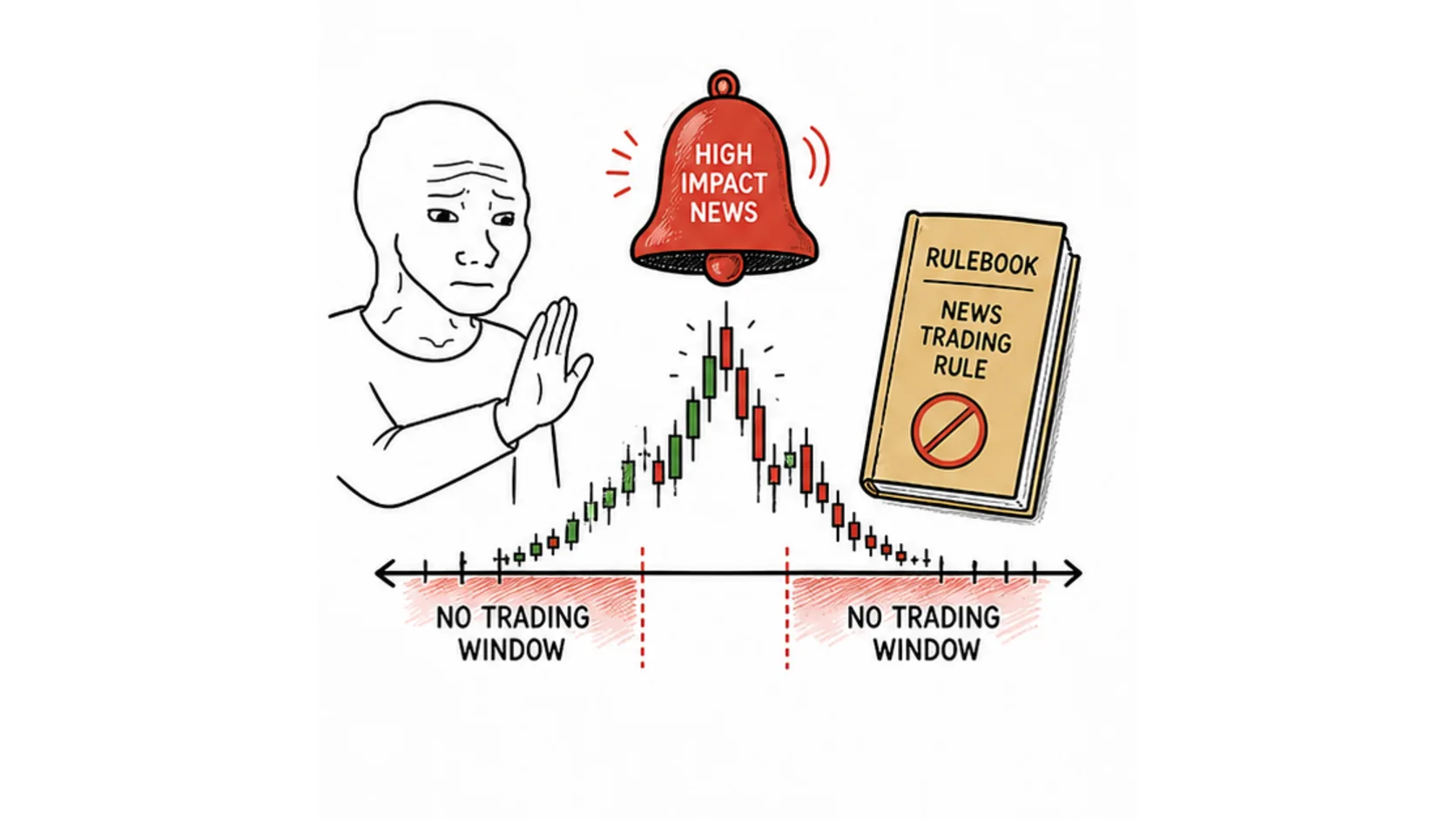
When a prop firm says "no news trading," they are not banning you from reading Reuters. They are banning you from opening or closing trades around scheduled high-impact economic events.
The restriction usually covers a specific window around the event. Two minutes before to two minutes after is common. Some firms go wider: 10 minutes before to 10 minutes after. A few lock out the entire session.
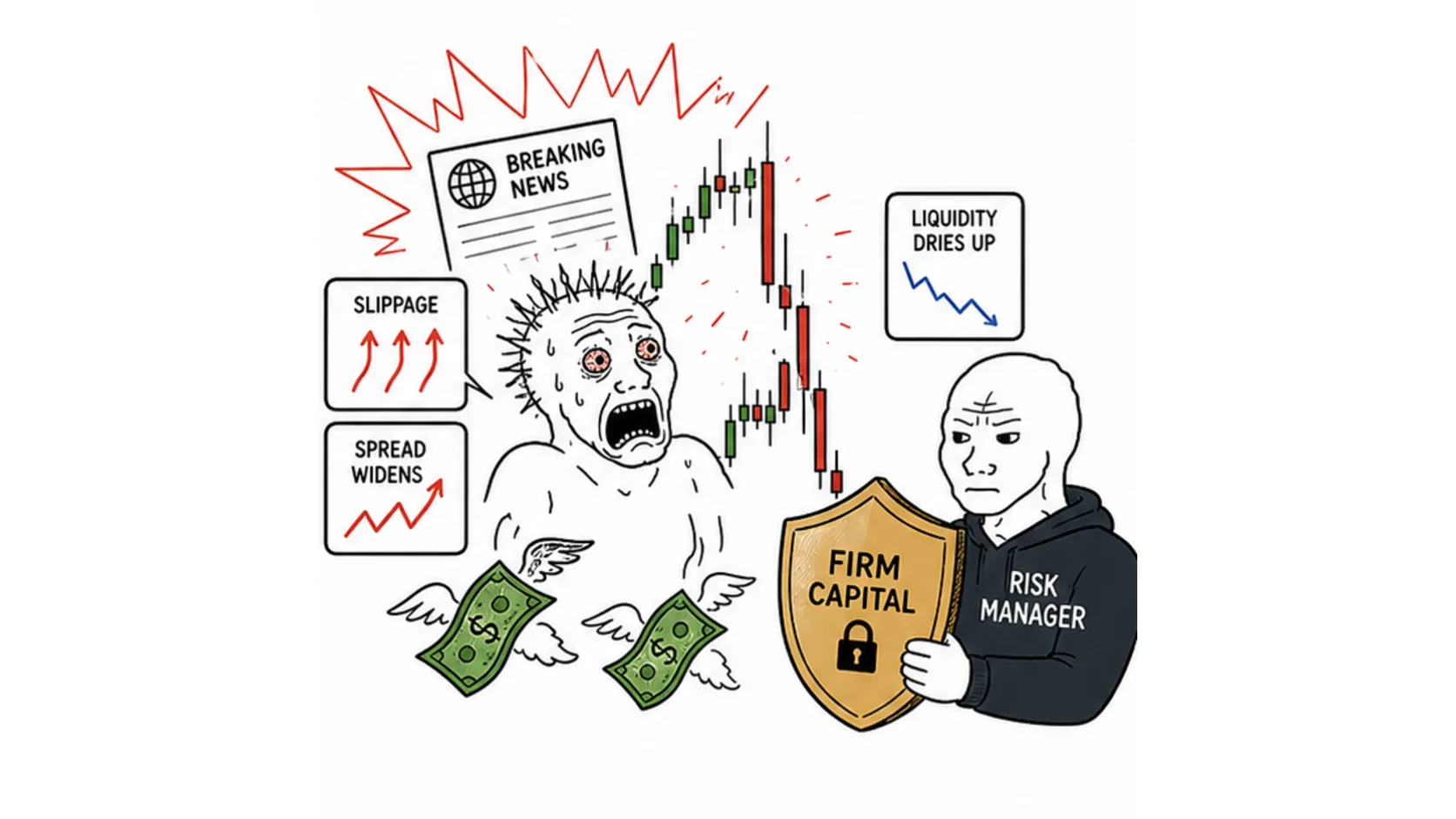
The rule exists because news events cause massive, unpredictable volatility. Spreads widen to absurd levels. Slippage destroys your risk management. Your carefully calculated daily loss limit can get blown out in seconds.
Some firms distinguish between "high-impact" and "medium-impact" news. They might ban trades around NFP and FOMC but allow trades around medium-impact data releases. Others ban everything above a certain impact level on the economic calendar.
The key point: if your firm has a news trading rule and you open a trade within the restricted window, you violated the rule. Even if the trade was profitable. Even if you did not know the news event was happening. Ignorance is not a defence.
Why Most Prop Firms Restrict News Trading
Prop firms restrict news trading for one reason: it destroys accounts.
During high-impact events, spreads on major pairs like EUR/USD can widen from 0.1 pips to 10+ pips in seconds. That is a 100x increase in the cost of entering a trade. If you are trading 1 standard lot, that is $100 in spread alone just to get in.
Slippage is even worse. You click buy at 1.0850, your order fills at 1.0865. That 15-pip slippage on a standard lot is $150 you did not plan for. Your stop loss? It might not trigger at the price you set. The market can gap straight through it.
According to data from the Bank for International Settlements, forex market volatility during NFP releases is roughly 5 to 10 times normal levels. That is not a trading environment. That is a casino.
Prop firms know this. They have seen thousands of accounts blown out by news trades. The 2 minutes around NFP have destroyed more funded accounts than any other single factor.
The restriction protects you from yourself and protects the firm from paying out on trades that were essentially gambling. If a trader makes $5,000 on a news trade, the firm knows it was luck, not skill. If the same trader loses $5,000, the firm takes the hit.
What Counts as a News Event
Not every data release triggers the news trading rule. Firms typically reference a standard economic calendar and restrict trades around events marked "high-impact" or "red-folder."
The big ones that almost every firm restricts.
- Non-Farm Payrolls (NFP), released first Friday of each month
- FOMC rate decisions and press conferences
- Consumer Price Index (CPI) releases
- GDP readings (advance, preliminary, final)
- European Central Bank rate decisions
These events move markets by 50 to 200 pips in minutes. Every prop firm on the planet restricts trading around them.
Medium-impact events that some firms restrict.
- Retail sales data
- Purchasing Managers Index (PMI) releases
- Employment reports outside NFP
- Trade balance figures
Whether these trigger the rule depends on the firm. Some firms list their restricted events in the challenge rules. Others reference a third-party calendar like Forex Factory and restrict anything marked red or orange.
What does not count as a news event.
Routine speeches by central bank officials, low-impact data from smaller economies, and unscheduled events like geopolitical surprises. Most firms do not restrict trading around these, but some do have broad catch-all clauses.
How Prop Firms Enforce News Trading Rules
Firms do not manually check every trade. They use automated systems that track your entry and exit timestamps against economic calendars.
When you open a trade, the platform logs the exact time down to the second. The firm's compliance system compares that timestamp against a list of scheduled news events. If your trade was opened or closed within the restricted window, it gets flagged.
Some firms check at payout time. Others check in real time and send you a warning. A few automatically close trades that are open during restricted windows.
The enforcement is not always perfect. If a news event gets rescheduled or a surprise announcement drops outside the calendar, the automated system might not catch it. But if it is on the calendar and you traded within the window, you will get caught.
This is why you need to check the economic calendar every single day before you start trading. Bookmark Forex Factory or Investing.com and make it part of your routine. Know your firm's specific news trading windows and stay away from the screen during those times.
Firms That Allow News Trading
Some prop firms allow news trading, either fully or with conditions. But the list changes constantly, so always verify current rules before trading.
Futures prop firms are generally more lenient. Futures markets handle news volatility better than forex because of centralised exchange pricing. Some futures firms have no news restrictions at all.
Forex prop firms are stricter. The spread widening and slippage on forex during news events makes it too risky for most firms to allow. The ones that do allow it usually impose conditions.
Common conditions for news trading when it is allowed include reduced maximum lot sizes during news windows, wider stop-loss requirements, and restrictions on opening new positions (closing existing ones is sometimes fine).
Some firms allow news trading during the evaluation phase but restrict it on funded accounts. The logic is simple: if you blow the evaluation, that is your fee gone. If you blow a funded account, the firm loses real money.
Before you assume a firm allows news trading, read the actual terms. The marketing page might say "trade whenever you want" while the terms of service contain a news restriction clause. This is exactly why you need to read the terms before buying.
News Trading Windows: How the Timing Works
Understanding the timing of news trading windows is critical. Get this wrong and you violate the rule even though you thought you were safe.
The standard window. Most firms use a symmetric window around the event: X minutes before to X minutes after. Common windows are 2 minutes (2 before, 2 after), 5 minutes, and 10 minutes.
A 2-minute window means if NFP drops at 13:30, you cannot open or close trades between 13:28 and 13:32. A 10-minute window means no trades between 13:20 and 13:40.
The asymmetric window. Some firms use a wider window before the event and a shorter one after. For example, 5 minutes before to 2 minutes after. This accounts for the pre-news positioning that happens as algorithms and traders front-run the release.
The session lockout. A few firms lock out the entire session. If NFP is at 13:30 London time, no trades from 13:00 to 14:00. Some go even further and restrict the entire London or New York session on major news days.
If you have a position open that enters the restricted window, different firms handle it differently. Some require you to close it before the window. Others let it ride but flag any new orders. Since firms track your session activity, they know exactly when you are trading.
How to Trade During News Without Breaking Rules
You want to trade during news events. I get it. The volatility is tempting. Here is how to do it without getting your account killed.
Trade firms that explicitly allow news trading. If news trading is your strategy, do not try to sneak around the rules at a firm that bans it. Find a firm that allows it and trade there. This is obvious, and yet people still try to cheat the system.
Use the economic calendar religiously. Check it before every session. Know what events are scheduled, what time they drop, and whether your firm restricts trading around them. Plan your session around the calendar, not the other way round.
Wait for the window to close. If NFP is at 13:30 and your firm has a 10-minute window, wait until 13:41 to open new positions. The volatility does not disappear instantly, but the spread normalises within 5 to 10 minutes after the event.
Trade the reaction, not the release. Some of the best setups happen 15 to 30 minutes after a news event when the initial chaos settles and the real direction emerges. You are not trading the news itself. You are trading the market's reaction to the news. That distinction matters for both your strategy and your compliance.
If you use expert advisors that trade around news events, make sure the EA has news filters built in. An EA that opens a trade during a restricted window will get you flagged just as fast as doing it manually.
Getting Caught: What Happens When You Violate News Rules
The penalties for news trading violations range from a slap on the wrist to account termination. Here is what actually happens.
Payout denial. The most common outcome. You request a payout, the compliance team reviews your trades, they find one that was opened 30 seconds before NFP, and they deny the payout. You keep the account but lose the money you earned.
Account termination. More severe. The firm closes your funded account entirely and keeps any remaining balance. This usually happens if the violation was significant or if you had multiple infractions.
Challenge disqualification. If you violate the news trading rule during an evaluation, the firm can fail you immediately. No refund, no second chance. You just bought yourself a very expensive lesson in reading the rules.
Soft breach warning. Some firms issue a warning for first offences, especially if the violation was minor and you were just outside the safe zone. The warning goes on your record and a second violation triggers harsher penalties.
The firms that are strict about news trading are also the ones most likely to enforce it. FTMO (Get my full PassPropTradingFirms FTMO writeup), for example, has automated detection and will flag trades opened within seconds of a restricted event. Smaller firms might not catch every violation, but banking on that is a terrible strategy.
If you want to keep your funded account and keep getting payouts, do not trade the news unless your firm explicitly allows it. It is that simple. The 2 minutes of excitement are not worth losing everything you built.