Learning how to keep records for prop firm taxes is the difference between a smooth tax filing and a panicked scramble through old emails trying to find payout confirmations from eight months ago. You need a system for tracking every payout, every challenge fee, and every trading expense before tax season arrives.
Here is the record-keeping framework that works. It takes 10 minutes per month, a single spreadsheet, and the discipline to log each transaction when it happens rather than when the tax deadline is breathing down your neck.
Key Takeaways
- Track every prop firm payout and challenge fee in a dedicated spreadsheet, not scattered across emails.
- You need records of all income (payouts, refunds) and all expenses (fees, software, education) for tax purposes.
- Most prop firms do not issue tax forms, so you are responsible for documenting everything yourself.
- Keep records for at least 5-7 years depending on your country's tax authority requirements.
- A simple monthly tracking habit takes 10 minutes and saves hours of stress at tax time.
On This Page
Why You Need a Record-Keeping System for Prop Firm Taxes
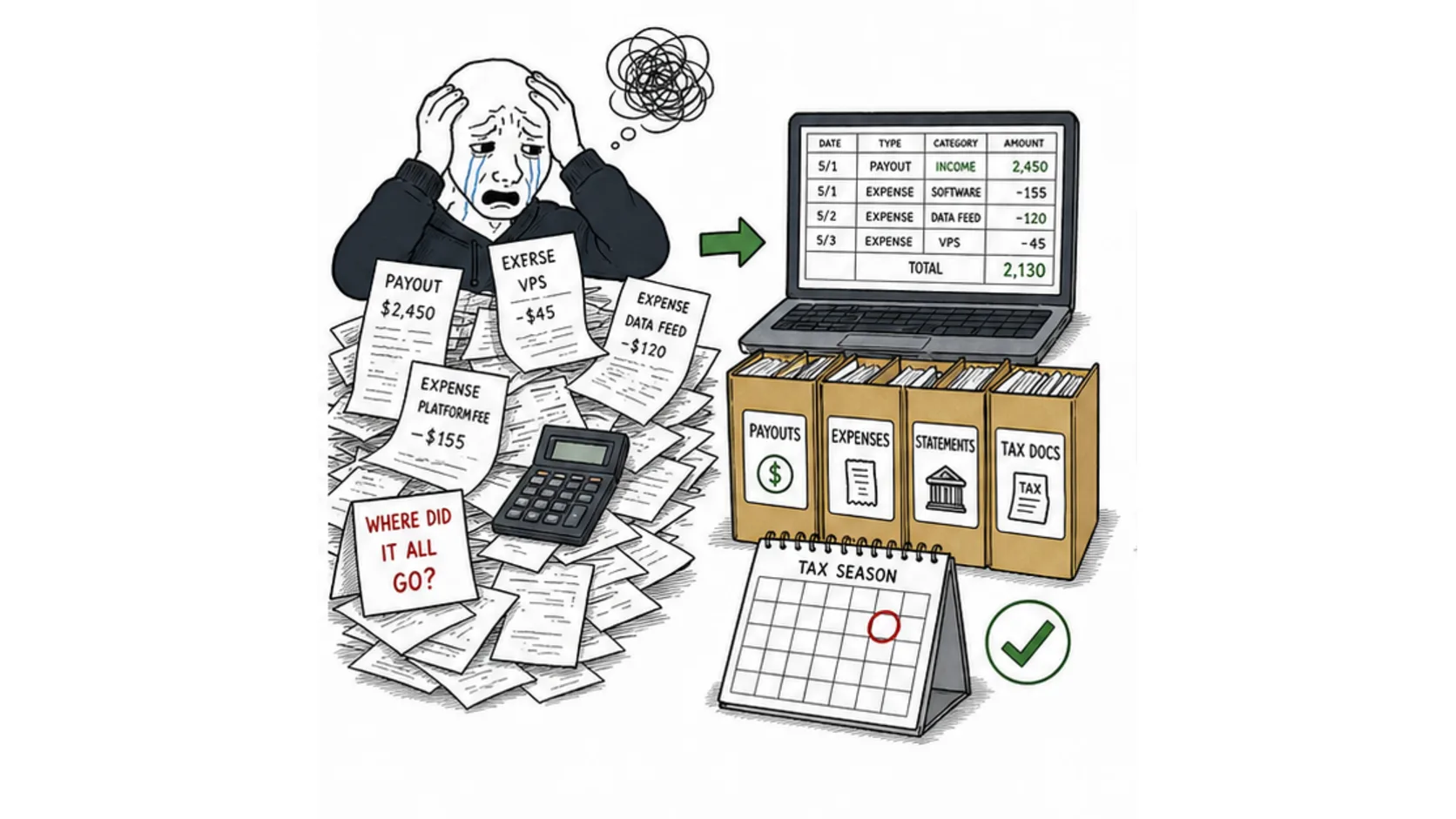
Most prop traders treat tax records like they treat their trading journal. They know they should do it, they plan to do it, and then April arrives and they have nothing. Do not be that person.
Prop firm payouts are taxed as ordinary income, not capital gains. That means every dollar you receive from a funded account needs to be reported. The Internal Revenue Service in the US and HM Revenue and Customs in the UK both require you to keep accurate records of all trading income and expenses.
The problem is that most prop firms do not send you tax forms. No 1099, no W-2, no neat summary at the end of the year. You are paid through crypto wallets, PayPal, Deel, or bank transfers. Nobody is tracking this for you except you.
According to the IRS, failure to report income can result in penalties of 20% of the underpaid amount for negligence, or up to 75% for fraudulent underreporting. You did not spend months passing a challenge just to give a chunk of your payout to penalties you could have avoided with a spreadsheet.
What Income to Track from Prop Firms
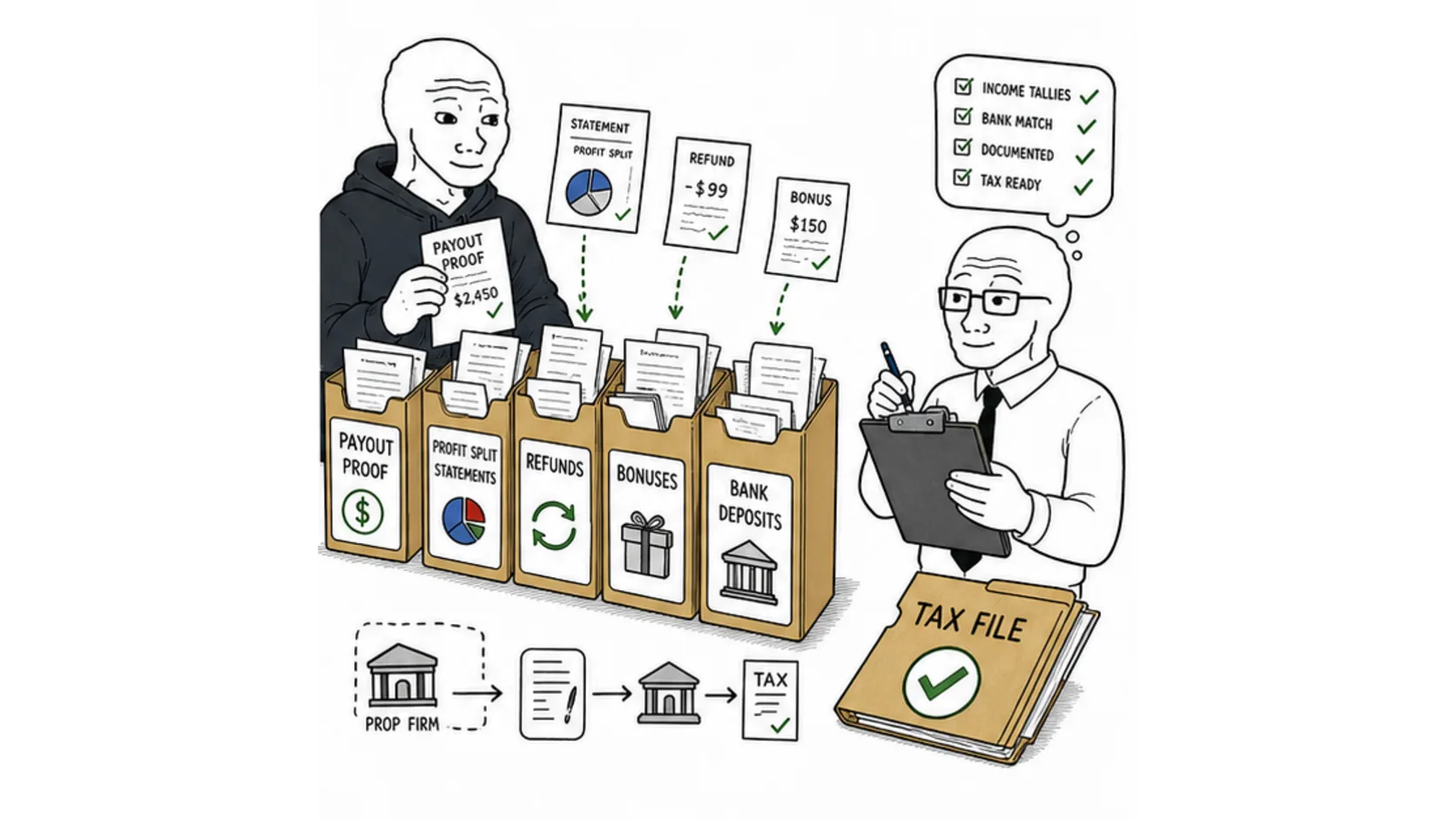
Your prop firm tax records need to capture every type of income you receive, not just the big payouts. Here is exactly what to track.
Payouts from Funded Accounts
Every payout you receive from a prop firm is taxable income. Record the date, amount, payment method, and which firm sent it. This is the big one. Miss a payout in your records and you are underreporting income.
Most firms pay out via crypto, Deel, or direct bank transfer. The payment method does not change the tax treatment. Crypto payouts are still income at their fiat value on the date you received them.
Fee Refunds and Credits
Some firms refund your challenge fee after your first payout. That refund is not free money. It offsets your original expense, and if you already deducted the fee, you need to account for the refund as income or reduce your deduction.
Referral and Affiliate Income
If you refer other traders to prop firms and earn commissions, that is separate income that needs its own tracking. Record each referral payment, the firm that paid it, and the date received.
Account Resets and Upgrades
If a firm gives you a free account reset or upgrades your account size as part of a promotion, note the value. Some tax authorities treat this as a benefit-in-kind that may be taxable.
What Expenses to Document for Tax Deductions
Prop firm fees are generally tax deductible as business expenses, but only if you have the records to prove them. Here is what to track.
Challenge and Evaluation Fees
Every challenge fee you pay, whether you pass or fail, is a deductible expense. Keep the receipt, the date, the firm name, and the account size you purchased. Even failed challenges are legitimate business expenses.
The average prop trader spends $500-$2,000 per year on evaluation fees alone. If you fail three challenges at $300 each before passing, that is $900 in deductible expenses. Miss those records and you are paying tax on income you never truly earned.
Software and Platform Costs
TradingView subscriptions, MetaTrader VPS hosting, charting software, journal apps, and any other trading-related software subscriptions are deductible. Keep the monthly or annual invoices.
Education and Training
Trading courses, books, community memberships, and educational materials directly related to your prop trading activity are deductible. Keep receipts for everything. The key word is "directly related." A general business course probably does not count. A forex scalping course does.
Equipment and Home Office
Your trading computer, monitors, internet costs (proportionally), and home office space may be deductible depending on your country's tax rules. Document the purchase dates and amounts.
The Record-Keeping System That Actually Works
You do not need fancy accounting software. A Google Sheet or Excel file with separate tabs for income and expenses is enough for most prop traders. Here is how to set it up.
Tab 1: Income Tracker
- Date received
- Prop firm name
- Payout amount (original currency)
- Payout amount (converted to your local currency)
- Conversion rate used
- Payment method (crypto, bank transfer, PayPal, Deel)
- Transaction ID or reference number
- Notes (first payout, scaled account, etc.)
Tab 2: Expense Tracker
- Date paid
- Category (challenge fee, software, education, equipment)
- Vendor or firm name
- Amount
- Payment method
- Receipt location (folder name or link)
- Notes
Tab 3: Monthly Summary
- Month
- Total income received
- Total expenses paid
- Net trading income
- Quarterly estimated tax due (US traders)
Update the spreadsheet the same day each payout or expense happens. Not tomorrow. Not next week. Today. The 10 minutes it takes immediately after a transaction saves you hours of reconstruction work later.
How to Track Each Payout and Expense
Here is the step-by-step process for keeping records for prop firm taxes that will hold up under scrutiny.
Step 1: Screenshot Every Payout Confirmation
When a payout lands, screenshot the confirmation email, the dashboard notification, and the transaction in your payment method. Save these in a folder named by year and month (e.g., "2026 Tax Records / January Payouts").
Step 2: Log It Immediately
Open your spreadsheet and enter the payout details right away. Include the exact amount, the date, the firm, and the payment method. If you received crypto, note the USD or GBP value at the time of receipt.
Step 3: Save All Receipts for Fees
Every time you buy a challenge, download the invoice or receipt. Most prop firms send email confirmations. Create a filter in your email to automatically route prop firm purchase confirmations to a dedicated tax folder.
Step 4: Reconcile Monthly
At the end of each month, compare your spreadsheet totals against your bank statements, crypto wallet history, and PayPal records. Make sure nothing is missing. This 10-minute reconciliation prevents the nightmare of finding gaps during tax season.
Step 5: Calculate Quarterly Estimates (US Traders)
If you are in the US and expect to owe more than $1,000 in taxes for the year, the IRS requires quarterly estimated payments. Use your monthly summary tab to calculate how much to send each quarter.
The Commodity Futures Trading Commission does not regulate prop firm taxation, but the IRS treats prop trading income as self-employment income subject to both income tax and self-employment tax at 15.3%.
Tax Deadlines You Cannot Miss
Miss a tax deadline and the penalties start stacking. Here are the critical dates for prop traders in major markets.
United States
- January 15: Q4 estimated tax payment due (for prior year)
- April 15: Annual tax return due (or extension request)
- April 15: Q1 estimated tax payment due
- June 15: Q2 estimated tax payment due
- September 15: Q3 estimated tax payment due
United Kingdom
- January 31: Self Assessment online tax return and payment due
- July 31: Second payment on account due
- October 5: Register for Self Assessment if new
Australia
- October 31: Individual tax return due (or May 15 with registered agent)
- Quarterly BAS: 28 days after end of each quarter if registered for GST
Set calendar reminders for every deadline a month in advance. Prop firm trading is legal in the UK, but HMRC still wants its cut. Same story everywhere.
The Tax Document Checklist for Prop Traders
Before you file your taxes, make sure you have every document on this checklist. Missing even one item can delay your filing or trigger an audit.
Income Documents
- Payout confirmation screenshots from each prop firm
- Bank statements showing incoming prop firm payments
- Crypto wallet transaction history with fiat conversions
- PayPal or Deel transaction reports
- Referral commission records (if applicable)
Expense Documents
- Challenge fee receipts and invoices
- Account reset fee receipts
- Software subscription receipts (TradingView, journaling apps)
- VPS hosting invoices
- Education and course receipts
- Equipment purchases (monitors, computers)
- Internet and phone bills (business portion)
How Long to Keep Records
- United States: 3 years minimum, 7 years recommended (IRS can audit up to 6 years for substantial underreporting)
- United Kingdom: 5 years minimum after the January 31 submission deadline
- Australia: 5 years from the date you lodge your return
Store everything digitally in cloud storage with clear folder names. A folder called "2026 Prop Trading Tax Records" with subfolders for income, expenses, and monthly summaries will save you when the tax authority comes asking questions.
Common Record-Keeping Mistakes That Cost Money
You have done these. Do not lie. You have done exactly these. Here are the record-keeping mistakes that cost prop traders real money every single tax season.
Not Tracking Failed Challenge Fees
Failed challenges are deductible expenses. Most traders only think to deduct the challenge they passed. The three failures before it? Those count too. Every fee you paid to any prop firm, pass or fail, is a business expense.
Mixing Personal and Trading Finances
If your prop firm payouts go into the same account as your grocery money, untangling them at tax time is a nightmare. Open a separate bank account for trading income and expenses. The IRS and HMRC both view this favorably if you are ever audited.
Ignoring Crypto Conversion Rates
If a prop firm pays you in USDT, you need to record the USD value on the exact date you received it. Crypto prices fluctuate, and the tax authority cares about the value on the day of receipt, not the day you convert it to fiat.
Waiting Until Tax Season to Organize
The trader who tracks everything in real time spends 10 minutes per month on records. The trader who waits until March spends two full weekends reconstructing eight months of transactions from email archives. Be the first one.
Not Backing Up Records
If your laptop dies and your only copy of your tax spreadsheet was on the desktop, you have a problem. Use cloud storage. Google Drive, Dropbox, OneDrive. Something that survives hardware failure. Keep records for prop firm taxes in at least two locations.
Learning how to keep records for prop firm taxes is not glamorous. Nobody posts screenshots of their neatly organized tax spreadsheet on Twitter. But the funded traders who stay funded are the ones who treat their trading like a business, and businesses keep records. Start the spreadsheet today, log every payout and fee, and next tax season will be the first one you actually enjoy. Or at least tolerate without panicking.