Prop firm challenge fees typically range from $50 for a small $5,000 account to $2,000 for a large $300,000 account. The most popular $100,000 account size costs between $300 and $600. The fee is non-refundable whether a trader passes or fails, and the realistic budget should account for at least two challenge attempts.
How much do prop firms cost? A standard $100,000 challenge costs between $300 and $600. A $50,000 account runs $200 to $400.
A $200,000 account will set you back $800 to $1,500. Those are the headline numbers. But the real cost includes hidden fees, monthly charges, and the cost of failing and buying again. Here is the complete breakdown so you know exactly what you are paying for before you click purchase.
Key Takeaways
- Prop firm challenge fees range from $50 for small accounts to over $2,000 for large accounts.
- The most popular $100,000 account size costs $300 to $600 at most firms.
- Hidden fees include activation fees, monthly subscriptions, and platform access charges.
- The fee is non-refundable if you fail. Budget for at least two attempts.
- Some firms refund the challenge fee after your first successful funded payout.
On This Page
- Challenge Fees by Account Size
- How Pricing Works
- Hidden Fees to Watch For
- What Happens If You Fail
- Forex vs Futures Pricing
- How to Budget for Prop Firms
- The Real Cost of One $100K Attempt, Priced Line by Line
- FTMO vs Cheaper Firms: When the Higher Fee Is Worth It
- The Five Most Expensive Prop Firm Spending Mistakes I See
- Challenge Fees vs Trading Your Own Capital: The Maths Nobody Runs
- How I Budget for Prop Firm Fees Now: My Actual System
- Frequently Asked Questions
How Much Do Prop Firms Cost by Account Size
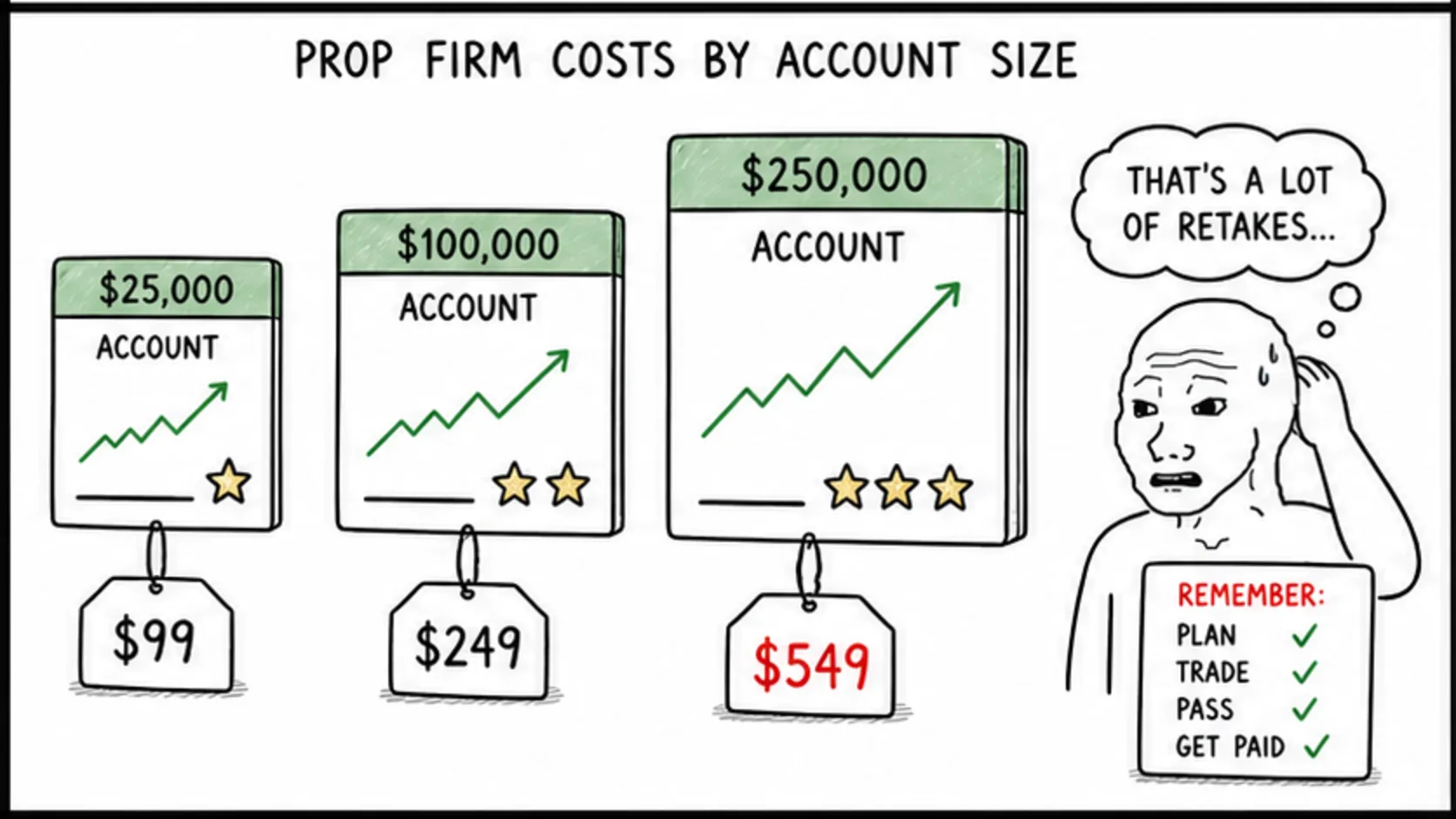
Here is what you will pay at the major firms for different account sizes. These are approximate ranges based on standard prop firm pricing in 2026.
| Account Size | Typical Fee Range | Cost as % of Account |
|---|---|---|
| $5,000 | $50 to $80 | 1.0% to 1.6% |
| $10,000 | $100 to $150 | 1.0% to 1.5% |
| $25,000 | $150 to $250 | 0.6% to 1.0% |
| $50,000 | $200 to $400 | 0.4% to 0.8% |
| $100,000 | $300 to $600 | 0.3% to 0.6% |
| $200,000 | $800 to $1,500 | 0.4% to 0.75% |
| $300,000 | $1,000 to $2,000 | 0.3% to 0.7% |
Notice the pattern. The cost as a percentage of the account stays roughly between 0.3% and 1.5% across most sizes. You are paying less per dollar of capital as the account gets larger, which makes larger accounts more cost-efficient per dollar.
But do not let that trick you into buying a $300,000 account if you are not ready for it. Larger accounts have larger drawdown targets, but they also have more psychological pressure. A $2,000 mistake on a $300,000 account feels different than a $20 mistake on a $5,000 account, even though both are the same percentage.
How Pricing Works
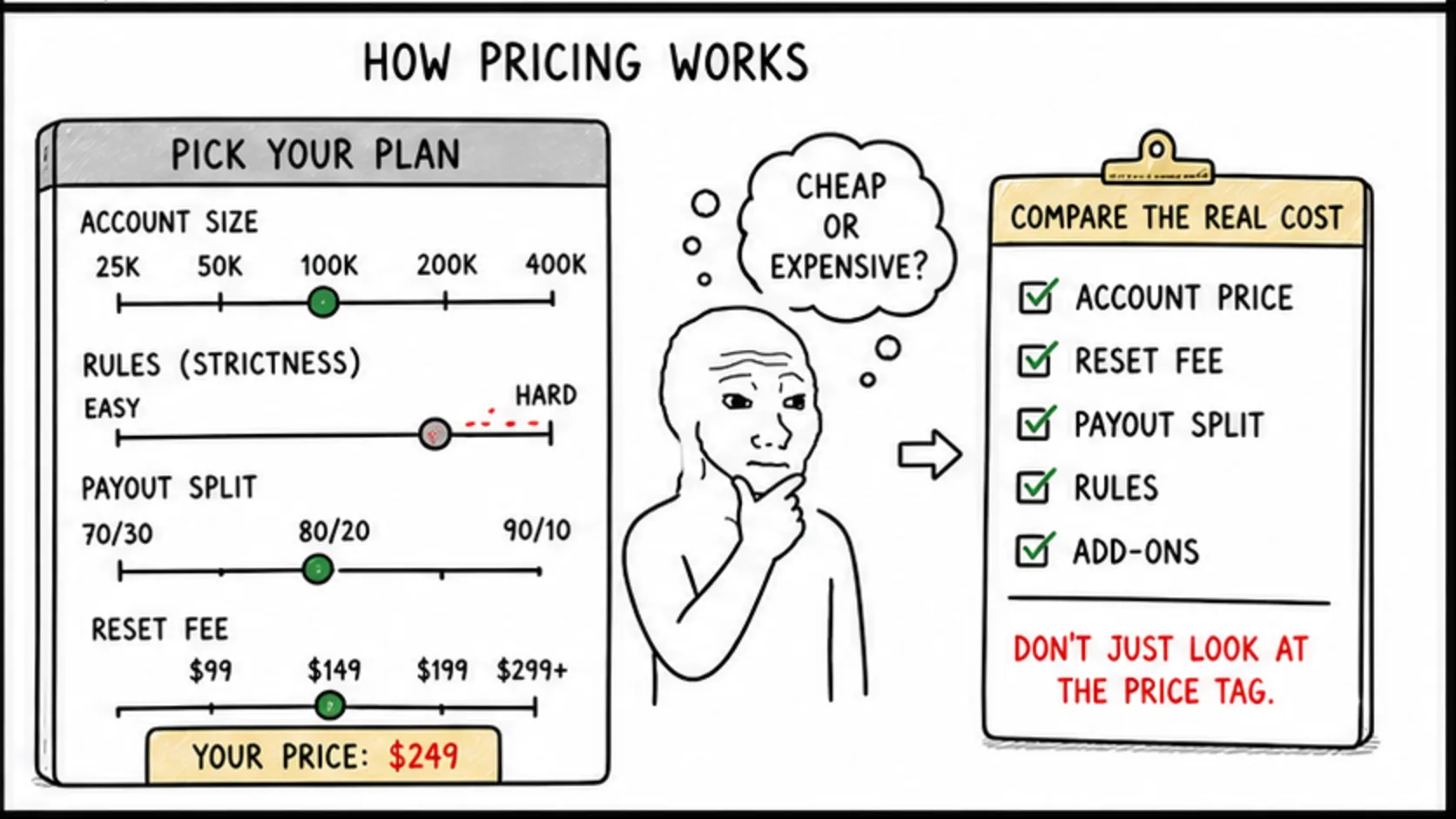
The challenge fee is a one-time payment. You pay it when you register for the evaluation. It covers the cost of your challenge period, typically 30 to 60 days, and gives you access to the trading platform.
What you are actually paying for is the opportunity to prove you can trade within the firm's rules. The fee is the firm's primary revenue source. Most traders fail, so most prop firm fees are pure profit for the firm. This is the business model.
Some firms offer discounts during promotions. You will see 20% to 50% off deals regularly, especially around holidays and trading events. If you are not in a rush, waiting for a promotion can save you $50 to $200 on a standard challenge.
Two-step challenges are usually cheaper than one-step challenges at the same account size. A two-step $100,000 might cost $400, while a one-step $100,000 at the same firm costs $500. One-step challenges are faster but harder, and the pricing reflects that.
When comparing prop firm costs across firms, always check whether the fee includes everything or if there are additional charges. The prop firm challenge cost is just the starting point.
Hidden Fees to Watch For
This is where things get interesting. The prop firm cost is the obvious part. The not-so-obvious costs can add up. Understanding the full prop firm fee structure before you buy is the difference between an informed decision and an expensive surprise.
Activation fees. Some futures prop firms charge an activation fee when you pass the challenge and become funded. This can be $50 to $150 on top of your challenge fee. The fee is usually deducted from your first payout, not charged upfront, but it reduces your initial earnings.
Monthly subscriptions. A few firms charge a monthly platform or data fee. This is more common with futures prop firms that need to cover exchange data costs. Expect $50 to $100 per month if the firm charges this.
Reset fees. If you fail a challenge and want to retry on the same account instead of buying a new one, some firms offer a reset at a reduced price, typically 50% to 75% of the original fee. This is cheaper than buying from scratch.
Payout fees. Most firms do not charge for standard payouts, but some have minimum payout thresholds or charge for expedited withdrawals. Read the payout rules carefully before you start trading.
Platform fees. If the firm uses NinjaTrader, Tradovate, or another premium platform, there may be platform licensing fees. Some firms include this in the challenge price. Others pass it on to you.
What Happens If You Fail
You lose the fee. That is the short answer.
The fee is non-refundable. Whether you fail on day one because you oversized your first trade, or on day 28 because you were $50 short of the profit target, the outcome is the same. The firm keeps your prop firm challenge fee and you get nothing.
According to industry estimates, roughly 90% to 95% of traders fail prop firm challenges. That means the firm keeps nine out of every ten fees collected. The European Securities and Markets Authority reports similar failure rates for retail traders in general. The prop firm model is built on this statistic.
This is why I tell people to budget for two attempts. If a $100,000 challenge costs $500, plan to spend $1,000. If you pass on the first try, great, you saved $500. If you fail, you already planned for it and you are not emotionally or financially wrecked.
Failing a challenge is not the end of the world. It is data. Figure out what went wrong, fix it, and try again. The problem is when traders fail, buy again immediately without fixing anything, and fail again. That is when it gets expensive.
Forex vs Futures Pricing
The pricing structure differs between forex and futures prop firms, and it matters for your budget.
Forex prop firms typically charge a single upfront fee for the challenge. No monthly fees, no activation fees (usually), no platform costs. You pay once and trade. FTMO (Read my full FTMO writeup on PassPropTradingFirms), FundedNext, and The5ers all work on this model.
Futures prop firms often have a more complex fee structure. The challenge fee might be lower, but there can be activation fees, monthly data fees, and platform costs. Topstep charges around $50 per month for its trading combine. Apex charges an evaluation fee plus activation.
The total annual cost of a futures prop firm can end up higher than a forex prop firm because of the recurring monthly charges. But the earning potential on futures accounts during volatile markets can be higher too.
When comparing firms, always calculate the total cost to get funded and receive your first payout. Do not just look at the headline challenge price. That $150 challenge might come with $100 in activation and $50 per month in fees.
How to Budget for Prop Firms
Here is the framework I recommend before you spend a single dollar on a challenge.
Step one: decide your account size. Start small if you are new to prop firms. A $25,000 or $50,000 account is enough to learn the process without risking $500 on your first attempt.
Step two: calculate the total cost. Challenge fee plus any activation fees, monthly fees, and platform fees. Add it all up before you buy.
Step three: multiply by two. This is your real budget. Plan for two attempts. If you only need one, you have extra money. If you need two, you planned for it.
Step four: can you afford to lose this money? If the answer is no, you are not ready. The most likely outcome of any single challenge attempt is that you fail and lose the fee. That is the statistical reality. Plan for it.
How much do prop firms cost? The answer is: whatever you are willing to lose. One challenge might cost $500.
Two challenges might cost $1,000. A year of trying without fixing your strategy might cost $3,000 to $5,000. The cost is not just the fee. It is the fee multiplied by the number of times you try before you either pass or quit.
The traders who spend the least are the ones who prepare properly, pass on their first or second attempt, and start earning payouts. Preparation is the cheapest thing you can do. Everything else is expensive.
The Real Cost of One $100K Attempt, Priced Line by Line
Every pricing table stops at the challenge fee. You deserve the full receipt.
Here is what one realistic $100,000 attempt actually cost me, line by line, the last time I ran one.
The fee comes first, and it is the only number most articles will give you: FTMO lists its $100K two-step challenge at €540. That is roughly half the story.
My first attempt failed at Phase 1. I broke no rule I knew of.
I hit my own daily loss ceiling twice in week two chasing volatility that did not fit my strategy. The second fee is where the bill doubles, because a fresh run at the same size costs the current list price again.
Budget €540 for the fee plus a second fee when the reset comes, and the honest two-attempt number at the $100K tier is €1,080 at list price. You only get the fee back on FTMO if you actually make it through.
Then the account itself. Some firms charge an activation or account-opening fee once you pass, commonly $50 to $150, usually deducted from your first payout rather than billed.
Mine did not, but two firms I have traded did, and if you have not read the fine print, that first payout lands smaller than you planned.
Data and platform costs are the futures version of this. Exchange data runs roughly $100 to $150 per month if your firm passes it through, and premium platforms can add their own licence fee.
Forex CFD traders usually skip this line entirely.
Payout costs are the last leak. Standard withdrawals are typically free, but faster rails and wire options can take a cut, and minimum withdrawal thresholds decide whether you can actually move your money when you want it.
Add it up the way I do now. One fee, one reset, two months of attention, small platform costs, a slice off the first payout.
The €540 sticker becomes €1,080 all in once the reset lands, before activation extras. Plan with the receipt, not the sticker, and use the position size calculator before attempt one so the reset line never makes it onto your bill.
FTMO vs Cheaper Firms: When the Higher Fee Is Worth It
The most common pricing question I get is whether the premium firms are worth double the fee. Let me answer it with the actual numbers, because the answer changes depending on how many attempts you realistically need.
Take the market leader. A $100,000 FTMO challenge costs €540 at list price, roughly $580 to $620 depending on the day's exchange rate, and on the 2-Step the fee is refunded in full with your first funded payout (the 1-Step fee is not refundable).
Cheaper competitors run equivalent evaluations at $300 to $400, usually with no refund at any point.
The naive maths says the cheaper firm wins. The realistic maths says otherwise.
A $540 fee that comes back is cheaper than a $350 fee that does not, the moment you actually pass. FTMO publishes over $650 million in total payouts since 2015 (FTMO, checked 23 October 2026) and holds a 4.8 out of 5 Trustpilot rating across more than 40,000 reviews, which is the track record behind that refund actually clearing.
Here is the comparison I run when friends ask. One attempt at a premium firm with a refund, or two attempts at a budget firm with none, costs roughly the same.
If your pass probability on a given attempt is decent, the refund structure is the cheaper product. If you expect to fail several times while you learn, the cheap non-refundable fee is the tuition that makes sense.
My own record is two for four on first attempts, and I still pay the premium where the refund exists, because the expected cost maths has been kind to me. What I will not pay a premium for is a firm with no refund, no payout track record, and a bigger logo.
That is paying extra for nothing.
The wider point about this industry's pricing: you are not buying an account, you are buying a lottery ticket with better odds and a rebate clause. Read the rebate clause first.
Every figure above comes from FTMO's own published pricing and Trustpilot page, checked September 2026, and our FTMO account prices guide tracks it in detail.
The Five Most Expensive Prop Firm Spending Mistakes I See
I have watched traders burn four figures on this industry without ever really sitting down at the charts. The fees are not the trap.
The behaviour around the fees is. Here are the five spending patterns that do the damage.
Mistake one: buying the account size your ego wants. The jump from a $50K evaluation at $300 to a $100K at $540 feels like doubling your shot.
What it actually doubles is the cost of your learning curve. My first two failed attempts were both size upgrades I had not earned, and the lessons were identical to the $25K lessons I could have bought for a third of the price.
Mistake two: the revenge reset. Fail an attempt, feel the sting, smash the reset button within the hour, fail again inside the week.
Firms love this. Reset discounts run commonly 50-75% of the fee where firms offer them, which feels like a discount, but two emotional resets cost more than one calm, prepared second attempt bought at full price.
Mistake three: collecting evaluations. Three accounts across three firms, all live at once, attention split three ways.
I did this in my second year. Every account got a fraction of my focus and all three underperformed the single-account months either side of that experiment.
Mistake four: paying for speed. Expedited payouts, premium platforms, add-on features that promise an edge.
The traders I know who are actually funded spend less per month on this industry than the perpetually-challenged traders spend on resets.
Mistake five: no budget, no stop. The most expensive trader in any firm's books is the one who decided the next attempt must work.
Set a total budget before attempt one, decide what happens when it is spent, and write it down. Mine is three attempts or a fixed pound figure, whichever arrives first, and the rule is the reason I am still here years later.
The pattern across all five: the cost is never the fee, it is the decision you make while emotional and slightly poorer than yesterday. If your budget is about to fund attempt three, run the risk of ruin calculator first and let arithmetic cast the deciding vote instead of hope.
Challenge Fees vs Trading Your Own Capital: The Maths Nobody Runs
Here is the comparison that puts these fees in their proper context. Friends outside trading flinch when I tell them I pay hundreds of dollars for a trading account.
Then I show them the alternative and the flinch stops.
Say you want to trade $100,000 seriously with your own money. At the 1% to 2% risk per trade that sensible intraday risk management requires, you would need to deposit the full $100,000.
Losing 10% in a bad month, which happens to professionals, is $10,000 gone from your own pocket.
The funded route to the same $100,000 costs roughly $500 per attempt, and your worst case is the fee. A blown personal account costs the whole deposit.
The fee is not the expensive part of this industry. The capital requirement it replaces is the expensive part.
There is a second maths people skip: cost per lesson. A failed evaluation at the $100K tier costs the full list fee, €540 at FTMO and typically $300 to $600 at the budget firms.
Expensive evenings. But each one bought a specific, permanent lesson about my sizing, my session choice, and my ego, which I would otherwise have bought with tens of thousands in a personal account.
The honest caveat, because the marketing will not give you one: if you are not profitable on demo, the evaluation fee is not cheaper tuition, it is just a smaller fire. The maths above only works once your strategy has proven it can hold up.
Fix the trading first, then the fee becomes the bargain of the whole arrangement.
That is the whole case for why I consider these fees reasonable in 2026. Not cheap.
Reasonable, if you treat every attempt as paid education and stop buying attempts once the tuition stops teaching you anything. When you are ready to pick a size, our guide to prop firm account sizes explained breaks down what each tier costs and what it demands.
How I Budget for Prop Firm Fees Now: My Actual System
I promised you the framework earlier, and the budgeting section above gives you the version for beginners. Here is the tightened version I run myself after eight years of paying these fees.
One trading budget per quarter. I decide my total evaluation spend every three months and it lives in a separate account.
When it is empty, buying stops, no exceptions. This single rule has saved me more money than any discount code ever printed.
Every attempt costs double on paper. Whatever the fee says, I book it mentally at two times that number, because the realistic outcome includes a reset.
If the doubled price is not acceptable, the account size is wrong, not the budget.
Preparation is a line item. Trial time, journalling, and rule review happen before any purchase, and I treat the weeks spent preparing as part of the cost.
My cheapest passes were the ones where I spent the most time before spending anything.
Wins fund the next attempt. After my first payout on any account, the following evaluation comes out of trading income, never from savings.
The firm paid for the last attempt through the refund. The account pays for the next one.
That is what a sustainable loop looks like.
Annual review of the whole spend. Once a year I add up every fee, reset, and data subscription.
The first time I ran that number it was uncomfortable, and it permanently changed how selectively I buy. Discomfort is cheap.
Ignorance of your own totals is what actually compounds.
Run your own numbers before your next purchase. The full fee tables in this guide give you the sticker prices, and the drawdown recovery calculator tells you whether the account you are about to buy can survive the losing streak your strategy will inevitably produce.