Most prop firm reviews are not trustworthy. That is the short answer. The slightly longer answer is that the prop firm review ecosystem is built on affiliate commissions, incentivised testimonials, and reputation management services that make it nearly impossible to tell which reviews are real and which are marketing. This page explains exactly how the system works, how to spot fake reviews, and where to find information you can actually trust.
Key Takeaways
- Most prop firm reviews are written by affiliate marketers who earn commissions when you sign up. Their financial incentive is to be positive, not honest.
- Trustpilot ratings can be and have been manipulated through review campaigns, bonus incentives, and reputation management services.
- The most reliable reviews come from independent trader communities on Reddit where users have no financial relationship with the firm.
- Genuine review profiles have a mix of ratings, specific details, and professional responses to complaints. Manufactured profiles do not.
- Always cross-reference at least three independent sources before trusting any single review or rating.
On This Page
Why Most Prop Firm Reviews Are Not Trustworthy
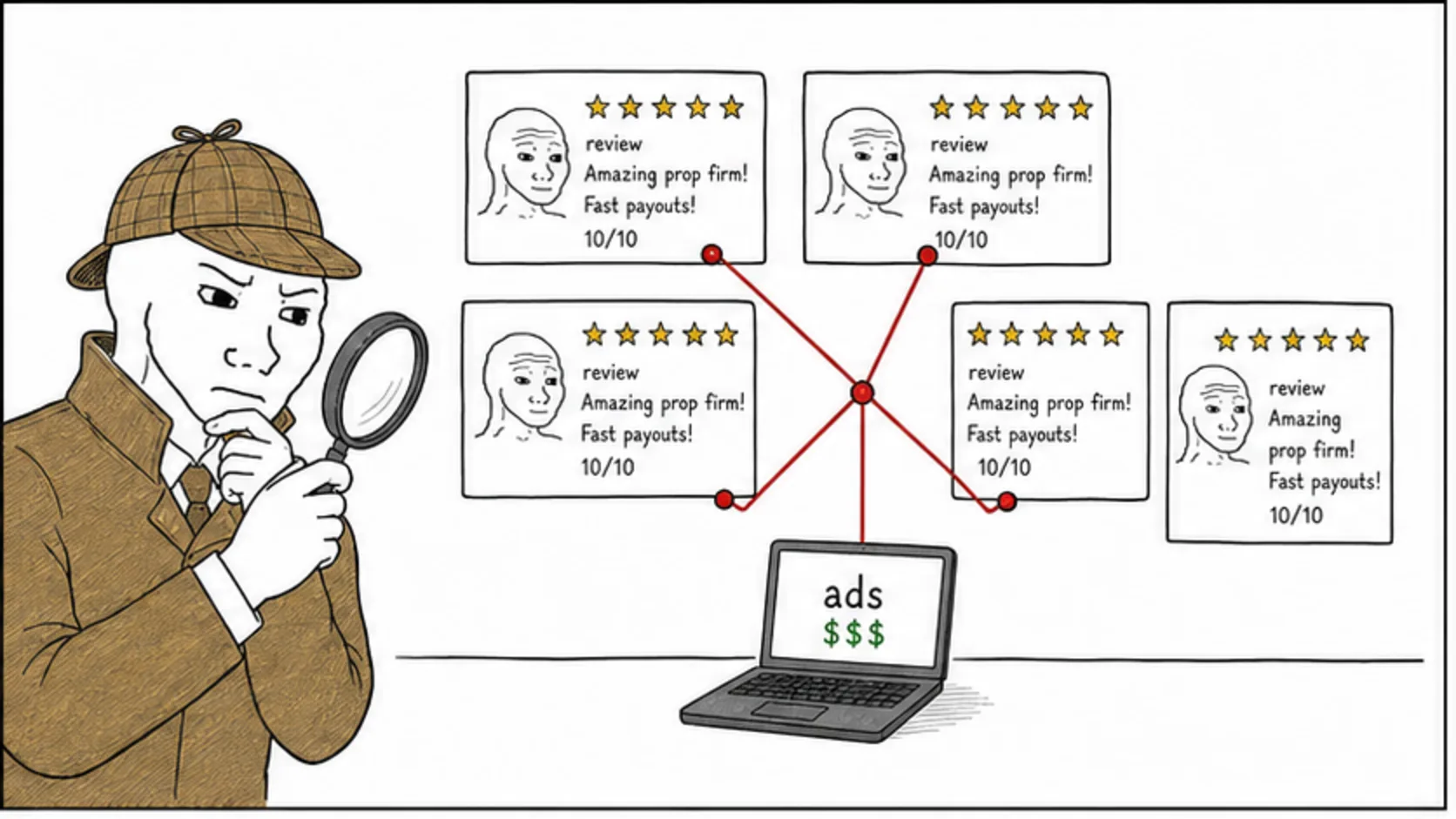
The prop firm industry runs on a simple economic model. Firms pay affiliates 10-20% of every challenge fee generated through their referral links. That means every YouTuber, blogger, and Instagram trader reviewing prop firms has a direct financial incentive to say positive things.
This does not mean every review is dishonest. Some affiliates genuinely try to provide useful information. But it does mean you should assume financial bias exists in every piece of content that includes a referral link, and then evaluate accordingly.
The problem is compounded by review sites that rank firms based on affiliate commission rates rather than trader experience. A firm that pays 15% commission will rank higher than a firm that pays 5%, regardless of which one actually treats traders better. The ranking you see is not an objective assessment. It is a revenue optimisation strategy. An honest ranking of the best prop firms should be based on trader outcomes, not affiliate commissions.
The Affiliate Review Problem
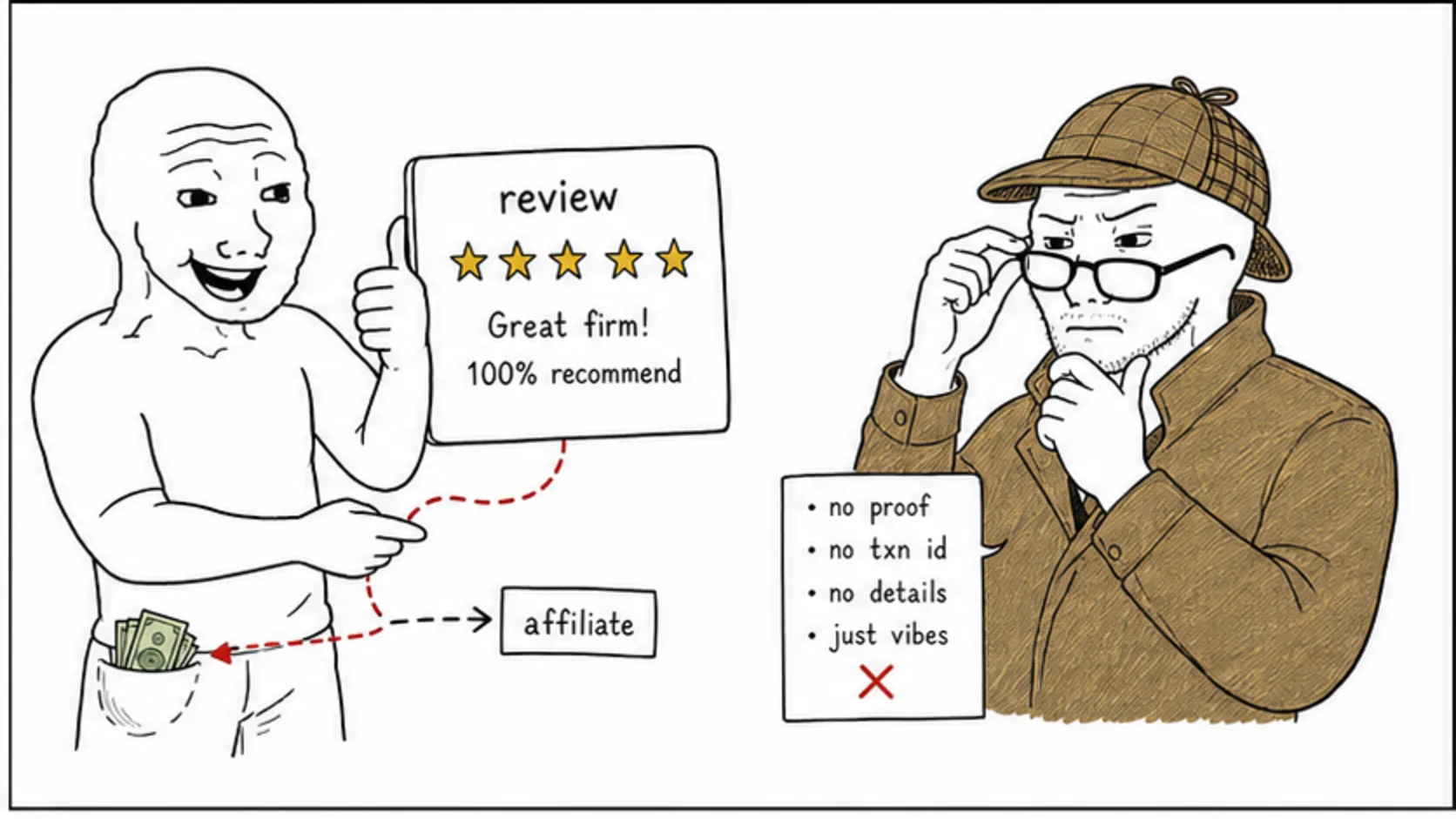
Here is how the affiliate review cycle works. A new prop firm launches. It offers generous affiliate commissions to attract promoters. YouTubers and bloggers create "review" content that highlights the firm's positives and either ignores or minimises the negatives. The firm gains traction. More affiliates jump on board.
The content looks helpful. It has production value. The presenter seems knowledgeable. But somewhere in the description, usually below the fold, there is an affiliate link. That link pays the creator every single time someone clicks through and buys a challenge.
If every single piece of content about a firm is from someone who gets paid when you sign up, and none of that content mentions the firm's rules, drawbacks, or limitations in any detail, you are not reading reviews. You are reading advertisements.
The genuine reviewers are easy to spot. They name specific drawbacks. They mention rules that tripped them up. They compare the firm to competitors without making every comparison favourable. The shills are equally easy to spot once you know what to look for. Everything is amazing. The rules are "fair." The payouts are "fast." And by the way, here is a link with a discount code.
How Trustpilot Gets Manipulated
Trustpilot is the most commonly cited review platform for prop firms. It is also the most commonly manipulated. Here are the specific tactics firms use to inflate their ratings.
Review campaigns. The firm offers traders a bonus, free challenge reset, or account credit in exchange for a Trustpilot review. The trader writes a five-star review because they want the bonus. The firm gets a positive rating. Everyone wins except you, the person relying on that rating to make a decision.
Timing campaigns. A new firm launches and within weeks has hundreds of five-star reviews. This is not organic growth. No firm generates hundreds of independent positive reviews in its first month of operation. Those reviews were solicited, incentivised, or in some cases fabricated.
Flagging negative reviews. Trustpilot allows companies to flag reviews that violate their guidelines. Some firms aggressively flag negative reviews as "defamation" or "not a genuine experience" to get them removed. The reviewer may not bother contesting the flag, so the negative review disappears.
Reputation management services. Some firms hire agencies that specialise in online reputation management. These agencies create positive content, suppress negative search results, and manage review profiles. The result is a Trustpilot page that looks organic but is professionally curated.
Signs of Fake Prop Firm Reviews
You do not need to guess whether reviews are genuine. Fake reviews leave patterns. Here is exactly what to look for.
All five-star ratings with no nuance. Genuine positive reviews mention specific features the trader liked. Fake reviews use generic praise like "great firm" and "highly recommend" without details.
Similar language across multiple reviews. If ten reviews use the same phrases, the same sentence structure, and the same talking points, they were likely written by the same person or team.
Reviews from accounts with no other activity. A Trustpilot profile created last week with only one review, and that review is for this specific prop firm, is suspicious. Real reviewers review multiple products and services.
Clustered posting dates. If most five-star reviews were posted within a short time window, like a two-week period, that suggests a coordinated campaign rather than organic feedback.
No negative reviews at all. A firm that has been operating for a year and has zero negative feedback on Trustpilot is either brand new or actively suppressing complaints. No legitimate business has perfect customer satisfaction.
Generic responses from the firm. Check how the firm responds to the few negative reviews it has. If the response is a copy-paste "we're sorry to hear that, please contact support" with no specific resolution, the firm is managing perception rather than solving problems.
YouTube Reviews and Undisclosed Payments
YouTube is the worst offender for undisclosed bias in prop firm reviews. The platform is built on engagement, and positive content generates more clicks than critical content. A video titled "[Firm X] Changed My Life" will always outperform "[Firm X] Has Serious Drawbacks You Should Know About."
The economics are straightforward. A YouTuber with 50,000 views per video reviewing a $500 challenge with a 15% affiliate commission needs roughly 30 people per video to buy through their link. That is $2,250 per video in affiliate revenue. The incentive to be positive is enormous.
Some YouTubers are genuinely helpful and disclose their affiliate relationships honestly. They still provide value despite the financial bias. But many do not disclose, or they bury the disclosure so deep in the description that nobody reads it.
Your best protection is to treat every YouTube review as potentially biased unless the reviewer explicitly names specific drawbacks, compares the firm honestly to competitors, and does not use urgency tactics like "sign up now before the sale ends."
Where to Find Honest Prop Firm Reviews
Not all review sources are corrupted. Here is where to look for information you can actually trust.
Reddit is the gold standard for unfiltered prop firm opinions. Search the firm name in r/PropFirmTester, r/Forex, and r/Daytrading. Sort by new for recent experiences. Sort by top for the most discussed issues. Redditors have no financial incentive to be positive. If a firm is bad, Reddit will tell you in detail.
Forex Peace Army maintains complaint records and scam warnings. It is not perfect, and some complaints come from traders who genuinely broke the rules and are angry about it. But the volume and consistency of complaints about specific firms is a useful signal.
Discord trading communities. Private Discords and Whop groups often have traders discussing their actual experiences with specific firms in real time. These conversations are less curated than public reviews and more likely to reflect genuine experiences.
Direct payout proof. The most trustworthy evidence is not a review at all. It is a payout confirmation. Bank transfer screenshots, crypto transaction hashes, and PayPal receipts posted by traders who have no reason to fabricate them. This is verifiable evidence, not opinion.
The Financial Conduct Authority warning list is also worth checking. If a firm appears on a regulatory warning list, that is not a review, that is a government agency telling you to stay away.
How to Read Reviews Like a Detective
Stop reading reviews passively. Start reading them actively. Here is the framework.
Check the reviewer first. Who are they? Do they have other reviews? Is this their only review? A profile with one review for one prop firm is not a reliable data point. A profile with reviews for multiple firms, products, and services is more likely genuine.
Read the negative reviews first. Not the positive ones. The negative reviews tell you what goes wrong. If the complaints are all about the same issue, slow payouts, denied withdrawals, retroactive rule changes, that pattern is more informative than a thousand five-star ratings.
Look for specificity. A review that says "I passed the $100,000 challenge in 22 days, hit the profit target of $8,000, and received my first payout of $6,400 via bank transfer within 5 business days" is specific enough to verify. A review that says "great firm, highly recommend" is not.
Check the dates. Are the positive reviews from a specific time period, perhaps during a promotional push? Are the negative reviews more recent, suggesting a change in the firm's behaviour over time? Timing patterns reveal more than star ratings.
Cross-reference multiple sources before making any decision. If Reddit, Trustpilot, Forex Peace Army, and YouTube all tell you the same thing, you have a signal. If they tell you different things, you need more data. Never rely on a single source.
The prop firm review industry is not going to fix itself. The financial incentives are too strong. Your only option is to get better at filtering. Use the framework. Trust the patterns, not the star ratings. And always remember that the person writing the review is almost certainly getting paid if you click their link.