Do prop trading firms have investors? No, not in the way you think. The entire point of proprietary trading is that the firm trades its own money, not other people's. That is what a prop firm is. You keep seeing this question everywhere because people confuse prop firms with hedge funds, and the distinction matters more than you realise.
Key Takeaways
- Traditional prop firms trade their own capital, raised from partners and retained earnings.
- Retail prop firms generate revenue from evaluation fees, not investor capital.
- Prop firms are fundamentally different from hedge funds, which exist to manage outside investor money.
- Some newer retail prop firms have taken VC funding, but this is the exception.
- You cannot invest in a prop firm as a retail investor. They are private partnerships.
On This Page
- The Short Answer
- Traditional Prop Firms: Where the Money Comes From
- Retail Prop Firms: A Completely Different Species
- Prop Firms vs Hedge Funds: Why the Confusion Exists
- Do Any Retail Prop Firms Take Outside Investment?
- Can You Invest in a Prop Firm?
- Why This Matters for Traders
- Frequently Asked Questions
The Short Answer
Proprietary trading firms trade their own money. The clue is in the name. "Proprietary" means the firm owns the capital it trades. No pension funds, no retail investors, no fundraising rounds, no quarterly investor letters explaining why the fund was down 4% in March.
The capital comes from the firm's partners, accumulated trading profits, or in the case of retail prop firms, from evaluation fees paid by traders like you. The money prop firms make stays inside the firm.
This is the fundamental difference between a prop firm and a hedge fund, and it is worth understanding because it explains why prop firms operate the way they do.
Traditional Prop Firms: Where the Money Comes From
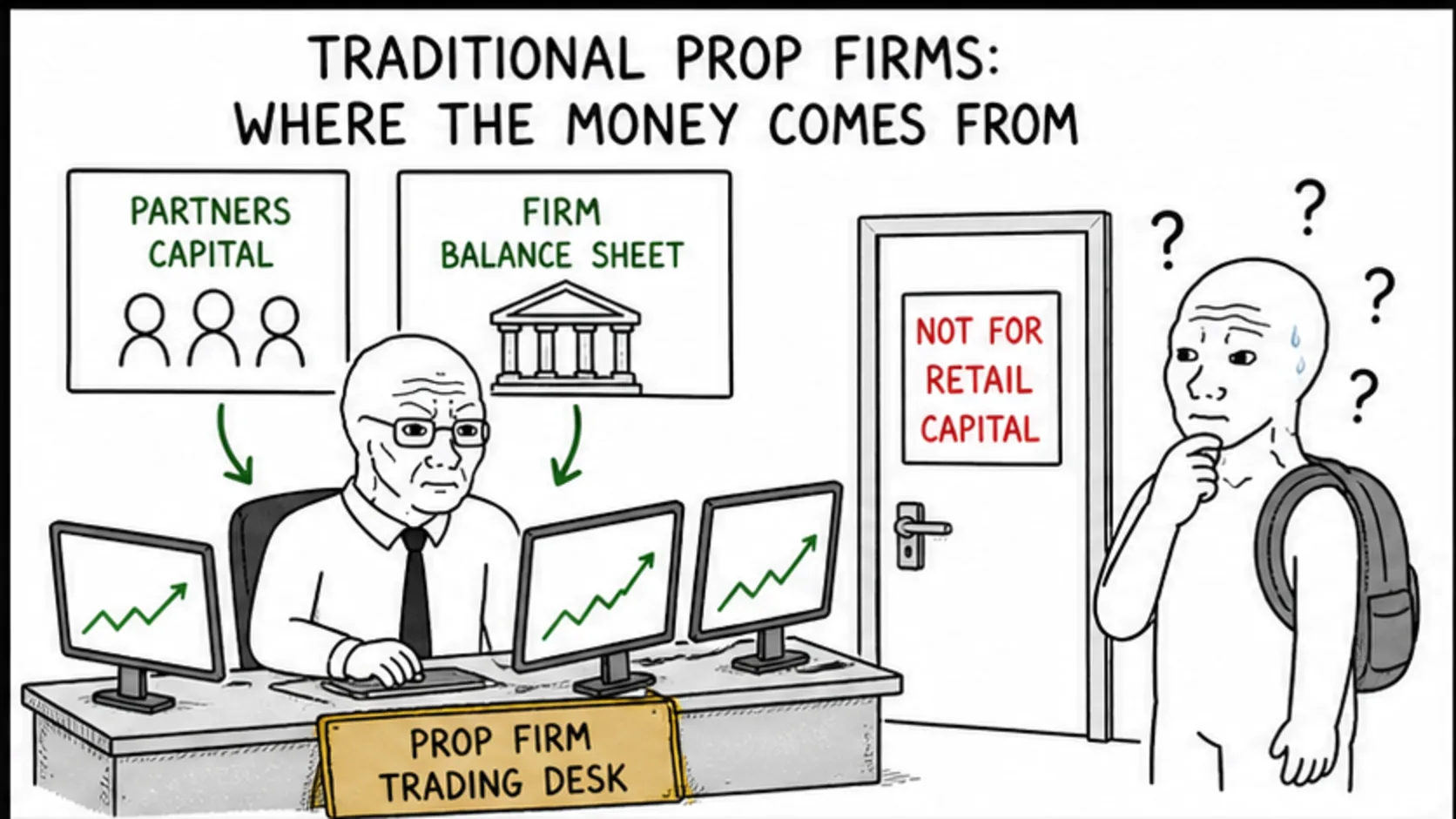
When people ask whether prop trading firms have investors, they are usually thinking about this type of firm. The big institutional operations in Chicago, London, New York, and Amsterdam. These are the original prop firms. And the answer for them is straightforward: they do not have outside investors. They have partners.
The big prop trading firms you have probably heard of, Jane Street, DRW, Optiver, Jump Trading, are privately held partnerships. The partners put in their own capital, the firm trades with it, and profits are distributed among the partners.
These firms do not need outside investors because their trading generates enough return to self-fund. When your quantitative strategies are generating hundreds of millions in annual profit, you do not need to pitch venture capitalists or raise a fund from family offices. The prop firm capital stays internal, compounding year after year.
The Bank for International Settlements estimates that proprietary trading desks at major institutions handle trillions in notional value annually. The firms at the top of this food chain are wildly profitable, and they have no incentive to share that profitability with outside investors.
Some of these firms have been operating for decades. DRW was founded in 1992. Jane Street started in 2000. Optiver has been around since 1986. They have built their capital base over many years of profitable trading. No IPOs, no public shareholders, no outside investors calling the shots.
Retail Prop Firms: A Completely Different Species
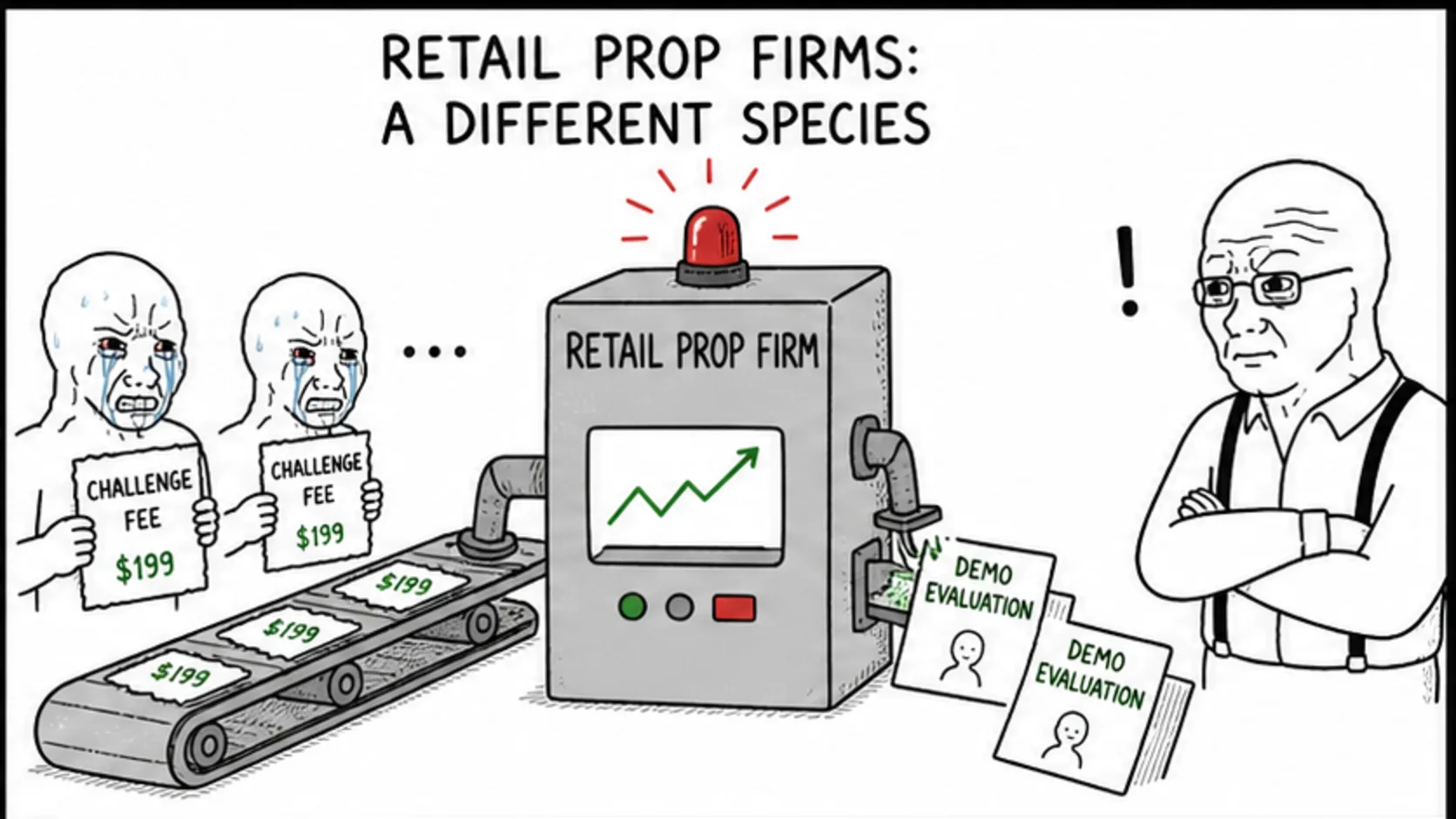
So do prop trading firms have investors in the retail space? Again, mostly no. The prop firms you interact with online, FTMO, FundedNext, Topstep, The5ers, operate on a completely different model. They are not sitting on a pool of partner capital that they allocate to traders. They are technology companies running a clever business model built around evaluation fees.
Here is how retail prop firms actually work. They sell evaluation challenges to thousands of traders. Most of those traders fail. The fees from failed evaluations fund the payouts for the few traders who pass and generate profits. The firm keeps the spread.
These firms do not have "investors" in the traditional sense. They have revenue from evaluation fees. That revenue covers their operating costs, their payouts to funded traders, and their profit margin. It is a self-sustaining business that does not require outside capital as long as the math works.
So if you are asking where prop firms get money from, for the retail variety the answer is simple: from you and every other trader who buys an evaluation. The prop firm funding model does not rely on institutional backers. It relies on a steady stream of traders willing to test themselves.
And the math works because roughly 85-90% of traders fail prop firm evaluations, according to data from multiple firms' published statistics. The 10-15% who pass and earn payouts are funded by the 85-90% who do not.
Prop Firms vs Hedge Funds: Why the Confusion Exists
People ask whether prop firms have investors because they are mentally filing prop firms in the same category as hedge funds. They are not the same thing. Not even close. Understanding the prop trading vs hedge fund distinction clears up this confusion immediately.
Hedge Funds
A hedge fund raises money from outside investors. Pension funds, endowments, family offices, wealthy individuals. The fund charges a management fee, typically 2% of assets under management, and a performance fee, typically 20% of profits.
The hedge fund manager is investing other people's money. The investors expect returns. The manager owes them a fiduciary duty. Prop firm investors, if they exist at all, are partners in the business, not external LPs expecting a share of trading profits. The US Securities and Exchange Commission regulates hedge funds. The Financial Conduct Authority oversees them in the UK.
Hedge funds exist because of their investors. Without outside capital, a hedge fund has nothing to manage.
Prop Firms
A prop firm trades its own capital. It does not accept outside investor money. It does not charge management fees to anyone. It does not send quarterly performance reports to limited partners.
The whole concept of prop trading is that the firm keeps 100% of its trading profits because it is trading its own money. In exchange, it takes 100% of the risk. No upside sharing with investors because there are no investors.
The confusion exists because both hedge funds and prop firms trade financial instruments for profit. But their funding structures, regulatory environments, and business models are fundamentally different.
Do Any Retail Prop Firms Take Outside Investment?
Yes, some do. And this is the one area where the question of whether prop trading firms have investors gets a more nuanced answer.
The retail prop firm industry has grown massively since 2020. According to industry estimates, the market grew from a handful of firms to over 200 in just a few years. Some of these newer firms have taken venture capital or private equity funding to scale their technology, marketing, and operations quickly.
This is not the same as hedge fund investors. VC investors in prop firms are buying equity in the company itself, not funding the trading capital. They are betting that the prop firm's business model, the evaluation fee revenue machine, will generate returns on their investment.
The trader never sees this side of the business. Your evaluation fee, your funded account, and your payouts are unaffected by whether the firm has VC backing or not. The VC money goes into the company's bank account, not into the trading capital pool.
Most established firms remain self-funded. FTMO (Read my full FTMO review on PassPropTradingFirms), one of the largest retail prop firms, has reportedly been profitable enough to self-fund its entire growth trajectory. No external rounds, no dilution, no venture partners on the board.
Can You Invest in a Prop Firm?
Not as a retail investor, no.
Traditional prop firms are private partnerships. You would need to be invited as a partner, which means having significant capital to contribute and a track record that makes the existing partners want you at the table.
Retail prop firms are also private companies. Some may have taken institutional investment, but retail investors cannot buy shares on a public exchange because none of these firms are publicly listed.
You can invest in your own prop firm challenge, which is a very different thing. That is spending money on an evaluation, not investing in the firm itself. If you fail the evaluation, that money is gone. If you pass, your return comes from your trading performance, not from the firm's equity value.
Why This Matters for Traders
If you have been wondering whether prop trading firms have investors before trusting them with your evaluation fee, you are asking the right question. Understanding the funding structure tells you about the firm's staying power.
You might be wondering why any of this matters to you. You just want to pass a challenge and get paid. Fair enough. But understanding the funding structure of the firm you are paying tells you something important about whether that firm will be around in six months.
A firm funded by evaluation fees is sustainable as long as enough traders keep buying challenges. That is a risk. If trader sentiment turns against prop firms, or if regulation cracks down on the industry, the revenue dries up and the firm could collapse.
A firm with additional capital reserves, whether from partners, VC funding, or other revenue streams, has a bigger buffer. It can survive a rough patch. It can afford to pay out even if evaluation revenue temporarily drops.
This is why you should research a prop firm's financial stability before buying a challenge. Look for firms that have been operating for at least two years. Check their payout history. Read trader reviews on independent platforms.
The firms that have been paying out consistently for years are the ones with sustainable business models. Whether they have outside investors or not, the model works. The ones that pop up overnight and offer impossibly cheap challenges are the ones to avoid. If you have ever wondered what it takes to start one of these firms yourself, the answer is less capital than you think and more regulatory headache than you want.